

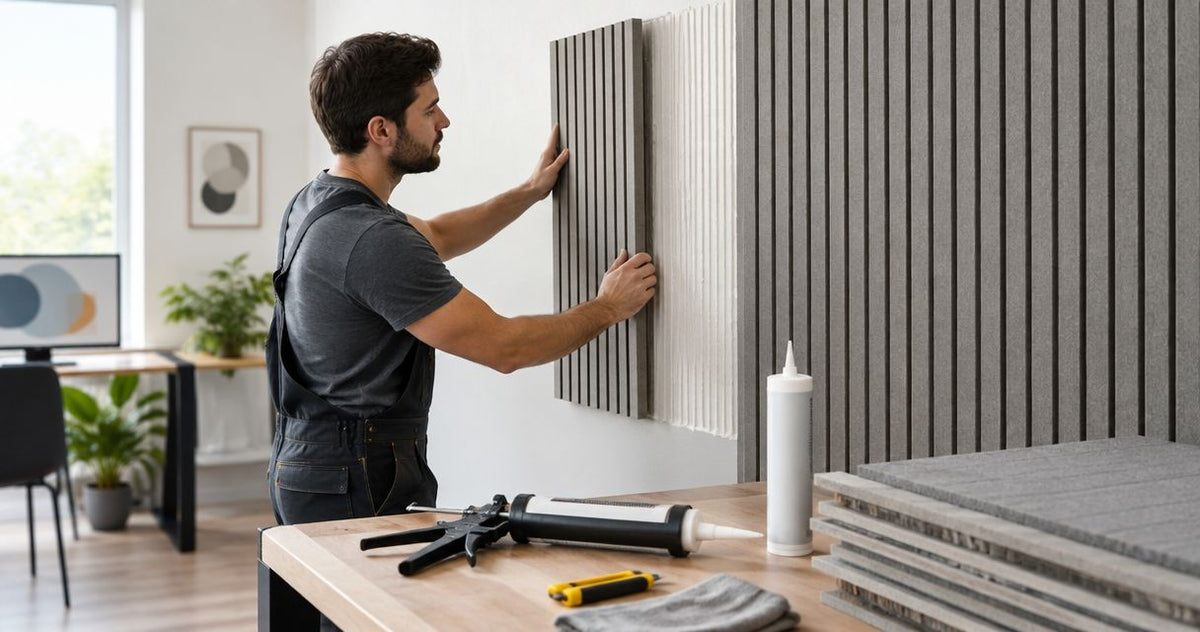
Best overall for felt-backed wooden slat panels: a manufacturer-approved high-tack panel adhesive. Best for mixed wall materials: a compatible hybrid-polymer mounting adhesive. Best for lightweight porous panels: an approved water-based grab adhesive. Best for acoustic foam: a foam-safe adhesive. This 2026 guide explains how to choose between them, starting with High Tack Panel Glue 290 ml White as a product to check against your panel and wall requirements.
- The best adhesive for acoustic wall panels matches both the panel backing and the wall surface.
- Akustiq UK acoustic wood panels need a fixing method approved for their felt backing and installation conditions.
- High initial grab does not mean an adhesive has reached its final strength.
- Use foam-safe adhesive for acoustic foam; do not transfer wooden-panel advice to foam tiles.
- Choose approved mechanical fixings when removal, overhead installation or the specified acoustic build-up requires them.
Why this matters
Acoustic panels do not all present the same bonding surface. Wooden slat panels often bond through their felt backing, while foam tiles and fabric-wrapped absorbers present different materials. An adhesive that suits one is not automatically suitable for another.
The wall matters just as much. A strong bond to loose paint still leaves you with a weak installation, because the paint can separate from the plaster underneath.
For Akustiq UK acoustic wood panels, choose the adhesive by its documented compatibility with the backing and wall—not by the strongest claim on the cartridge. That is the practical buying rule for this 2026 shortlist.
What makes the best adhesive for acoustic wall panels?
Use these criteria before comparing adhesive types:
- Backing compatibility: The adhesive must suit the material actually touching it, including felt, foam or a rigid backing board.
- Wall compatibility: Check whether the product accepts your plaster, paint, masonry, timber or other substrate, including any preparation requirements.
- Initial grab: Vertical panels need support against movement during installation. Initial grip and fully cured strength are different properties.
- Curing conditions: Follow the stated requirements for temperature, moisture, ventilation and temporary support.
- Approved application: Bead spacing, coverage and permitted bond thickness come from the installation instructions, not a generic decorating rule.
- Removal and acoustic design: A permanent direct bond is a different installation from a removable panel or a panel mounted over an acoustic cavity.
Do not choose adhesive by the visible wood finish. Natural oak and smoked oak describe the room-facing surface; your adhesive selection concerns the reverse of the panel and the wall.
Best acoustic panel adhesives at a glance
The order below prioritises felt-backed wooden slat wall panels, then separates the alternatives by their intended use. It is a compatibility-led shortlist, not a laboratory strength ranking.
| Adhesive option | Best for | Standout consideration | Key limitation |
|---|---|---|---|
| High-tack panel adhesive | Felt-backed wooden slat panels with an approved direct-bond installation | Panel-specific application is the starting point | The product name alone does not establish backing compatibility |
| Hybrid-polymer mounting adhesive | Mixed-substrate installations covered by its technical sheet | Some formulations accept several construction substrates | Products within this category have different restrictions |
| Water-based grab adhesive | Lightweight porous panels on suitable porous walls | An option where the specified materials permit water-based bonding | Unsuitable combinations can restrict drying or fail to bond |
| Foam-safe acoustic adhesive | Acoustic foam tiles | Compatibility with the exact foam type takes priority | Foam suitability does not establish suitability for wooden slat panels |
1. High-tack panel adhesive: best for felt-backed wooden slat panels
High-tack panel adhesive is the first category to investigate when you want to bond wooden slat panels directly to a prepared wall. Choose a specific product only when the panel instructions and adhesive technical sheet support that combination.
Akustiq UK lists High Tack Panel Glue in a 290 ml white format. Check its current instructions for supported materials, application and curing before treating it as the fixing specification for your project.
High-tack panel adhesive pros:
- A panel-focused product gives you a relevant starting point for checking installation requirements.
- High initial grab addresses movement while a vertical bond develops.
- An approved direct bond avoids a separate supporting framework where the design permits it.
High-tack panel adhesive cons:
- High grab does not eliminate the need for temporary support when the instructions require it.
- Permanent bonding complicates later removal and wall repairs.
- A weak paint layer remains a weak point beneath the adhesive.
Best for: Homeowners fitting felt-backed wooden slat panels to sound, prepared interior walls under an approved direct-bond method.
Verdict: Buy only after confirming the exact panel backing, wall surface and application instructions.
2. Hybrid-polymer mounting adhesive: best for mixed wall materials
Hybrid-polymer mounting adhesives are another category to compare when a project involves different construction substrates. Read the individual product's technical sheet: the category name does not guarantee that every formulation accepts every wall finish or panel backing.
This option belongs on your shortlist when the documentation explicitly covers the materials you need to join. Do not assume the high-tack panel glue above uses this chemistry; its formulation must come from its own product information.
Hybrid-polymer mounting adhesive pros:
- Some formulations cover a range of construction substrates.
- Cartridge application suits controlled placement where the instructions specify beads.
- A product with suitable movement characteristics can meet a specified flexible-bond requirement.
Hybrid-polymer mounting adhesive cons:
- Compatibility, priming and curing requirements vary between formulations.
- General construction suitability does not establish compatibility with felt.
- A flexible bond does not repair an unstable or crumbling wall.
Best for: Installations where the adhesive documentation explicitly covers both the panel backing and the particular wall material.
Verdict: Buy for a documented substrate match, not simply because the cartridge says hybrid polymer.
3. Water-based grab adhesive: best for lightweight porous panels
A water-based grab adhesive is an option for lightweight panels when the manufacturer approves the panel, substrate and drying conditions. Water must leave the adhesive as the bond develops, so the materials around it matter.
Do not transfer approval from a small porous decorative tile to a full-height wooden slat panel. Panel dimensions, backing construction and the required support method all need separate confirmation.
Water-based grab adhesive pros:
- Provides an alternative where the panel instructions specify water-based bonding.
- Suits certain porous material combinations described in the product documentation.
- Products with permitted wet cleanup simplify removal of fresh excess.
Water-based grab adhesive cons:
- Drying can be restricted between unsuitable non-porous surfaces.
- Suitability for lightweight materials does not establish capacity for larger panels.
- Application conditions and temporary support still need checking.
Best for: Lightweight porous acoustic panels on compatible porous surfaces, with explicit manufacturer approval.
Verdict: Hold until the exact panel and wall combination is confirmed; skip as an unverified substitute for slat-panel adhesive.
4. Foam-safe acoustic adhesive: best for acoustic foam tiles
Foam-safe adhesive is the right category to investigate for acoustic foam, rather than wooden slat panels. The exact foam chemistry matters because incompatible solvents can damage some foams.
Choose a product approved for that foam and wall surface. If the instructions specify spray application, follow the ventilation, protective equipment and overspray precautions rather than treating it like an ordinary cartridge adhesive.
Foam-safe acoustic adhesive pros:
- Puts material compatibility ahead of a general-purpose strength claim.
- Covers a distinct installation need that wooden-panel guidance does not address.
- Provides a clear basis for checking the foam manufacturer's instructions.
Foam-safe acoustic adhesive cons:
- Foam-safe does not mean suitable for felt-backed wooden panels.
- Spray products require control of overspray and exposure.
- Permanent bonding can damage foam or wall finishes during removal.
Best for: Lightweight acoustic foam tiles whose instructions approve the selected adhesive.
Verdict: Buy for the specified foam application; skip for wooden slat panels without separate approval.
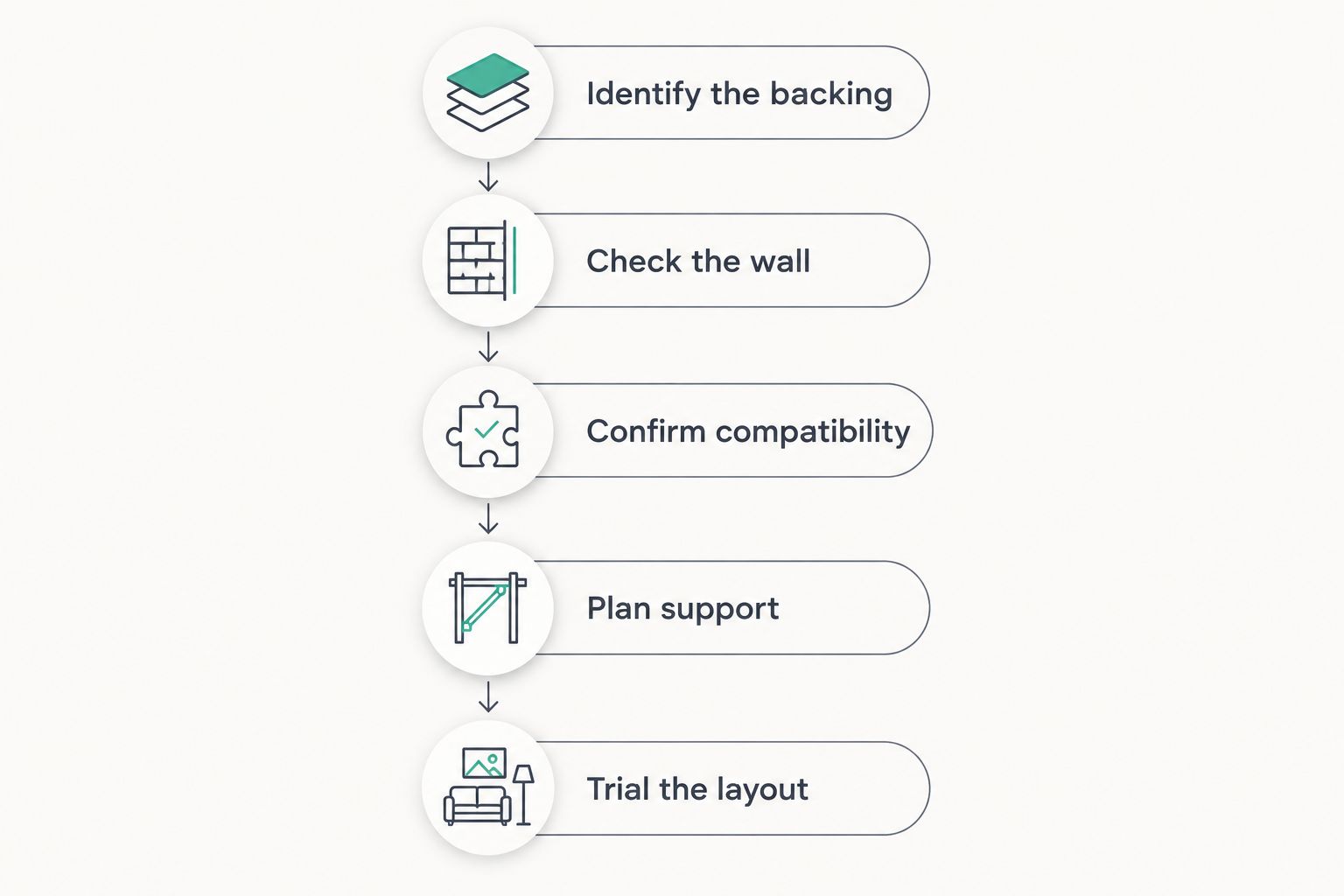
Choose your adhesive in the right order
For a 2026 installation, follow this sequence before opening a cartridge:
- Identify the backing. Read the panel specification and inspect the reverse. Do not mistake the visible veneer for the bonding surface.
- Check the wall. Identify the substrate and any paint, wallpaper, dust or loose material covering it.
- Confirm compatibility. Match both surfaces to the adhesive documentation and the panel installation method.
- Plan support. Establish the required temporary support, curing conditions and any permanent mechanical fixings.
- Trial the layout. Dry-fit panels, cuts and exposed edges before adhesive makes repositioning difficult.
For scale, the Natural Oak wooden wall panel measures 240 x 60 cm, while the longer Natural Oak format measures 300 x 60 cm. These are large surfaces to position accurately; dimensions alone do not tell you panel weight, adhesive consumption or fixing capacity.
Akustiq UK panels feature a 3-sided real wood veneer finish and acoustic felt backing. Protect the visible veneer during handling, and confirm that the approved adhesive application concerns the backing rather than the decorative face.
Wall preparation matters more than extra glue
Start with a sound surface. Remove loose material and address the cause of damp before considering a direct-bond installation; adhesive is not a treatment for moisture problems.
Wallpaper adds another potential failure layer between panel and wall. Follow the preparation requirements for both products rather than assuming that a strong adhesive will hold the wallpaper itself in place.
Check painted walls for flaking, chalking and poor adhesion. Where a primer is required, use the specified type and allow it to reach the stated condition before bonding.
Do not use extra adhesive as a substitute for levelling a wall. Excessive bond thickness can fall outside a product's permitted application and make consistent panel contact difficult. Repair the substrate or select an approved supporting system instead.
Initial grab, curing and cartridge quantities
For your 2026 project schedule, separate the moment a panel appears to stay in place from the point at which the bond is ready for service. Initial grab describes early holding behaviour; full cure is a different stage.
Use the adhesive manufacturer's stated support and curing instructions. Do not copy a drying time from a different product, even if both cartridges use similar wording.
Likewise, a 290 ml cartridge size does not establish how many panels it will cover. Consumption depends on the approved application pattern, bead size, panel dimensions and substrate condition. Calculate quantities from the specified coverage rather than a universal cartridges-per-panel rule.
When glue is the wrong fixing choice
Choose the installation system before choosing its adhesive. Some acoustic designs use battens, a cavity or additional absorption behind the panel; directly bonding the same panel to a wall is a different build-up.
Use acoustic performance information only for the mounting arrangement it describes. Glue does not turn a decorative wall treatment into a soundproof partition, and direct bonding does not reproduce the conditions of a tested cavity installation.
For ceilings and overhead applications, use an explicitly approved fixing system rather than assuming wall adhesive alone is sufficient. Where later access or removal matters, investigate approved mechanical or demountable systems first. Obtain permission before permanently bonding panels in rented premises.
How the adhesive options are ranked
This 2026 order starts with the article's main application: felt-backed wooden slat panels. Backing compatibility and wall suitability take priority, followed by initial grab, curing, application control and removal requirements.
The categories overlap: a high-tack product can also be a hybrid polymer. They represent buying decisions, not mutually exclusive chemical families. No unverified strength figures, cure times or coverage claims determine the ranking.
Which adhesive should you choose?
For a permanent wooden slat feature wall, start with a panel-specific high-tack adhesive approved for both bonding surfaces. Compare a hybrid-polymer alternative only when its documentation establishes the required compatibility.
Keep water-based grab adhesives for approved lightweight porous applications, and keep foam-safe products for the foam they specify. For Akustiq UK acoustic wall panels, the deciding document is the installation specification—not a generic adhesive leaderboard.
FAQ
What's the best adhesive for acoustic wall panels in 2026?
The best adhesive for acoustic wall panels is one approved for the exact panel backing and wall surface. For felt-backed wooden slat panels, start by checking a panel-specific high-tack adhesive against both manufacturers' instructions.
Can I use any grab adhesive for felt-backed acoustic panels?
No, a grab adhesive needs explicit compatibility with the felt backing and the wall substrate. A general claim about bonding wood does not establish suitability when the adhesive touches felt rather than wood.
Is high-tack adhesive fully cured when the panel stays in place?
No, initial grab and full cure are different stages. Keep any specified support in place and follow the product's curing instructions before treating the installation as complete.
How many cartridges do I need for acoustic wall panels?
Calculate cartridge quantities from the adhesive's specified coverage and approved application pattern. Cartridge volume and panel dimensions alone do not establish a reliable quantity.
Can I glue acoustic panels straight onto painted plasterboard?
Only use a direct bond where the panel and adhesive instructions permit the painted plasterboard surface. The paint must be sound, because the installation depends on its bond to the surface underneath.
Is acoustic foam adhesive suitable for wooden slat panels?
Foam compatibility does not establish suitability for wooden slat panels. Check the felt or rigid backing separately, together with the panel's fixing requirements.
Can I remove glued acoustic panels without damaging the wall?
Do not assume a permanent adhesive installation will remove without damage. If removal matters, choose an approved demountable fixing method before installation rather than relying on a removable-adhesive claim.
One last thing
The weakest part of your installation might not be the glue. It can be the thin paint layer underneath it. Before your 2026 panel project begins, check that the surface you intend to bond to is firmly attached to the wall itself.
Share:
Best shed cladding panels in 2026
Best shed cladding panels in 2026