


Best overall shortlist: fibre-cement cladding for a mineral finish. Best for crisp façades: metal cladding. Best for a wood-effect brief: exterior-grade composite cladding. For waterproof exterior wall cladding panels UK buyers should choose a documented wall system, not a panel advertised as waterproof; this 2026 guide compares the main options and the checks that decide suitability.
- For waterproof exterior wall cladding panels UK projects, assess joints, drainage and openings alongside the panel material.
- Fibre cement suits mineral finishes; metal suits crisp façades; exterior-grade composite suits a wood-effect brief.
- Akustiq UK exterior wall cladding suits buyers comparing oak, birch, stone grey and black finish options.
- Choose exterior products explicitly; indoor acoustic panels are not substitutes for a documented external wall system.
Why this matters
A water-resistant panel does not automatically make a watertight wall. Rain protection depends on the assembly: the outer cladding, joints, flashings, drainage provisions and the wall behind it. A convincing surface photograph tells you little about those details.
Akustiq UK sells exterior wall cladding alongside indoor acoustic wooden panels. Keep those categories separate when comparing products. A finish you like indoors is not evidence that the same product belongs outside.
For a 2026 refurbishment, decide what the wall needs before choosing its colour. A garden building, a house extension and a commercial façade need project-specific checks, even when their finished appearance looks similar.
What makes the best exterior wall cladding?
Use these criteria before reading the ranking. They distinguish a suitable specification from a decorative purchase.
- Exterior suitability: require written confirmation that the exact product is intended for external walls and your proposed application.
- Water management: examine joints, corners, openings, base details and the route for water to drain away.
- Fixing requirements: establish the permitted substrate, supporting structure, fixing arrangement and movement allowances.
- Fire performance: check the exact product and proposed wall build-up against the requirements for your building.
- Maintenance: compare cleaning, coating and inspection requirements rather than assuming any material needs no attention.
- Appearance: assess the finish beside your actual brickwork, render, roof and window frames.
Colour is the final selection within a suitable system. It is not a substitute for technical evidence, and neither is a generic description such as weatherproof.
Exterior wall cladding options at a glance
This ranking assigns each material a distinct design brief. It does not claim that every product within a material category has the same performance.
| Rank and option | Best for | Standout characteristic | Key limitation |
|---|---|---|---|
| 1. Fibre cement | A mineral-finish façade | Cement-based boards or panels | Cutting, handling and edge details need planning |
| 2. Metal | Crisp contemporary elevations | Folded profiles and defined edges | Movement, fixings and metal compatibility need attention |
| 3. Exterior-grade composite | A wood-effect design brief | Manufactured profiles with wood-effect options | Composition and installation requirements vary by product |
| 4. Exterior-grade PVC | Utility areas with a plastic finish | Profiles that do not need a painted timber finish | Thermal movement and fire suitability need checking |
| 5. Timber | A genuine wood exterior | Natural grain and individual boards | Moisture movement and appearance changes need acceptance |
1. Fibre cement: best exterior cladding for a mineral finish
Fibre-cement cladding combines cement with reinforcing fibres in manufactured boards or panels. It belongs on your shortlist when you want a mineral-based exterior rather than timber grain or a metallic finish.
Best for: homeowners specifying a mineral-finish elevation with deliberate panel lines or board courses. Choose the exact product by its installation documentation, not by the material name alone.
Fibre-cement pros:
- Provides a material route distinct from timber and plastic cladding.
- Offers board and panel formats across the category.
- Works as a design choice where a mineral appearance is central to the brief.
Fibre-cement cons:
- Cutting requires the appropriate tools and dust controls.
- Handling and support requirements need checking before installation.
- Cut edges, joints and fixings need the product-specific treatment.
For a 2026 project, ask for the current technical sheet and installation manual together. Confirm that the specified board thickness, supports and fixing method belong to the same proposed system. Do not combine instructions from unrelated products.
Verdict: Buy for a mineral-finish brief once the exact wall specification is confirmed.
2. Metal: best exterior cladding for crisp contemporary façades
Metal cladding uses sheets, profiles or formed panels to create an external skin. Aluminium and steel systems offer different specifications; neither material name alone establishes suitability for an exposed site.
Best for: extensions and contemporary buildings where defined edges and a metallic or coated finish lead the design. Decide how corners, roof junctions and window reveals will look before committing to the main panels.
Metal cladding pros:
- Supports folded profiles and clearly expressed panel lines.
- Offers a visual alternative to wood-effect and mineral finishes.
- Allows corners and junctions to become intentional design details.
Metal cladding cons:
- Thermal movement needs provision in the fixing design.
- Dissimilar metals require compatibility checks.
- Damage to a coating needs assessment under the manufacturer's guidance.
For coastal or otherwise demanding locations, request explicit confirmation of the finish and fixing suitability. Do not assume that every coated metal panel has the same exposure limits or maintenance instructions.
A metal façade also needs a complete junction strategy. A neat sheet face cannot compensate for a poorly resolved opening or roof edge.
Verdict: Buy for a crisp architectural finish with properly specified junctions and fixings.
3. Exterior-grade composite: best cladding for a wood-effect brief
Composite cladding is a broad category rather than a single material specification. Products use different constituents and profiles, so compare the exact construction and instructions rather than transferring claims between brands.
Best for: buyers who want a manufactured wood-effect exterior. Establish whether the appearance, maintenance instructions and movement requirements suit your wall before choosing a finish.
Exterior-grade composite pros:
- Gives you a route to a wood-effect design without choosing conventional timber boards.
- Offers manufactured profiles for a repeated façade pattern.
- Supports comparison by finish, profile and documented installation method.
Exterior-grade composite cons:
- The word composite does not establish composition or water performance.
- Movement allowances and support arrangements are product-specific.
- Repair and replacement methods need checking before purchase.
Akustiq UK exterior wall cladding includes oak and stone grey options, alongside birch and black. Use those names to shortlist the appearance; they do not establish timber species, core material, fire classification or waterproof performance.
Akustiq UK exterior wall cladding is best for buyers comparing oak, birch, stone grey and black finish options. Select the technical specification separately from the colour decision.
Verdict: Buy exterior-grade composite for a wood-effect brief only after checking the exact product specification.
4. Exterior-grade PVC: best cladding for a utility-area finish
PVC cladding provides a plastic-faced option for external applications where the exact product is specified for that use. Interior bathroom panels and exterior cladding are not interchangeable simply because both contain PVC.
Best for: utility elevations where a plastic finish meets the design brief. Confirm the permitted exposure, supporting structure and installation arrangement first.
Exterior-grade PVC pros:
- Avoids the need to maintain a painted timber surface.
- Provides a distinct alternative to natural wood grain.
- Offers profiled systems within the exterior-cladding category.
Exterior-grade PVC cons:
- Thermal movement needs the prescribed clearances and fixing method.
- Fire suitability must be checked for the proposed application.
- The surface appearance will not satisfy a genuine-timber brief.
For your 2026 shortlist, require an exterior installation manual rather than relying on the phrase waterproof plastic. Pay particular attention to how the system terminates around openings and how its profiles accommodate movement.
Verdict: Buy for a utility-area brief when the exterior specification and appearance both fit.
5. Timber: best exterior cladding for genuine wood character
Timber cladding gives you actual wood grain rather than a reproduction. Species, board profile, treatment and installation arrangement all influence the specification, so compare a defined product rather than timber in the abstract.
Best for: garden buildings and façades where genuine wood is the priority and you accept changes in appearance. Plan whether you want to maintain a coating or allow the timber to weather in accordance with the product guidance.
Timber cladding pros:
- Provides genuine grain and natural variation.
- Offers a choice of board profiles within the category.
- Suits a design brief centred on real wood rather than imitation.
Timber cladding cons:
- Moisture changes cause dimensional movement.
- Exposed timber changes appearance over time.
- Coated finishes need maintenance according to the specified coating system.
Do not describe timber boards as a waterproof wall on their own. The detailing must manage rain, protect vulnerable junctions and support drying. Those requirements remain important whether the boards look rustic or sharply contemporary.
Verdict: Buy for genuine timber character; skip if unchanged appearance is essential.
How to check the wall system before ordering
For a 2026 purchase, ask the supplier or designer to explain the proposed wall build-up from the outer face back to the existing structure. Use these checks to keep that conversation specific.
Panel face
Confirm exterior suitability and the permitted installation orientation. Ask how cut edges and damaged surfaces are treated, where applicable.
Panel joints
Check how the profiles connect and accommodate movement. Do not add sealant indiscriminately: follow the system's instructions for open, lapped or sealed joints.
Openings
Request details for window heads, sills, door thresholds and service penetrations. These interruptions need their own rain-management details rather than improvised cuts around the obstacle.
Base drainage
Establish how water leaves the assembly and how the base terminates above the surrounding surface. Keep the specified drainage and ventilation routes clear.
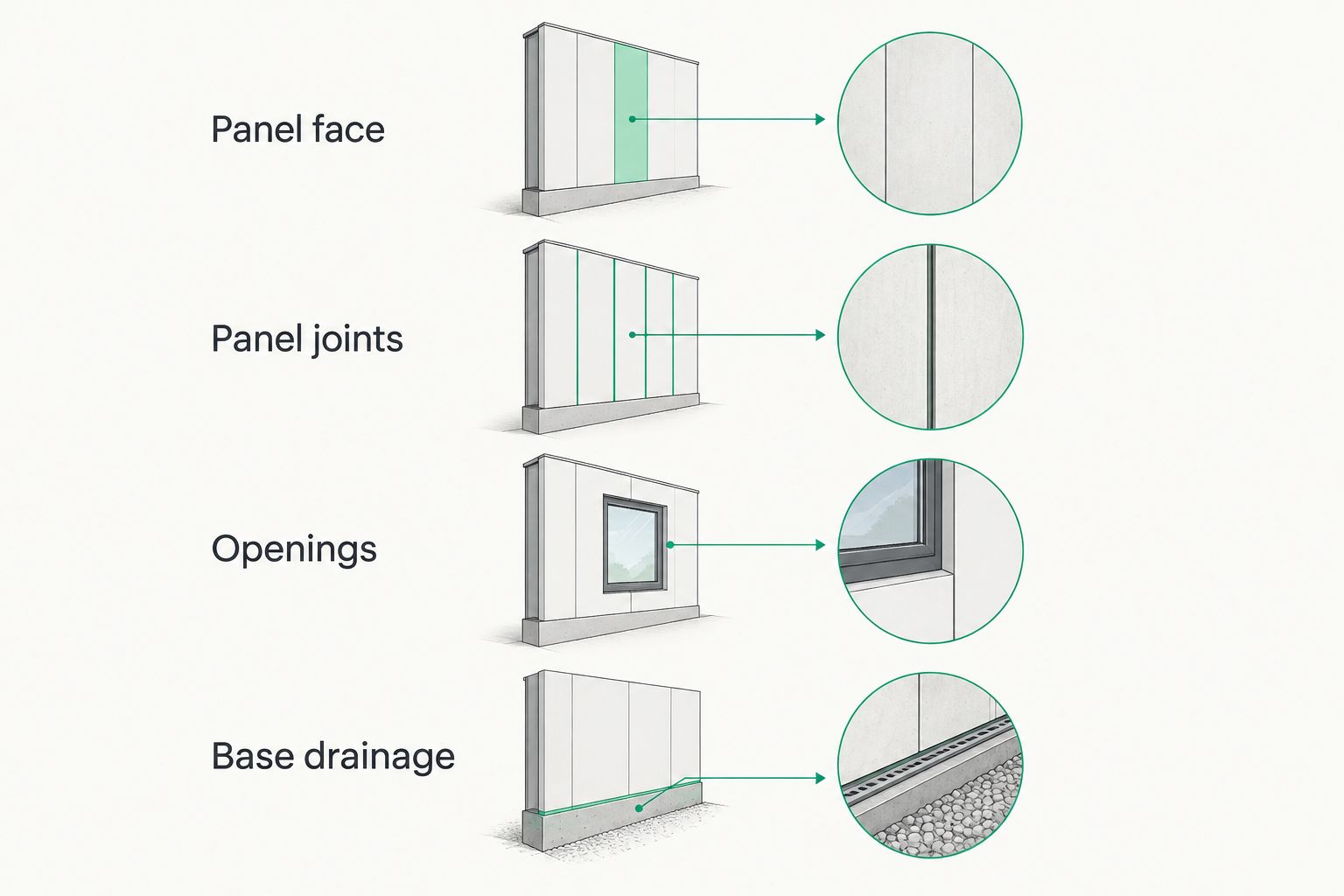
Do not order from wall area alone. Give your installer the elevations, openings, corners and intended orientation so the quantity calculation includes the actual layout and required finishing components.
Keep indoor acoustic panels off the exterior shortlist
The indoor wooden panels described by Akustiq UK include 240 cm and 300 cm lengths, with listed panel widths of 60 cm. Those dimensions help with interior layout; they do not establish outdoor suitability.
Likewise, three-sided real wood veneer and acoustic felt backing describe the indoor product construction, not an external rain-protection system. Do not infer outdoor approval from the word wood, the finish name or a matching colour.
For a garden office, specify the exterior enclosure and interior acoustic treatment as separate jobs. Each product needs to suit its own side of the wall.
How the options are ranked
This 2026 ranking uses design fit, water-management requirements, fixing considerations and maintenance trade-offs. Fibre cement takes the default mineral-finish slot; metal, composite, PVC and timber each serve a different brief.
This is a material-selection guide, not a comparative waterproof test. Choose between suitable products using their actual documentation, with project-specific advice where required. No colour or category receives a higher water-performance rating here.
Which exterior cladding should you choose?
Start with fibre cement if you want a mineral finish and have no stronger material preference. Choose metal for defined architectural edges, exterior-grade composite for a wood-effect brief, PVC for an appropriate utility finish, or timber for genuine grain.
Then apply the same rule to every option: confirm the complete wall detail before ordering. If the product documentation does not address your proposed use, hold the purchase rather than asking an installer to improvise.
FAQ
What's the best waterproof exterior wall cladding for a UK home?
The best choice is a documented exterior wall system suited to your building, exposure and design brief. Fibre cement, metal, exterior-grade composite, PVC and timber all need appropriate joints, fixings and rain-management details.
Are waterproof panels enough to stop rain getting into a wall?
No, a water-resistant panel face alone does not establish a watertight wall. Openings, joints, flashings and drainage provisions must work with the wall construction behind the cladding.
Is composite cladding better than timber for wet weather?
The material name alone does not establish which product is better for your wall. Compare the exact exterior specifications, installation instructions and maintenance requirements rather than assuming every composite outperforms every timber product.
Can I put indoor acoustic wooden panels outside?
Do not use an indoor acoustic panel outside unless its manufacturer explicitly approves that exact external application. Wood veneer and acoustic felt are not evidence of outdoor suitability.
Does black cladding keep rain out better than oak-coloured cladding?
Colour does not establish rain resistance. Compare the product construction, installation details and supporting performance information independently of the finish name.
Can I glue exterior cladding directly onto brickwork?
Use direct adhesive fixing only when the exact exterior system permits it for that substrate and application. Do not substitute general panel adhesive for the prescribed support and fixing arrangement.
What should I ask a cladding supplier before ordering?
Ask for the exact exterior specification, installation manual, fire-performance information and details for openings and drainage. Confirm that the documents apply to your chosen product and proposed wall build-up.
One last thing
Ask your installer to sketch the bottom edge of the wall before discussing the finish. If the drawing cannot show where water exits, the cladding decision is not finished. That check focuses the conversation on protecting the building rather than simply covering it.
Share:
Best composite cladding in the UK in 2026
Best exterior wall cladding in the UK in 2026