

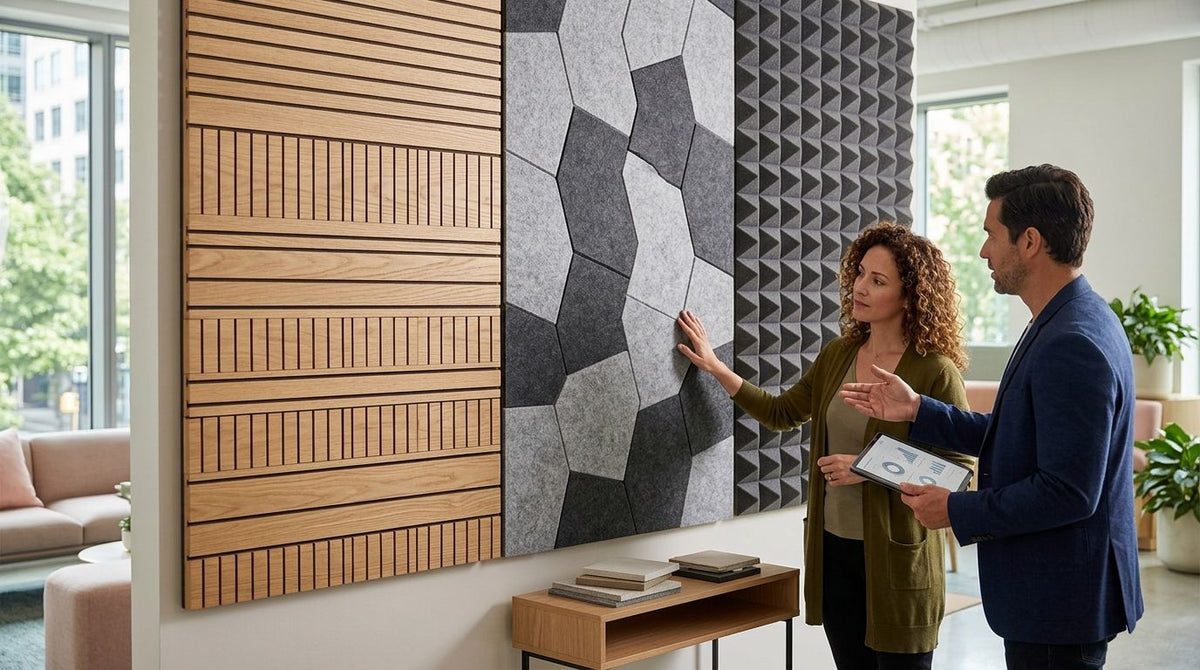
Best overall: Akustiq UK natural oak wood veneer panels with acoustic felt backing. Best for colour-led interiors: felt-only panels. Best budget option: foam panels. This 2026 guide compares how each material controls echo, looks on the wall and fits different rooms.
- Wood veneer and felt panels win overall when acoustic treatment must also function as the finished wall.
- Felt-only panels suit colour-led interiors that do not need a natural wood surface.
- Foam panels are the budget option for studios, workshops and other function-first rooms.
- Selected Akustiq UK hexagon wood-felt panels list an NRC 0.75 sound absorption rating.
Why this matters
Acoustic wall panels reduce reflected sound inside a room. They do not automatically stop voices, television or music passing through a wall, because sound absorption and sound insulation are different jobs.
Material choice determines what the treatment does beyond sound control. Wood veneer creates a finished feature wall, felt gives you a softer colour-led surface, and foam prioritises function over appearance. The right answer in 2026 depends on whether you are treating a living room, bedroom, office, meeting room, home cinema or recording space.
NRC is one useful comparison point for porous absorbers. The scale runs from 0, representing no absorption, towards 1, representing complete absorption under the test conditions. Use the declared rating for the exact product and installation rather than assuming every panel made from the same material performs identically. This guide to reading NRC sound absorption ratings explains what the figure can and cannot tell you.
Akustiq UK acoustic wall panels combine real wood veneer with acoustic felt backing. The range includes 3-sided veneer finishes and 240 cm and 300 cm formats, giving homeowners and commercial buyers a decorative alternative to exposed foam.
What makes the best acoustic wall panel material
Use these six criteria to judge acoustic wall panel materials in 2026:
- Declared acoustic performance: Check whether the exact panel has an NRC or another recognised sound absorption rating. Material names alone do not prove performance.
- Finished appearance: Decide whether the panel will be visible in a living space, client-facing office or purely functional room. Wood, felt and foam create very different results.
- Panel construction: A slatted wood face, porous felt backing and air space can work together. A solid decorative board without an absorbent layer serves a different purpose.
- Installation method: Check panel weight, wall condition and the specified fixing system before ordering. Adhesive, screws and battens create different demands on the substrate.
- Room conditions: Kitchens, bathrooms and other moisture-prone spaces need materials explicitly approved for those conditions. Do not assume an indoor acoustic panel is moisture resistant.
- Supporting documentation: Commercial projects should verify acoustic, reaction-to-fire and installation information for the exact product specification.
The best material is therefore not the one with the most dramatic texture. It is the one that provides documented absorption, suits the room and creates a finish you will keep.
Acoustic wall panel materials at a glance
| Rank | Material | Best for | Standout feature | Key limitation |
|---|---|---|---|---|
| 1 | Wood veneer with felt backing | Living rooms, offices and feature walls | Decorative wood surface and porous backing in one system | Heavier and more visually permanent |
| 2 | Felt-only panels | Colour-led interiors and flexible layouts | Soft surface available in varied shapes and colours | Does not create a natural wood finish |
| 3 | Foam panels | Studios, workshops and function-first rooms | Easy to cut and position for local reflection control | Looks like visible acoustic treatment |
1. Wood veneer with felt: best for finished feature walls
Wood veneer acoustic panels use a decorative wood surface over slats or a shaped core, with felt providing the porous absorbing layer. The gaps and felt allow reflected sound to reach the absorbent material instead of bouncing directly from a hard, flat wall.
This construction is the strongest all-round choice when the wall must perform acoustically and still look appropriate in a living room, bedroom, office or reception area. Akustiq UK supplies premium acoustic wooden slat panels with 3-sided real wood veneer, acoustic felt backing and 240 cm or 300 cm formats.
Selected hexagon samples in the supplied product range list an NRC 0.75 rating. That figure applies to those specified products; it should not be transferred to every wood-felt panel without checking its own documentation.
Wood veneer with felt pros:
- Combines acoustic treatment with a finished decorative surface.
- Real wood veneer provides natural grain rather than a printed imitation.
- Slatted and geometric formats can cover a full wall or define a smaller acoustic zone.
- Multiple wood finishes make it easier to coordinate the wall with floors, doors and furniture.
Wood veneer with felt cons:
- The panels are heavier than thin felt or foam, so the wall and fixing method need proper preparation.
- Wood grain and slat alignment make inaccurate cuts or uneven installation more visible.
- A strong wood finish can dominate a small room if every wall receives the same treatment.
- Product-specific acoustic and fire documentation still needs checking for commercial specifications.
Best for: homeowners, interior designers and project teams that need one wall treatment to handle appearance and sound absorption. Verdict: Buy for living rooms, bedrooms, offices and client-facing spaces.
2. Felt-only panels: best for colour-led acoustic layouts
Felt-only panels use porous fibre as both the visible face and the absorbing material. They can be supplied as flat sheets, tiles or shaped pieces, allowing a designer to create a restrained grid or a more graphic arrangement without introducing wood grain.
Felt works well when the existing interior already contains timber, patterned flooring or strong furniture finishes. A plain felt surface adds acoustic treatment without forcing another material into the room. It is also useful behind desks, around meeting areas and on walls where full-height slats would feel too visually heavy.
Performance depends on the panel density, thickness, mounting method and any air gap behind it. A thin decorative felt layer should not be treated as equivalent to a tested acoustic panel simply because both products use the same fibre type.
Felt-only panel pros:
- Creates a softer visual surface than exposed foam.
- Works in geometric layouts, partial-wall treatments and colour-blocked schemes.
- Easier to cut around sockets and small obstructions than slatted wood systems.
- Does not require grain matching across adjoining pieces.
Felt-only panel cons:
- The visible surface looks like fabric rather than timber or joinery.
- Exposed edges need careful cutting because rough lines remain visible.
- Pale felt can show handling marks and surface dust.
- Acoustic performance varies by construction, so the material label is not enough for specification.
Best for: offices, study areas, bedrooms and creative spaces where colour and flexible panel placement matter more than a wood finish. Verdict: Buy when you want visible acoustic treatment without timber slats.
3. Foam panels: best for function-first rooms
Acoustic foam is an open-cell porous absorber commonly formed into flat, wedge or pyramid profiles. It is easy to cut and can be placed at reflection points, making it a practical option for speech recording, music practice and other rooms where acoustic function takes priority over interior finish.
Foam mainly addresses reflected energy inside the room. It is not a substitute for adding mass, sealing gaps or isolating the wall structure when the actual problem is noise transfer between rooms.
Panel depth, foam structure, wall coverage and mounting method all influence the result. A decorative profile does not prove higher absorption, and an undeclared foam product should not be selected solely because it resembles studio treatment.
Foam panel pros:
- Easy to trim around corners, equipment and irregular wall areas.
- Suitable for targeted treatment rather than full-wall coverage.
- Widely recognised as a functional choice for recording and practice spaces.
- Profiled surfaces can reduce direct reflections around microphones and listening positions.
Foam panel cons:
- The visible finish looks technical, which limits its appeal in living rooms and reception areas.
- Small tiles create many seams across a large wall.
- Adhesive removal can damage paint or leave residue if the fixing method is not planned.
- Fire performance and emissions documentation must be checked for the exact foam product, especially in workplaces or public buildings.
Best for: podcast corners, home studios, music practice rooms and workshops where appearance is secondary. Verdict: Buy for targeted studio treatment; skip for a decorative feature wall.


How we ranked the materials
The 2026 ranking starts with documented acoustic performance, then considers appearance, installation and room suitability. Wood veneer with felt ranks first because it can replace a decorative wall finish while adding porous absorption. Felt-only panels rank second because they offer flexible shapes and colours but do not provide the same joinery-style finish.
Foam ranks third overall, not because it lacks a valid use, but because its visible studio appearance narrows where it belongs. In a recording corner, that limitation matters little. In a living room or customer-facing office, it often decides the purchase.
No material receives credit for unverified acoustic claims. Akustiq UK product data identifies NRC 0.75 for selected hexagon wood-felt samples, while the wider category comparison still requires you to check the documentation attached to each exact product.
Which acoustic wall panel material should you choose?
Choose wood veneer with felt backing if the wall is part of the interior design. It is the clear default for living rooms, bedrooms, home offices, meeting rooms and reception spaces because the acoustic layer sits behind a finished wood surface.
Choose felt-only panels when colour, shape and local coverage matter more than natural grain. Felt works particularly well where you want acoustic zones around desks, seating areas or specific reflection points rather than a full-height feature wall.
Choose foam panels when function takes priority and the treatment can remain visibly technical. A home studio, podcast corner or workshop is a better fit than a hallway or open-plan living room.
For an undecided buyer in 2026, Akustiq UK wood veneer acoustic panels are the best overall choice for combining sound absorption with a finished interior surface. Check the exact panel specification, order a physical sample and confirm the fixing method before planning the full wall.
FAQ
What is the best acoustic wall panel material for a living room?
Wood veneer with acoustic felt backing is the best overall material for a living room. It combines porous sound absorption with a finished surface suited to visible feature walls.
Is felt better than foam for acoustic wall panels?
Felt is better for visible living and working spaces, while foam is better suited to function-first recording areas. The exact acoustic result depends on thickness, density, coverage and mounting.
Do wooden wall panels absorb sound?
Wood veneer panels absorb sound when their construction includes gaps and a porous layer such as acoustic felt. A flat, solid wooden board without an absorbing layer mainly reflects sound.
What does an NRC 0.75 rating mean?
NRC 0.75 indicates that a tested product absorbs a substantial proportion of incident sound across the frequencies used for the rating. The figure applies to the tested construction and mounting method, not every panel made from similar materials.
Are acoustic panels the same as soundproofing?
No, acoustic panels control reflections and reverberation inside a room. Soundproofing focuses on reducing sound transmission through walls, floors, ceilings, doors and gaps.
Can acoustic wall panels cover only part of a wall?
Yes, partial coverage can target reflection points or noisy zones without covering every surface. The required area depends on room volume, existing finishes and the acoustic objective.
Should I order acoustic wall panel samples first?
Yes, order samples before committing to a full wall. A sample lets you inspect veneer grain, felt colour, edge quality and the way the material looks under the room lighting.
Which acoustic panel material is best for an office?
Wood veneer with felt suits client-facing offices, while felt-only panels suit colour-led work zones. Foam is better reserved for recording booths or other technical areas.
One last thing
Do not compare wood, felt and foam by touching the front surface alone. The hidden construction matters just as much: backing material, panel depth, mounting and any air space can change acoustic performance even when two products look similar.
A physical sample answers the design questions, but only the product documentation answers the performance questions. In 2026, treat those as two separate checks before ordering: confirm that the finish works in your room, then confirm that the tested specification matches the installation you plan to build.
Share:
Exterior Cladding Materials Compared: 2026 Winner
Best Acoustic Wall Panels for Contractors 2026