

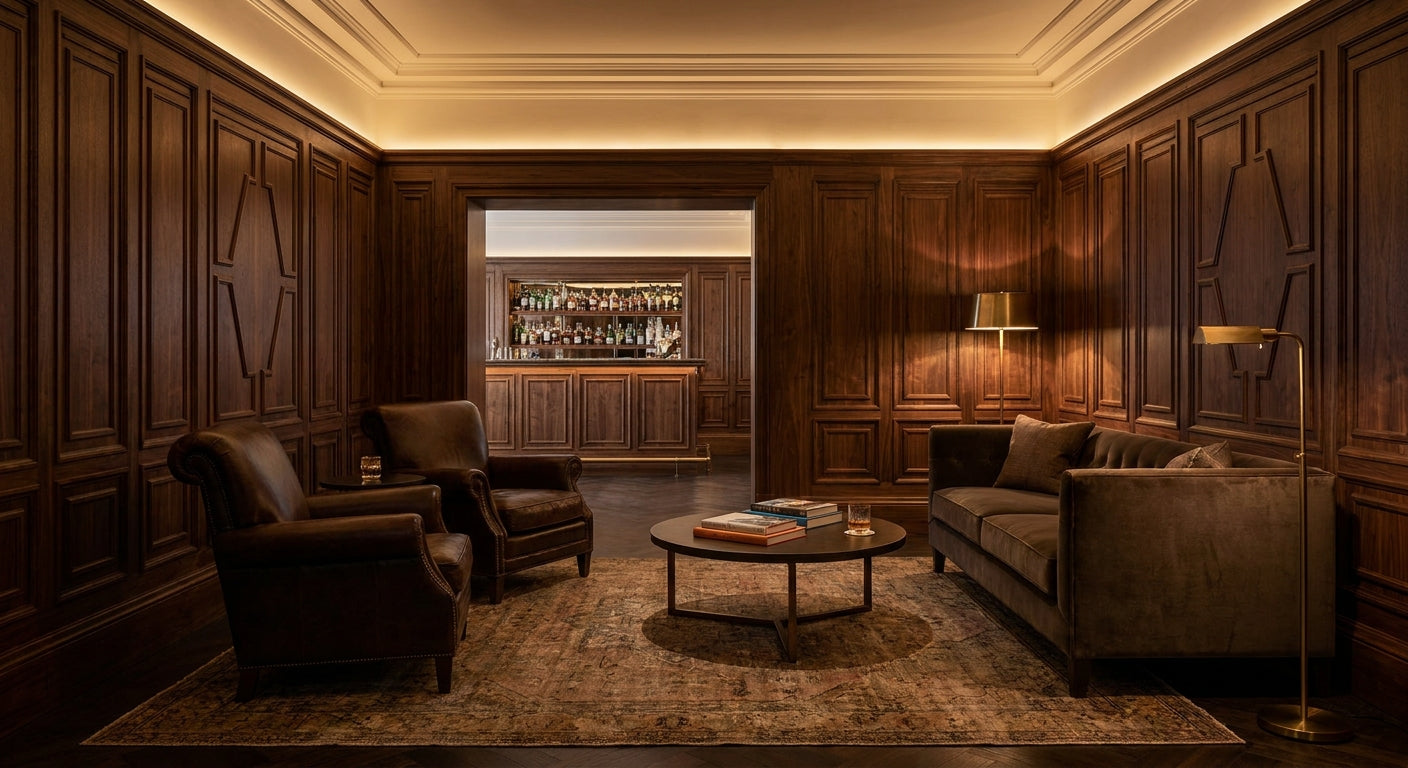
Private members clubs live and die on atmosphere: hushed conversation, low music, the right kind of quiet buzz. Wooden wall panels solve the acoustic problem and the design problem at once, and this guide breaks down which finishes and formats actually hold up in a commercial lounge, bar or private dining room.
TL;DR
For private members club interiors, Akuwood Panel's Black Oak and Walnut acoustic wooden wall panels are the strongest picks in 2026 — both use a 3-sided real wood veneer over acoustic felt backing, come in 240cm and 300cm formats, and read as premium under low lounge lighting without the maintenance headache of raw timber. Smoked Oak is the wildcard for a darker, moodier bar area. Skip anything described as "wood-effect laminate" for members club use — it looks fine in daylight photos and flat under a bar's warm lighting. Verdict: Black Oak and Walnut are the safe buys; Smoked Oak is worth considering for statement walls.
Why this matters
Members clubs run small rooms with hard surfaces — marble bars, glass, leather banquettes — and all of that reflects sound. Add 40-80 covers talking over a house playlist and echo becomes the dominant complaint in member feedback, not the food or the drinks list. Wooden wall panels for members club interiors solve this because the acoustic felt backing behind the wood veneer wall panels absorbs mid-to-high frequency reflection while still looking like a fitted timber wall, not a fabric-wrapped acoustic tile. That distinction matters more in a members club than almost any other commercial setting, because the paneling is part of the brand experience members are paying a subscription for.
A 2026 refurbishment brief for a members club interior typically covers three zones — lounge, bar, private dining — each with different lighting and different noise loads. Panel choice needs to answer to all three without looking like three different buildings stitched together.
Who this is for
This guide is for interior designers, fit-out contractors and club operations managers specifying wall finishes for a private members club — whether that's a new build, a full refurbishment, or a phased room-by-room upgrade across 2026. If you're comparing timber veneer against fabric acoustic panels, plaster, or exposed brick for a lounge or bar wall, this is the decision framework.
What to look for in wooden wall panels for members club interiors
Acoustic backing, not just a wood face
A members club needs genuine sound absorption, not a decorative timber skin nailed to plasterboard. Panels built with an acoustic felt layer behind the veneer cut reverberation in a working room with people talking, glassware clinking and background music running most evenings — a flat MDF veneer panel does none of that.
Real wood veneer over printed foil
Under warm bar lighting, a printed wood-effect foil goes flat and slightly plastic within a few weeks of handling and cleaning. A genuine 3-sided real wood veneer keeps its grain depth and colour variation under low, amber-toned lighting, which is exactly the lighting most private members clubs run.
Finish consistency across a long run
A members club lounge wall might need 8-15 panels in a single run behind a bar or banquette. Batch-to-batch colour drift is far more visible across a continuous wall than it is on a single feature panel in a living room, so consistent finish across the same wood species and stain matters more here than in residential jobs.
Size format matched to the room
Panels come in 240cm and 300cm lengths. A 300cm format suits floor-to-ceiling lounge walls with high ceilings typical of converted period buildings, while 240cm works better in bar areas with standard commercial ceiling heights and less waste when panels need to meet doorframes or service hatches.
Installation method for commercial walls
Members clubs rarely have the luxury of a long install window between opening hours. A glue-fix system using panel adhesive onto prepared plasterboard or battens is faster to fit around bar counters, banquette seating and skirting than a full batten-and-screw system, and leaves a cleaner finish where panels meet joinery.
Tone that matches the brand, not just the trend
A members club interior is a brand statement as much as a design choice. Dark, moody finishes suit whisky bars and cigar lounges; lighter oak tones suit daytime co-working or all-day dining rooms within the same club. Pick the finish that matches how the room is actually used at different times of day, not just what looks best in a render.
Top picks for members club interiors
Black Oak wall panel — the sophisticated pick. Deep, near-charcoal tone with real wood grain visible under low lighting, available in the 240cm and 300cm formats with acoustic felt backing behind the 3-sided veneer. It reads as premium in bar and cigar-lounge settings where dark timber and brass fittings dominate. Verdict: Buy for bar walls and private dining rooms wanting a statement finish.
Walnut wall panel — the safe pick. Warm mid-tone brown that pairs with leather seating and brass without fighting either. It's the finish least likely to date across a multi-year club refurbishment and works across lounge, bar and reception in the same building without looking mismatched. Verdict: Buy as the default across most rooms.
Smoked Oak wall panel — the wildcard. Sits between Black Oak and Walnut in depth, with a slightly grey-brown cast that photographs well in low-light social spaces built for phone content. Strong choice for a single feature wall behind a bar back-bar or DJ booth. Verdict: Consider for one accent wall rather than a full room.
Natural Oak — the daytime pick. Lighter tone that suits members clubs running breakfast or co-working hours alongside evening service, since it doesn't disappear into shadow the way the darker finishes can under daylight. Less suited to a nightclub-adjacent bar concept where mood lighting dominates. Verdict: Consider for daytime lounge or reception zones only.
What to avoid
- Printed wood-effect laminate panels — cheaper upfront, but they flatten out visually under warm bar lighting and don't carry acoustic backing, so you'd need a separate acoustic treatment anyway.
- Ultra-pale finishes in low-lit bar zones — a very light oak reads as unfinished or institutional once the lighting dims below daytime levels, which undercuts the premium feel a members club is selling.
- Mixing more than two wood tones in one open-plan room — a lounge that opens directly onto a bar needs one dominant finish carried through, with a second tone reserved for a single accent wall, not scattered across multiple zones.
Verdict comparison
| Finish | Best room | Size formats | Tone under low light | Verdict |
|---|---|---|---|---|
| Black Oak | Bar / cigar lounge | 240cm, 300cm | Deep, statement | Buy |
| Walnut | Lounge / reception | 240cm, 300cm | Warm, consistent | Buy |
| Smoked Oak | Feature wall / DJ booth | 240cm, 300cm | Grey-brown, moody | Consider |
| Natural Oak | Daytime lounge | 240cm, 300cm | Light, bright | Consider |
FAQ
What's the best wood finish for a members club interior? Walnut is the most versatile default for 2026 club refurbishments because it holds tone across daytime and evening lighting; Black Oak suits bar and cigar-lounge zones wanting a darker, more dramatic statement.
Is wooden wall paneling acoustic or just decorative? It depends on construction. Panels with a felt backing behind the wood veneer absorb sound; a flat veneer sheet with no backing is decorative only and won't reduce echo in a busy bar.
How much wall panelling do I need for a private members lounge? Measure the wall run in linear metres and divide by the panel width, then add roughly 10% for cuts around doorways, sockets and skirting — a typical single-wall lounge feature runs 8-15 panels depending on ceiling height.
Can wood wall panels handle a high-footfall commercial venue? Yes, when fitted properly onto prepared plasterboard or battens with a commercial-grade adhesive; the wear point is usually the adhesive and substrate prep, not the panel itself.
What's the difference between 240cm and 300cm wall panels? 300cm suits floor-to-ceiling walls in period buildings with higher ceilings; 240cm suits standard commercial ceiling heights and cuts down on waste around doorframes and service points.
Do wall panels need special glue for a stud wall? A high-tack panel adhesive designed for the wood-to-plasterboard bond gives a cleaner, faster fix than screws in areas where visible fixings would spoil the finish, such as a bar back wall.
Is Black Oak or Walnut better for a members club bar? Black Oak reads as more dramatic under low bar lighting; Walnut is the safer long-term choice if the same wall needs to work for both daytime and evening service.
Are wooden wall panels a good fit for a private dining room? Yes — the acoustic backing cuts down on clatter and conversation bounce in a smaller enclosed dining room, and a warm finish like Walnut or Natural Oak suits the softer lighting most private dining rooms run.
One last thing
Most members club briefs default to one finish throughout the whole building, but the strongest results in 2026 come from running Walnut as the base tone across lounge and reception, then reserving Black Oak or Smoked Oak for a single bar feature wall — the contrast does more for the room's sense of arrival than either finish would alone.
Share:
Acoustic Panels for Commercial Kitchen Pass Areas 2026
Composite Cladding for Hot Tub Surround: 2026 Verdict