

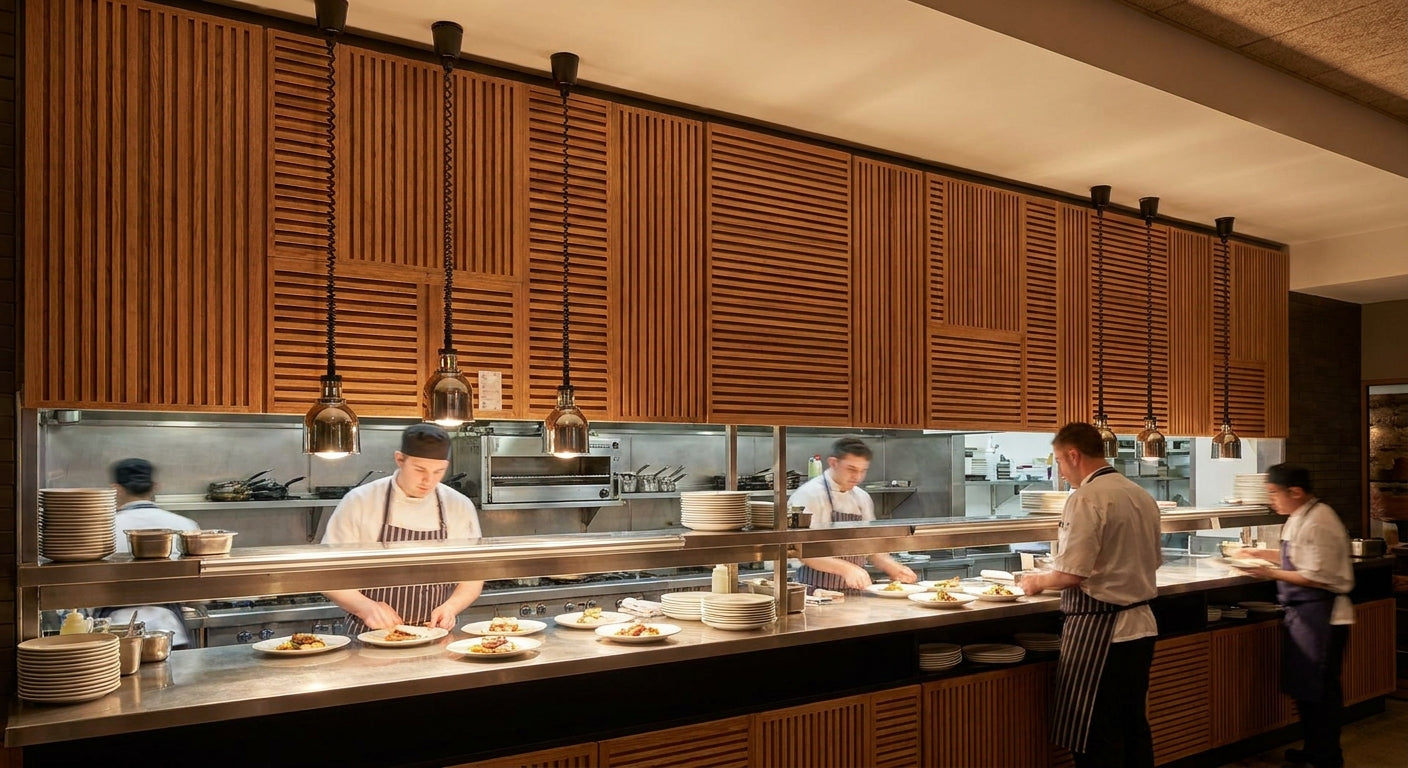
Kitchen pass areas in UK restaurants routinely hit 85-95 dB during dinner service, and a bare block or tiled wall behind the pass throws every ticket shout and pan clang straight back at the chefs and front-of-house staff standing there. This guide covers what actually works for acoustic panels for commercial kitchen pass areas in 2026, and where real wood veneer beats foam and mineral wool on both looks and durability.
TL;DR
Acoustic panels for commercial kitchen pass areas need three things standard acoustic foam skips entirely: a wipeable, heat-tolerant face, felt backing that actually pulls sound out of the air, and a fixing method that survives steam and grease over years of service. Akuwood Panel's Black Oak acoustic wall panel is the Buy for pass walls that need to look sharp under pass lighting and hide grease marks between deep cleans; Smoked Oak is a strong Consider for darker service corridors. Skip raw acoustic foam near any pass wall in 2026 fit-outs - it absorbs grease, degrades under heat, and rarely survives an EHO inspection cycle intact.
Why this matters
A pass wall isn't a living room feature wall. It sits inches from extraction fans, fryers, and a chef expediting orders at volume, and it often faces straight into the dining room in open-kitchen layouts. Noise at the pass doesn't just tire out staff - it forces front-of-house teams to repeat orders, slows ticket times, and bleeds straight into guest tables if the wall between kitchen and dining is thin or untreated.
Standard drywall and tile reflect almost all of that sound energy back into the room. Acoustic wood panels with a felt backing absorb a meaningful share of it instead, cutting the reverberation that makes a busy pass feel louder than it actually is. That's the mechanism worth understanding before you spend money on any panel system in 2026.
Who this is for
This guide is built for head chefs, restaurant owners, and fit-out contractors specifying wall treatment for a working pass area - not a dining room feature wall. If you're dealing with steam, grease aerosol, extraction noise, and a wall that has to survive a nightly deep clean, the criteria below apply directly. If you're panelling a front-of-house dining wall with no kitchen exposure, standard interior acoustic panels from Akuwood Panel will do the job without the extra durability spec.
What to look for in acoustic panels for a commercial kitchen pass
Wipeable, grease-resistant face
A pass wall gets splashed daily. Fabric-wrapped acoustic panels and open-cell foam trap grease and odour in the fibres, and once that happens no amount of wiping brings them back. A sealed wood veneer face wipes clean with a damp cloth and doesn't hold smell the way soft fabric does.
Heat and steam tolerance
Extraction hoods and open flat-tops push warm, moist air across nearby walls for hours at a stretch. Panels rated for standard interior use can warp or delaminate under sustained heat cycling near a pass - check the finish is a proper multi-layer veneer construction, not a printed laminate, before you commit a whole wall.
Real absorption, not just visual texture
Slatted timber looks acoustic, but the acoustic felt backing behind the slats is what actually does the absorbing. A slat panel with no backing layer is decorative, not functional, and won't touch reverberation at the pass.
Fixing method that survives vibration
Extraction fans and constant foot traffic put low-level vibration through a wall day and night. Panels fixed with the wrong adhesive or weak mechanical fixings work loose within months near a working pass - a high-tack panel adhesive built for continuous-contact bonding matters more here than in a bedroom feature wall.
Fire and hygiene compliance for your specific kitchen
Every commercial kitchen has different fire and hygiene sign-off requirements depending on layout and local building control. Confirm compliance with your installer or building control officer before specifying any wall finish near cooking equipment - don't assume a domestic-rated panel clears a commercial kitchen inspection.
Front-of-house appearance
In open-kitchen and pass-visible layouts, the wall behind the chefs is part of the dining room's visual identity. A panel that looks premium from the guest side, not just functional from the kitchen side, earns its place on a wall diners can see into.
Top picks for restaurant kitchen pass areas
Black Oak acoustic wall panel - the moody backdrop pick. Its dark 3-sided real wood veneer finish hides grease film and scuffs far better than a pale finish does between deep cleans, and the acoustic felt backing behind the slats is what's actually cutting reverberation, not the timber alone. Available in both 240 cm and 300 cm formats to match most standard UK ceiling heights. Buy for open-kitchen passes that face the dining room.
Smoked Oak acoustic wall panel - the close second for service corridors with less direct guest sightline. Same felt-backed construction as Black Oak, a slightly warmer tone, and it reads less severe under warm pass lighting. Consider if your pass sits in a back-of-house corridor rather than an open dining-facing kitchen.
Natural Oak acoustic wall panel - the safe pick for bright, high-visibility kitchens where a dark finish would feel heavy. It carries the same acoustic backing and veneer construction, just in a lighter tone that suits pass-and-plating areas lit for photography or pass-side service theatre. Consider for bright, modern fit-outs.
All three use the same 3-sided real wood veneer and felt-backed acoustic construction - the choice between them is tone and how visible the wall is to guests, not performance.
What to avoid
- Raw acoustic foam wedges near the pass. They look technical, but foam absorbs grease aerosol permanently, degrades under sustained heat, and most commercial kitchens fail hygiene checks on foam within a year of installation.
- Fabric-wrapped panels with no wipeable face. Fabric holds odour and grease in a way a sealed veneer face never will, and replacing a soiled fabric panel mid-lease is expensive.
- Thin decorative slat cladding with no felt backing. It photographs well but does almost nothing for reverberation - if the spec sheet doesn't mention an acoustic backing layer, it's a look, not a fix.
Verdict comparison
| Panel | Finish tone | Best for | Verdict |
|---|---|---|---|
| Black Oak acoustic panel | Dark | Open-kitchen, dining-facing pass | Buy |
| Smoked Oak acoustic panel | Warm dark | Back-of-house pass corridors | Consider |
| Natural Oak acoustic panel | Light | Bright, high-visibility kitchens | Consider |
| Raw acoustic foam | N/A | Nowhere near a working pass | Skip |
FAQ
What's the best acoustic panel for a restaurant kitchen pass? A felt-backed real wood veneer panel, such as Black Oak or Smoked Oak, outperforms foam and fabric options because the sealed face wipes clean and tolerates heat from extraction and cooking equipment.
Is wood veneer better than acoustic foam for commercial kitchens? Yes, for any wall exposed to grease, steam, or a nightly clean-down. Foam absorbs grease permanently and degrades under heat; a sealed veneer face wipes down and holds its finish for years.
Do acoustic panels reduce noise levels at a busy pass? They reduce reverberation - the sound bouncing off hard surfaces - rather than the raw volume of a shout or a pan drop. That reverberation cut is what makes a loud pass feel manageable instead of chaotic.
How much does acoustic panelling for a commercial kitchen cost? Costs vary by wall area, finish, and installation method - check current panel pricing directly on the product pages before budgeting a fit-out.
Can acoustic wood panels handle steam and grease exposure? A sealed 3-sided veneer face handles ambient steam and light grease well when wiped regularly; panels shouldn't sit in direct fryer splash zones without additional protection.
What size acoustic panels work best for standard pass wall heights? Akuwood Panel's panels come in 240 cm and 300 cm formats, covering most standard UK commercial kitchen ceiling heights without extra cutting.
Do I need a fire rating check before installing panels near a kitchen? Yes - confirm compliance with your installer or local building control before fitting any wall finish near cooking equipment, since requirements vary by kitchen layout.
Is a felt backing necessary or just decorative? It's functional, not decorative. The felt layer behind the slats is what actually absorbs sound; slatted timber with no backing is closer to cladding than an acoustic treatment.
One last thing
Acoustic panels absorb reflected sound, they don't block noise from travelling through a wall - a distinction a lot of pass area specs get backwards in 2026. If the goal is stopping kitchen noise from reaching the dining room through the wall itself, you need mass and sealing behind the panel, not just a felt-backed veneer facing. If the goal is making the pass itself less punishing to stand at for a ten-hour shift, felt-backed wood panels solve exactly that problem, and they do it while looking like a design choice instead of a retrofit.
Share:
Best Exterior Cladding for Outdoor Dining 2026
Wooden Wall Panels for Members Club Interiors 2026