

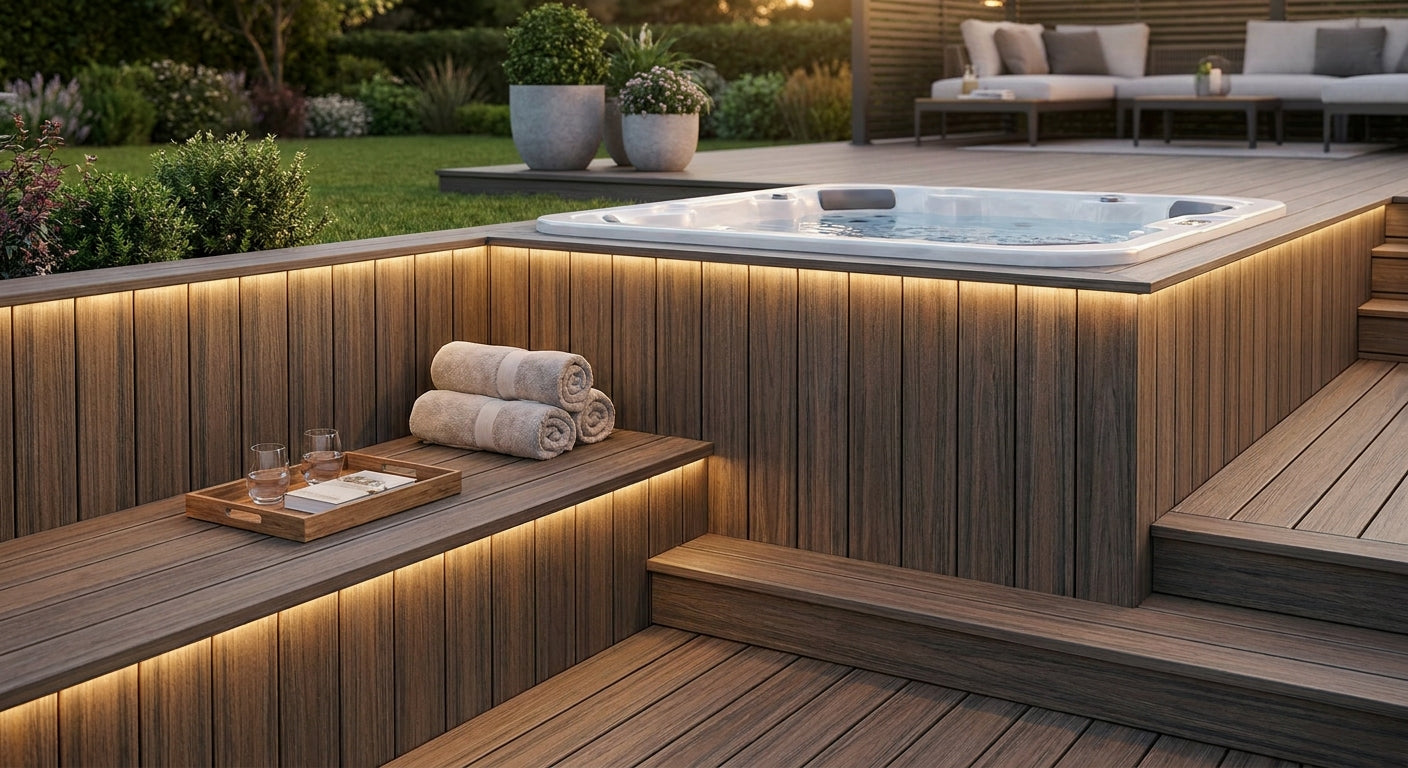
Composite cladding for a hot tub surround needs to survive splashback, steam and constant damp ground contact without cupping, fading or growing algae within two seasons — and not every panel marketed for exterior use is built for that job.
This guide covers what actually holds up around a hot tub in 2026, which AKU Woodpanel exterior cladding finishes suit the job, and which combinations to skip before you order a full run of panels.
TL;DR
The right composite cladding for hot tub surround projects is a wood-plastic composite (WPC) panel that tolerates constant moisture, doesn't need annual staining, and ventilates properly behind the deck skirt. AKU Woodpanel's exterior wall cladding panel in Black finish is the Buy for hot tub surrounds and pump housings — it hides splash marks and copes with shade from the tub canopy. The Oak finish is a Consider if the surround sits in full sun rather than tucked against a fence. Stone Grey is better matched to rendered house facades than to hot tub decking, and standard softwood boarding is a Skip for anything within a metre of standing water in 2026.
Why this matters
A hot tub throws off heat, steam and chlorinated splash every time it's used, and the ground around it stays damp for hours after each session. Timber decking boards in that zone start cupping and greying within a single UK winter. Composite cladding, engineered from recycled wood fibre and polymer, doesn't absorb that moisture the way solid softwood does, which is exactly why more installers now spec it for pool and hot tub surrounds instead of stained timber panels.
Get the ventilation gap and fixing detail wrong, though, and composite cladding traps moisture behind the panel rather than shedding it — which is worse than doing nothing at all.
Who this is for
This is for anyone building or re-skinning a hot tub surround, a decking skirt, or a plant-room enclosure that sits within a metre of standing water — homeowners fitting a new tub in 2026, self-builders finishing a garden deck, and tradespeople quoting hot tub installs who need a cladding spec that won't come back as a callout.
What to look for in composite cladding for hot tub surrounds
Water and splash resistance
Relative humidity around an uncovered hot tub commonly sits above 90% during and after use, so the panel core has to resist swelling, not just surface water. WPC composite construction copes with that; painted MDF or untreated softwood does not.
Ventilation gap behind the panel
A sealed cladding run traps steam and speeds up rot in the batten frame underneath. Leave a 15-20mm ventilation gap between the panel back and the substrate, with weep points at the base so trapped moisture has somewhere to go.
Fixing system and batten spacing
Hot tub surrounds get knocked, leaned on, and occasionally removed for pump access, so the fixing has to be serviceable, not just strong. Battens set at 400mm centres with a hidden screw fix hold composite cladding flat without the panel bowing between fixings.
UV and colour fade resistance
Darker composite finishes fade less visibly than light ones because the colour shift reads as a shade change rather than a patchy bleach-out. If the surround sits in direct summer sun for six hours or more a day, factor that into which finish you pick.
Maintenance and cleaning demands
Chlorine splash and pollen build-up on a horizontal ledge near a hot tub need more frequent rinsing than a plain garden wall. Composite panels wipe down with water and a stiff brush; they don't need re-staining the way softwood cladding does every 12-18 months.
Colour match to decking and fencing
A hot tub surround usually sits against existing decking boards or a fence line, so the cladding finish needs to read as one continuous scheme rather than a mismatched patch. Match the undertone (grey, oak, or black) before ordering, not after the panels arrive.
Top picks
The safe pick — exterior wall cladding panel in Oak Oak-finish composite cladding reads as natural timber from three metres away but doesn't need the annual oil treatment softwood decking does. It suits surrounds that get full sun for most of the day, where a warmer tone hides dust and pollen better than black. Verdict: Buy for sun-facing hot tub decks.
The wildcard — exterior wall cladding panel in Black Black composite cladding disguises splash marks and pump-housing grime far better than any lighter finish, and it pairs well with modern hot tub cabinets that already come in dark composite or resin. It's the pick for shaded surrounds tucked against a fence or under a pergola. Verdict: Buy for shaded or partially covered hot tub zones.
The rendered-house match — Stone Grey exterior wall cladding panel Stone Grey cladding is built to sit alongside pale render and modern brick, which makes it a strong choice for the house wall behind a hot tub but a weaker one for the tub surround itself, where splash marks show up more visibly against light grey. Verdict: Consider for the backdrop wall, not the splash zone.
The budget-adjacent option — Birch exterior wall cladding panel Birch is the lightest of the four cladding finishes and shows water spotting and pollen fastest of the range, which makes it a harder sell for anything within splashing distance of a hot tub. It still has a place on a dry-side fence panel a metre or more back from the water. Verdict: Consider only if it's set back from direct splash.
What to avoid
- Painted MDF or plywood boarding — looks fine in the shop, swells and delaminates within one wet UK winter against a hot tub.
- Sealed, unventilated panel runs — trapping steam behind cladding accelerates rot in the batten frame faster than leaving the wall bare.
- Light finishes in a full-splash zone — pale composite shows chlorine spotting and algae bloom sooner than darker tones, even though the material itself resists water equally well.
Verdict comparison table
| Finish | Best for | Fade resistance | Verdict |
|---|---|---|---|
| Oak | Sun-facing surrounds | Moderate | Buy |
| Black | Shaded or covered surrounds | High | Buy |
| Stone Grey | Rendered backdrop wall | High | Consider |
| Birch | Dry-side fence panels, set back | Lower | Consider |
FAQ
What is the best composite cladding for a hot tub surround? A WPC composite panel in a darker finish, such as Black exterior wall cladding, holds up best around a hot tub because it hides splash marks and resists visible fading better than lighter tones. Fit it with a 15-20mm ventilation gap behind the panel for the best result in 2026.
Is composite cladding actually waterproof? Composite cladding is water-resistant rather than fully waterproof — the wood-plastic composite core doesn't absorb and swell the way solid timber does, but standing water still needs somewhere to drain via a ventilation gap and weep points.
How much ventilation gap does hot tub cladding need? Leave 15-20mm between the back of the panel and the substrate, with clear weep points at the base of the run. Skipping this gap is the single biggest cause of composite cladding failing early around wet areas.
Can you fix exterior wall cladding directly against a hot tub cabinet? No — batten the cladding off the cabinet with the same 15-20mm gap used elsewhere, since direct contact traps steam against both surfaces and shortens the life of the fixing frame.
Does composite cladding fade in direct sun? All composite finishes shift colour slightly under UV exposure over several summers, but darker finishes like Black show it as a tonal shade change rather than visible patchiness. Surrounds in six or more hours of daily sun benefit from Oak or Black over lighter finishes.
How do you clean composite cladding around a hot tub? Rinse with water and a stiff brush every few weeks during the season to clear chlorine splash and pollen build-up before it stains. Composite cladding doesn't need re-staining or re-oiling the way timber decking boards do.
What's the difference between composite cladding and timber decking boards for a hot tub surround? Timber decking boards need annual staining or oiling and swell faster in constant splash zones, while composite cladding holds its shape and colour with a wipe-down clean. For anything within a metre of a hot tub, composite is the lower-maintenance choice in 2026.
How long does composite cladding last around a hot tub? Composite cladding installed with proper ventilation and correct batten spacing outlasts stained softwood boarding in the same wet zone, provided the ventilation gap and weep points are maintained rather than sealed over.
One last thing
Most hot tub cladding failures in 2026 trace back to one detail: someone sealed the ventilation gap to make the surround look tidier, and trapped the steam behind the panel instead of letting it escape. Leave the gap visible, or hide it with a slatted skirt rather than a solid seal, and the cladding will outlast the tub's first pump replacement.
Share:
Wooden Wall Panels for Members Club Interiors 2026
Acoustic Feature Wall Loft: 2026 DIY Fit Guide