

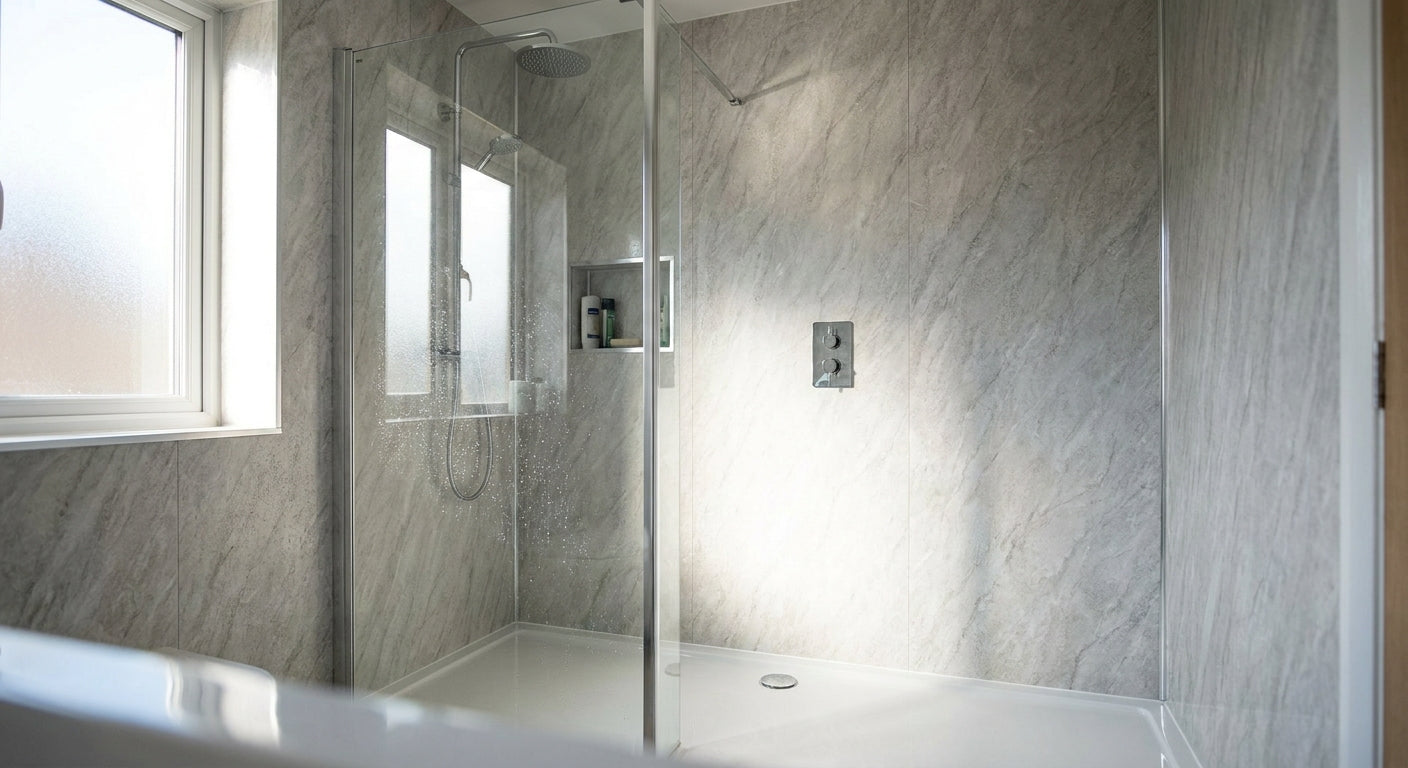
Wet wall panels for shower enclosures need a water-contact rating that ordinary wood veneer simply doesn't carry — this guide covers what actually goes inside the enclosure in 2026, and where AKU Woodpanel's real wood finishes fit once you step outside the wet zone.
- Wet wall panels for shower enclosures need a stated water-contact rating; acrylic is the safe 2026 buy.
- PVC tongue-and-groove wet wall panels cost less but need re-sealed seams every 2-3 years.
- AKU Woodpanel's Natural Oak panel suits the dry wall beside the enclosure, not the wet zone itself.
- Laminate wood-effect wet wall panels fake the grain; genuine veneer belongs outside the spray zone.
- 240cm and 300cm AKU panel formats cover most bathroom wall heights next to a shower enclosure.
Why this matters
Get the material wrong here and you're re-doing the enclosure within 18 months. Standard veneered board swells the moment water sits against a seam, and once the substrate behind it takes on moisture, silicone doesn't fix it. Wet wall panels for shower enclosures exist specifically to solve that problem — a single water-resistant surface with no grout lines for mould to colonise.
The confusion happens outside the enclosure. Homeowners see a bathroom fully panelled in warm oak online and assume the same board runs straight into the shower. It doesn't, and pairing a genuine water-rated wet wall panel inside the enclosure with a best wooden wall panels for bathrooms finish on the dry walls around it is how that look actually gets built in 2026.
Who this is for
This is for anyone re-panelling a bathroom or ensuite who's replacing tiles around the shower tray and also wants to carry a warmer finish onto the walls either side of it. You're comparing acrylic, PVC and laminate wet wall panels for the enclosure itself, and you want an honest answer on whether a wood-look panel belongs anywhere near the water. If it's a full bathroom refit rather than just the shower, the material split matters more than the finish you pick.
What to look for in wet wall panels for shower enclosures
Water-contact rating
A wet wall panel needs a stated water-contact certification before it goes anywhere near the shower tray — this is the single spec that separates a genuine wet wall panel from a merely humidity-friendly wall panel. If a panel doesn't carry a stated water-contact rating, it doesn't belong inside the shower enclosure. Check the datasheet before you check the finish.
Seam and joint sealing
Every seam is a potential leak point, so look at how the range handles joints — tongue-and-groove with a sealant channel, or a single sheet with none at all. Fewer seams inside the enclosure means fewer places for water to find the substrate over the next 10-15 years.
Panel size vs ceiling height
Standard acrylic sheets run close to 2440mm, which covers most UK ceiling heights in one piece without a horizontal joint. A horizontal seam at chest height is the most common failure point in a shower re-panel, so measure floor-to-ceiling before you order.
Core material behind the surface
The decorative face is not the waterproofing — the core is. Foam-core and ply-core panels behave very differently once water gets past a chipped edge, and that's the detail suppliers gloss over in the showroom.
Finish and cleaning
A gloss or semi-gloss finish sheds soap scum and limescale faster than a matte laminate, which matters in an enclosure used daily. Matte finishes look closer to real wood grain but hold water spots longer.
“If a panel doesn't carry a stated water-contact rating, it doesn't belong inside the shower enclosure.”
Top picks for wet wall panels and the walls around them
The safe pick. Acrylic wet wall panels run as a single seamless sheet up to roughly 2440mm x 1220mm, with a factory gloss finish rated for direct water contact. Typical UK installed cost sits around £150-£300 per sheet in 2026, more than tile but with none of the grout upkeep. Buy — it's the benchmark everything else in the enclosure gets measured against.
The budget pick. PVC tongue-and-groove wet wall panels click together board by board, typically starting around £15-£25 per board, well under acrylic sheet pricing. The trade-off is more seams, and every seam needs silicone re-applied every 2-3 years to stay watertight. Consider — fine for a rental or a quick refresh, less so for a forever bathroom.
The imitation-wood pick. Laminate wet wall panels print a wood grain onto a water-rated core, chasing the look of oak without the veneer. Up close the repeat pattern is visible within about 60cm, and the surface feels noticeably different from actual timber. Skip if the wood look is the whole point of the room — it reads as fake next to a genuine finish.
The finishing touch outside the enclosure. The Natural Oak wall panel carries AKU Woodpanel's 3-sided real wood veneer over an acoustic felt backing, sold in 240cm and 300cm formats to match most bathroom wall heights. It is not rated for direct water contact and does not belong inside the enclosure — it belongs on the dry wall beside it, warming up a room that's otherwise all acrylic and tile. Buy for that wall, not the wet one.
The feature-wall wildcard. AKU Woodpanel's hexagon acoustic panel in Natural Oak breaks up a flat run of wet wall panel with a geometric pattern on the opposite wall, and the felt backing takes some of the echo out of a room that's otherwise all hard, reflective surfaces. It's a statement piece, not everyday utility panelling. Buy if the bathroom needs a focal point beyond the shower enclosure itself; Skip if the room's already busy.


What to avoid
Any veneered or MDF-core panel marketed loosely as "waterproof" without a stated rating. Humidity-resistant and water-contact-rated are not the same claim, and the gap between them is exactly where enclosures fail.
Wet wall panels with exposed, untreated cut edges at the shower tray. That's the single most common leak point in a re-panel — the factory edge is sealed, the site-cut edge often isn't unless you treat it separately.
Wood veneer panels installed inside the spray zone, however good they look in photos. AKU Woodpanel's ranges, including the Natural Oak and hexagon finishes above, are built for the dry side of the room. Real wood veneer and standing water don't mix, in 2026 or any other year — for the humid-but-dry areas nearby, the guide on fitting wall panels in a high-humidity bathroom covers what does and doesn't need extra sealing.
Verdict comparison
| Panel type | Water-contact rating | Typical cost (2026) | Best zone | Verdict |
|---|---|---|---|---|
| Acrylic sheet | Direct-contact rated | £150-£300/sheet | Inside enclosure | Buy |
| PVC tongue-and-groove | Direct-contact rated, seams need silicone | £15-£25/board | Inside enclosure, budget | Consider |
| Laminate wood-effect | Direct-contact rated | £20-£40/board | Inside enclosure, budget wood look | Skip if grain matters |
| AKU Woodpanel Natural Oak (3-sided veneer) | Not water-contact rated | 240cm/300cm formats | Dry wall beside enclosure | Buy for dry zone only |
FAQ
What are wet wall panels?
Wet wall panels are single-sheet or interlocking boards rated for direct water contact, designed to replace tiled surfaces inside a shower enclosure or bath surround. They come mainly in acrylic, PVC and laminate, each with a different balance of cost and seam count. None of them are wood veneer, which isn't rated for standing water.
How much do wet wall panels cost for a shower enclosure in 2026?
Acrylic wet wall panels typically run £150-£300 per sheet installed in 2026, while PVC tongue-and-groove boards start around £15-£25 per board. Laminate wood-effect panels usually sit in between, closer to £20-£40 per board.
Can you use wood wall panels inside a shower enclosure?
No — genuine wood veneer wall panels, including AKU Woodpanel's ranges, are not rated for direct water contact and shouldn't go inside the spray zone. They work on the dry wall beside the enclosure, not the wet one.
Is acrylic or PVC better for a wet wall panel?
Acrylic wins on fewer seams and a longer service life, since most sheets run as a single piece up to roughly 2440mm. PVC tongue-and-groove costs less upfront but needs the seams re-sealed every 2-3 years.
Do wet wall panels need tanking behind them?
Yes, in most UK installs a tanking membrane or waterproof backer board goes behind the wet wall panel, not instead of it. The panel is the finish layer; the membrane is the actual waterproofing.
How long do wet wall panels last?
A correctly installed acrylic wet wall panel typically lasts 15-20 years before the finish dulls enough to consider replacement. PVC panels with resealed seams last a similar span, provided the silicone gets refreshed on schedule.
What size wet wall panels fit a standard UK shower enclosure?
Most standard enclosures take a single sheet around 2440mm x 1220mm, covering floor to ceiling in most UK homes without a horizontal joint. Taller rooms need a made-to-measure sheet or a panel range with a matching extension piece.
Can AKU Woodpanel's wood panels go in a bathroom?
Yes, on the dry walls — AKU Woodpanel's Natural Oak and hexagon acoustic panels are sold for bathroom feature walls outside the direct splash zone, in 240cm and 300cm formats. They're not a substitute for the wet wall panel inside the enclosure itself.
One last thing
The detail most re-panel jobs miss isn't the shower wall at all — it's the corner where the wet wall panel meets the dry wall next to it. That joint needs a proper trim, not just a bead of silicone, or you'll get the exact leak point you were trying to avoid by moving away from tile in the first place. If the dry-zone wall is getting a wood veneer finish in 2026, order that trim before the wet wall panel goes in, not after.
Share:
Shower Wall Boards for Wet Rooms: What to Buy in 2026
PVC Wall Panels for Bathrooms in 2026: Buy or Skip?