

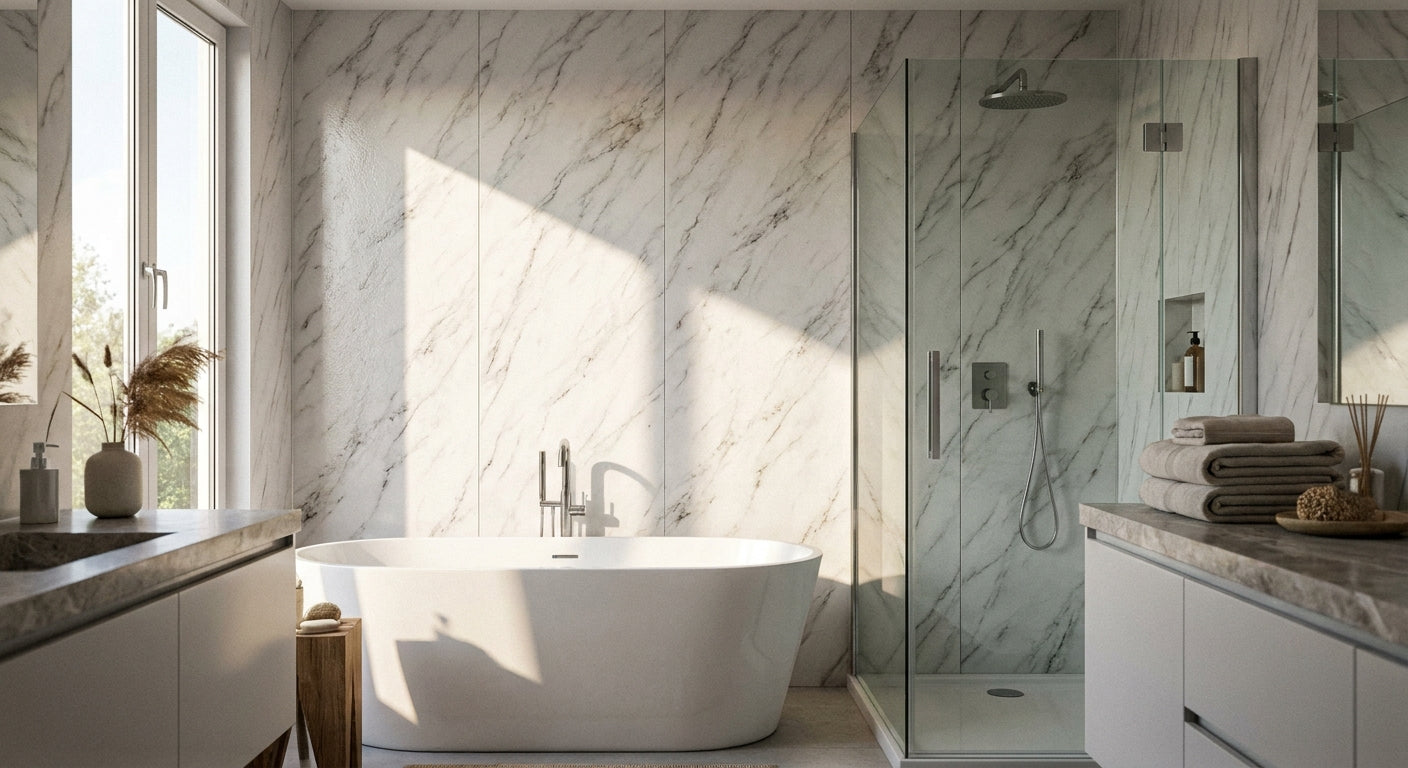
PVC wall panels handle the wet zone in a bathroom renovation - the shower recess, the bath surround, the splashback behind a basin. Akuwood Panel wood veneer panels handle everywhere else in the room, and getting that split right is what separates a bathroom that lasts from one that needs stripping back in three years.
- PVC wall panels for bathrooms belong in the wet zone only - buy panels 8mm thick or more with sealed seams.
- Akuwood Panel's Natural Oak wood veneer panel is the pick for the dry-zone feature wall, not the shower.
- Snowdrop Smoked Brown decorative panel at £48.95 works as a vanity accent - skip it near direct spray.
- Seam sealant failure causes most 2026 bathroom PVC panel complaints, not the panel material itself.
- Mixing PVC in the wet zone with a wood veneer feature wall is standard practice for 2026 UK renovations.
Why this matters
Most searches for pvc wall panels for bathrooms assume one material covers the whole room. It doesn't, and treating a dry-side feature wall the same as a shower enclosure is the single biggest reason panels fail early in a UK bathroom.
PVC handles constant water contact because it's a closed, non-porous plastic sheet with sealed joints. Wood veneer panels, including the ones Akuwood Panel builds with an acoustic felt backing, are built for rooms with humidity swings, not standing water - the felt behind the veneer needs to stay dry to hold its shape and its sound-absorbing properties.
That distinction decides where each material goes in a 2026 bathroom refit, not personal taste. Get the zoning wrong and the most expensive panel in the room is the one you'll be pulling off the wall first.
Who this is for
This guide is for anyone planning a full or partial bathroom renovation in 2026 who needs waterproof panelling around the shower or bath and also wants a proper design decision for the rest of the room - the vanity wall, the space behind a freestanding tub, the wall you actually look at from the toilet.
It's written for homeowners doing the work themselves over a weekend and for small contractors specifying materials for a client, not for developers ordering pallets of one finish for an entire block. If the brief is "waterproof where it needs to be, decent where it doesn't," this is the split to work from.
What to look for in PVC wall panels for bathroom renovations
Panel thickness and rigidity
Thin panels flex when you lean on them mid-shower, and that flex works the seams loose over months rather than years. Panels built for wet rooms typically run 8mm or thicker; stiffness is what keeps a seam sealed under repeated temperature and humidity swings, not the surface finish.
Waterproof rating and seam sealing
A panel is only as waterproof as its joints. Look for a genuine tongue-and-groove or click-fit seam plus a manufacturer-specified sealant, not a panel that relies on a bead of silicone to bridge the gap between sheets - silicone alone shrinks and cracks faster than a proper mechanical joint.
Finish - gloss, matte, or wood-effect print
Gloss shows water spots and needs wiping down more often; matte hides marks but scratches faster. Wood-effect print finishes have improved by 2026, but they're still a print on plastic, not a veneer - worth knowing before a buyer expects the grain to run through a cut edge the way it does on a real timber panel.
Fixing method - adhesive vs batten and trim
Panels glued straight onto a painted or old-tiled wall need a compatible primer or they lift within a year in a steamy bathroom. Batten-and-trim systems cost more upfront but let you run cables or fix a future leak without demolishing the wall behind the panel.
Fire and building regs compliance
Rental properties and HMOs in the UK have specific requirements for wall surfaces in bathrooms. Check the fire rating on the spec sheet before ordering for a let property - not every decorative panel sold for a domestic bathroom clears the bar for a shared building.
Cleaning and long-term maintenance
Every panel in a bathroom picks up limescale and soap residue, so check what the manufacturer recommends for cleaning before you commit to a finish. A panel that needs an abrasive cleaner to stay presentable will scratch and dull faster than one rated for a soft cloth and standard bathroom spray.
Top picks: what actually goes where in the room
The wet zone workhorse - PVC shower panel, 8mm or thicker. The safe pick for full water contact. Look for a panel at least 8mm thick with a factory-sealed tongue-and-groove joint; anything thinner is built for a kitchen splashback, not a shower enclosure that gets sprayed daily. Buy for the enclosure walls, never for anywhere else in the room.
The splashback shortcut - PVC panel behind a basin or bath. A single sheet cut to size behind a basin does the job of six rows of tiling in an afternoon. It's the fast fix when the rest of the bathroom is staying tiled and only one wall needs protecting. Consider it for a quick basin refresh, skip it as the only finish in a full renovation.
The dry-zone feature wall - Natural Oak wood veneer panel. This is where wood earns its place in the room. The Natural Oak wood veneer panel comes in the 240cm and 300cm formats Akuwood Panel runs across its range, and it reads as a genuine upgrade against a wall of white tile. Buy for the wall facing the bath, not the wall inside it.
The vanity showpiece - Snowdrop Smoked Brown decorative panel. At £48.95 for a handcrafted 60x60cm panel, the Snowdrop Smoked Brown decorative wall panel works as a single accent piece behind a vanity mirror rather than full wall coverage. Buy as a small-footprint statement, not a wet-zone material.
The dark contrast - Smoked Oak veneer. Smoked Oak reads darker and moodier than Natural Oak and suits a bathroom with black fittings or a matte black tap set. It sits in the same dry-zone category as Natural Oak and works well as a half-height panel above a wainscot line. Consider it if the rest of the room already leans dark.


What to avoid
- Full wood veneer panelling inside a shower enclosure or on a wall that takes direct spray. The acoustic felt backing behind any veneer panel, Akuwood Panel's included, isn't built for standing water and will delaminate faster than the timeline any warranty covers.
- PVC panels under 5mm sold generically as "bathroom panels" online. Check the spec sheet before ordering - a lot of stock photographed in a bathroom setting is actually rated for kitchen splashbacks only, and it flexes and gaps at the seams within a year of shower use.
- Gluing any panel straight onto old tile without a bonding primer. The panel looks fitted for the first few months, then a corner lifts the first time the extractor fan fails to clear steam fast enough. For a longer breakdown of where panels do and don't survive constant humidity, see Akuwood Panel's guide on fixing wall panels in a high-humidity bathroom.
“PVC covers the spray zone; wood veneer covers the walls it never touches.”
Verdict comparison table
| Zone in the room | Material | Spec that matters | Verdict |
|---|---|---|---|
| Shower enclosure | PVC panel | 8mm+, sealed seams | Buy (PVC only) |
| Basin/bath splashback | PVC panel | 5-8mm | Consider |
| Feature wall facing the bath | Natural Oak wood veneer | 240cm/300cm format | Buy |
| Vanity accent | Decorative 3D panel | 60x60cm | Buy |
| Full wet-zone coverage | Wood veneer | n/a | Skip |
FAQ
What's the best PVC wall panel for a bathroom in 2026?
The best PVC wall panel for a bathroom in 2026 is at least 8mm thick with a factory-sealed tongue-and-groove joint, built for wet rooms rather than kitchen splashbacks. Thinner panels flex under pressure and the seams work loose within a year of daily shower use.
Is PVC or wood better for a bathroom wall?
PVC is better for any wall that takes direct water contact, such as a shower enclosure or bath surround, because it's a closed, non-porous sheet. Wood veneer panels work well on the dry side of the room - a vanity wall or the wall facing the bath - but not inside the spray zone.
How much do PVC wall panels cost for a bathroom?
Cost varies by thickness, finish, and supplier, so check current pricing directly before budgeting a full room. Thicker, sealed-seam panels built for wet rooms cost more than thin laminate sold for kitchens, and that difference is usually worth paying for durability.
Can wood wall panels go in a bathroom?
Wood wall panels can go in a bathroom on walls that stay dry, such as behind a vanity or opposite the shower door, but not inside the enclosure itself. Akuwood Panel's veneer panels use a felt backing that needs to stay dry to hold its shape.
Do PVC panels need tanking behind them?
Yes, in a shower enclosure PVC panels still need a waterproofed or tanked substrate behind them, because the panel covers the wall but doesn't replace the membrane that stops water reaching the structure. Skipping tanking behind PVC is one of the most common failure points in UK bathroom renovations.
How thick should PVC bathroom panels be?
PVC bathroom panels for a shower or bath surround should run at least 8mm thick with a sealed seam system. Panels under 5mm are usually made for kitchen splashbacks and flex enough in a wet room to loosen joints within months.
Can I mix PVC and wood panels in one bathroom?
Yes, mixing PVC in the wet zone with a wood veneer feature wall on the dry side is standard practice for 2026 bathroom renovations. The split works because each material does the job it's actually built for, rather than one material covering a room with two very different moisture conditions.
How long do PVC wall panels last in a bathroom?
A properly sealed PVC panel with reseated seams every 12 to 18 months lasts well beyond a decade in a bathroom. Most failures that happen sooner trace back to sealant breakdown at the joints, not the panel material itself.
One last thing
Most PVC panel complaints logged against 2026 UK bathroom renovations trace back to the seam sealant failing, not the panel itself - a full reseal every 12 to 18 months outlasts most warranty disputes about the plastic. On the dry side of the room, the wall directly opposite the shower door rarely gets splashed even in a small bathroom, which is exactly why it's the wall most renovators pick for Akuwood Panel's Natural Oak or Smoked Oak veneer rather than more tiling.
Share:
Wet Wall Panels for Shower Enclosures: 2026 Verdict
Larch Cladding for Garden Rooms: Buy or Skip in 2026