

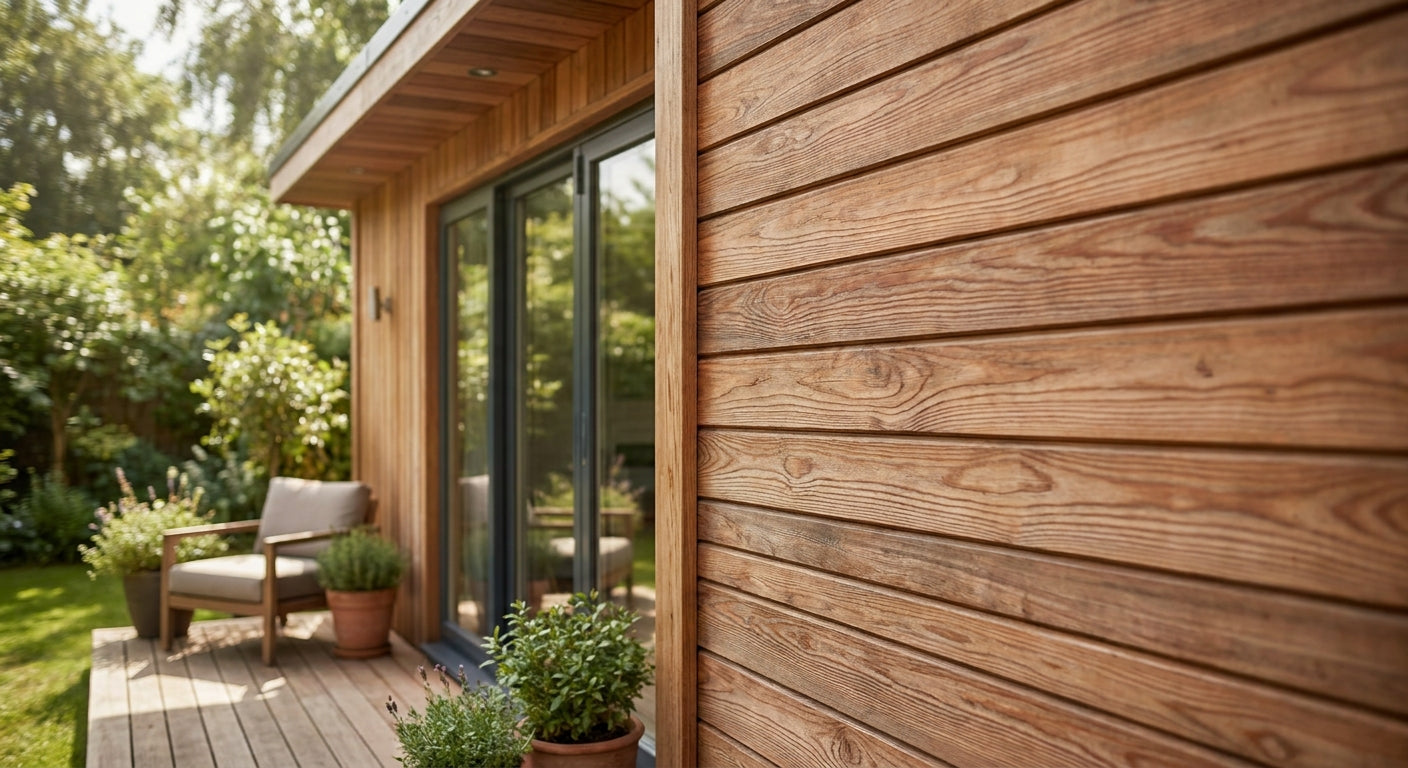
Real larch cladding is the material most UK garden room builders picture when they think "natural timber exterior" — but it's not the only option, and it's not always the right one once you factor in maintenance. This guide breaks down what larch cladding actually costs you in upkeep, where composite alternatives beat it, and which pick suits your garden room in 2026.
- European larch cladding silvers to grey within 6-12 months and needs re-oiling every 2-3 years if you want to keep the honey tone — Buy if you want real timber patina.
- Thermally modified larch resists rot better but costs more per board — Consider it for exposed north or west-facing walls.
- Akuwood Panel's 290cm oak and black composite exterior cladding panels carry a 25-year maintenance-free claim from the manufacturer — Buy for a set-and-forget garden room exterior.
- Feather-edge fencing-grade larch repurposed as cladding is not rated for vertical wall use on a garden room — Skip it.
Why this matters
A garden room has no eaves overhang and no neighbouring wall to shelter it — every face takes full weather, all year. That's a harsher exposure than most house walls get, which is exactly why cladding choice on a garden room matters more than it does on a main dwelling.
Get the material wrong and you're not just fixing a cosmetic problem. Water tracking behind an unventilated board rots the OSB sheathing underneath, and by the time you notice, you're stripping cladding off a structural skin, not just repainting a fence panel.
Who this is for
This is for anyone specifying or buying exterior cladding for a UK garden room, home office pod, or outbuilding in 2026 — whether you're self-building from a kit or replacing tired cladding on an existing structure. If you're deciding between real larch cladding and a composite alternative like the panels sold by Akuwood Panel, the criteria below apply whichever way you lean.
What to look for in larch cladding for garden rooms
Board profile and fixing pattern
Shiplap and open-joint (rainscreen) profiles shed water differently, and a garden room's flat, unsheltered walls need whichever profile matches your ventilation gap. Waney-edge or feather-edge boards look rustic but were designed for fences, not vertical wall cladding that has to stay watertight.
Moisture content and grading
Cladding-grade larch is kiln-dried to roughly 16-18% moisture content before installation; construction-grade timber sold at a higher moisture content will cup and twist as it dries in situ. Ask for the grading certificate before you buy — a supplier who can't produce one is selling you fencing timber at cladding prices.
Weathering behaviour
Untreated larch silvers within 6-12 months of installation as UV breaks down the surface lignin. If you want to keep the honey-brown colour, you're committing to re-oiling every 2-3 years for the life of the building — factor that into your total cost, not just the purchase price.
Ventilation and batten spacing
Larch needs a ventilated batten cavity behind it, typically 25mm, so moisture that gets past the board can dry out instead of sitting against the sheathing. Skip this on a garden room and you're building in a rot problem that won't show until the cladding is already failing.
Maintenance schedule and lifespan
Well-detailed European larch, left to silver naturally with no coating, can last 40+ years with almost no intervention beyond checking fixings. The moment you introduce a stain or oil finish, you've created a maintenance schedule you have to keep up with indefinitely.
Cost per board vs total cost of ownership
Larch typically costs less per board than a finished composite panel up front, but re-oiling labour and product over a couple of decades closes that gap fast. Composite cladding, like Akuwood Panel's 290cm exterior panels, carries a higher unit price but a manufacturer-stated 25-year maintenance-free window that changes the total cost of ownership entirely.
Top picks for garden room cladding
European larch, left unfinished — the traditional choice. Standard board thickness runs 20-22mm in a shiplap profile, and it silvers to a uniform grey within a year with zero maintenance if you accept the colour change. Buy this if you want a genuinely natural finish and you're not chasing the original honey tone.
Thermally modified larch — the premium upgrade. Heat treatment (typically in the 180-212°C range) reduces the timber's moisture uptake and improves rot resistance over untreated stock, at a higher price per board. Consider this for a north- or west-facing wall that stays wet longer after rain.
Akuwood Panel exterior cladding, Oak finish — the maintenance-free swap. The oak exterior cladding panel runs 290cm per length in a 3D wood-grain composite finish, and the manufacturer states over 25 years of maintenance-free use with UV and weather resistance built in. Buy if you want the timber look on a garden room without a re-oiling calendar.
Akuwood Panel exterior cladding, Black finish — the modern contrast pick. Same 290cm format and 25-year maintenance-free claim as the oak option, but in a dark black exterior cladding panel finish that reads as contemporary rather than rustic. Buy for a garden room you want to look sharp on day one and day 3,650.
Feather-edge larch fencing board repurposed as wall cladding — the budget trap. It's cheap because it's fencing timber, not cladding, and the overlapping edges aren't detailed to stay watertight on a vertical wall face the way a proper shiplap profile is. Skip it on any structure you don't want to reclad in three years.


What to avoid
- Kiln-dried construction timber sold as "larch cladding." If the supplier can't confirm the moisture content and grading, it wasn't milled for exterior wall use — it'll cup within a season.
- Staining larch before it's fully seasoned. Trapping colour into timber that's still drying locks moisture behind the coating instead of letting it dry through the board face.
- Skipping the ventilated batten system to save on depth. A garden room's OSB sheathing has nowhere to dry out if the cladding sits flush against it — that's the fastest route to a rot claim.
“If the board profile isn't rated for vertical fixing, water finds the horizontal joint every time.”
Verdict comparison
| Material | Maintenance | Design life | Fixing needs | Verdict |
|---|---|---|---|---|
| European larch, unfinished | None once silvered | 40+ years | Ventilated battens, shiplap profile | Buy |
| Thermally modified larch | Low, occasional inspection | 30-40 years | Ventilated battens | Consider |
| Feather-edge larch (fencing grade) | High, frequent repair | Under 10 years on a wall | Not rated for vertical cladding | Skip |
| Akuwood Panel composite, oak/black finish | Manufacturer states 25 years maintenance-free | 25 years+ | Standard batten fixing, 290cm lengths | Buy |
If you want to see how a composite panel behaves on an actual garden building before you commit to a full elevation, the guide on choosing composite cladding for a UK garden building walks through fixing patterns and coverage calculations.
FAQ
What's the best cladding for a garden room in 2026?
For a low-maintenance exterior, a composite panel with a 25-year maintenance-free claim beats real timber on total cost of ownership. If you want a natural material and don't mind the grey weathering, unfinished European larch is the standard choice and lasts 40+ years with minimal upkeep.
Is larch cladding better than composite cladding for garden rooms?
Larch wins on natural appearance and repairability; composite wins on maintenance, because it doesn't need re-oiling or staining. The right choice depends on whether you're prepared to re-oil every 2-3 years to keep larch's original colour.
Does larch cladding need to be treated?
No, larch cladding does not need treatment to survive outdoors — untreated boards silver naturally and can last 40+ years. Treatment is only needed if you want to preserve the original honey-brown colour rather than let it weather to grey.
How long does larch cladding last untreated?
Untreated, well-detailed European larch cladding on a properly ventilated wall typically lasts 40 years or more. Lifespan drops sharply if the batten ventilation gap is missed or fencing-grade boards are used instead of cladding-grade stock.
Can you use larch cladding vertically on a garden room?
Yes, larch cladding works vertically as long as the board profile and fixing pattern are designed for a vertical wall, not a horizontal fence application. Vertical runs need a horizontal batten counter-lath underneath to maintain the ventilation gap.
What's the difference between larch and Siberian larch?
Siberian larch grows slower in a colder climate, which produces a denser, tighter grain than European larch grown in milder conditions. Both are used for cladding, but Siberian larch is often marketed as the higher-durability option.
Is composite cladding cheaper than larch long term?
Composite cladding usually costs more per panel upfront but removes the recurring cost of re-oiling that real larch requires if you want to keep its colour. Over a 20-25 year horizon, a composite panel with a stated maintenance-free lifespan can work out cheaper once labour and coating products are counted.
How much does exterior cladding cost per panel in 2026?
Akuwood Panel's 290cm composite exterior cladding panels are priced at £41.95 each as of 2026, covering a fixed run length regardless of finish. Real larch pricing varies by grade and supplier, so get a quote against your exact coverage area before comparing.
One last thing
Most of the "grey weathered larch" look homeowners chase with a stain is the exact finish untreated larch reaches on its own within a year — the stain is solving a problem that doesn't exist. The boards that actually fail early are almost always the ones someone painted or dark-stained too soon, trapping moisture behind a film that unfinished larch was never going to have in the first place.
Share:
PVC Wall Panels for Bathrooms in 2026: Buy or Skip?
Board and Batten Cladding for House Exteriors (2026)