

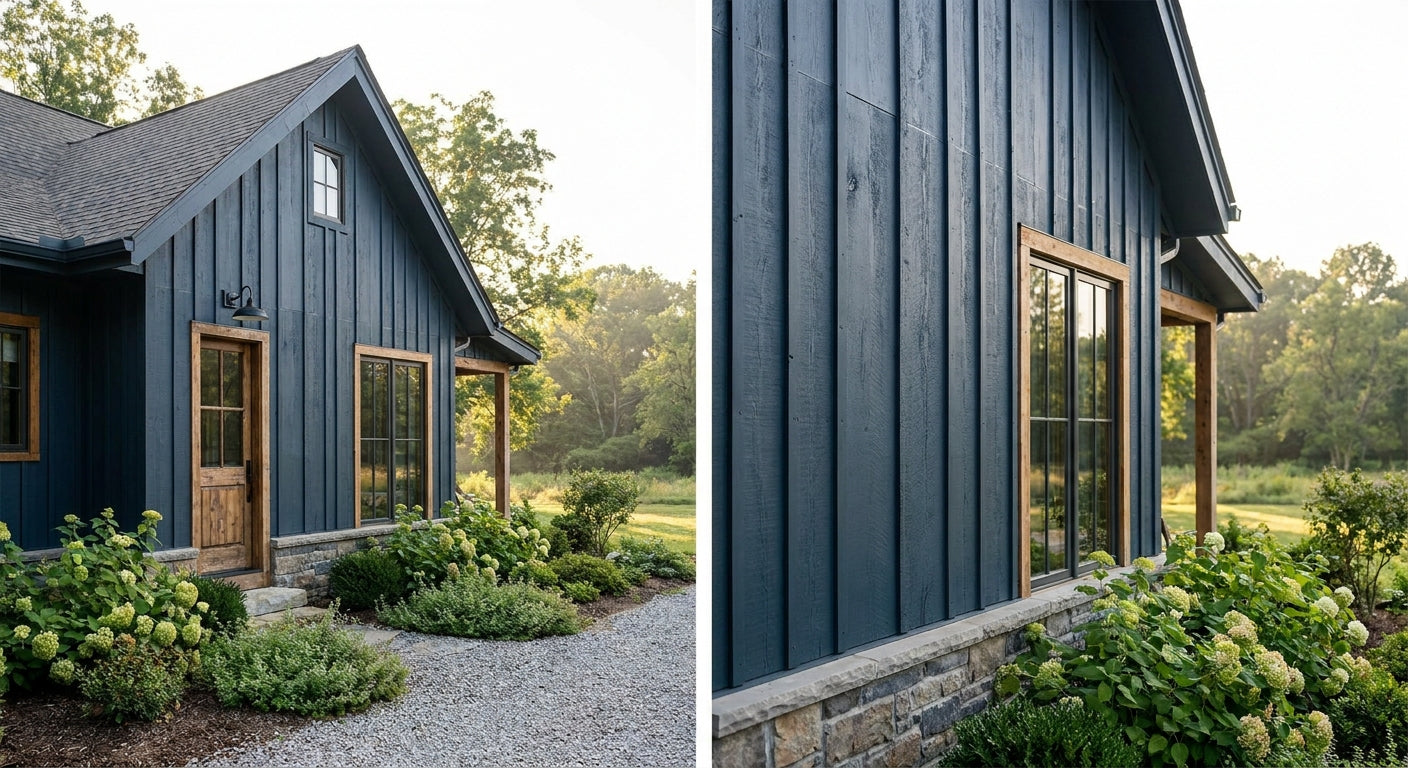
Board and batten cladding turns a flat house front into one with real shadow lines and texture, but in 2026 the choice isn't just timber anymore — uPVC, fibre cement and pre-finished composite panels all compete for the same job, and picking wrong means recoating a wall every three years.
- Board and batten cladding in 2026 splits into timber, uPVC, fibre cement and composite panels — AKU Woodpanel's exterior range wins on maintenance.
- Real timber board and batten needs recoating every 3 to 5 years; AKU Woodpanel's composite panels are rated for 25+ years maintenance-free.
- AKU Woodpanel's 290cm exterior cladding panels cost £41.95 each in oak, black or stone grey finishes.
- Skip cheap uPVC batten cladding on street-facing elevations — it reads as plastic within a few metres.
Why this matters
Board and batten used to mean one thing: vertical timber boards with a batten covering each seam, nailed to a timber frame. That's still available in 2026, but it's now one option among several, and the material you pick decides whether you're painting a ladder every other spring or ignoring the wall for two decades.
Most homeowners researching outdoor wall cladding for UK homes are trying to solve one of two problems: a tired render facade that needs a facelift, or a new extension that needs an exterior finish before render cracks in year one. Board and batten solves both, but only if the material matches the exposure the wall actually gets.
Who this is for
This guide is for UK homeowners and self-builders choosing exterior cladding for a house front, extension, or garden room in 2026 — people comparing real timber against composite panels because they've priced out repainting a full elevation and don't like the number. If you're cladding a shed or fence, the calculus is different and the budget options make more sense.
What to look for in board and batten cladding for house exteriors
Weather resistance and UV stability
A south or west-facing elevation in the UK takes direct sun and driving rain in the same afternoon. Untreated timber greys within a year; UV-stable finishes and factory-applied coatings hold colour for far longer, which matters most on the wall visible from the street.
Board width and batten spacing
Wider boards with narrow battens read as bold and modern; narrower boards with wide battens look more traditional and cottage-like. Get this wrong on a new-build estate house and the cladding fights the roofline instead of complementing it.
Fixing method: framed, cavity or direct-to-render
Timber board and batten typically needs a treated timber frame or counter-battens for ventilation behind the boards — skip this and you trap moisture against the wall. Panel systems fix differently, often screwing straight to battens with concealed or exposed fixings, which changes your install timeline.
Maintenance commitment
This is the criterion most people underweight before buying. Real timber board and batten needs oiling, staining or repainting every 3 to 5 years depending on exposure; factor that cost in now, not after the first repaint.
Fire rating and building regs
Height, proximity to boundaries and building type all affect what cladding material building control will accept, especially on terraces and multi-storey extensions. Check with your local building control officer before ordering material, not after it arrives.
Top picks for board and batten cladding in 2026
1. Traditional timber board and batten — the classic pick
Sawn softwood or cedar boards with cover battens, usually 150mm boards and 25mm battens, built on a treated timber frame. It's the most authentic look and ages naturally if you're happy with silvering over time. Consider it if you want genuine timber grain and don't mind recoating every 3 to 5 years — skip it if low maintenance is the priority.
2. uPVC board and batten — the budget pick
Extruded plastic profiles moulded to mimic the board-and-batten shadow line, sold by the metre through most builders' merchants. It needs almost zero upkeep and costs the least upfront, but close up it reads as plastic rather than timber, especially in matte black or grey finishes. Consider for outbuildings and rear elevations — skip for a street-facing house front in 2026 if kerb appeal matters.
3. Fibre cement board and batten — the fire-rated pick
Cement-based boards finished to mimic timber grain, commonly specified on multi-unit developments and party-wall situations where fire rating is non-negotiable. It's heavier to install and usually needs a professional fitter, but it won't rot and holds paint well. Consider for terraces and developments where building control flags fire performance — skip for a simple DIY weekend job.
4. Composite wood-grain exterior panels — the low-maintenance pick
This is where AKU Woodpanel's exterior cladding range sits: 290cm panels finished in a 3D wood-grain texture across oak, black, birch and stone grey, priced at £41.95 per panel, rated for over 25 years of maintenance-free use with UV and weather resistance built into the finish rather than applied afterward. The look reads as board-and-batten from the pavement without a repaint schedule attached to it. Start with the oak exterior cladding panel for a warm timber tone, the black exterior cladding panel for a modern new-build front, or the stone grey exterior cladding panel if you're matching a rendered facade. Buy if you want the board-and-batten look for a self-build or extension without a maintenance schedule attached to it.


What to avoid
- Untreated timber on a north-facing gable wall without ventilation battens behind it — it looks fine for one winter, then damp gets trapped and boards cup within two years.
- Mixing batten spacing across one elevation to save material — it looks deliberate in a render, but on cladding it just looks like you ran out of boards.
- Cheap uPVC in a gloss finish for a period property — the shadow-gap profile is close enough to fool nobody standing at the front gate in 2026.
“If you're recoating timber battens every three years, cheap material up front isn't actually saving you money.”
Verdict comparison
| Material | Maintenance | Typical use | 2026 verdict |
|---|---|---|---|
| Timber board and batten | Recoat every 3-5 years | Authentic period look | Consider |
| uPVC board and batten | Near zero | Sheds, rear elevations | Skip for house fronts |
| Fibre cement board and batten | Low, occasional repaint | Terraces, fire-rated builds | Consider |
| AKU Woodpanel composite exterior panels | 25+ years maintenance-free | Self-builds, extensions, render facades | Buy |
FAQ
What is board and batten cladding?
Board and batten cladding is vertical exterior boarding where a narrower strip, the batten, covers each seam between wider boards. It creates a repeating shadow line down the wall and traditionally uses timber, though uPVC, fibre cement and composite panels now replicate the same look.
Is board and batten cladding still popular for UK houses in 2026?
Yes, it's one of the most requested exterior finishes for extensions and self-builds in 2026, largely because it breaks up render-heavy new-build estates. Composite wood-grain panel versions have grown the fastest because they skip the recoating cycle real timber needs.
Can you fit board and batten cladding over existing render?
Yes, as long as battens are fixed through the render into sound masonry behind it and a ventilation gap is left for moisture to escape. A cracked or hollow-sounding render surface needs repair first, not cladding over the top.
Does board and batten cladding need planning permission in the UK?
Most houses can change exterior cladding under permitted development rights, but listed buildings, conservation areas and some new-build estates with design covenants are exceptions. Check with the local planning authority before ordering material.
What's the difference between board and batten and shiplap cladding?
Board and batten uses a narrow strip over each seam for a vertical, ribbed shadow line, while shiplap boards overlap horizontally with a rebated edge. Board and batten reads taller on a wall; shiplap reads more traditional and weatherboard-style.
How long does composite wood-grain cladding last compared to timber?
AKU Woodpanel's exterior composite panels are rated for over 25 years of maintenance-free use, against a 3 to 5 year recoat cycle for untreated timber. The gap widens further once you factor in scaffold or ladder costs for repainting a full elevation.
Is board and batten cladding suitable for wet UK weather?
Yes, provided the material and fixing method match the exposure — timber needs a ventilated cavity behind it, and composite panels need correctly fitted trims at joints and corners. Poor detailing at the base of the wall causes more damp problems than the cladding material itself.
How much does board and batten cladding cost per panel?
AKU Woodpanel's 290cm composite exterior panels cost £41.95 each in oak, black, birch or stone grey finishes as of 2026. Timber and fibre cement pricing varies by supplier and board width, so get a like-for-like quote before comparing.
One last thing
The detail most people skip: corner and finishing trims. A wall full of board and batten panels looks unfinished at the edges without them, and retrofitting trims after the main panels are up costs more in labour than fitting them in the same pass. Order trims alongside the panels, not after.
Share:
Larch Cladding for Garden Rooms: Buy or Skip in 2026
Tongue and Groove Wall Panels for Period Homes: 2026 Picks