

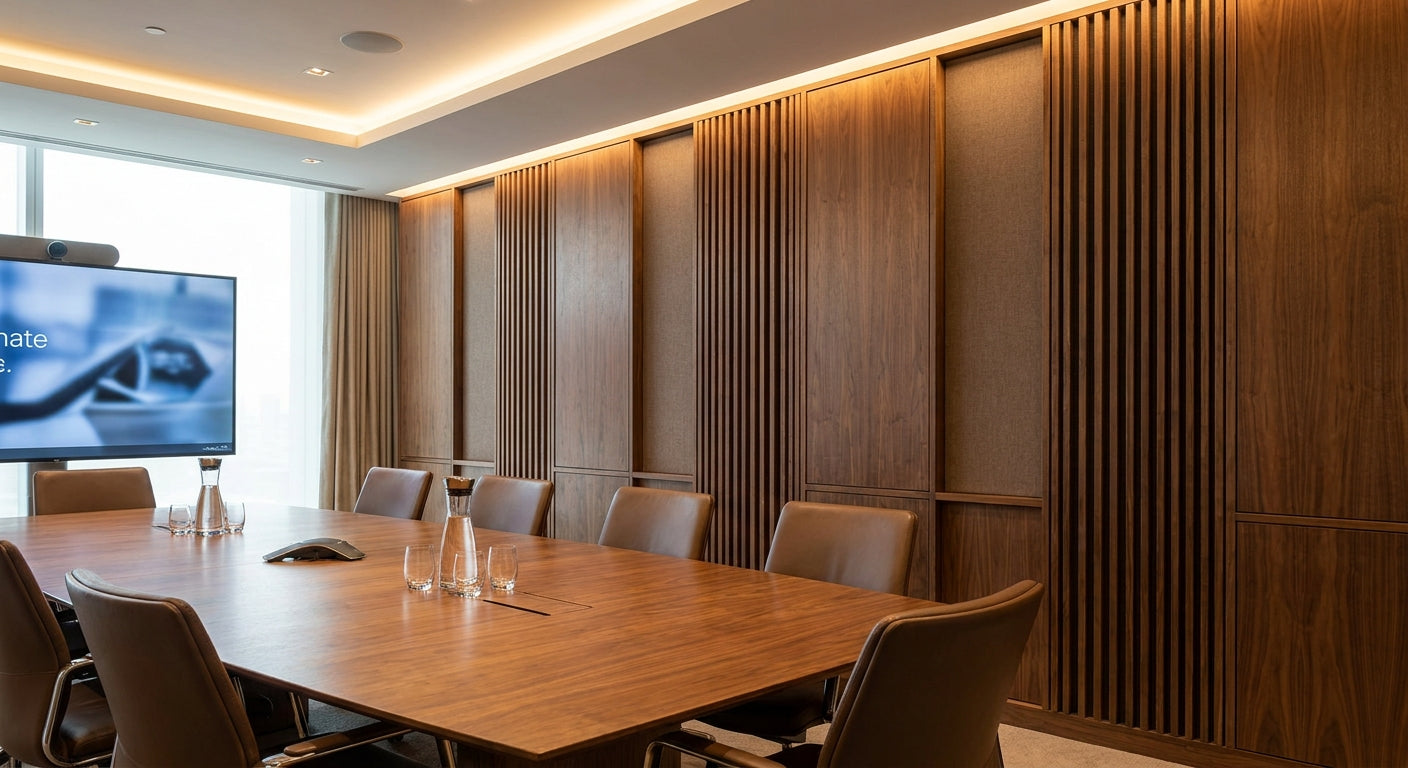
Boardroom walls take a beating from video calls, echo, and every visitor who judges the company by the room they're sitting in. Walnut acoustic panels solve the sound problem and the appearance problem at once, and this guide breaks down which walnut format actually earns a spot on a boardroom wall.
TL;DR
For most boardrooms, the full-size walnut acoustic wall panel is the Buy: a 3-sided real wood veneer with acoustic felt backing that cuts echo without turning the room into a spa. The hexagon walnut panel with grey felt is a Consider for a feature wall behind the head of the table, and walnut end pieces are a Buy for finishing exposed edges cleanly. Skip anything sold as "decorative wood-look" without a felt backing — it looks similar in photos but does nothing for the acoustics a boardroom actually needs in 2026.
Why this matters
A boardroom with hard walls, a glass table, and a ceiling full of AV equipment reflects sound instead of absorbing it. That's why voices bounce, video call mics pick up echo, and a 10-person meeting sounds like 20 people talking at once. Walnut acoustic panels for boardroom walls address this directly because the acoustic felt backing behind the veneer absorbs mid and high frequencies where speech clarity lives.
The same principle applies to any meeting space, not just formal boardrooms — the acoustic panels for conference room walls guide covers the wider category if your space is smaller than a full boardroom. What sets a boardroom apart in 2026 is the visual bar: clients and investors sit in that room, so the finish has to read as premium wood, not acoustic foam with a veneer sticker.
Who this is for
This guide is for facilities managers, office fit-out contractors, and business owners specifying finishes for a boardroom or executive meeting space where both acoustics and appearance carry equal weight. If you're panelling a home office or a casual breakout room, the criteria shift — cost per square metre matters more than veneer grain matching, and a lower-tier finish is fine. Boardrooms don't get that leniency.
What to look for in walnut acoustic panels for boardrooms
Real wood veneer, not a print
A boardroom wall photographed for a client deck or company report needs to hold up under scrutiny. A 3-sided real wood veneer walnut finish shows genuine grain variation panel to panel, which is the visual detail that separates it from a printed laminate. Printed finishes flatten under direct light and repeat their pattern every 40–60cm, which is obvious once you know to look for it.
Acoustic felt backing, confirmed not assumed
The felt backing is doing the actual sound absorption work — the veneer is the finish, not the function. Confirm the panel has a felt backing bonded to the rear before ordering, because some "acoustic-style" panels in the market are solid wood-look boards with slotted grooves and no absorptive layer behind them at all.
Panel size format matches your wall run
Walnut acoustic panels come in two size formats — 240cm and 300cm — and picking the wrong one for your boardroom wall height means more visible seams than necessary. A standard 2.4m to 2.7m ceiling height boardroom usually runs cleaner with the 240cm format, while taller rooms or floor-to-ceiling runs benefit from the 300cm length to minimise horizontal joins.
Installation disruption to the working week
Boardrooms get booked days in advance, so a panel system that needs wet trades, extended drying time, or a multi-day install is a real cost, not just an inconvenience. Glue-fixed slat panels typically go up faster than mechanically fixed systems because there's no batten framework to build out first.
Consistency across a full wall run
A single feature panel hides veneer variation; a full wall of walnut panels does not. Order from the same finish batch across the whole run and check panel-to-panel colour consistency before committing to a large boardroom wall, since natural wood veneer varies by design.
Edge and corner finishing
A boardroom wall with visible cut edges or exposed MDF cores looks unfinished no matter how good the veneer is. Matching end pieces close out exposed edges at doorways, corners, and wall terminations so the finish reads as a considered installation rather than a DIY job that ran out of panel.
Top picks for boardroom walls
The boardroom classic: Walnut Acoustic Wall Panel
The hook here is straightforward coverage: this is the panel most boardroom fit-outs default to because it works on a full wall without needing a design decision at every metre. It comes in the 240cm and 300cm formats, with the 3-sided real wood veneer and felt backing combination that handles both the acoustics and the appearance brief.
For a standard boardroom — four walls, one feature wall, rest painted — this is the panel that goes behind the head of the table or across the AV wall. Buy for any boardroom running a continuous walnut wall in 2026.
Order the walnut acoustic wall panel
The statement wall: Hexagon Walnut with Grey Felt
The hook is geometry: a hexagon module reads as a deliberate design choice rather than default panelling, which matters if the boardroom doubles as a client-facing showpiece. The grey felt visible between the walnut hexagons adds a two-tone contrast that a flat panel run can't replicate.
This isn't the pick for a full wall — the segmented pattern draws attention, which is exactly the point for one accent wall but overkill for four. Consider it for the wall behind the presentation screen or the entrance wall of the boardroom suite.
Check the hexagon walnut panel with grey felt
The finishing detail: Walnut End Piece
The hook is the detail nobody notices unless it's missing: a clean edge finish at every corner and door frame where the main panels stop. Skipping end pieces on a boardroom wall is the fastest way to make an otherwise premium install look unfinished at the margins.
This is a small line item next to the main panel order, but it's the difference between a fitted look and a cut-and-hope look at every termination point. Buy alongside any walnut panel order that includes a corner, doorway, or open edge.
The low-risk move: order a sample first
Before committing to a full boardroom wall run, get an actual sample of the walnut finish under the room's real lighting — boardroom lighting is often a mix of daylight and downlights, and veneer tone reads differently under each. A sample takes the guesswork out of the veneer-tone decision before the panel order gets placed.
What to avoid
- Printed wood-look panels with no felt backing. They photograph fine and cost less, but they do zero acoustic work, which defeats the entire reason a boardroom needs acoustic panels over paint.
- Mixing veneer batches mid-wall. Walnut grain varies by nature, and ordering two separate batches for one continuous wall run risks a visible tone break exactly where a client's eye lands.
- Skipping end pieces to save on the order. A boardroom is the one room in the building where an unfinished edge gets noticed by exactly the people you don't want noticing it.
Verdict comparison
| Criteria | Walnut Acoustic Wall Panel | Hexagon Walnut (grey felt) | Walnut End Piece |
|---|---|---|---|
| Best use | Full wall runs | Feature/accent wall | Edge and corner finishing |
| Veneer | 3-sided real walnut | 3-sided real walnut + grey felt | Matching walnut trim |
| Size format | 240cm / 300cm | Hexagon module | Trim piece |
| Boardroom fit | Whole-room coverage | One statement wall | Every install |
| Verdict | Buy | Consider | Buy |
FAQ
What are the best acoustic panels for a boardroom wall? A full-size walnut acoustic wall panel with 3-sided real wood veneer and an acoustic felt backing is the standard choice for boardroom walls in 2026, because it delivers echo reduction and a premium finish in the same product.
Is walnut better than oak for a boardroom? Walnut reads as a darker, more formal tone that suits executive spaces, while oak finishes (natural, smoked, or black oak) suit lighter or more contemporary boardrooms — it's a tone decision, not a performance one, since both come with the same acoustic felt backing.
Do acoustic wood panels actually reduce echo in a meeting room? Yes — the felt backing behind the veneer absorbs sound reflections that bare walls bounce back, which is the direct cause of echo and poor speech clarity on video calls.
What size format should I order for a boardroom wall? Walnut acoustic panels come in 240cm and 300cm formats; match the format to your ceiling height to minimise horizontal seams across the wall run.
Can I panel just one wall instead of the whole boardroom? Yes — a single feature wall behind the table head or presentation screen delivers most of the visual impact and meaningful acoustic improvement without panelling every wall.
How do I finish the edges of a walnut panel wall? Use matching end pieces at every corner, doorway, and open edge so the veneer wraps cleanly instead of exposing the panel core.
Is glue installation strong enough for a commercial boardroom wall? Glue-fixed slat panels are standard for interior boardroom walls and avoid the extended install time of a full batten framework, which matters when the room needs to be back in use quickly.
Should I order a sample before committing to a full boardroom order? Yes — boardroom lighting mixes daylight and downlights, and a sample confirms how the walnut tone reads in that specific room before a full wall order is placed.
One last thing
The detail most boardroom fit-outs get wrong isn't the panel choice — it's ordering the main wall panels without ordering matching end pieces at the same time, then discovering the exposed edge at the doorway after the main wall is already up. Order both in the same pass.
Share:
How to Cover an Ugly Interior Wall with Wood Panels (2026)
Oak Wall Panels for Kitchen Islands: 2026 Buying Guide