

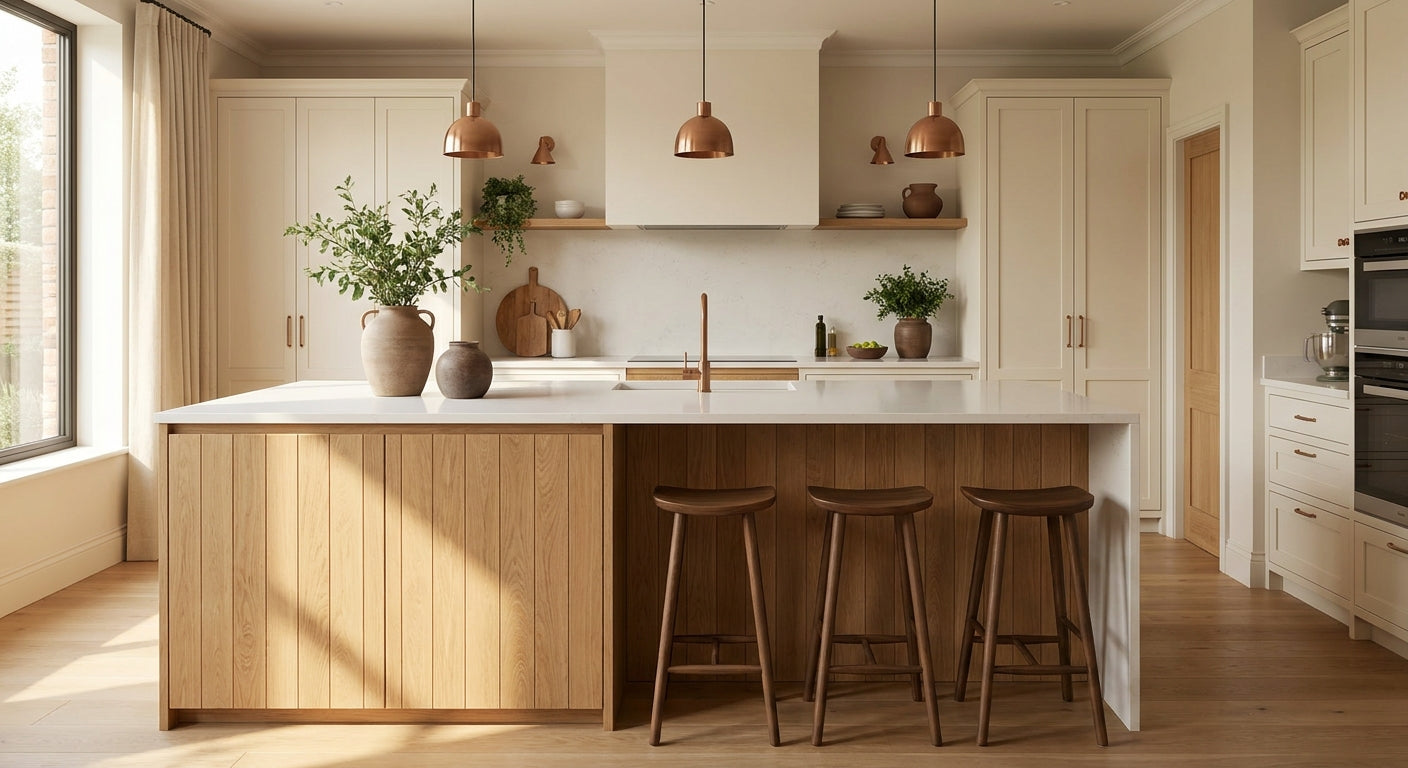
Open-plan kitchens amplify every clatter, every chair scrape, every conversation bouncing off glass, tile and worktop stone — and a bare kitchen island wall makes it worse. Natural oak wall panels solve the echo problem and give the island a warm, tactile backdrop that laminate splashbacks can't match.
TL;DR
Natural oak wall panels for kitchen island walls work best when they carry a 3-sided real wood veneer and acoustic felt backing, not a printed laminate finish. The natural oak wall panel from AKU Woodpanel is the Buy for most open-plan kitchens in 2026 — it comes in 240 cm lengths, matches oak cabinetry and worktops, and cuts reverberation off hard surfaces. Order a natural oak sample panel before committing to a full run; skip anything without felt backing if noise is your actual complaint.
Why this matters
Open-plan layouts remove the walls that used to absorb sound. Kitchen islands sit in the middle of that open volume, surrounded by tile, glass and stone worktop — all reflective surfaces. The result is a room where you can't hear the person next to you over a running tap, and where every dropped pan sounds like a gunshot.
Acoustic wood panelling behind or around the island breaks up those reflections without adding curtains or rugs to a kitchen, which is a non-starter for hygiene reasons anyway. AKU Woodpanel's guide on acoustic panels for open-plan kitchen walls covers the wider room; this guide is specifically about choosing natural oak finishes for the island itself, where humidity, splash exposure and cabinetry matching all raise the stakes.
Who this is for
This guide is for homeowners with an open-plan kitchen-diner or kitchen-living space, an island that's become a visual and acoustic dead zone, and a preference for oak-toned cabinetry, flooring or worktops they want the wall treatment to complement rather than clash with. If you're renovating in 2026 and want a natural material finish instead of paint or tile, keep reading.
What to look for in oak wall panels for a kitchen island
Real wood veneer, not a printed finish
A 3-sided real oak veneer reads as wood from every angle, including the exposed edges where a printed laminate gives itself away immediately. Kitchen islands get looked at from all sides, so edge quality matters more here than on a single flat wall.
Acoustic felt backing
The felt layer behind the slats is what actually absorbs sound rather than just breaking up the visual monotony of a flat wall. Skip panels that are pure decorative slat with no backing if noise reduction is the actual goal, not just the look.
Panel length matched to your run
AKU Woodpanel's natural oak panels come in 240 cm and 300 cm formats — measure your island wall or breakfast bar run before ordering so you're not left with an awkward off-cut in the middle of the visible face.
Humidity and splash tolerance
Kitchens generate steam, grease and the odd water splash near sinks and hobs. Position panels away from direct splash zones and check the product listing for the panel's suitability near kitchen use before you commit a full wall.
Finish match to existing cabinetry
Natural oak reads warm and light; it sits well against pale worktops and light oak flooring but can look flat against very dark cabinetry, where a smoked or black oak finish often works harder. Hold a sample against your actual cabinet door before ordering the full run.
Clean edge finishing
End pieces and trims matter more on an island than on a flush wall because the panel edge is often visible from the room, not tucked into a corner. Factor trim pieces into the order rather than leaving a raw panel edge exposed.
Top picks for 2026
The safe pick — Natural Oak Wall Panel Comes in a 240 cm length with a 3-sided real wood veneer and acoustic felt backing. This is the standard reference point for a kitchen island wall that needs to look like genuine oak from every angle while doing real acoustic work. Buy — this is the panel most open-plan kitchen renovations in 2026 default to for good reason.
Try before you commit — Natural Oak Sample Panel A cut-down sample of the same finish, useful for holding against your worktop or cabinet door under your kitchen's actual lighting before ordering a full 240 cm run. Kitchen lighting — warm downlights, cool under-cabinet strips — shifts how oak tone reads more than in any other room. Consider this a mandatory step, not an optional one, before a multi-panel order.
The installation essential — High-Tack Panel Glue A 290 ml tube built for fixing wood veneer panels without visible fixings, which matters on an island wall where screw heads or brackets would sit in plain sight. Buy alongside your panel order rather than sourcing glue separately and hoping it's compatible.
What to avoid
- Printed laminate "oak-effect" panels — they look convincing in photos but the repeat pattern and flat edge give it away under kitchen downlighting within a few weeks.
- Panels with no acoustic backing — if the actual complaint is echo around the island, a decorative-only slat panel does nothing for the sound problem, only the look.
- Undersized runs with no end trim — a raw cut edge on a visible island wall looks unfinished; budget for end pieces in the same finish from the start.
Verdict comparison table
| Criteria | Natural Oak Wall Panel | Natural Oak Sample | High-Tack Panel Glue |
|---|---|---|---|
| Real wood veneer | Yes, 3-sided | Yes, same finish | n/a |
| Acoustic felt backing | Yes | Yes (swatch) | n/a |
| Format | 240 cm length | Cut sample | 290 ml tube |
| Best for | Full island wall run | Colour/light test | Fixing panels invisibly |
| Verdict | Buy | Consider | Buy |
FAQ
What's the best oak finish for a kitchen island wall in 2026? Natural oak wall panels with a 3-sided real wood veneer and acoustic felt backing are the strongest choice for most open-plan kitchens, since they match light cabinetry and worktops while cutting echo off hard surfaces.
Is natural oak better than smoked oak for kitchens? Natural oak suits light, Scandinavian-leaning kitchens with pale worktops; smoked oak reads better against dark cabinetry or matte black fittings. Match the panel to your existing cabinet tone, not the other way round.
Do oak wall panels actually reduce kitchen noise? Panels with acoustic felt backing absorb reflected sound off hard kitchen surfaces like tile, glass and stone worktop; a decorative-only slat panel with no backing does not do this job.
Can you fit wood wall panels near a kitchen sink or hob? Keep panels clear of direct splash zones near sinks and hobs, and check the product listing for kitchen suitability before covering a full wall in that area.
What size panel do I need for a kitchen island wall? Measure the exact run first — AKU Woodpanel's natural oak panels come in 240 cm and 300 cm lengths, so plan the layout to minimise off-cuts on a visible island face.
How do you fix wood panels to a kitchen wall without visible screws? A high-tack panel glue designed for wood veneer slats gives a clean fix with no visible fixings, which matters most on an island wall viewed from multiple angles.
Should I order a sample before buying full oak panels? Yes — kitchen lighting shifts how oak tone reads more than in most rooms, so holding a sample against your actual worktop and cabinetry under real lighting avoids an expensive colour mismatch.
Do natural oak panels work with dark kitchen cabinetry? They can look flat against very dark units; a smoked or black oak finish generally reads stronger in that setting, so test both against your cabinet door before deciding.
One last thing
Most people order enough panel to cover the visible island face and forget the end pieces entirely — then discover the raw cut edge sits at eye level from the dining table. Order the matching end piece in the same natural oak finish from the start; it's a five-minute decision that avoids a return trip for a small trim piece later in 2026.
Share:
Walnut Acoustic Panels for Boardroom Walls: 2026 Verdict
Wooden Wall Panels for Pub Refurbishment: 2026 Verdict