

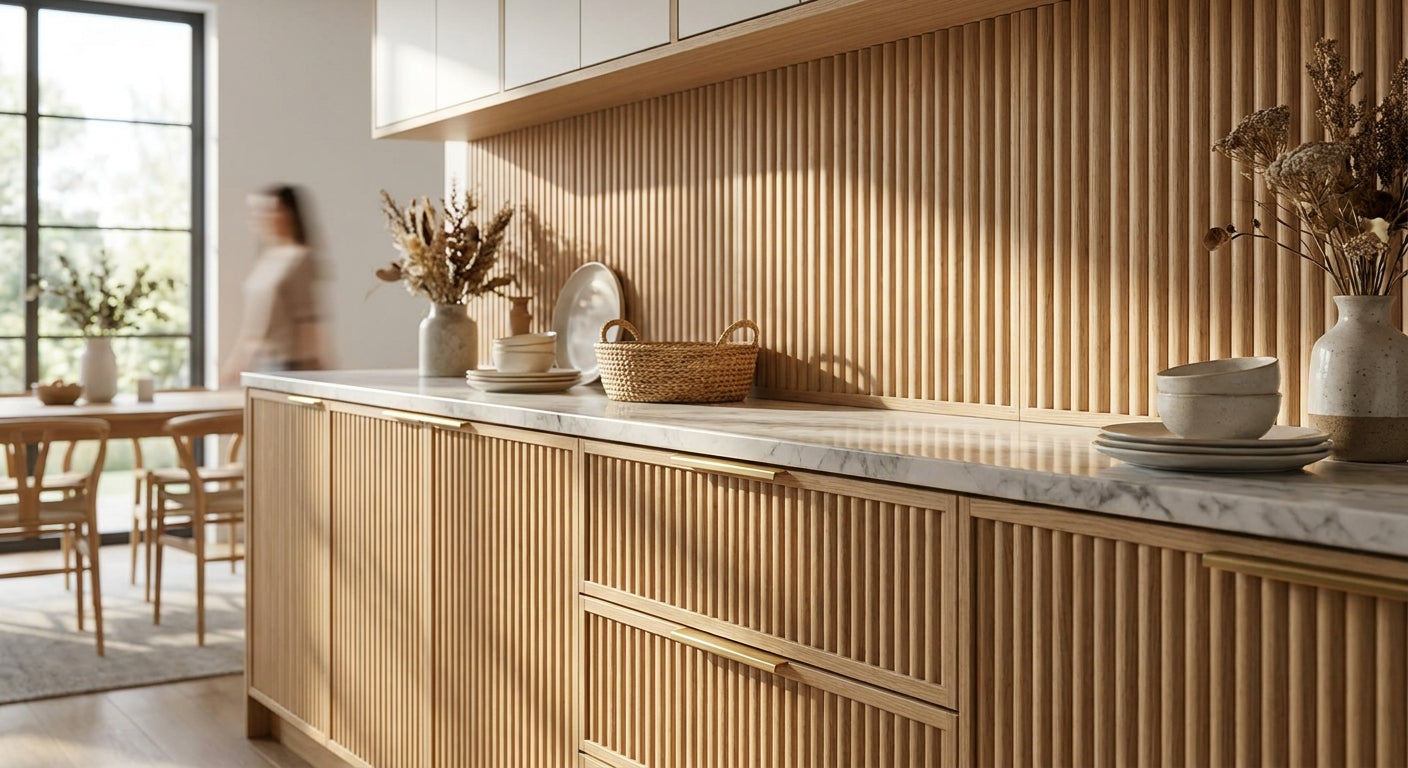
Reeded wall panels bring the grooved, shadow-line look of fluted cabinetry to kitchen fronts, island ends and splashback strips without the price tag of custom joinery. This guide breaks down what actually survives a working kitchen versus what only looks good in a showroom photo.
- Rustic Oak Premium 3-sided veneer wall panel gives the deepest groove shadow for reeded wall panels on kitchen cabinetry in 2026 - Buy.
- Natural Oak wall panel is the safe reeded wall panels pick for light, Scandi-leaning kitchens - Buy.
- Black Oak wall panel delivers a dark reeded look but flattens out without strong task lighting - Consider.
- Skip printed foil 'reeded effect' MDF sheets - the groove is printed, not routed, and fades under kitchen grease.
Why this matters
Fluted and reeded cabinet fronts moved out of bespoke joinery workshops and into everyday kitchen renovations well before 2026, but most of what gets sold as "reeded panel" online is a printed foil skin over MDF. That works for a bedroom accent wall. It does not work six inches from a hob.
A real reeded look on cabinetry needs a panel with actual routed groove depth, a wood veneer that survives contact and steam, and a size format that matches your cabinet run without an awkward horizontal joint. Aku Woodpanel's slat-style wall panels are built with a 3-sided real wood veneer finish rather than a printed layer, which is the difference that shows up after 12 months of daily kitchen use, not on day one.
Who this is for
This is for homeowners planning a kitchen renovation who want the fluted, grooved cabinet-front look on an island end, a run of base units, or a splashback strip, without commissioning custom millwork. It's also for kitchen fitters and small joinery firms who need a wood-veneer panel they can spec confidently for a client job and cut to a standard cabinet module.
What to look for in reeded wall panels for kitchen cabinetry
Groove depth and shadow line
The entire point of a reeded finish is the shadow the groove casts under kitchen lighting. Shallow or printed grooves lose that shadow line the moment you step back from the cabinet, which defeats the reason you chose the finish.
Real wood veneer, not printed foil
A genuine wood veneer takes an oil finish and ages with light exposure the way solid timber does. Printed foil panels chip at the groove edge within a year of kitchen wear and can't be sanded or re-oiled to fix it.
Moisture and heat tolerance near the hob
Kitchens generate steam, grease and the occasional splash. Panels used on cabinet fronts near a hob or sink run need sealed edges, because an acoustic felt backing that's meant for a living room wall will trap moisture if it's left exposed on a kitchen face.
Panel length versus your cabinet run
Aku Woodpanel's slat panels come in two formats, 240cm and 300cm. Measure your run before you order: a 300cm panel covers a full-height island end without a horizontal joint, while 240cm suits standard base-unit heights with less waste.
Batch-matched grain across multiple panels
Buying panels for a full run of cabinetry across separate orders risks visible grain and tone mismatch between panel batches. Order everything for one job from the same run where possible, and check a physical sample against your cabinet colour before committing.
Fixing method for a vertical cabinet face
Wall-mounted slat panels usually go up with construction adhesive on a flat backer. A cabinet front is a different substrate and often a smaller, load-bearing surface, so confirm with a fitter that the fixing method you're planning suits a door or end panel rather than a full wall.
Top picks for reeded-style kitchen cabinetry
Natural Oak wall panel - the safe pick. It carries a 3-sided real wood veneer finish in a light, even tone that reads as reeded oak cabinetry rather than a feature-wall gimmick, and it pairs with almost any kitchen palette. Verdict: Buy.
Rustic Oak Premium 3-sided wood veneer wall panel - the wildcard. The grain figure is deeper than the standard oak run, which throws a more pronounced shadow line under under-cabinet lighting, exactly the effect a reeded island end is chasen for. Verdict: Buy.
Black Oak wall panel - the statement pick. A dark reeded cabinet front looks striking in daylight photography but needs strong, direct task lighting in real kitchens, otherwise the grooves disappear into the tone and you lose the whole point of the finish. Verdict: Consider.
Grey Oak wall panel - the mismatch risk. It's a genuine 3-sided veneer panel, but a cool grey undertone clashes with warm oak worktops and brass fittings, which is the most common kitchen colour scheme it gets paired with by mistake. Verdict: Skip for warm-toned kitchens; fine for a cooler, concrete-and-steel scheme.
“If the groove shadow disappears under kitchen lighting, the panel isn't reeded - it's printed.”
What to avoid
- Printed foil "reeded effect" MDF sheets. The groove pattern is printed on a flat board, not routed, so it looks convincing in a product photo and flat in person under angled light.
- Single-sided veneer boards on a visible island end. If the end panel is seen from both the kitchen and a dining or living space, a single-sided veneer leaves an unfinished back on view.
- Unsealed panels near the hob or sink. The acoustic felt backing on a wall panel is not designed for splash zones. Any cut edge or exposed backing near water needs sealing before it goes up.
Verdict comparison table
| Pick | Veneer | Best kitchen zone | Verdict |
|---|---|---|---|
| Natural Oak | 3-sided real wood veneer | Light, Scandi-style kitchens | Buy |
| Rustic Oak Premium 3-sided veneer | 3-sided, deeper grain figure | Island ends, feature runs | Buy |
| Black Oak | 3-sided veneer, dark tone | Dark kitchens with strong task lighting | Consider |
| Grey Oak | 3-sided veneer, cool tone | Cooler-toned kitchens only | Skip for warm schemes |
FAQ
What are reeded wall panels made from?
Genuine reeded wall panels use a real wood veneer bonded over a grooved backing board, not a printed foil skin. Aku Woodpanel's slat panels use a 3-sided real wood veneer finish, which is what allows the groove to be re-oiled and refinished over time.
Can reeded wall panels go on kitchen cabinet fronts?
Yes, but the fixing method changes from a wall installation to a cabinet face, and any exposed edge near a hob or sink needs sealing. Ask a fitter to confirm the adhesive method suits your specific cabinet substrate before ordering.
What size do reeded wall panels come in?
Aku Woodpanel's wood veneer wall panels ship in 240cm and 300cm lengths in 2026. The 300cm format covers a full-height island end without a horizontal joint, while 240cm suits standard base-unit runs.
Is Black Oak or Natural Oak better for a reeded kitchen island?
Natural Oak reads more reliably in everyday kitchen lighting and suits most palettes, making it the safer buy. Black Oak looks striking but needs strong, direct task lighting to keep the groove shadow visible, so it's a considered pick rather than a default.
How much does a reeded wall panel cost?
Pricing varies by finish and panel size, so check current pricing on the product page before budgeting a full run. Ordering a physical sample against your cabinet colour is worth the small extra step before committing to a full order.
Do reeded wall panels need sealing in a kitchen?
Any cut edge or exposed backing near a hob, sink, or splash zone should be sealed. The panels are built for interior wall use, so kitchen-specific edge sealing is an extra step a fitter needs to handle at install.
What's the difference between reeded and fluted panels?
The terms are used interchangeably in most kitchen renovation contexts and both describe a repeated groove profile that casts a shadow line under light. What matters more than the label is whether the groove is routed into real veneer or printed onto a flat board.
One last thing
The detail buyers miss most often: a reeded look lives or dies on lighting direction, not on the panel itself. The same Rustic Oak Premium panel photographs completely differently under a straight-on kitchen ceiling light versus raking under-cabinet LED strips, so check your lighting plan before you lock in a finish, not after the panels are cut.
Share:
Fluted Wood Panels for Wardrobe Doors: 2026 Verdict
MDF Slatwall Panels for Shop Displays: 2026 Verdict