

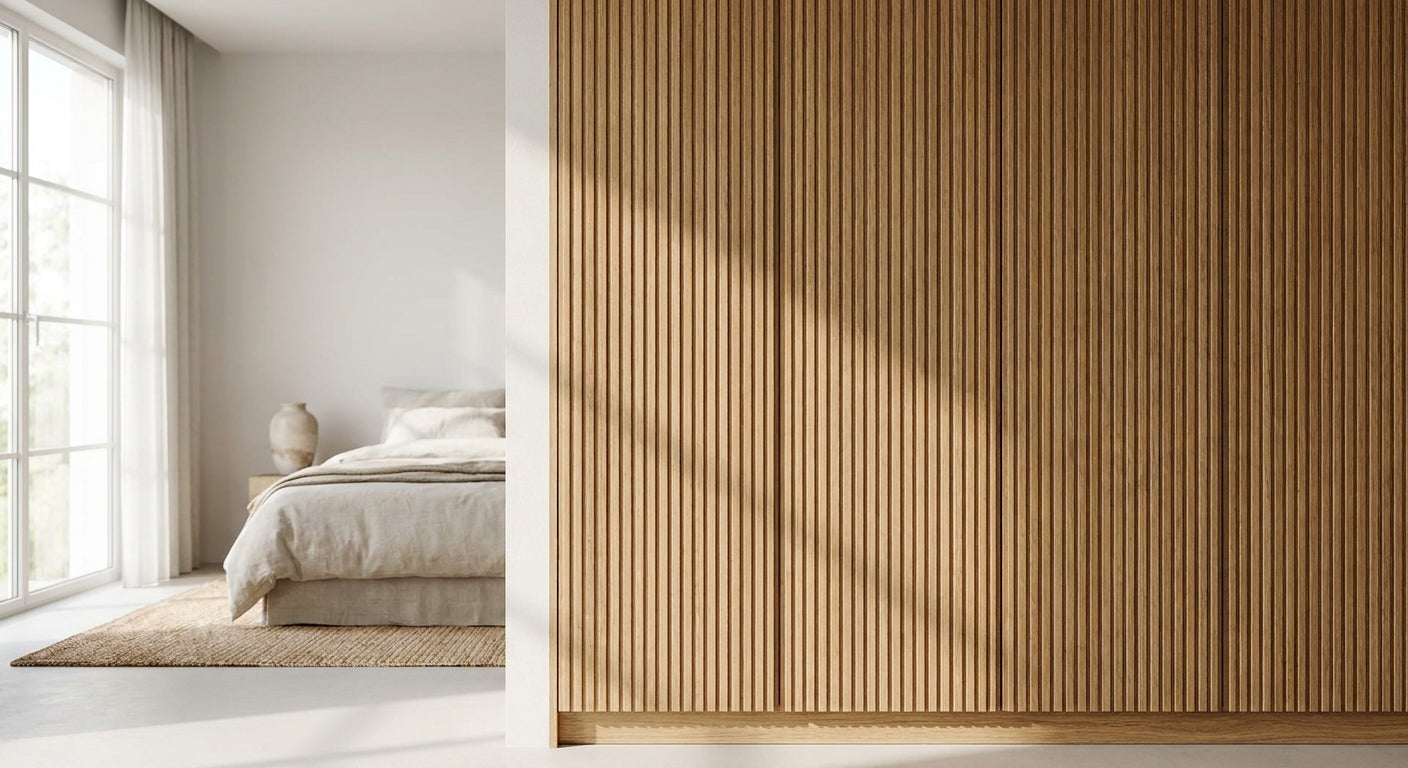
Flat MDF wardrobe doors look tired fast, and painting them only buys you a year before the marks show again. Fluted wood panels fix that by adding real depth and grain to a door face without a full carpentry job.
- Fluted wood panels with real 3-sided veneer, like Akuwood Panel's Natural Oak, outlast printed foil slats on wardrobe doors — buy real veneer.
- Black Oak wins for dark, contemporary wardrobes; Mocca wins for warm mid-tone furniture in 2026 schemes.
- Cut panels to door height rather than buying a size that needs trimming twice — measure first, order once.
- Skip felt-free veneer strips on tall doors over 200cm; the felt backing on Akuwood Panel's range resists bowing better.
- Use a proper panel adhesive, not general contact glue, or the fluted strips lift within months on a door that opens and closes daily.
Why this matters
A wardrobe door gets touched, knocked and slammed hundreds of times a year, which is a very different job to a wall panel that just hangs there. Fluted wood panels bring the same grooved-slat look that's driving feature-wall sales in 2026, but on a door the veneer, backing and fixing method all have to work harder.
Akuwood Panel's Natural Oak wall panel range is built as a wall product first, so picking the right finish and adapting the fixing approach for a door matters more than it does on a static wall. Get the veneer and backing wrong and you'll see gaps open at the hinge line within a year.
Who this is for
This guide is for homeowners and renters upgrading fitted or freestanding wardrobes — sliding, hinged or built-in — who want the fluted, grooved texture on the door face without replacing the whole unit. It also suits small joinery businesses building bespoke wardrobes who want a real wood veneer finish rather than a printed foil that chips at the edges.
What to look for in fluted wood panels for wardrobe doors
Real veneer, not printed foil
A 3-sided real wood veneer shows genuine grain variation across every panel, so cut edges and joins on a door face don't reveal a flat printed pattern. Printed foil slats look convincing in a photo but the pattern repeats every 20-30cm, which is obvious up close on a door you open every morning.
Panel thickness and rigidity
Wardrobe doors flex when they're opened and closed, so a panel needs enough backing structure to stay flat over time. Felt-backed panels carry extra rigidity from the acoustic layer, which is a side benefit on a door even though you're not chasing sound absorption.
Groove depth and spacing
Deep, wide grooves read as a bold, modern statement; tight, shallow grooves look closer to traditional tongue-and-groove panelling. Match the groove spacing to the scale of the wardrobe — a narrow single door with deep grooves can look busy, while a wide double door carries it well.
Colour match to existing furniture
Wardrobe carcasses are rarely pure white or pure black, so hold a physical sample against the actual door before ordering full sheets. Ordering a sample panel before committing to a full run is standard advice in the trade for exactly this reason.
Size format versus door height
Standard fitted wardrobe doors in UK homes run 190-220cm; panels typically come in 240cm or 300cm lengths that need trimming down. Buy the format closer to your finished height so you're cutting off waste, not stretching a short panel with a mismatched join.
Fixing method for a moving door
A wall panel gets glued or clipped to a static surface; a door face needs an adhesive rated for vibration and repeated movement. A high-tack panel glue designed for this material holds up where general-purpose contact adhesive fails after a season of daily use.
Top picks for wardrobe doors in 2026
Natural Oak — the safe pick. Light, warm tone that reads as fluted oak from across the room, with the 3-sided veneer construction that avoids flat printed grain. It works on light and mid-tone wardrobe carcasses without fighting the existing colour scheme. Buy if your wardrobe sits in a bedroom with light flooring or neutral walls.
Black Oak — the bold pick. Dark, near-black veneer that turns a plain wardrobe front into the room's focal point rather than a box to hide. It pairs well with brass or matte black handles for a 2026-style contemporary bedroom. Buy for a statement wardrobe wall; skip it in a small, low-light room where dark panelling can feel heavy.
Mocca — the warm mid-tone pick. Sits between the light oak tones and the black finish, closer to a walnut-brown that suits Scandinavian and Japandi-leaning bedrooms. It hides fingerprints and daily wear better than the black finish because the grain variation is denser. Consider it if you're matching against warm wood flooring already in the room.
Walnut — the premium pick. Richer, more pronounced grain than Mocca, aimed at anyone treating the wardrobe as furniture rather than storage. It's the pick that photographs best for a bespoke joinery portfolio. Consider for a hero piece; skip if you're panelling a wardrobe that's mostly out of view.


What to avoid
- Printed foil slat wraps. They look right in a listing photo but chip at cut edges within months on a door that gets bumped by hangers and boxes.
- Panels with no felt or backing layer. Bare veneer strips without a support layer bow along tall doors over 200cm, especially in centrally heated bedrooms.
- General contact adhesive. It grips fine on day one and starts lifting corners by month three on a door that opens dozens of times a week; use a panel glue rated for this job instead.
Verdict comparison
| Pick | Best for | Veneer style | Verdict |
|---|---|---|---|
| Natural Oak | Light, neutral bedrooms | Light, even grain | Buy |
| Black Oak | Statement, contemporary wardrobes | Dark, near-black | Buy |
| Mocca | Warm mid-tone rooms | Dense warm-brown grain | Consider |
| Walnut | Bespoke, furniture-grade builds | Rich, pronounced grain | Consider |
FAQ
What's the best fluted wood panel finish for wardrobe doors in 2026?
Natural Oak is the safest choice for most bedrooms because its light, even grain suits neutral colour schemes. Black Oak works better if the wardrobe is meant to be a statement piece in a contemporary room.
Is fluted wood better than printed foil slat cladding for a wardrobe door?
Real 3-sided wood veneer is better for wardrobe doors because it doesn't show a repeating printed pattern at cut edges. Printed foil chips and reveals a flat backing layer within months of daily door use.
How much does fluted wood panelling cost for a wardrobe door in 2026?
Panels run roughly £80-£85 per sheet before cutting, so a single door face typically needs one panel plus trim pieces. The exact count depends on your door width and how much of the panel you cut away.
Can you cut wall panels to size for a wardrobe door?
Yes, standard 240cm or 300cm wall panels are designed to be cut down to fit a door height. Order the format closest to your finished measurement so you're trimming waste, not stretching a short panel.
Do fluted wood panels need a backing board on a door?
A felt-backed panel adds rigidity that helps resist bowing on taller doors, even though the acoustic benefit itself doesn't matter on a wardrobe. Bare veneer strips without backing are more prone to warping over time.
What adhesive works best for fluted panels on a moving door?
A high-tack panel glue rated for vertical and vibrating surfaces holds up where general contact adhesive fails. Doors open and close daily, so the adhesive needs to handle repeated movement, not just static weight.
Should I choose 240cm or 300cm panels for wardrobe doors?
Pick whichever format is closest to your door height without going shorter, since panels are designed to be trimmed down rather than extended. Most UK fitted wardrobe doors at 190-220cm work well from the 240cm format.
Can fluted wood panels be used on sliding wardrobe doors?
Yes, as long as the added panel thickness doesn't interfere with the sliding track clearance. Measure the gap between the door face and the track before committing to a panel thickness.
One last thing
The felt backing on Akuwood Panel's acoustic range exists to absorb sound on a wall, but on a wardrobe door it does something nobody expects: it stops the veneer strip flexing when the door slams. A bare veneer slat without that backing layer is more likely to show hairline cracks along the grooves after a winter of central heating drying out the wood.
Share:
Shiplap Cladding Interior: 2026 Feature Wall Buying Guide
Reeded Wall Panels for Kitchen Cabinetry: 2026 Verdict