

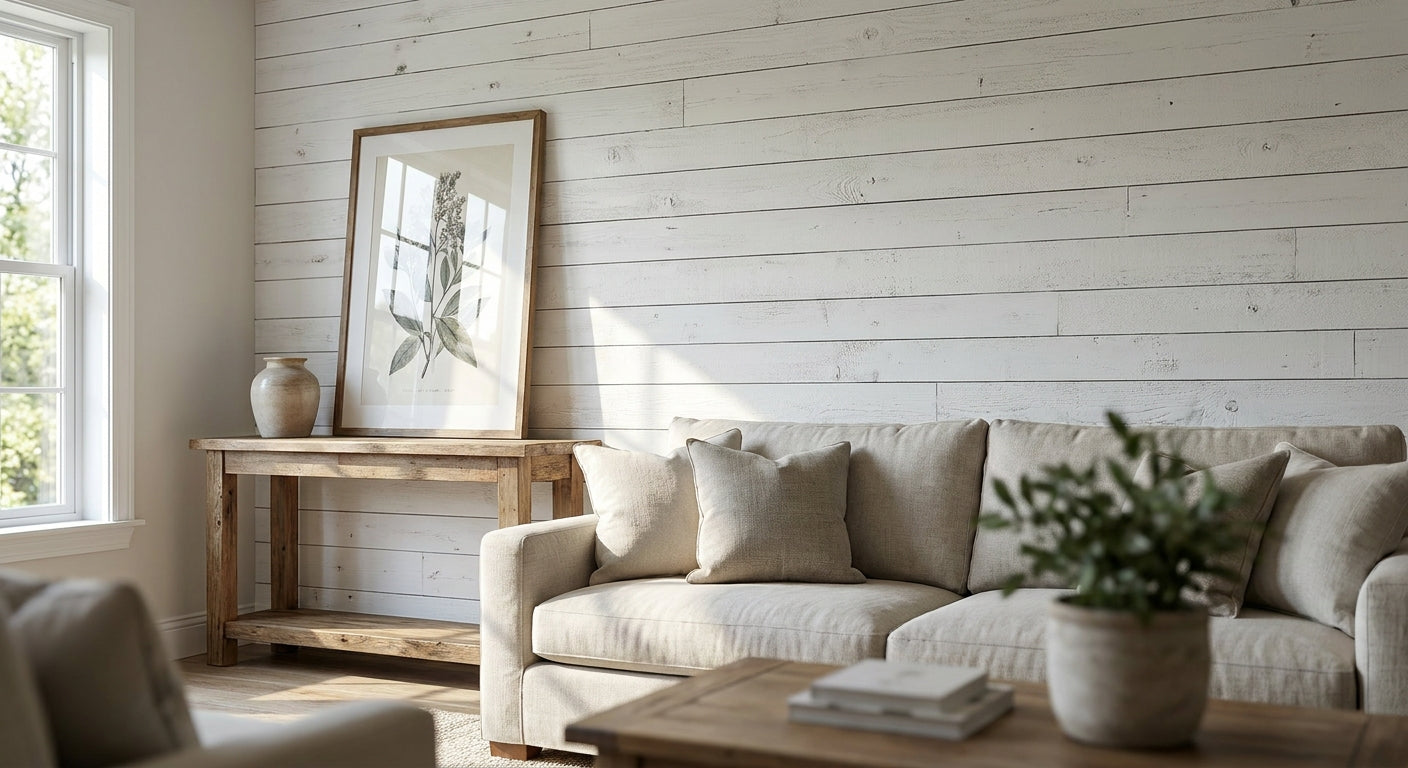
Shiplap cladding interior style feature walls give a room the horizontal board look everyone wants in 2026, without the flat, echoey plaster wall underneath it. This guide is for anyone weighing up real wood veneer panels against painted tongue-and-groove boards for a living room, bedroom or home office feature wall.
- Real 3-sided wood veneer panels beat painted MDF shiplap boards for durability and acoustic performance in 2026.
- Natural Oak wall panels are the safe buy for most living rooms and bedrooms doing a shiplap cladding interior project.
- Rustic Oak Premium 3-sided veneer panels suit anyone who wants visible grain texture over a flat painted look.
- Skip printed foil shiplap effect boards - they fade and offer zero acoustic benefit.
Why this matters
Traditional shiplap is painted tongue-and-groove board, usually MDF or pine, nailed up in overlapping horizontal strips. It looks good in photos. It does nothing for a room that already bounces sound off a TV wall, a laminate floor and a bare ceiling.
Acoustic wood veneer panels give you the same horizontal-board visual rhythm but with a felt backing behind a real wood face. You get the shiplap look and a room that actually sounds calmer. That's the trade-off this guide is built around, and it's the reason Akustiq UK builds its wooden wall panel range around 3-sided real wood veneer rather than printed foil.
Who this is for
This is for a homeowner or landlord planning a feature wall in a living room, bedroom, or home office in 2026, who wants the shiplap cladding interior look but is tired of shopping between cheap printed MDF boards and expensive bespoke joinery. If you're choosing between a natural oak wall panel and a can of primer and a stack of pine boards, read on before you commit to either.
What to look for in shiplap cladding for interior feature walls
Real wood veneer, not printed foil
Printed foil "shiplap effect" boards look convincing in a showroom and start peeling at the seams within a couple of years, especially near a radiator or a south-facing window. A genuine 3-sided wood veneer wraps real timber around the visible faces of the panel, so the grain doesn't repeat every 30cm and the surface can be lightly waxed or oiled rather than repainted.
Acoustic felt backing for echo control
A bare feature wall with hard flooring and a flat TV screen is one of the most common causes of a room that sounds "loud" even at normal volume. Panels with an acoustic felt backing absorb some of that reflected sound instead of bouncing it straight back at the sofa. This matters more in open-plan living rooms and home offices used for video calls than in a small box bedroom.
Panel size matched to wall height
Most UK ceiling heights fall between 2.3m and 2.7m, which is why panels come in 240cm and 300cm formats. Buying the wrong format means an extra horizontal seam at eye level, which undercuts the whole point of a clean shiplap cladding interior look. Measure floor to ceiling before you order, not floor to where you think the panel will stop.
Finish tone versus room light
A north-facing bedroom with one small window will read a dark walnut or black oak finish as almost black by late afternoon in 2026's shorter winter days. Lighter finishes like natural oak or grey oak keep a small or dim room feeling open, while darker tones work best where there's already good natural light or dedicated lighting aimed at the wall.
Installation system
Traditional tongue-and-groove shiplap needs nailing into studs or battens, filling nail holes, and painting - a full weekend job minimum. Click-and-glue wood veneer panel systems go up with adhesive and don't need painting afterward, which matters if you're doing this on a Saturday and want to hang art the same evening.
Fire and moisture suitability
A shiplap-style feature wall behind a log burner or in a steamy bathroom needs a panel rated for that environment, not a standard interior board. Check the specification sheet for the room you're actually installing in before you fall in love with a finish.
Top picks for a shiplap cladding interior feature wall
Natural Oak Wall Panel - the safe pick. Light, even grain that suits both a Scandi-style living room and a small box bedroom without darkening the space. Comes in the 3-sided real wood veneer construction with acoustic felt backing behind it, in both 240cm and 300cm formats. Verdict: Buy - it's the natural oak wall panel most homeowners should default to if unsure.
Rustic Oak Premium 3-sided wood veneer - the textured upgrade. More visible grain and knot character than the standard Natural Oak, which reads as a deliberate design choice rather than a budget panel once it's up. Suits a living room or home office where the wall is the main feature, not a backdrop. Verdict: Buy for anyone upgrading from a flat painted shiplap look - see the Rustic Oak Premium 3-sided veneer panel.
Black Oak - the moody statement wall. Works behind a TV wall or in a home cinema corner where the goal is contrast, not brightness. Needs a room with decent ambient or accent lighting or it reads flat rather than dramatic. Verdict: Consider - check the Black Oak wall panel against your room's natural light before ordering a full wall's worth.
Smoked Oak - the wildcard. Sits between Natural Oak and Black Oak in tone, and suits a hallway or dining feature wall that gets passing light rather than a room you sit in for hours. Verdict: Consider for transitional spaces, Skip for a small north-facing bedroom where it'll read almost black by 4pm in winter 2026.
What to avoid
- Printed foil "shiplap effect" MDF boards. They look identical to real veneer on a shelf and start showing seam lines and fading within two to three years, especially near heat sources.
- Painted tongue-and-groove with no acoustic backing. You get the visual style without any of the sound-absorbing benefit, and repainting scuffs and nail holes is a recurring job, not a one-off.
- A single dark finish across a whole small room. One dark accent wall reads as intentional; four dark walls in a box room reads as a mistake once the sun goes down.
Verdict comparison
| Pick | Best for | Finish tone | Verdict |
|---|---|---|---|
| Natural Oak Wall Panel | Living rooms, small bedrooms | Light | Buy |
| Rustic Oak Premium 3-sided veneer | Feature walls, home offices | Medium, textured | Buy |
| Black Oak Wall Panel | TV walls, home cinema corners | Dark | Consider |
| Smoked Oak Wall Panel | Hallways, dining walls | Medium-dark | Consider |
“If a shiplap panel needs paint to look expensive, it isn't real wood veneer.”
FAQ
What is shiplap cladding interior style and how is it different from wood panelling?
Shiplap cladding interior style refers to overlapping horizontal boards on a wall, traditionally painted pine or MDF. Wood veneer panels achieve the same horizontal look with a real timber face and often an acoustic felt backing behind it, which painted boards don't have.
Is shiplap cladding interior good for reducing echo in a room?
Panels with an acoustic felt backing reduce reflected sound in a room, while standard painted shiplap boards do not. If echo is the main problem, choose a panel built with acoustic backing rather than a decorative-only board.
How much does shiplap-style interior panelling cost in 2026?
Cost depends on finish, panel size format and how much of the wall you're covering. Wood veneer panels sit above basic painted MDF boards on price but avoid the repeat cost of repainting every couple of years.
Can shiplap cladding go in a bathroom or kitchen?
Check the moisture rating on the specific panel before installing near steam or splashback zones. Not every interior wood veneer panel is rated for high-humidity rooms, so confirm suitability for the room first.
What's the difference between 240cm and 300cm panel formats?
240cm and 300cm are the two standard panel size formats, matched to common UK ceiling heights. Picking the format closest to your actual floor-to-ceiling measurement avoids an extra seam at eye level.
Do wood veneer shiplap-style panels need painting after installation?
No. A 3-sided real wood veneer panel is finished before it arrives, unlike traditional tongue-and-groove boards which need priming and painting on site.
How long does it take to install a shiplap-style feature wall?
A click-and-glue wood veneer panel system typically goes up in a single day for one wall, compared with a full weekend for traditional nailed and painted tongue-and-groove boards.
Is real wood veneer better than printed shiplap boards?
Real wood veneer holds its finish and grain pattern for years, while printed foil boards fade and peel at the seams within two to three years in most UK homes. For a feature wall meant to last, veneer is the stronger long-term choice.
One last thing
The detail most people miss when planning a shiplap cladding interior feature wall: the seam pattern matters as much as the finish. A wall built from one long 300cm panel per row reads calmer than the same wall pieced together from shorter offcuts, even in the exact same wood tone - fewer joints, fewer places for the eye to stop.
Share:
Cedar Cladding for Garden Buildings: 2026 Buying Guide
Fluted Wood Panels for Wardrobe Doors: 2026 Verdict