

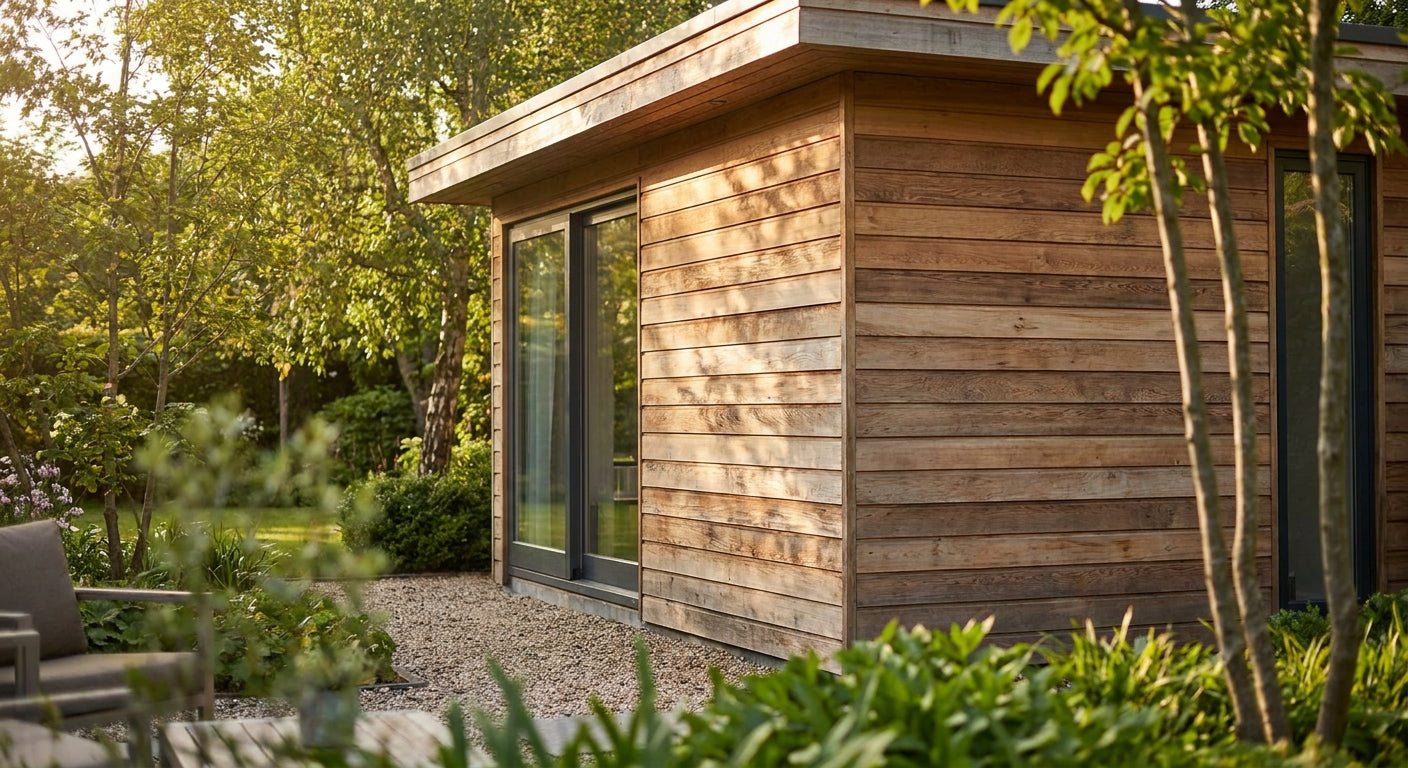
Cedar cladding for garden buildings gets specified for its colour and grain, but the fixing detail and maintenance schedule decide whether it still looks good in year ten. This guide breaks down what actually matters when you're cladding a shed, garden room, or outbuilding in 2026, and where a low-maintenance wood-grain alternative earns its place.
- Cedar cladding for garden buildings costs more upfront and needs re-oiling every 2-3 years to hold its colour.
- Western Red Cedar weathers to silver-grey in 6 to 18 months on its own — skip oiling if you like that look.
- Akuwood Panel's Oak and Stone Grey wood-grain cladding panels give a weathered-cedar look with no re-oiling. Buy for low-maintenance builds.
- Stainless steel fixings are non-negotiable on garden building cladding; mild steel screws and staples fail within a few seasons.
Why this matters
A garden building is exposed on four sides with no roof overhang the way a house extension has, so its cladding takes weather a house wall rarely sees. Get the species, fixing, or gap wrong and you're stripping and re-cladding inside 5 years, not the 20 to 25 cedar is supposed to deliver.
Cedar's appeal is real: tight, straight grain, natural oils that resist rot, and a colour that ages rather than just fades. But "cedar cladding" covers a wide quality range, from clear Western Red Cedar down to knotty, budget boards sold under the same name. The exterior wall cladding for garden buildings guide covers the fixing detail most suppliers skip — worth reading before you order any board.
Who this is for
This guide is for anyone cladding a shed, summer house, garden room, or timber-frame outbuilding in 2026 and weighing real cedar against a lower-maintenance wood-effect panel. It's written for someone doing the cladding themselves over a weekend, not a specifier ordering pallets for an estate — the criteria below assume DIY-level tools and a UK garden, not a commercial fit-out.
What to look for in cedar cladding for garden buildings
Species and grade
"Cedar" on a listing isn't a guarantee — look for Western Red Cedar named explicitly, ideally FSC or PEFC certified, and check whether it's clear grade or knotty. Clear grade costs more but resists cupping and splitting far better over a 20-year outbuilding life.
Ventilation gap and fixing detail
Boards need a 5 to 8mm gap behind them, usually created with counter-battens and a breather membrane. Skip the gap and moisture traps behind the board, rotting the frame from the inside where you won't see it until the cladding is already loose.
Fixings — stainless steel, not staples
Use stainless steel or A2/A4-grade screws. Staples and plain steel corrode within a season or two and bleed black tannin streaks straight down cedar boards — a cosmetic problem that also signals a fixing that's failing.
Maintenance expectation
Left untreated, real cedar weathers to a silver-grey within 6 to 18 months. If you want to keep the orange-brown tone instead, plan on re-oiling every 2 to 3 years — skipping this is only fine if the grey look is what you actually want.
Planning and boundary distance
Garden buildings under permitted development still carry height and boundary-distance rules that affect eaves and cladding overhang. Check the limits for your plot before you order a full run of board, not after.
Lifecycle cost, not just board price
Cedar's board price is only part of the number. Add oil or stain, stainless fixings, and the labour hours to re-treat every few years across a 20-year building life before comparing it to a maintenance-free alternative.


Top picks for cladding a garden building
Real cedar boards — the traditional pick. Genuine Western Red Cedar in a clear grade has a straight, tight grain with almost no knots, and left untreated it weathers to a consistent silver-grey within 6 to 18 months. It needs stainless fixings and a ventilated gap to hit the multi-decade lifespan cedar is known for. Consider it if you want the real material and don't mind the colour shifting in year one.
Akuwood Panel Oak wood-grain cladding — the low-maintenance pick. This panel carries a 3D wood-grain finish in an oak tone and is rated for over 25 years of maintenance-free use, with UV and weather resistance built into the panel rather than applied as a coating. It installs in the same 290cm board format as timber cladding, on the same batten-and-gap principle. Buy it if you want the cedar-adjacent look on day one without a re-oiling routine. Exterior wall cladding panel oak
Akuwood Panel Black wood-grain cladding — the modern contrast pick. The black finish reads as deliberately modern against cedar's warm tone, and it's built to the same 25-year, UV and weather-resistant spec as the oak panel. It suits garden studios and contemporary outbuildings where you want a hard edge against greenery rather than a timber-cabin blend-in. Buy it for a garden room or studio going for a dark, architectural finish. Exterior wall cladding panel black
Akuwood Panel Stone Grey wood-grain cladding — the pre-weathered pick. Stone Grey lands close to where real cedar ends up naturally after 6 to 18 months outdoors, so you get the weathered look immediately instead of waiting a year for cedar to grey on its own. Buy it if the silver-grey finish is what drew you to cedar in the first place, without the wait or the oiling debate.
Budget "cedar-style" softwood — the wildcard. Some merchants sell kiln-dried pine or spruce boards under a "cedar-style" label at roughly half the price of true Western Red Cedar. It looks close in the yard but lacks cedar's natural oils, so it needs pressure-treatment or a heavy coating to resist rot at all. Skip it unless you're planning to paint or stain it every year regardless.
What to avoid
- Cladding fixed tight to the frame with no gap. Looks flush and neat on day one, traps moisture behind the board, and rots the frame from the inside before the cladding shows any sign of a problem.
- Staples or plain steel screws. They corrode within a season or two and bleed black tannin streaks down cedar boards — always use stainless or A2/A4 grade fixings.
- "Cedar-style" labelling with no species named. If a listing doesn't name Western Red Cedar or another specific cedar species and just says "cedar-style" or "cedar-effect," assume it's a cheaper, different softwood.
| Cladding | Maintenance | Weathering | Verdict |
|---|---|---|---|
| Western Red Cedar (clear grade) | Re-oil every 2-3 years for colour retention | Greys naturally in 6-18 months | Consider |
| Akuwood Panel Oak wood-grain panel | None — rated 25 years maintenance-free | Consistent from day one | Buy |
| Akuwood Panel Black wood-grain panel | None — rated 25 years maintenance-free | Consistent from day one | Buy |
| Akuwood Panel Stone Grey wood-grain panel | None — rated 25 years maintenance-free | Pre-weathered grey look | Buy |
| Budget "cedar-style" softwood | Needs annual coating to resist rot | Fades unevenly | Skip |
FAQ
What's the best cladding for a garden building, cedar or composite?
Real Western Red Cedar gives the most authentic look but needs re-oiling every 2-3 years; a wood-grain composite panel like Akuwood Panel's Oak or Stone Grey range gives a similar finish with no re-oiling. Pick cedar for authenticity, composite for low maintenance.
Is cedar cladding worth it for a shed or garden room?
Cedar cladding is worth it if you want a natural material and don't mind the colour shifting to grey within 6-18 months. If you want the finish to stay consistent without upkeep, a wood-grain composite panel is the better fit.
How much does cedar cladding cost for a garden building in 2026?
Cedar board pricing varies by grade and merchant, and clear-grade Western Red Cedar sits well above budget softwood alternatives. Factor in stainless fixings and oil or stain on top of the board price when budgeting for 2026.
Does cedar cladding need painting or oiling?
Cedar cladding doesn't need painting, but it does need re-oiling every 2-3 years if you want to keep its orange-brown colour. Left untreated, it weathers naturally to silver-grey within 6-18 months instead.
How long does cedar cladding last on an outbuilding?
Properly fixed cedar cladding with a ventilation gap and stainless fixings lasts 20-25 years on a garden building. Skipping the gap or using the wrong fixings can cut that lifespan dramatically.
Can you clad a garden building without planning permission?
Most garden buildings under permitted development can be clad without separate planning permission, but height and boundary-distance rules still apply. Check your specific plot's limits before ordering board.
What's the alternative to cedar cladding that doesn't need maintenance?
Wood-grain composite cladding panels, such as Akuwood Panel's Oak, Black, and Stone Grey ranges, are rated for over 25 years of maintenance-free use. They give a similar visual finish to cedar without a re-oiling schedule.
Why does cedar cladding turn grey?
Cedar turns grey because UV exposure breaks down the surface oils that give it its original orange-brown colour, a process that finishes within 6-18 months outdoors. Regular oiling slows this but doesn't stop it permanently.
One last thing
The black streaks people blame on dirt or algae on old cedar sheds are usually tannin bleeding from a corroding steel fixing, not grime — pull the offending screw and the streak stops spreading. It's the single most common cedar cladding fault seen on garden buildings, and it's entirely down to using the wrong fixing on day one.
Share:
Tongue and Groove Wall Panels for Period Homes: 2026 Picks
Shiplap Cladding Interior: 2026 Feature Wall Buying Guide