

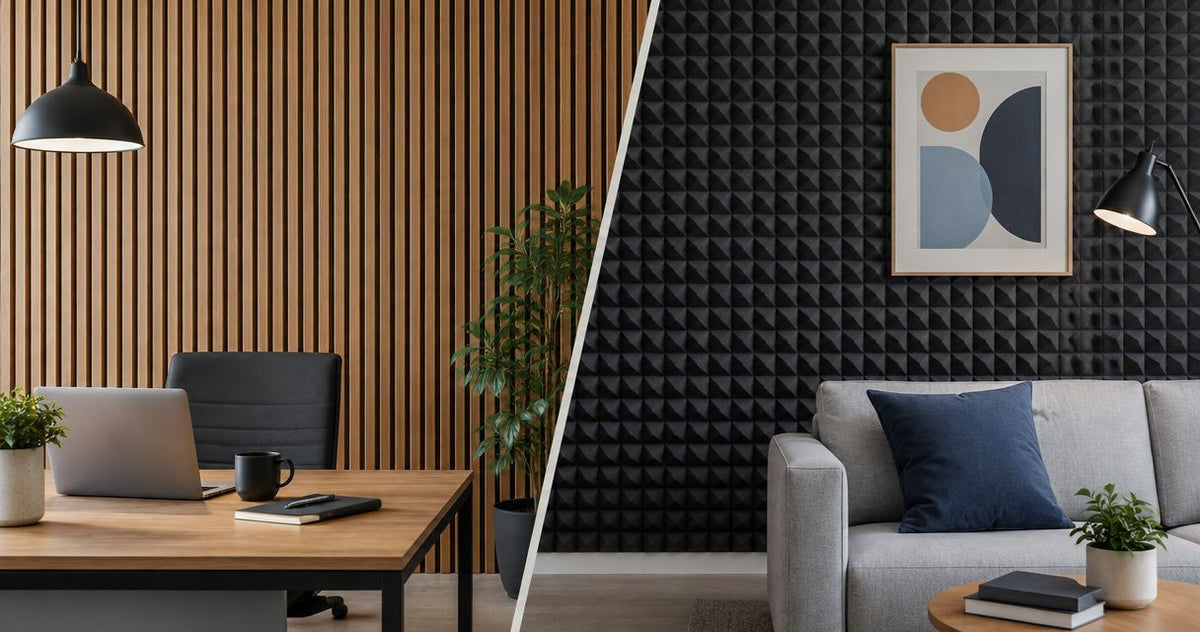
Acoustic wood panelling is the better choice when you want echo control and a wood-finished feature wall; acoustic foam suits targeted sound absorption where a studio-style finish is acceptable. Neither material wins on acoustic performance by name alone: compare the tested construction, frequency response and mounting method. For a 2026 project, treat both as room treatments, not substitutes for soundproofing.
- Acoustic wood panels vs acoustic foam: choose by tested absorption, placement and the finish your room needs.
- Akustiq UK acoustic wood panels suit homeowners seeking real wood veneer and felt-backed wall treatment.
- Acoustic foam suits targeted reflection control where its exposed finish fits the room.
- Neither acoustic wood panelling nor foam alone soundproofs a shared wall.
Is acoustic wood panelling better than acoustic foam?
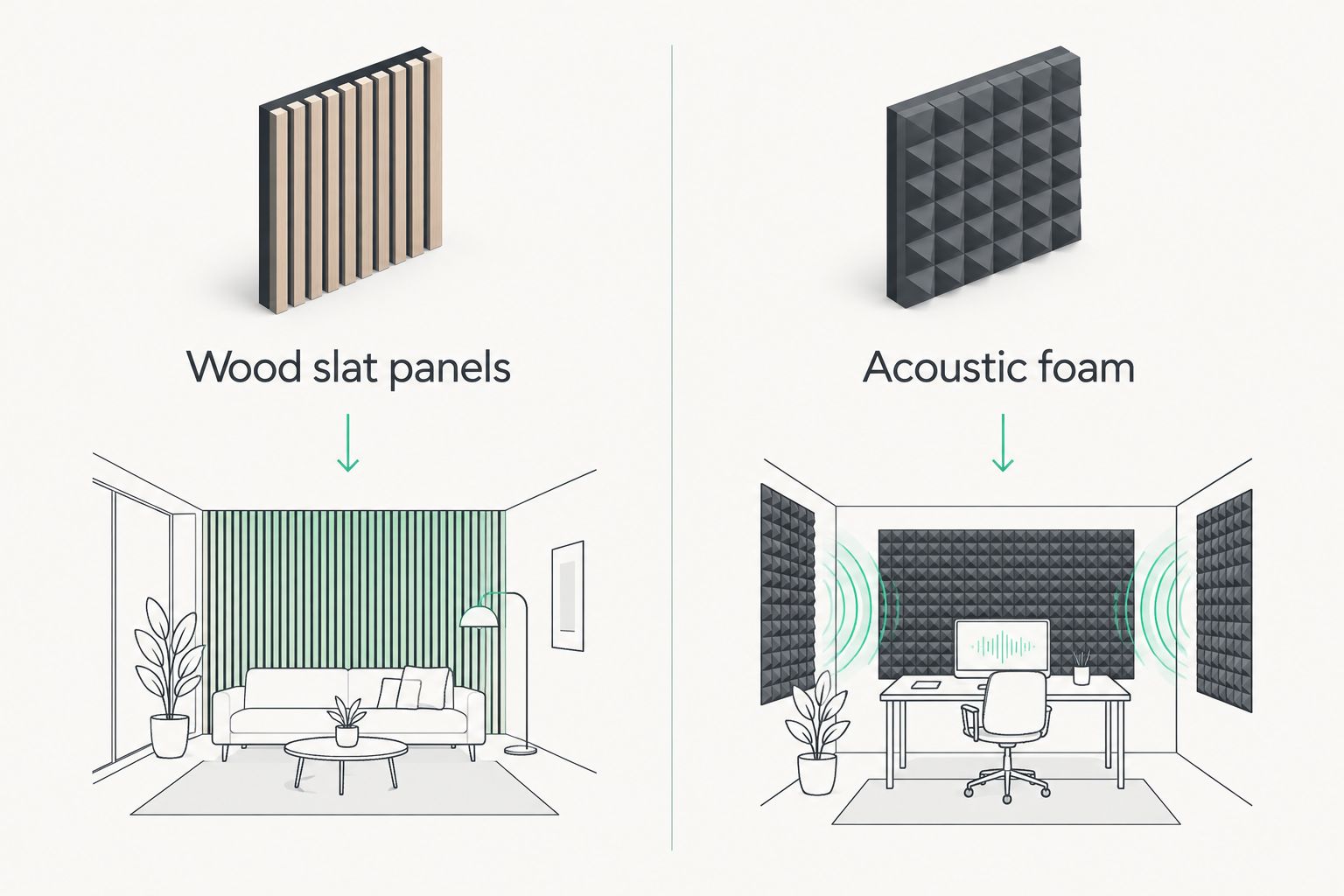
Wood panelling is better for combining a decorative wall finish with acoustic treatment. Foam is better suited to projects where exposed absorbers fit the design and you want to treat specific reflection points. For sound absorption alone, choose the tested assembly rather than the material label.
| Decision | Wood slat panels | Acoustic foam |
|---|---|---|
| Best for | Interior finish with acoustic treatment | Targeted absorption where an exposed foam finish is acceptable |
| How absorption works | Sound reaches absorbent backing through gaps between slats | Open-cell structure absorbs sound energy |
| Main advantage | Combines a wood surface with an absorbent backing | Offers treatment without a decorative wood facing |
| Main limitation | Slats, backing and mounting all affect performance | Thickness and construction limit the frequencies treated |
| Installation check | Confirm fixings, substrate and any specified cavity | Confirm adhesive or mounting compatibility and removal method |
| Soundproofing | Not a standalone soundproof wall | Not a standalone soundproof wall |
| Evidence to request | Frequency-based absorption data for the installed assembly | Frequency-based absorption data for the installed foam |
Start with the guide to reading NRC sound absorption ratings. A headline rating does not tell you how either treatment performs at every frequency.
Why this matters
An echoing living room and noise coming through a bedroom wall are different problems. Treating the wrong one leaves you with a new wall finish but the same frustration.
Room absorption reduces sound reflections inside your space. Sound insulation limits sound travelling between spaces and depends on the building construction, junctions, doors and other transmission paths. If your 2026 refurbishment aims to improve conversation or TV clarity, investigate room reflections first; if it aims to block neighbours, investigate sound transmission.
Listen for the problem before choosing a material
Speak from your usual seat, play familiar dialogue and listen from the places you actually use. A clap can reveal obvious flutter echo between hard surfaces, but it cannot measure a panel's absorption or diagnose every acoustic problem.
Separate the symptoms. Ringing after speech points towards reflections; a persistent low-frequency boom needs a closer look at room behaviour; clearly audible neighbours require an assessment of the separating construction.
Acoustic wood panels: best for a finished feature wall
Acoustic wood panels suit living rooms, bedrooms and offices where the treatment must also work as an interior finish. In a slatted system, the wood is not the whole absorber: the gaps, felt backing and any additional construction determine how the assembly interacts with sound.
Akustiq UK acoustic wood panels are best for homeowners who want a real wood veneer finish alongside felt-backed acoustic treatment. The indoor range includes three-sided real wood veneer and 240 cm and 300 cm formats. Those dimensions help you plan the wall layout; they do not establish an acoustic rating.
For a wood-finished living room or office, the Natural Oak wooden wall panel is a relevant option to assess. Check the installation instructions and supporting acoustic information before deciding how much wall to cover.
Advantages and limitations of wood panelling
- Advantage: the exposed surface provides a wood finish rather than leaving the absorber as the main visual feature.
- Advantage: slatted panels combine the decorative facing and absorbent backing within a wall treatment.
- Limitation: a decorative feature wall does not automatically provide enough absorption for the whole room.
- Limitation: direct mounting and cavity mounting are different assemblies; do not assume their test results are interchangeable.
When choosing wood panelling in 2026, decide whether your priority is a particular wall design, a measurable acoustic outcome, or both. For a specified acoustic outcome, make the evidence part of the purchase decision rather than an afterthought.
Acoustic foam: best for targeted reflection treatment
Acoustic foam suits recording corners, rehearsal spaces and other rooms where an exposed absorber is an acceptable finish. Its open-cell structure dissipates sound energy, but the result depends on the foam's construction, thickness and placement.
Do not choose foam because it has a wedge or pyramid pattern. Surface shape alone does not establish useful absorption across the frequencies causing your problem. Ask for the same frequency-based evidence you would request for wood panels.
Advantages and limitations of acoustic foam
- Advantage: foam treatment can be arranged around specific reflection areas rather than designed as a continuous wood feature wall.
- Advantage: it provides an exposed absorber where a decorative wood facing is unnecessary.
- Limitation: thin foam is not a complete answer to low-frequency room problems.
- Limitation: adhesive-mounted foam is not automatically removable without marking the wall.
Choose acoustic foam for its documented performance and practical fit, not because it looks like studio equipment. Check fire documentation, cleaning instructions and fixing requirements for the actual product, especially in workplaces or shared buildings.
Why acoustic performance varies
Material names describe only part of the treatment. These factors explain why two products sold as acoustic panels can behave differently:
- Absorbent construction: backing, foam structure and other absorbent layers affect how sound energy is dissipated.
- Thickness: porous absorption depends partly on absorber depth, particularly as you move towards lower frequencies.
- Mounting arrangement: a backing cavity changes the assembly, so test results must match the proposed installation.
- Treated area: a small decorative patch and a substantial treated surface do not provide the same total absorption.
- Placement: treatment must intercept relevant reflections rather than simply occupy the easiest available wall.
- Existing room surfaces: glazing, plaster, flooring, curtains and furniture all contribute to the room's acoustic behaviour.
The practical lesson is simple. A well-specified foam installation is a better choice than unverified wood panelling for a defined acoustic target, and the reverse also applies. Neither material deserves an automatic performance win.
What acoustic evidence should you compare in 2026?
Request an absorption report that identifies the product and the tested mounting arrangement. A result for panels over a cavity with additional absorption behind them does not establish the performance of panels fixed directly to plaster.
NRC, or Noise Reduction Coefficient, summarises absorption using the 250 Hz, 500 Hz, 1,000 Hz and 2,000 Hz frequency bands under the ASTM C423 method. It is useful for comparison, but it is not a soundproofing score or a complete description of bass performance.
Read the frequency results as well as the summary. A treatment chosen for speech reflections and one chosen for a low-frequency music problem need different scrutiny, even when both carry an acoustic label.
Ask these questions before ordering
- Which product was tested? Match the construction, not merely the range name or photograph.
- How was it mounted? Check for cavities, battens, backing materials and other test conditions.
- Which frequencies matter? Compare results around the problem you are treating rather than relying only on an average.
- Does the proposal match the room? Confirm the intended area and placement before committing to a layout.
For Akustiq UK acoustic wood panels, apply the same checks as you would to any alternative. Veneer finish and panel length answer design questions; the tested assembly answers performance questions.
How should you choose treatment for your room?
Begin with the activity, not the wall colour. You need treatment that improves the sound where you sit, speak, work or record, while remaining suitable for the room's everyday use.
Living room or bedroom
Best for a visible feature wall: acoustic wood panelling. Choose it when the wood finish is part of the brief, then plan the treatment around the room's reflective surfaces. Do not assume that panelling behind the TV alone will address reflections throughout an open-plan space.
Keep ordinary room furnishings in the assessment. Curtains, upholstered furniture and rugs contribute absorption too, although their effects differ by material and frequency.

Home office or recording corner
Best for targeted treatment with an exposed absorber: acoustic foam. Identify reflections around the speaking or listening position and check the foam's test data before selecting its thickness and layout. A wall covered with foam is not evidence that a microphone position is well treated.
If the office also needs a wood-finished video-call backdrop, wood panelling remains a relevant alternative. Make the choice on both appearance and the absorption required, rather than treating either material as compulsory.
Commercial meeting room
Best for a specified acoustic outcome: a documented treatment plan. Either material needs suitable acoustic evidence, fire documentation and a fixing method appropriate to the building. Appearance alone cannot establish suitability for an occupied commercial space.
For a 2026 fit-out, confirm those requirements before approving the decorative scheme. This avoids designing the room around a finish that does not meet the project's technical brief.
Will either treatment stop noise from neighbours?
Neither acoustic wood panels nor acoustic foam alone forms a soundproof separating wall. Both address absorption within a room rather than replacing the mass, airtightness and construction details needed to control sound transmission.
If neighbours' speech, music or footsteps are the problem, identify the transmission route before buying surface treatment. Noise can travel through adjoining walls, floors, ceilings, gaps and connected building elements.
Are wood panels better than foam for bass?
Wood panels are not automatically better than foam for bass. Low-frequency performance depends on the complete design, including absorber depth, cavities and any tuned elements; the visible facing does not settle the comparison.
For a booming home cinema or music room, request low-frequency data and assess the room. Neither a thin foam tile nor a decorative slatted surface should be assumed to provide a complete bass solution.
Can you combine acoustic wood panels and foam?
You can combine wood panels and foam when each has a defined role. A wood-finished feature wall and targeted foam treatment elsewhere can coexist, but placement and total absorption still need planning.
Avoid adding materials merely to fill bare space. Decide which reflections each area addresses, then check whether the combined treatment supports the room's intended sound.
FAQ
What's better for a living room, acoustic wood panels or acoustic foam?
Acoustic wood panels are the better fit when you want a wood-finished feature wall alongside acoustic treatment. Compare the tested assembly and plan the treated area; the finish alone does not guarantee enough echo reduction.
Does acoustic foam soundproof a bedroom?
Acoustic foam does not soundproof a bedroom on its own. It treats reflections inside the room rather than replacing a properly designed separating wall, floor or ceiling.
Do wooden slats absorb sound by themselves?
Solid wooden slats are not the main porous absorber in a felt-backed slatted panel. The backing, gaps and complete mounting arrangement determine the assembly's absorption.
Is a higher NRC always better?
A higher NRC indicates a higher average absorption across the frequencies used in that rating, not better performance for every problem. Compare frequency results and matching mounting conditions, especially when bass is the concern.
Can I glue either treatment straight onto a wall?
Use direct adhesive fixing only where the product instructions and wall substrate permit it. Check both acoustic test conditions and removal implications before treating direct mounting as interchangeable with another installation method.
Which panel length should I choose?
Choose panel length to suit the measured wall height and your planned joints and cuts. Akustiq UK offers indoor acoustic wood panels in 240 cm and 300 cm formats; length alone does not establish acoustic performance.
What should I check before buying acoustic treatment in 2026?
Check the product's absorption evidence, tested mounting arrangement, fire documentation and fitting instructions. Then confirm that the planned area and placement address your room's actual problem.
One last thing
Changing the mounting arrangement changes the acoustic comparison. Before choosing wood or foam, write down exactly what will sit between the visible treatment and the structural wall. If that build-up differs from the test report, do not carry the headline rating across to your installation.
Share:
Can beginners install acoustic wall panels themselves?
How much do 2400 x 600 acoustic wall panels cost?