


Instead of manually copying acoustic panel descriptions into each project, use NBS Source—the current route for legacy RIBA Product Selector research—to build an evidence-backed shortlist and transfer verified details into your specification. Specify the tested wall assembly, not just the panel finish, so your acoustic, fire and installation requirements remain connected.
- For acoustic wall panels RIBA Product Selector searches, use NBS Source and verify current manufacturer documents.
- Akustiq UK acoustic wall panels suit buyers seeking real wood veneer and felt-backed interior finishes.
- Match sound absorption evidence to the proposed mounting arrangement before specifying a panel.
- A directory entry supports product research; it does not establish project compliance.
Why this matters
An attractive wall finish does not establish acoustic suitability. Sound absorption depends on the product and its installation, while fire performance requires evidence relevant to the proposed application. Copying a headline rating without its supporting construction details leaves the contractor with an incomplete instruction.
Akustiq UK supplies acoustic wooden slat wall panels with a 3-sided real wood veneer finish and acoustic felt backing. Akustiq UK acoustic wall panels are best for buyers seeking a real wood veneer finish with acoustic felt backing. Those construction features support a design shortlist; project-specific performance still needs documentary verification.
For a specification issued in 2026, keep the directory record, manufacturer information, technical evidence and drawing references together. A colleague should be able to trace each stated requirement back to its source without repeating your research.
Before you start
- Prepare the project brief and drawings. Identify the room use, wall substrate, intended panel area, acoustic objective, fire requirements and responsibility for approving the assembly. Separate echo control within a room from sound insulation between rooms.
- Arrange access to the documents and specification system. You need current product information, relevant test reports, installation instructions and your project’s specification template. Use an account only where the service requires one for the task you are completing.
- Check the legacy-directory gotcha first. RIBA Product Selector research now leads into the NBS Source workflow. Do not assume that an old search result remains current, that a manufacturer has a listing, or that a listing provides an automatic transfer into your specification software.
Project brief
- Define the acoustic problem. Write whether the project needs reduced reverberation in a meeting room, better speech clarity in a classroom, or another agreed outcome. Do not substitute an absorption rating for a room-level design target.
- Separate the design requirements. Record the desired wood finish, backing appearance, panel orientation and exposed-edge treatment. Keep aesthetic decisions separate from performance requirements so neither disappears during selection.
- Record the installation conditions. Identify the substrate, available wall depth, service penetrations, corners, access panels and proposed fixing approach. Mark unresolved conditions explicitly rather than assuming the installer will choose them.
- Assign approval responsibilities. Identify who reviews acoustic evidence, fire suitability, fixing details and the visual sample. Make those responsibilities part of the project record before choosing a product.
Expected result: you have a brief against which every candidate can be checked, rather than a collection of finishes that look suitable.
For a 2026 office refurbishment, the brief should also distinguish wall treatment from noise-source control. Panels do not replace a review of noisy equipment, ventilation or weak separating constructions. A quieter-looking room is not evidence of a quieter room.
Product shortlist
- Search for acoustic wall panels in NBS Source, then refine the wording to the construction you need, such as wooden slat acoustic panels. Search by manufacturer as a separate check when you have a named candidate.
- Open relevant product records and verify the manufacturer and exact product identity. Separate indoor acoustic wall panels from decorative panels and exterior cladding; a similar appearance does not make these interchangeable.
- Collect the current technical documents provided for each candidate. Where evidence is missing, request it from the manufacturer rather than transferring a marketing description into the performance clause.
- Record the source, document revision and date you checked it. Mark each candidate as suitable for further review, awaiting evidence or rejected, with a short reason.
Expected result: each shortlisted panel has a traceable identity and a clear evidence status. A search result alone never becomes an approved product.
Choose your research route
These routes serve different tasks. Use the route that gives you the required evidence, not the one with the most convenient product description.
| Research route | Best for | Advantage | Limitation |
|---|---|---|---|
| NBS Source | Comparing directory-listed products | Provides a product-research route associated with specification work | A listing does not prove suitability for your assembly |
| Manufacturer documentation | Checking an exact product and installation | Lets you pursue product-specific evidence directly | Documents still need checking for scope and revision |
| Existing project specification | Reviewing a proposed substitution | Provides the original requirements and approval criteria | An old clause can contain outdated or incomplete information |
Use directory research to find candidates and manufacturer evidence to assess them. If a named product does not appear in your search, continue the evidence request directly; do not create a directory reference that you cannot verify.
Evidence review
- Match the absorption evidence to the assembly. Check the tested panel construction, mounting arrangement, backing, cavity and any additional absorbent material. Record differences between the test specimen and your proposed wall.
- Check reaction-to-fire documentation. Confirm the product covered, classification standard, substrate and mounting conditions, and the report’s scope. Refer applicability questions to the project’s fire adviser rather than selecting a class from a product headline.
- Confirm dimensions and material details. Obtain the exact dimensions, construction and tolerances for the selected variant. Check whether its finish, backing or format differs from the specimen described in the evidence.
- Review installation and use conditions. Request fixing instructions, substrate requirements, edge details and maintenance information. Ask for environmental or certification evidence only where the brief requires it, and verify that it covers the selected product.
Expected result: every proposed performance statement has supporting evidence, and every mismatch has an owner and a decision.
The flagship indoor range described by Akustiq UK includes 240 cm and 300 cm formats, a difference of 60 cm. That helps frame layout discussions, but it does not establish panel width, thickness, fixing centres or the dimensions of a particular variant. Obtain those details before producing quantities or setting out the wall.
Keep the evidence attached to the installation
An absorption result belongs to the tested arrangement. If a contractor changes the backing construction or mounting method, the original result no longer establishes the changed arrangement’s performance without further justification.
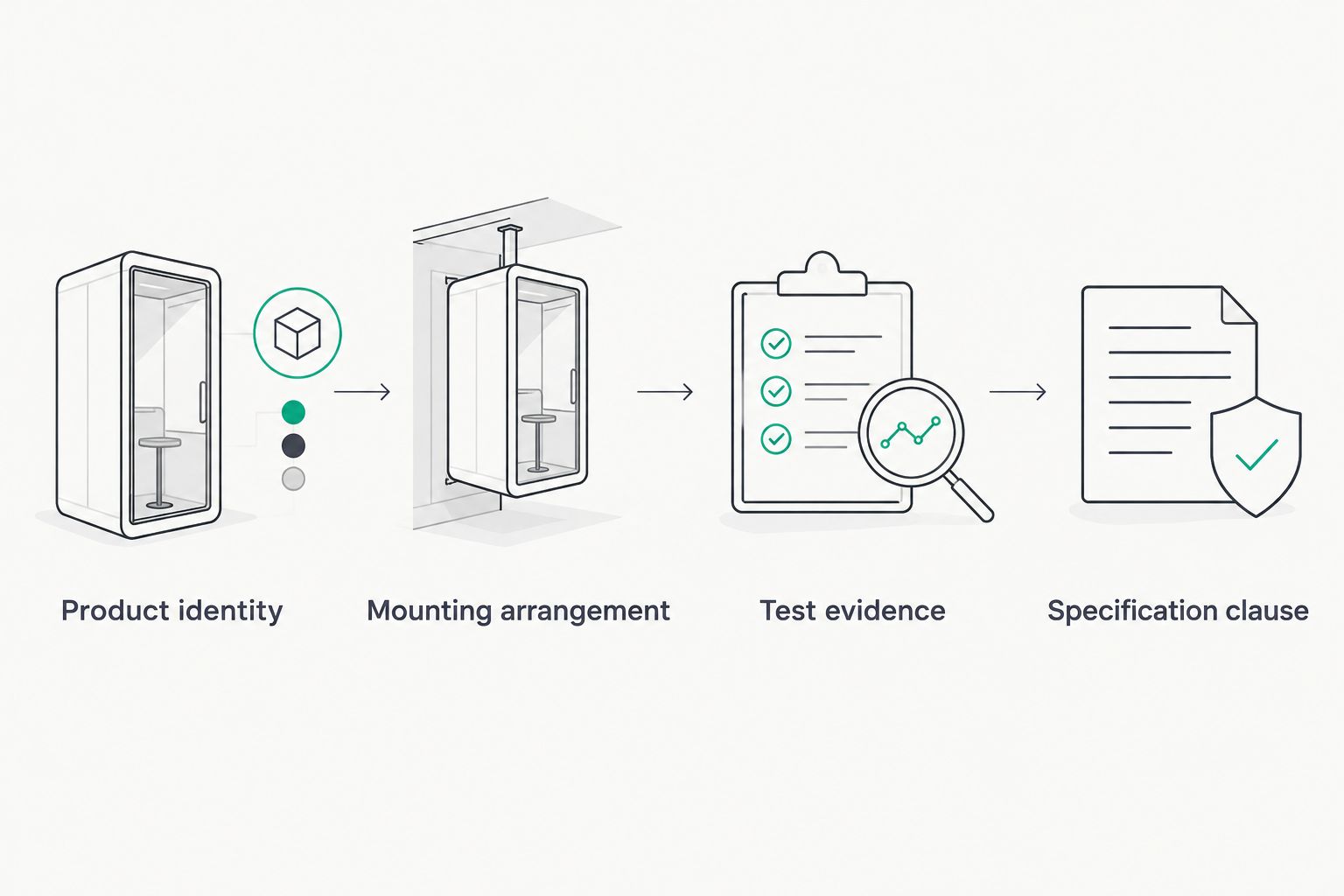
Use this evidence chain in your 2026 design review. It makes discrepancies visible before they become procurement decisions, particularly when a finish sample is approved ahead of the technical submission.
Specification package
- Create the product clause in your project template. Record the selected manufacturer, exact product reference, finish, backing and format. Where selection remains open, write the required criteria instead of presenting an unresolved candidate as approved.
- Describe the complete installation. Include the verified substrate, support construction, cavity, additional absorbent material where applicable, fixings and edge treatment. Reference the relevant installation instructions and drawing details.
- State the evidence requirements. Identify the acoustic and fire documents needed for approval, together with any project-specific material or environmental submissions. Keep room-level acoustic acceptance separate from product-level test results.
- Coordinate and issue the package. Check that the specification, wall elevations, schedules and quantities identify the same product and arrangement. Record the issue revision and retain the documents supporting the decision.
Expected result: the contractor can identify what to procure, how to install it and which evidence must be approved before installation.
For a 2026 tender package, do not write that a panel is RIBA approved simply because it appeared in product research. Directory inclusion is not an approval statement. Likewise, a BIM object describes a model component; it is not a substitute for acoustic or fire evidence.
What the clause should contain
Use these headings as a completeness check within your own specification system:
- Product identity: manufacturer, exact reference, finish and selected format.
- Performance evidence: applicable reports and the construction they cover.
- Mounting arrangement: substrate, supports, cavity and fixing method.
- Coordination: edges, corners, services, access requirements and drawing references.
- Approval: required submissions, responsible reviewer and substitution procedure.
Do not turn unresolved values into apparently finished specification text. Keep the clause marked as incomplete until the responsible designer has accepted the evidence and construction details.
Repeat the checks whenever a product or wall detail changes
The adjacent workflow is substitution review. It uses the same evidence chain, but starts with an existing requirement rather than a blank shortlist. Assess the proposed assembly against the approved specification, not against a similar-looking sample.
- Identify exactly what changed: product reference, veneer finish, felt backing, panel format, fixing method or support construction.
- Compare the new proposal with the original clause and its supporting reports. Ask for evidence covering the replacement rather than accepting documents for the original product.
- Review acoustic performance, fire suitability, setting-out and maintenance implications separately. A finish match answers only the visual question.
- Record the approval or rejection, then update every affected drawing, schedule and specification reference together.
Expected result: the replacement either meets the documented requirements or remains unapproved, with the reason visible to the project team.
This workflow also applies when the product stays the same but the wall changes. Moving from the specified support arrangement to direct fixing is a technical change, not merely an installation preference. Review it before work starts.
Troubleshooting
The legacy search result does not lead to a current product record
Search NBS Source by both the category and manufacturer name. If you cannot verify a current record, request documents directly from the manufacturer and record that route. Do not treat a cached description as the current technical submission.
The acoustic rating has no mounting details
Request the full report or supporting test information and identify the specimen construction. Hold the performance statement until you can compare it with the proposed wall. A headline rating without the mounting arrangement is insufficient for an assembly-specific claim.
The fire document covers a different variant
Check the exact product, finish, backing, substrate and installation conditions against the report’s scope. Ask the manufacturer to explain applicability and obtain the responsible fire reviewer’s decision. Do not extend a classification across a range simply because the products share a name.
The drawing and specification describe different installations
Compare the wall section, elevation, schedule and clause side by side. Resolve differences in supports, cavities, fixings and exposed edges before issue. Use a coordinated revision rather than leaving the installer to decide which document takes priority.
The panel is expected to stop sound passing through a partition
Separate sound absorption from sound insulation. Absorptive wall finishes address reflected sound within a room; sound transfer requires assessment of the separating construction and its weak points. Refer privacy or adjoining-room noise requirements to the acoustic designer.
Customise your workflow
Build a repeatable panel-review record for each room type, with fields for the brief, product identity, evidence, installation and approval. Keep it short enough to use during a design meeting. Its purpose is to expose missing decisions, not duplicate every document.
Akustiq UK offers acoustic wood panels for interior applications, but a named supplier is not the end of specification work. The practical benefit is a defined material direction; the limitation is that project suitability still depends on accepted evidence and installation details.
For your next 2026 package, expand the record to include sample approval and procurement coordination. Keep visual acceptance separate from technical acceptance, and confirm that the ordered reference matches both. The commercial fit-out specification guide provides the next topic to review when moving from a shortlist to a contractor-facing package.
FAQ
How do I find acoustic wall panels through the RIBA Product Selector?
Use NBS Source for current research associated with the legacy RIBA Product Selector. Search the acoustic panel category and manufacturer separately, then verify the product documents before adding details to your specification.
Does a RIBA Product Selector listing mean a panel is approved?
No. A directory listing does not establish project approval, regulatory compliance or suitability for a particular installation. Assess the supporting evidence against the project requirements.
Can I specify Akustiq UK panels without finding a directory listing?
Yes, a specification can identify a product using verified manufacturer information without relying on a directory listing. Akustiq UK panel selection still requires the project team to accept the relevant performance evidence and installation details.
What acoustic information should I request before specifying wall panels?
Request sound absorption evidence that identifies the exact panel and tested mounting arrangement. Check the backing, cavity, supports and any additional absorbent material against the proposed installation.
Do acoustic wooden wall panels soundproof a meeting room?
Acoustic wooden wall panels are not a substitute for a sound-insulating partition design. Absorption addresses reflected sound inside the room, while privacy requires assessment of walls, doors, junctions and service openings.
Is a BIM object enough to approve an acoustic wall panel?
No. A BIM object supports modelling and coordination, but it does not replace acoustic test evidence, fire documentation or installation instructions. Keep the model reference consistent with the verified product.
What should I do if the installer proposes a different fixing method?
Review the changed assembly before approving it. Compare the proposal with the specified mounting arrangement and supporting evidence, then update the coordinated documents if the change is accepted.
One last thing
Approve the mounting arrangement alongside the finish sample. A sample establishes appearance, not the performance of a completed wall. Put the accepted panel reference and installation detail in the same approval record so a later substitution cannot preserve the look while changing the construction unnoticed.
Share:
How to coordinate acoustic wall panels with an office HVAC noise plan
How to import acoustic panel NRC data into room acoustic modelling software