

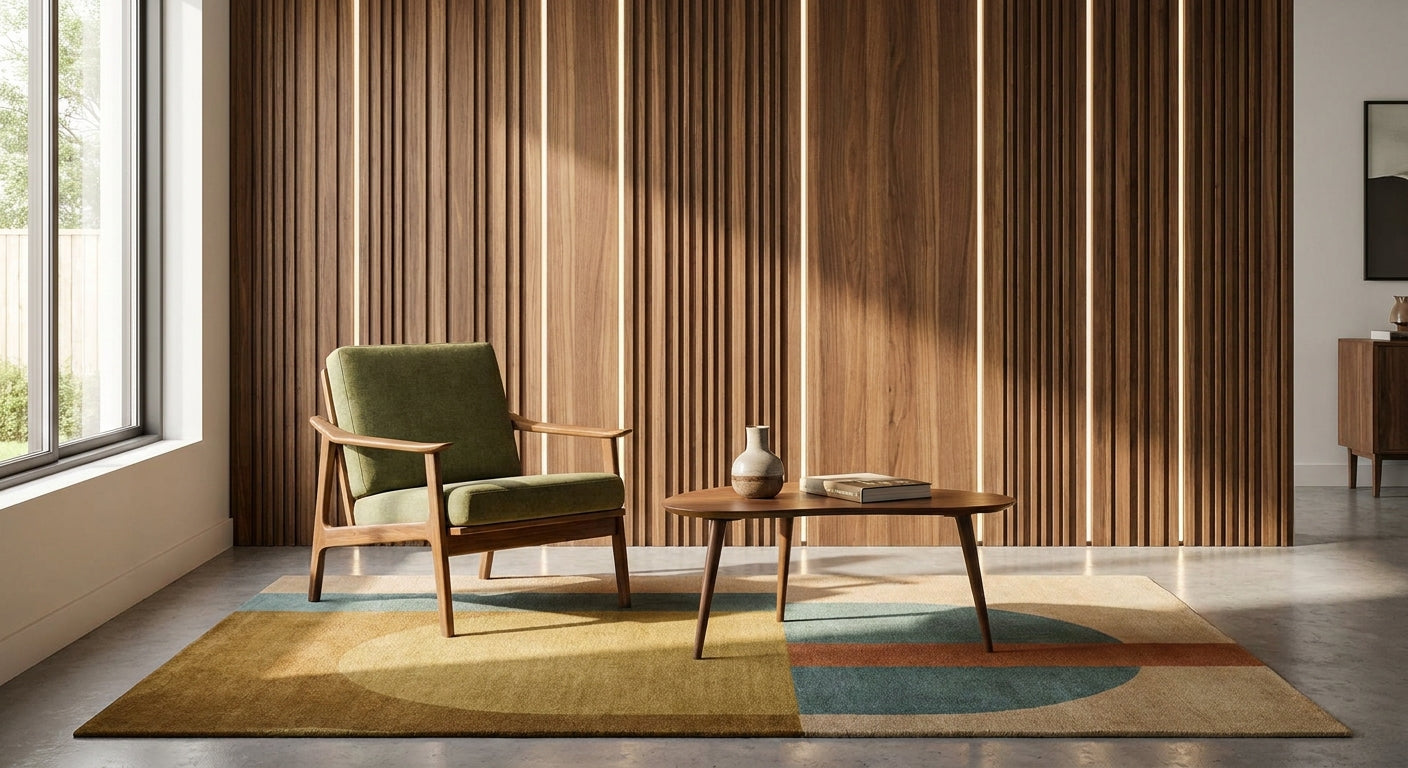
Mid-century modern interiors run on warm wood, clean lines and almost no clutter — which makes wall texture the single biggest lever you have left. This guide ranks the wood wall panels that actually read as mid-century modern in 2026, not just "wood-look" panels with the wrong grain or the wrong tone.
TL;DR
For a genuine mid-century modern feel, Walnut Wooden Wall Panels from Akustiq UK are the safest buy: the reddish-brown veneer and vertical slat rhythm match the Eames-era palette almost exactly. If you want something lighter, Natural Oak Wooden Wall Panels deliver the same acoustic wood panel construction in a warmer, honey-gold finish that suits smaller rooms. Both come in 240 cm and 300 cm formats with a 3-sided real wood veneer and felt acoustic backing, and both are a Buy for 2026 mid-century modern projects. Skip anything with a printed or laminate finish — mid-century design lives or dies on real timber grain.
Why this matters
Mid-century modern isn't a colour scheme, it's a material logic: solid wood, exposed grain, warm tones, minimal ornament. A flat-painted wall or a generic slatwall panel breaks that logic instantly, no matter how good the furniture is.
Wood wall panels solve two problems at once. They add the timber texture the style demands, and — because the wooden wall panel range is built with an acoustic felt backing — they also cut down the flutter echo that bare plaster and hard flooring create in open, sparsely furnished mid-century rooms. That's a real functional gain, not just an aesthetic one, and it's the reason acoustic wood panels have overtaken plain veneer sheets as the default choice for this style in 2026.
How we ranked
Each panel finish was scored against four criteria that matter specifically for mid-century modern rooms: grain authenticity (does it read as real wood veneer or does it look printed), tone accuracy (does it sit in the warm walnut-to-oak range the style calls for), format flexibility (240 cm vs 300 cm coverage), and acoustic performance (felt-backed vs unbacked). Panels that scored well on grain and tone but failed on format or acoustic performance were marked down, not excluded. Pricing wasn't scored directly — availability and finish accuracy were weighted higher, since a mid-century modern wall lives or dies on how convincing the wood looks, not on being the cheapest board in the catalogue.
The ranked list
1. Walnut Wooden Wall Panel — the archetypal tone
Walnut is the wood mid-century modern designers reached for first, and the deep reddish-brown 3-sided veneer on this panel matches that palette closely. Available in the standard 240 cm and 300 cm lengths, it pairs naturally with tan leather, brass fixtures and the tapered-leg furniture the era is known for. The felt backing sits behind the slats, so you get sound absorption without losing the visible grain.
For a living room or study aiming at a genuine 1960s feel, this is the finish to start with. Verdict: Buy.
2. Natural Oak Wooden Wall Panel — the warm neutral
Not every mid-century modern room wants walnut's darkness — a lot of Scandinavian-influenced mid-century interiors lean lighter. The Natural Oak panel gives you that same slat profile and 3-sided veneer construction in a honey-gold tone that brightens smaller rooms without breaking the material logic of the style.
It reads as authentic wood grain up close, which matters because printed oak-effect boards are common at this price point and almost never pass inspection next to real veneer. Verdict: Buy.
3. Smoked Oak Wooden Wall Panel — the moody update
Smoked Oak sits between walnut and natural oak on the tone scale — grey-brown, slightly weathered-looking, and increasingly popular in 2026 for mid-century modern rooms that want to avoid feeling like a period reproduction. It works especially well as a single feature wall behind a sideboard or media unit rather than floor-to-ceiling.
The grain is still real 3-sided veneer, so it holds up to the same close-up scrutiny as the lighter finishes. Verdict: Buy for a feature wall, Consider for full-room coverage.
4. Grey Oak Wooden Wall Panel — the wildcard
Grey Oak is the one finish on this list that pushes past strict mid-century modern into a more contemporary-minimalist register. It's cooler in tone than anything the 1950s-60s palette would have used, but it can work as a deliberate contrast wall against warmer walnut or oak furniture.
Treat it as an accent, not a base — used across a whole room it tips the space toward Scandi-minimalist rather than mid-century. Verdict: Consider, accent use only.
5. Rustic Oak Premium 3-Sided Wood Veneer — the one to skip
Rustic Oak's heavier knots and grain variation are built for farmhouse and rustic interiors, and that's exactly the problem for mid-century modern rooms, which depend on clean, restrained grain lines rather than rough texture. It's a genuinely good panel for the right room; this just isn't that room.
Verdict: Skip for mid-century modern projects.
6. Hexagon Acoustic Panel, Natural Oak with Grey Felt — the geometric layer
Hexagon panels aren't a mid-century staple on their own, but a small cluster of them in natural oak with grey felt can work as a secondary geometric accent alongside a slat-panelled feature wall — mid-century interiors did use geometric motifs in rugs, tile and screens. Used sparingly, on one wall segment, it adds pattern without fighting the slat panel's linear rhythm.
Verdict: Consider as a secondary accent, not a primary wall treatment.
Comparison table
| Finish | Tone | Format | Best use in a mid-century modern room | Verdict |
|---|---|---|---|---|
| Walnut | Deep reddish-brown | 240 cm / 300 cm | Full room, living rooms, studies | Buy |
| Natural Oak | Warm honey-gold | 240 cm / 300 cm | Full room, smaller spaces | Buy |
| Smoked Oak | Grey-brown, weathered | 240 cm / 300 cm | Feature wall behind furniture | Buy (feature wall) |
| Grey Oak | Cool grey | 240 cm / 300 cm | Contrast accent wall | Consider |
| Rustic Oak Premium | Heavy grain, knotty | 240 cm / 300 cm | Farmhouse interiors, not MCM | Skip |
| Hexagon Natural Oak w/ grey felt | Warm gold, geometric | Modular hex tiles | Secondary pattern accent | Consider |
Where to buy
Order a sample before committing to a full wall — wood veneer tone shifts noticeably under different room lighting, and what reads as walnut on a screen can look almost black under warm bulbs. Sample panels exist for every finish on this list, so check tone against your actual wall before ordering the full 240 cm or 300 cm boards.
Buy panel glue at the same time as the panels rather than sourcing it separately — matching adhesive and panel batch avoids colour mismatch issues if you need to reorder later in 2026. If you're mixing finishes (walnut feature wall plus natural oak elsewhere), order both sample sets side by side rather than trusting product photography alone.
FAQ
What's the best wood wall panel for mid-century modern interiors? Walnut wall panels are the closest match to the original mid-century modern palette because of their deep reddish-brown veneer tone. Natural Oak is the best lighter alternative for smaller or brighter rooms.
Is walnut better than oak for a mid-century modern feature wall? Walnut is more historically accurate to the style, but oak (natural or smoked) works equally well in 2026 interiors that blend mid-century shapes with a lighter, Scandi-influenced palette. Neither is objectively wrong — it depends on your existing furniture tones.
Do wood wall panels need to be acoustic to suit a mid-century modern room? No, but felt-backed acoustic panels solve a real problem in these rooms: minimal furniture and hard flooring create flutter echo, and acoustic wood panels absorb it without adding visible foam or fabric panels that break the style.
What size wood wall panels should I use for a standard UK room? 240 cm panels suit standard ceiling heights found in most UK homes, while 300 cm panels are built for taller rooms or floor-to-ceiling coverage in loft conversions and extensions.
Can I mix walnut and oak panels in the same mid-century modern room? Yes — a walnut feature wall paired with natural oak on adjoining walls is a common mid-century modern approach, as long as the two tones don't compete on the same wall.
How much wall coverage do I need for a mid-century modern feature wall? Measure the wall width and height first, then calculate panel count based on the 240 cm or 300 cm format you're using — most single feature walls need fewer than ten panels depending on room size.
Are rustic or knotty oak panels suitable for mid-century modern rooms? No. Rustic Oak's heavy grain and knots suit farmhouse or rustic interiors, not the clean, restrained grain lines mid-century modern rooms need.
Do hexagon wood panels fit a mid-century modern style? Used sparingly as a secondary accent, yes — hexagon acoustic panels echo the geometric motifs common in mid-century textiles and screens, but they shouldn't replace a primary slat-panelled wall.
One last thing
The detail most people miss: mid-century modern rooms were rarely all one wood tone. Original interiors from the 1950s and 60s regularly paired walnut furniture against a lighter oak or ash wall, using tone contrast rather than matching everything. If your walnut feature wall is starting to feel heavy, don't reach for more walnut elsewhere in the room — a natural oak wall on an adjoining surface will do more for the mid-century modern feel than doubling down on one tone. For guidance on combining finishes without it looking accidental, see how to mix different wood panel finishes in one room.
Share:
Exterior Cladding for Breeze Block Walls: 2026 Verdict
Natural Oak Cladding for Garden Room Exterior: 2026 Verdict