

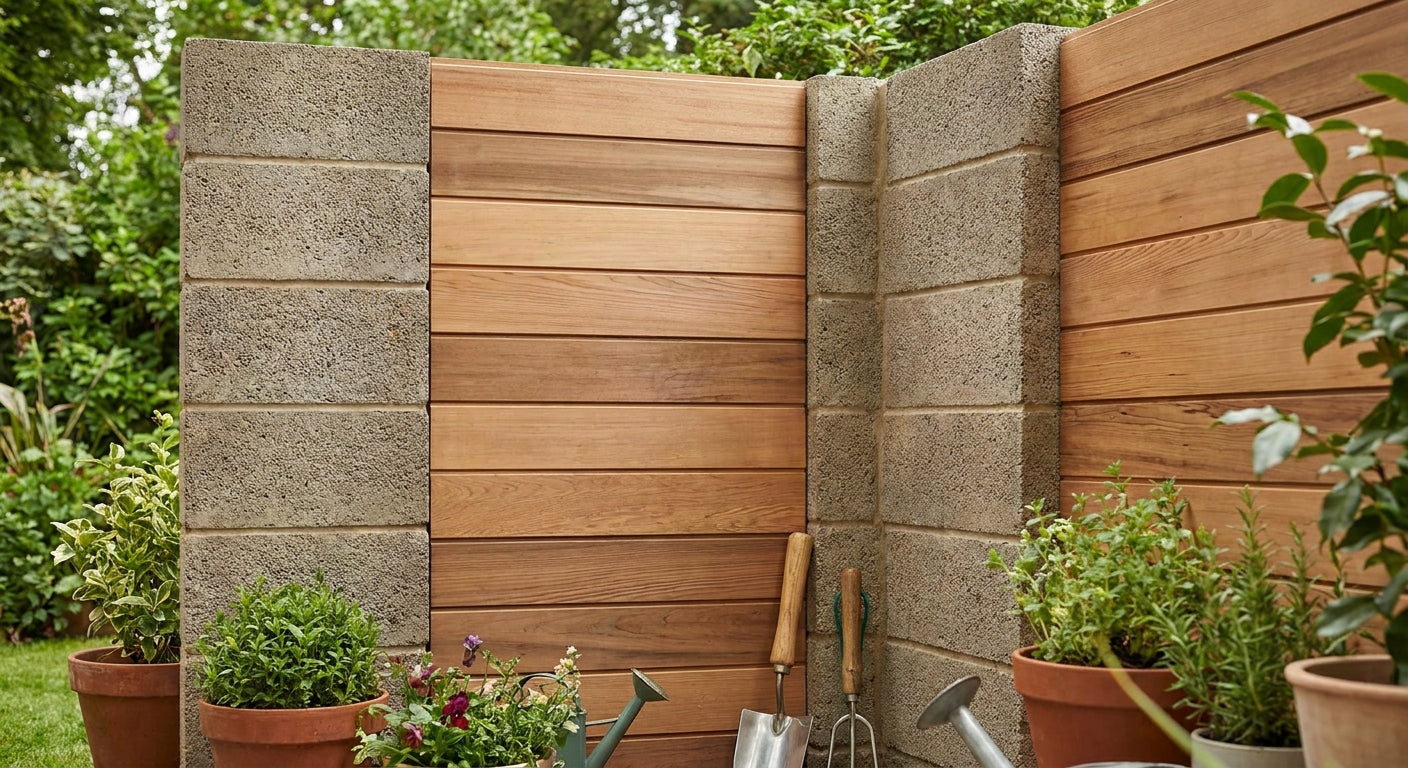
Cladding a breeze block garden wall turns bare grey block into a finished exterior wall without pulling it down and rebuilding in brick or render.
This guide covers what actually matters when you're choosing exterior cladding for breeze block wall projects in 2026 — fixing method, weatherproofing, and which finish holds up on an exposed boundary or garden room wall.
TL;DR
For exterior cladding for breeze block wall jobs in 2026, the Stone Grey exterior cladding panel from Akustiq UK is the safe buy — it sits close to typical render tones and needs a standard batten fixing system that works on porous block. The Black exterior cladding panel is the stronger pick if you want a modern contrast finish rather than a blend-in look. Skip anything marketed as universal cladding with no stated batten or ventilation gap system — on a breeze block wall, that's the detail that decides whether the cladding lasts or traps damp behind it. Both Akustiq UK picks are rated Buy for 2026 breeze block projects; a third finish, oak, is a Consider rather than a default.
Why this matters
Breeze block walls are structural, not decorative — they're built for strength, not looks, which is why so many UK gardens end up with a grey, cold-looking boundary wall by the patio or garden room. Cladding solves the aesthetic problem, but breeze block behaves differently to brick or timber frame: it's more porous, and it doesn't always give you a flat, even fixing surface.
Get the detail on exterior cladding panels for garden walls wrong and you end up with panels that bow, discolour, or trap moisture against the block within a season or two. Get it right and the wall reads as a designed feature rather than a patched-over problem.
Who this is for
This guide is for homeowners with an existing breeze block boundary wall, garden room shell, or outbuilding who want to clad the exterior rather than render or repoint it. It's also relevant if you're finishing a new breeze block skin on a self-build or extension and want a timber or composite face rather than raw block or wet render.
What to look for in exterior cladding for breeze block walls
Weatherproofing built for exposed masonry
Breeze block absorbs and holds water more readily than dense brick, so cladding sitting directly against it without a gap becomes a damp trap rather than a damp barrier. Panels designed for exterior use need to shed water off the face and allow airflow behind, not just resist rain on the front surface.
Fixing method matched to breeze block
Breeze block doesn't always take a screw or fixing as cleanly as brick or timber, especially on older or lower-grade block. Cladding that relies on a standard vertical batten system, rather than direct adhesive fixing, gives you a more forgiving install on an uneven block face.
Colour that works with render, not against it
Most UK gardens with breeze block walls have a rendered house behind them, so the cladding either needs to blend with that render tone or contrast deliberately. A stone grey or muted finish sits close to typical render colours; black or a strong wood tone reads as a statement rather than a match.
A ventilation gap behind the panel
This is the single most-skipped detail on DIY exterior cladding jobs. A 25-32mm batten gap behind the cladding lets moisture that does get through evaporate, instead of sitting against the block and encouraging mould or timber rot behind the panel.
Trims and finishing pieces for clean edges
A cladding panel on its own doesn't solve corners, top edges, or joins against a fence post or gate — that's where finishing trim earns its keep. Exposed edges without a trim are the first place cladding starts to lift or discolour, particularly on a wall that takes wind-driven rain.
Maintenance load in a UK climate
A breeze block wall clad in exterior panels still sits outside year-round, through frost, driving rain, and UV exposure across a British summer. Finishes that need annual oiling or resealing are a different ongoing commitment to a composite board that's built to be left alone.
Top picks for breeze block walls
Stone Grey exterior cladding panel — the safe pick
This is the finish that does the least visual damage if you get the colour match wrong, because it sits within the tonal range of most rendered UK house exteriors. It uses the standard batten fixing approach suited to an uneven breeze block face rather than a flat, factory-finished substrate.
Spec that matters: the tone works across both painted white render and warmer sand-toned render finishes without clashing. Verdict: Buy — this is the default choice for a boundary wall or garden room exterior in 2026 where you want the wall to disappear into the rest of the garden rather than stand out.
Stone Grey exterior cladding panel
Black exterior cladding panel — the modern statement
Black exterior cladding on a breeze block wall reads as a deliberate design choice rather than a repair job, and it's the finish that photographs best against greenery and paving. It uses the same batten-based fixing system as the grey option, so the install complexity doesn't change — only the visual outcome does.
Spec that matters: dark finishes show less patina from rain streaking than pale renders do over a season. Verdict: Buy for anyone treating the boundary wall as a feature rather than something to hide.
Oak exterior cladding panel — the warm-tone option
Oak grain brings warmth that stone grey and black don't, and it suits gardens with a lot of planting or a more traditional cottage-style house behind the wall. The trade-off is that lighter wood tones show dirt streaking and green algae bloom faster on a north-facing or shaded wall than a solid grey or black finish does.
Spec that matters: oak tones need a wall aspect that gets some sun and airflow to stay looking clean through a wet UK winter. Verdict: Consider — right for a south or west-facing wall, a weaker pick for a permanently shaded, damp corner of the garden.
What to avoid
- Cladding sold without a stated fixing or batten system. If the listing doesn't tell you how it attaches to masonry, assume it's designed for a flat timber or metal frame substrate, not an uneven breeze block face.
- Indoor acoustic panels used outdoors. Felt-backed acoustic wood panels are built for indoor sound absorption, not weather exposure — the felt backing has no role to play outside and will hold moisture against the wall.
- Render-effect composite with no ventilation detail. If a product doesn't mention an air gap behind the panel, you're likely looking at a system designed for a different wall type than exposed breeze block.
Verdict comparison table
| Criteria | Stone Grey | Black | Oak |
|---|---|---|---|
| Blends with typical UK render | Strong | Weak (deliberate contrast) | Moderate |
| Best wall aspect | Any | Any | South/west facing |
| Maintenance load | Low | Low | Moderate |
| Best for | Blending in | Feature statement | Warm, planted gardens |
| Verdict | Buy | Buy | Consider |
FAQ
What's the best exterior cladding for a breeze block wall? A composite or timber-effect cladding panel fixed on a ventilated batten system is the best exterior cladding for breeze block wall projects in 2026, because it accounts for the block's porous surface and uneven fixing points. Stone grey and black finishes are the strongest all-round picks for UK gardens.
Can you fix cladding directly to breeze block without battens? Direct fixing is possible on a flat, sound block face, but a batten system is the more reliable route because it creates the air gap breeze block needs to avoid trapping moisture. Skipping battens raises the risk of damp building up behind the panel over a wet UK winter.
Is exterior cladding waterproof enough for a garden wall in the UK? Exterior-rated cladding panels are built to shed rain off the face, but the wall's long-term dryness depends more on the ventilation gap behind the panel than the panel material itself. A well-ventilated install outlasts a sealed, gap-free one in UK rainfall conditions.
How much does exterior wall cladding cost per square metre? Pricing varies by finish and panel format, so check current listings directly on the Akustiq UK site for up-to-date figures rather than relying on a fixed number.
Do you need planning permission to clad a garden wall? Most garden wall cladding falls under permitted development in England and Wales, but boundary walls near a road, in a conservation area, or on a listed property can have different rules — check with your local planning authority before starting.
Can you use indoor acoustic panels outside? No — indoor acoustic wood panels with a felt backing are built for sound absorption in dry, temperature-stable rooms, not for rain, frost, or UV exposure. Use an exterior-rated cladding panel for any wall facing the weather.
How long does exterior cladding last on a breeze block wall? With correct battening, a ventilation gap, and finishing trims at the edges, composite and timber-effect cladding is built to handle repeated UK weather cycles across multiple years rather than one season. The install detail matters more to longevity than the panel material alone.
What colour cladding suits a rendered UK garden? Stone grey is the safest match for the pale and sand-toned renders common on UK houses, while black works better as a deliberate contrast rather than a blend. Oak suits gardens with heavier planting and a sunnier wall aspect.
One last thing
The detail most DIYers skip on a breeze block cladding job isn't the panel choice — it's the gap behind it. A 25-32mm ventilated batten gap does more for long-term durability in 2026 than picking between grey, black, or oak ever will, because breeze block holds water differently to brick and needs that airflow to dry out between wet spells.
Share:
Waterproofing Base of Exterior Cladding: 2026 Guide
Waterproofing Base of Exterior Cladding: 2026 Guide