

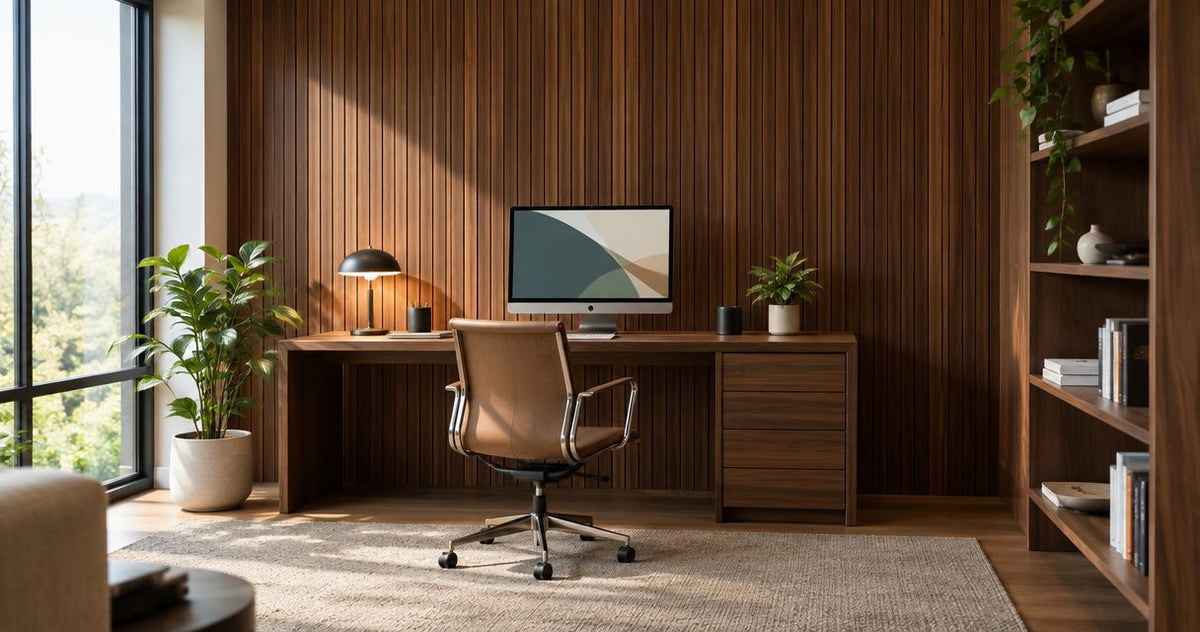
Best overall: Wooden Wall Panel | Walnut 240 x 60 cm. Best for tall walls: Wooden Wall Panel | Walnut 300 x 60 cm XL. Best for a grey-led office: Wooden Wall Panel | Grey Walnut 240 x 60 cm. This 2026 guide compares walnut wall panels by dimensions, veneer finish and home-office use, with clear limits on what acoustic panelling does.
- Akustiq UK walnut wall panels suit home offices needing real wood veneer and acoustic felt backing.
- Choose Walnut 240 x 60 cm for a desk feature wall that fits within its length.
- Choose Walnut 300 x 60 cm XL when your planned panelled height exceeds 240 cm.
- Choose Grey Walnut 240 x 60 cm for a grey-led office scheme.
- Treat room echo and noise passing through walls as different problems.
Why this matters
Your home office has to work when the camera is off, too. A panelled backdrop changes the room's appearance, but an acoustic wall treatment should also address the sound reflected around your working area.
Akustiq UK walnut wall panels are best for home-office buyers who want real wood veneer with acoustic felt backing. Choose the format around your measured wall, then choose the finish around your desk, lighting and existing furniture.
For your 2026 office project, keep the brief specific: a desk surround, a video-call backdrop or a taller feature wall. These are different layouts, and the longest panel is not automatically the right one.
What makes the best walnut wall panels?
Use these criteria before comparing finishes. They separate a panel that suits your office from one that simply looks attractive in a photograph.
- Panel length: Match the panel to the intended finished height, not an assumed ceiling height.
- Panel width: The shortlisted slat panels are 60 cm wide; plan the visible edges and cuts around that format.
- Veneer finish: Each shortlisted panel specifies three-sided wood veneer. Check the sample from an angle as well as straight on.
- Acoustic purpose: Felt-backed acoustic panels address room reflections; do not treat them as a complete soundproofing system.
- Room colour: Compare Walnut and Grey Walnut alongside your actual desktop, flooring and wall paint.
- Installation layout: Account for sockets, skirting, shelving and wall-mounted equipment before choosing your panel quantity.
Walnut wall panels at a glance
This 2026 shortlist compares formats within the Akustiq UK range. The ranking is a home-office buying guide, not a claim that one finish absorbs more sound than another.
| Panel | Best for | Standout feature | Key limitation |
|---|---|---|---|
| Wooden Wall Panel — Walnut 240 x 60 cm | A measured desk feature wall | Three-sided wood veneer in the shorter format | Cannot cover a height above 240 cm in one vertical piece |
| Wooden Wall Panel — Walnut 300 x 60 cm XL | Taller floor-to-ceiling layouts | Longer format for high ceilings | Requires more handling space than the 240 cm format |
| Wooden Wall Panel — Grey Walnut 240 x 60 cm | Grey-led office interiors | Grey Walnut finish with three-sided wood veneer | Not the same finish as Walnut; compare before combining |
The product names above distinguish the panel formats. All three are veneer panels rather than solid walnut boards, so choose them for that construction rather than assuming the entire slat is solid walnut.
1. Walnut 240 x 60 cm: best walnut wall panels for desk walls
The Wooden Wall Panel | Walnut 240 x 60 cm combines a walnut veneer finish with the range's acoustic felt backing. Its 240 cm length suits a desk feature wall when your intended panelled height fits within that dimension.
This is the default choice for a contained home-office layout. Start with the wall you actually want to cover rather than extending the design around the entire room.
Walnut 240 x 60 cm pros:
- Three-sided wood veneer gives you a wood finish across the specified slat faces.
- The 240 cm format avoids choosing extra length when your layout does not need it.
- The 60 cm width gives you a consistent module for planning a desk surround.
- Acoustic felt backing combines the slatted finish with a sound-absorbing material.
Walnut 240 x 60 cm cons:
- A planned height above 240 cm needs a different format or a jointed design.
- Cuts, sockets and exposed edges still need planning; panels do not remove those installation tasks.
- The acoustic benefit depends on the room and installation, not the Walnut finish name.
Best for: A homeowner creating a defined panelled area behind or beside a desk.
For a video-call backdrop, check the camera frame before marking the wall. A layout centred on your chair can look more intentional on screen than one centred on furniture that sits outside the picture.
Verdict: Buy the Walnut 240 x 60 cm when its length matches your measured design.
2. Walnut 300 x 60 cm XL: best walnut panels for tall office walls
The Wooden Wall Panel | Walnut 300 x 60 cm XL provides the walnut veneer finish in a longer format. Its product description identifies high ceilings as the intended application, making it the stronger choice when your planned vertical coverage exceeds 240 cm.
Choose length for a reason. A taller panel helps you avoid a horizontal joint where the wall height fits within 300 cm, but it also needs a suitable route into the room and enough space to handle it.
Walnut 300 x 60 cm XL pros:
- The 300 cm length supports taller panelled layouts.
- Three-sided wood veneer retains the specified wood finish across the slat faces.
- The 60 cm width keeps the planning module consistent with the shorter panel.
- A suitable wall height allows a continuous vertical panel rather than stacked sections.
Walnut 300 x 60 cm XL cons:
- The longer format needs more manoeuvring space during handling and fitting.
- A shorter feature wall does not benefit simply from having more panel length.
- Ceilings, skirting and wall irregularities still determine the final cut dimensions.
Best for: A tall home-office feature wall where the intended panelled height is above 240 cm and within 300 cm.
Check the access route before committing to the XL format. Include stairs, turns and doorways in that check, especially if your office is upstairs or in a loft conversion.
Verdict: Buy the Walnut 300 x 60 cm XL for a measured tall-wall requirement; skip the extra length otherwise.
3. Grey Walnut 240 x 60 cm: best walnut panels for grey-led offices
The Wooden Wall Panel | Grey Walnut 240 x 60 cm offers a different finish in the shorter slat-panel format. Choose it when Grey Walnut fits your room scheme better than Walnut, not because a colour name suggests different acoustic performance.
The product is named Grey Walnut even though its page address contains grey-oak. Use the product title and the physical finish as your reference when comparing options.
Grey Walnut 240 x 60 cm pros:
- Grey Walnut gives you a distinct finish option for a grey-led interior.
- Three-sided wood veneer keeps real wood in the specified finish construction.
- The 240 x 60 cm dimensions suit modular planning around a desk area.
- Acoustic felt backing belongs to the indoor slat-panel construction.
Grey Walnut 240 x 60 cm cons:
- Grey Walnut is not interchangeable with the Walnut finish when matching adjoining panels.
- The 240 cm length limits single-piece vertical coverage.
- A product photograph does not establish how the finish looks beside your flooring.
Best for: An office where grey furniture, flooring or paint makes Grey Walnut the preferred visual match.
Compare the finish in daylight and under your working light. Place it beside the desk rather than judging it against an unrelated wall elsewhere in the house.
Verdict: Buy Grey Walnut 240 x 60 cm when the finish comparison confirms it belongs in your office.
Compare the shortlisted panels
The practical choice is between a shorter Walnut panel, a longer Walnut panel and a different finish in the shorter format. Compare the product dimensions with your wall sketch before selecting the final option.


Plan your home-office wall before fitting
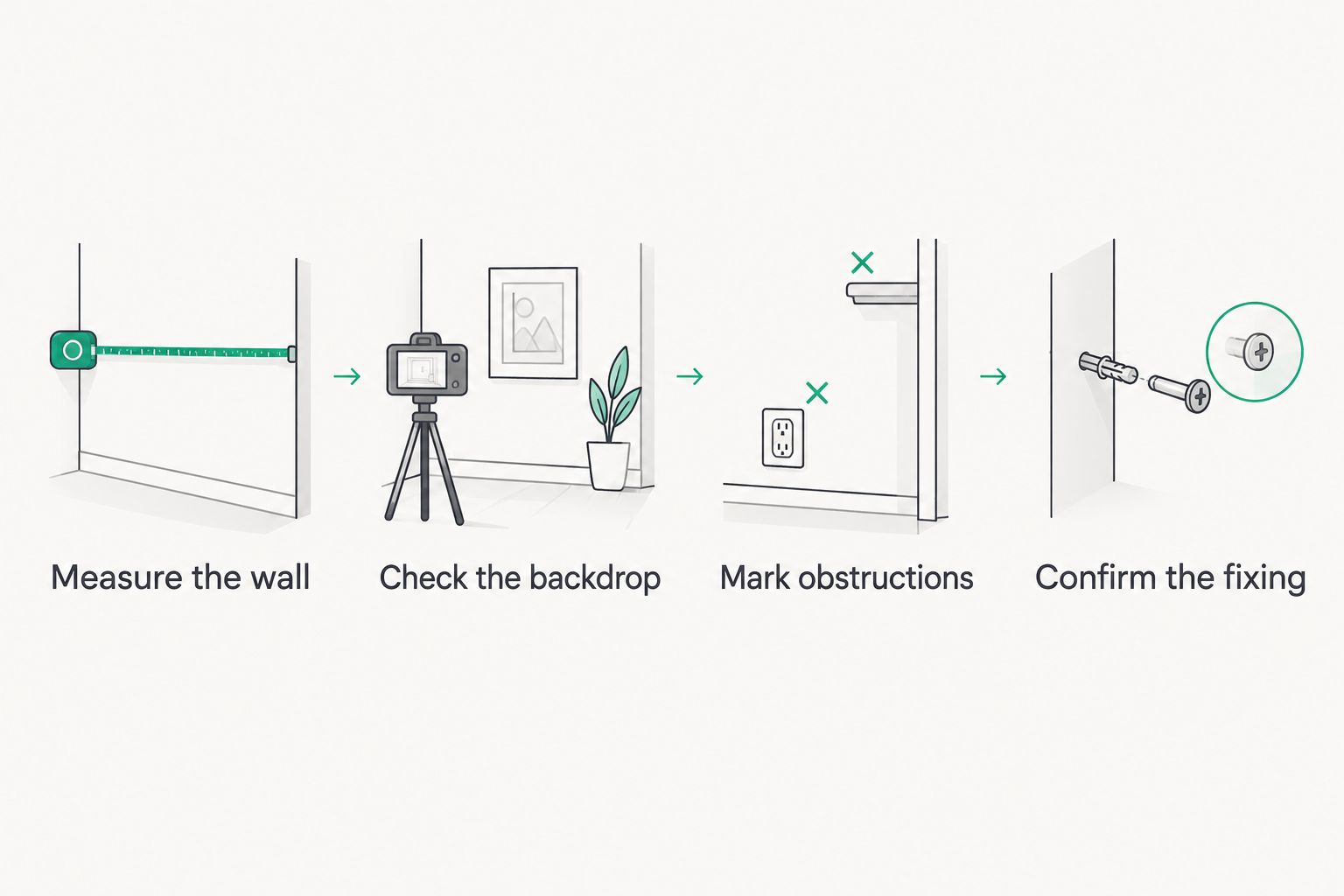
For a 2026 home-office refresh, settle the layout before choosing fixings. A clear wall sketch helps you keep useful sockets accessible and avoid placing a panel edge where it looks accidental.
Measure the wall
Measure the intended panelled height and width at more than one position. Mark skirting, ceiling lines and any slope; use the actual finished boundaries rather than the room's nominal dimensions.
Check the backdrop
Sit at your desk and open your normal camera view. Mark the area visible behind you, then decide whether the panelled section should follow that frame or a wider architectural feature.
Mark obstructions
Put sockets, switches, shelves and monitor brackets on the sketch. Plan how each remains accessible, and support equipment with fixings appropriate to the wall rather than assuming decorative slats can carry it.
Confirm the fixing
Check the panel instructions and identify the wall substrate before fitting. Adhesive and mechanical fixing choices depend on the installation; do not assume the same method suits every wall or a rented room.
Before cutting, lay out the proposed panel sequence and check the visible ends. A small change in the starting position can change where a cut falls around a socket or at the edge of the desk.
Acoustic panels are not a soundproof office
Choose acoustic walnut panels for room reflections, not as a promise to block neighbouring noise. Sound absorption within a room and sound insulation between rooms are separate jobs.
A felt-backed wall treatment adds an absorbing surface, but the result depends on coverage, installation and the other surfaces in your office. A desk wall does not automatically correct every reflection from windows, ceilings and bare floors.
If your problem is speech through a shared wall, footsteps above or traffic through a window, identify that transmission path first. Choosing a darker finish or a longer panel does not establish better sound insulation.
For calls, keep expectations practical. Panelling is part of the room setup alongside microphone position, furnishings and the location of reflective surfaces; it is not a substitute for checking those basics.
How we ranked these walnut wall panels
The 2026 ranking prioritises dimensional fit, the stated three-sided veneer construction, acoustic purpose and a distinct home-office use case. Walnut 240 x 60 cm is the default because it suits a contained desk-wall brief without automatically specifying the longer format.
Walnut 300 x 60 cm XL wins the tall-wall slot, while Grey Walnut 240 x 60 cm serves a different colour scheme. This is a comparison of the supplied product specifications, not a laboratory test or a whole-market performance ranking.
Which walnut wall panels should you choose?
Choose Walnut 240 x 60 cm unless your measurements or finish comparison point elsewhere. Move to Walnut 300 x 60 cm XL for a taller layout, or Grey Walnut 240 x 60 cm for the alternative finish.
Akustiq UK walnut wall panels combine a decorative wood surface with acoustic felt backing. Your next move is to measure the intended panelled area, check the finish beside your desk and confirm the installation method for your wall.
FAQ
What's the best walnut wall panel for a home office in 2026?
Walnut 240 x 60 cm is the default choice in this shortlist for a measured desk feature wall. Choose Walnut 300 x 60 cm XL when the intended panelled height exceeds 240 cm, or Grey Walnut for a different finish.
Should I choose 240 cm or 300 cm walnut wall panels?
Choose the length that covers your planned panelled height with the intended layout. The 300 cm format suits taller walls, while 240 cm avoids specifying extra length when you do not need it.
Will walnut acoustic wall panels stop noise from next door?
Do not choose walnut acoustic panels as a complete solution to noise from next door. Room absorption and sound insulation are different tasks; identify how sound enters the office before choosing a treatment.
Are these walnut wall panels made from solid walnut?
The shortlisted products specify three-sided wood veneer, not solid walnut construction. Judge them as veneer panels and check the product information before specifying a project.
Is Grey Walnut better than Walnut for video calls?
Neither finish is automatically better for video calls. Compare the finish with your furniture and check the actual camera view under your normal office lighting.
Can I mount a monitor directly on the wooden slats?
Do not assume decorative wooden slats can support a monitor. Use a mounting arrangement and fixings suitable for the equipment and underlying wall, following the relevant instructions.
Do I need to panel every home-office wall?
A decorative desk backdrop does not require every wall to be panelled. Acoustic coverage needs a separate assessment of the room, its reflective surfaces and the result you want.
One last thing
Check the backdrop while sitting in your normal working position, not standing in the doorway. The wall that looks balanced from the entrance is not necessarily balanced behind your chair on a call.
Before fixing anything, mark the proposed edges with removable tape and inspect the camera frame. Keep a socket, shelf or panel edge from becoming the most noticeable thing behind you.
Share:
Best 3m acoustic wall panels alternatives in 2026
Best wooden acoustic panels in the UK in 2026