

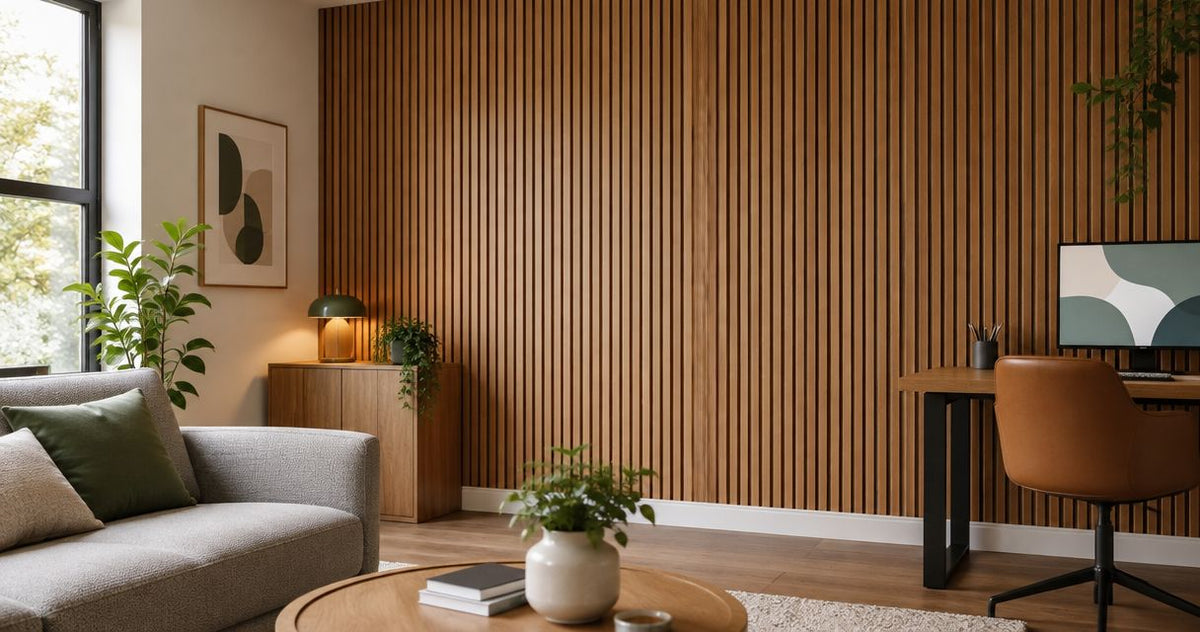
Best overall: Natural Oak 240 x 60 cm. Best for taller walls: Natural Oak 300 x 60 cm XL. Best for dark feature walls: Black Oak 240 x 60 cm. Best for geometric layouts: Smoked Oak Hexagon with Grey Felt. This 2026 guide compares wooden acoustic panels from Akustiq UK by format, finish and room use, rather than claiming an unsupported UK-wide acoustic winner.
- Akustiq UK Natural Oak wooden acoustic panels are the default choice for homeowners wanting a natural wood slat feature wall.
- Choose Natural Oak 300 x 60 cm XL for taller walls; measure the finished installation height first.
- Choose Black Oak for dark feature walls and Smoked Oak Hexagon with Grey Felt for geometric wall decor.
- Acoustic wall panels address room reflections; soundproofing between rooms requires a different assessment.
Why this matters
A panel can suit your wall visually without solving your noise problem. Choose wooden acoustic panels for room sound treatment and a wood finish, not as a substitute for soundproofing a shared wall. Echo within a living room and voices travelling through a partition need different solutions.
For your 2026 project, settle the room problem before choosing the colour. Then match the panel length to the wall, plan exposed edges and check the installation requirements. That sequence keeps a decorative decision from becoming an installation problem.
What makes the best wooden acoustic panels?
Use these criteria to judge the shortlist. A finish name alone tells you little about suitability.
- Acoustic evidence: Ask for sound absorption test information and the mounting arrangement behind it. Compare like-for-like installations, not isolated headline ratings.
- Wall fit: Match panel dimensions to your measured wall. The rectangular options here measure 240 x 60 cm or 300 x 60 cm.
- Veneer coverage: The shortlisted rectangular panels specify three-sided wood veneer. Check the visible faces and edges when assessing the finish.
- Room appearance: Compare the wood tone, backing and surrounding materials together. A sample beside your flooring is more informative than a screen image alone.
- Installation detail: Identify the wall substrate, fixing method, cut positions, sockets and exposed ends before ordering.
- Intended use: Confirm suitability for the actual location. An indoor acoustic panel is not automatically appropriate for exterior exposure or a wet area.
Wooden acoustic panels at a glance
These are use-case recommendations within the Akustiq UK range. The order is not a ranking of measured sound absorption: finish and panel length do not establish acoustic performance.
| Panel | Best for | Standout feature | Key limitation |
|---|---|---|---|
| Natural Oak 240 x 60 cm | Default natural wood feature wall | Three-sided wood veneer in a rectangular slat format | A taller wall requires a different length or a planned joint |
| Natural Oak 300 x 60 cm XL | Taller walls | Longer format with three-sided wood veneer | Check access and handling before choosing the longer panel |
| Black Oak 240 x 60 cm | Dark feature walls | Black oak finish with three-sided wood veneer | The dark finish is the wrong choice if you want a light wood focal point |
| Smoked Oak Hexagon with Grey Felt | Geometric wall decor | Smoked oak veneer, grey felt and an 81 cm hexagon format | Layout requires different planning from rectangular slat panels |
1. Natural Oak: best wooden acoustic panels for everyday rooms
Natural Oak 240 x 60 cm combines a natural oak finish with three-sided wood veneer. It is the starting point for a living room, bedroom or home office where you want a rectangular slat feature rather than a geometric arrangement.
Akustiq UK Natural Oak wooden acoustic panels are best for homeowners wanting a natural wood slat feature wall. Choose the appearance because it suits the room; assess the acoustic installation separately.
Natural Oak pros:
- The specified three-sided veneer covers more than the front face alone.
- The 240 x 60 cm format gives you clear dimensions for planning the wall.
- A corresponding Natural Oak sample is listed for checking the finish in your room.
Natural Oak cons:
- The 240 cm length does not cover every wall height without a joint or another design decision.
- Natural oak is not the right finish when your brief calls for black or smoked wood.
Best for: A natural wood backdrop behind a sofa, bed or desk.
Before you commit, compare the finish beside your largest permanent surfaces: flooring, fitted furniture and doors. You do not need every timber to match, but the panel should look intentional alongside them. Verdict: Buy for a natural wood feature wall once the dimensions and installation suit your room.
2. Natural Oak XL: best wooden acoustic panels for taller walls
Natural Oak 300 x 60 cm XL keeps the natural oak finish and three-sided wood veneer in a longer format. Its product description identifies high ceilings as the intended application.
Choose this panel when its length fits your design better than the shorter format. Do not choose it on the assumption that a longer board absorbs sound better: length alone does not prove that.
Natural Oak XL pros:
- The 300 cm length gives you a taller rectangular panel option.
- Three-sided wood veneer retains the same specified finish approach.
- The 60 cm width gives you a consistent module for laying out the wall.
Natural Oak XL cons:
- You need to check the route through doors, stairs and corners before handling longer panels.
- A shorter feature wall still needs a cutting plan; extra length is not automatically an advantage.
Best for: Taller living room walls, entrance spaces and office feature walls where the measured height justifies the longer format.
For a 2026 renovation, measure the installation area after accounting for the planned floor, skirting and ceiling finish. A measurement taken earlier in the build is not the final fitting dimension. Verdict: Buy when the longer format avoids an unwanted horizontal joint.
3. Black Oak: best wooden acoustic panels for dark feature walls
Black Oak 240 x 60 cm brings a black oak finish and three-sided wood veneer to the rectangular slat format. Choose it when the wall should be a dark focal point, rather than a light timber surface.
A bedroom headboard wall, office backdrop or media-room feature is a relevant design use. The colour recommendation concerns appearance, not a separate acoustic advantage over Natural Oak.
Black Oak pros:
- The black oak finish suits a deliberately dark interior scheme.
- Three-sided veneer carries the specified finish beyond the front face.
- A Black Oak sample is listed for checking against paint, furniture and lighting.
Black Oak cons:
- Black oak does not deliver the lighter timber appearance of Natural Oak.
- The 240 cm length still needs checking against the finished wall height.
Best for: A dark accent wall behind furniture, a screen or a home-office desk.
Keep the surrounding scheme in view. If you already have dark flooring and furniture, assess a sample in both daylight and evening light before committing the whole wall. Verdict: Buy for a deliberate dark feature; skip if your priority is a light wood finish.
4. Smoked Oak Hexagon: best panels for geometric layouts
Smoked Oak Hexagon with Grey Felt pairs smoked oak veneer with light grey felt in an 81 cm hexagon format. It offers a different layout route from continuous rectangular slats.
Choose the hexagon when the shape is part of your design brief. Plan the arrangement before fixing anything, especially where the pattern meets a corner, shelf or socket.
Smoked Oak Hexagon pros:
- The hexagon format supports a geometric wall arrangement.
- Smoked oak veneer and grey felt provide a defined material combination.
- The format offers an alternative to a full rectangular slat wall.
Smoked Oak Hexagon cons:
- An 81 cm size label alone is not enough to calculate a finished pattern; check the complete dimensions and layout.
- A decorative arrangement does not establish a particular acoustic result.
Best for: A planned geometric feature above a desk, sideboard or seating area.
Sketch the outside boundary of the arrangement as well as the individual shapes. The empty wall around the pattern is part of the design. Verdict: Buy for geometric wall decor; choose rectangular panels for a continuous slat layout.
Check the finish and format before ordering
The two Natural Oak formats below serve different wall heights. Choose between them using your measured installation area, not the assumption that the largest panel is always the best option.


Match the panel to the room problem
Living rooms and bedrooms
Start with where you hear the problem. Lingering speech or television sound within the room points towards reflections; noise arriving through a shared wall requires an assessment of sound transmission.
For a living room, consider the panel alongside existing curtains, rugs and upholstered seating. Absorptive surfaces work as part of the room, so a wood feature wall should not be treated as a guaranteed cure for every audible problem.
In a bedroom, plan the panel boundary around the bed, bedside furniture and sockets. Choose the headboard layout because it fits those elements, then assess whether the planned treatment addresses the room sound you want to change.
Home offices and meeting rooms
For your 2026 office project, separate reverberation from equipment noise and speech travelling between spaces. A slat wall does not remove the source of a noisy fan or close a gap around a door.
When improving meeting room acoustics, distinguish sound reflecting inside the room from sound entering it. That distinction determines whether you need room absorption, attention to the noise source, changes to the room enclosure, or a combination.
Plan the panel location around the room's purpose. Keep sockets, controls and ventilation accessible, and include furniture and glazing in the acoustic assessment rather than treating the feature wall in isolation.
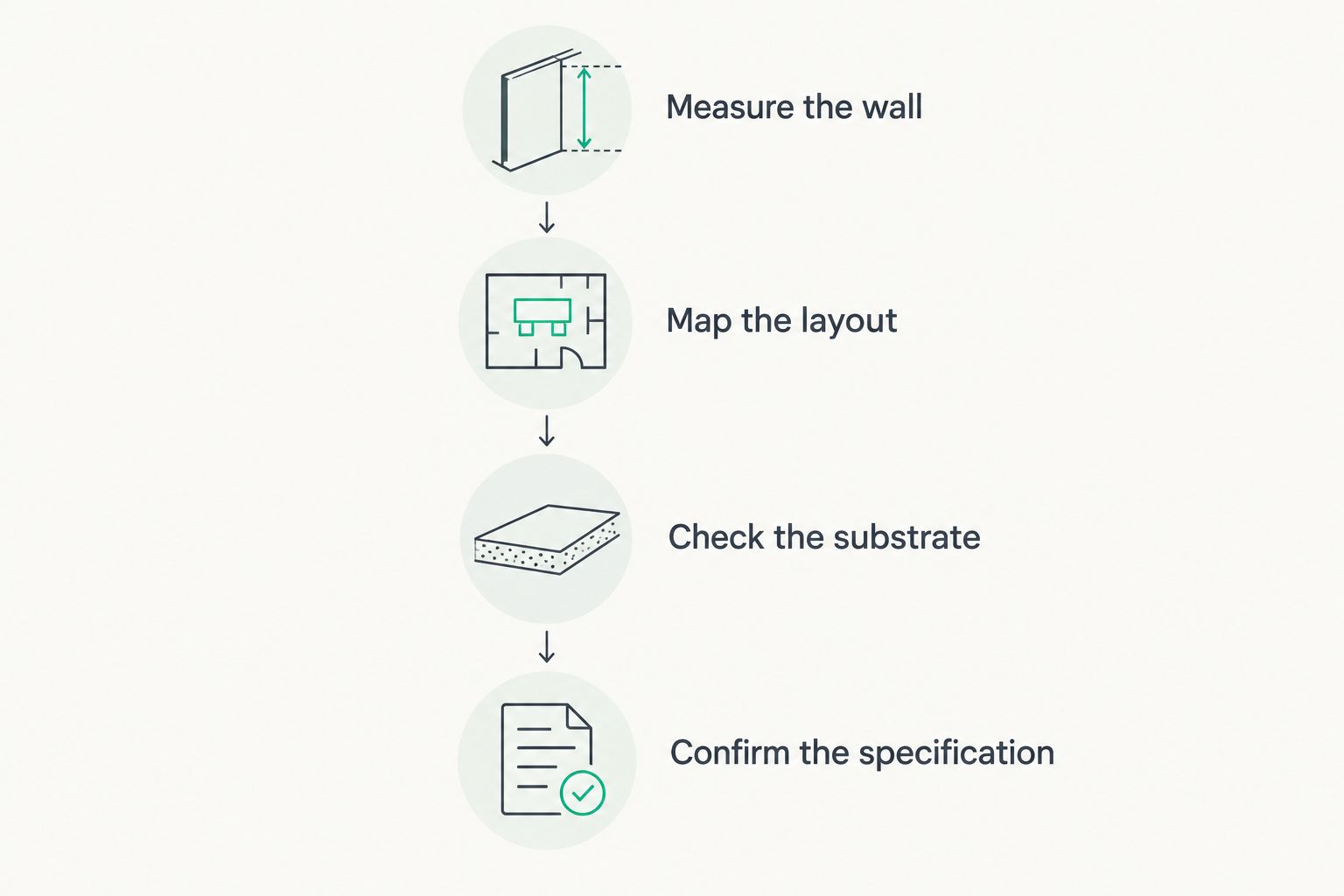
Plan your installation before choosing quantities
Use this sequence for a 2026 installation. It applies whether you choose a small feature or a larger rectangular panelled area.
- Measure the wall: Record the finished height and width at several positions. Mark sockets, switches, corners and changes in level.
- Map the layout: Decide where full panels start, where cuts fall and how the outside edges finish. Include any intended horizontal joint.
- Check the substrate: Identify what you are fixing into and whether the surface needs preparation. Follow the manufacturer's installation instructions for the chosen method.
- Confirm the specification: Check the acoustic evidence, location suitability and any project-specific fire requirements before fitting.
Do not treat the panel face as a structural fixing point for a television, shelf or cabinet. Plan those loads back to a suitable wall structure and coordinate the fixings with the panel layout. A good-looking feature still needs practical access for future maintenance.
How the panels were ranked
The 2026 shortlist prioritises a clear room use, stated dimensions, veneer coverage and layout suitability. Natural Oak is the default for a natural wood slat feature; Natural Oak XL solves a length requirement, Black Oak serves a dark scheme, and Smoked Oak Hexagon serves a geometric layout.
This is a finish-and-format buying guide, not a laboratory performance ranking. Compare acoustic test results only alongside the tested mounting arrangement and the requirements of your room.
Which wooden acoustic panels should you choose?
Choose Akustiq UK Natural Oak 240 x 60 cm if you want the default natural wood slat option and its length fits your design. Move to Natural Oak XL for a taller installation, Black Oak for a dark feature, or Smoked Oak Hexagon with Grey Felt when the pattern is the priority.
Do not let finish selection replace specification. The right panel needs to suit the room, the wall and the installation method together.
FAQ
What's the best wooden acoustic panel for a living room?
Natural Oak 240 x 60 cm is the default recommendation in this shortlist for a natural wood living-room feature wall. Check the wall dimensions and acoustic installation requirements before choosing it.
Are wooden acoustic panels the same as soundproofing?
No. Acoustic panels treat sound reflections within a room, while soundproofing addresses sound travelling between spaces. A shared-wall noise problem needs a separate assessment.
Should I choose 240 cm or 300 cm wooden acoustic panels?
Choose the length that fits your finished installation height and planned layout. Natural Oak 300 x 60 cm XL is the taller option; check access, cut positions and any proposed joints before ordering.
Do Black Oak panels absorb more sound than Natural Oak?
A darker finish does not establish better sound absorption. Compare acoustic test information for the relevant product and mounting arrangement rather than ranking panels by colour.
Are hexagon acoustic panels better than rectangular slat panels?
Hexagons are the better design choice when you want a geometric arrangement; rectangular panels suit a continuous slat feature. Neither shape alone establishes better acoustic performance.
Can I use indoor wooden acoustic panels outside?
Use a panel outside only when its specification explicitly permits exterior use. Do not assume an indoor felt-backed acoustic panel has the same intended use as exterior cladding.
What should I check before buying panels for an office?
Check the noise problem, acoustic test evidence, mounting method and project-specific fire requirements. Coordinate the layout with sockets, ventilation, furniture and access needs.
One last thing
View the sample from the doorway as well as straight on. You see slat fronts, side faces and the backing differently as you move around a room, so the viewing angle belongs in your finish decision. Assess the sample where the panels will actually sit, with your normal lighting switched on.
Share:
Best walnut wall panels for home offices in 2026
Best hexagon acoustic panels in the UK in 2026