

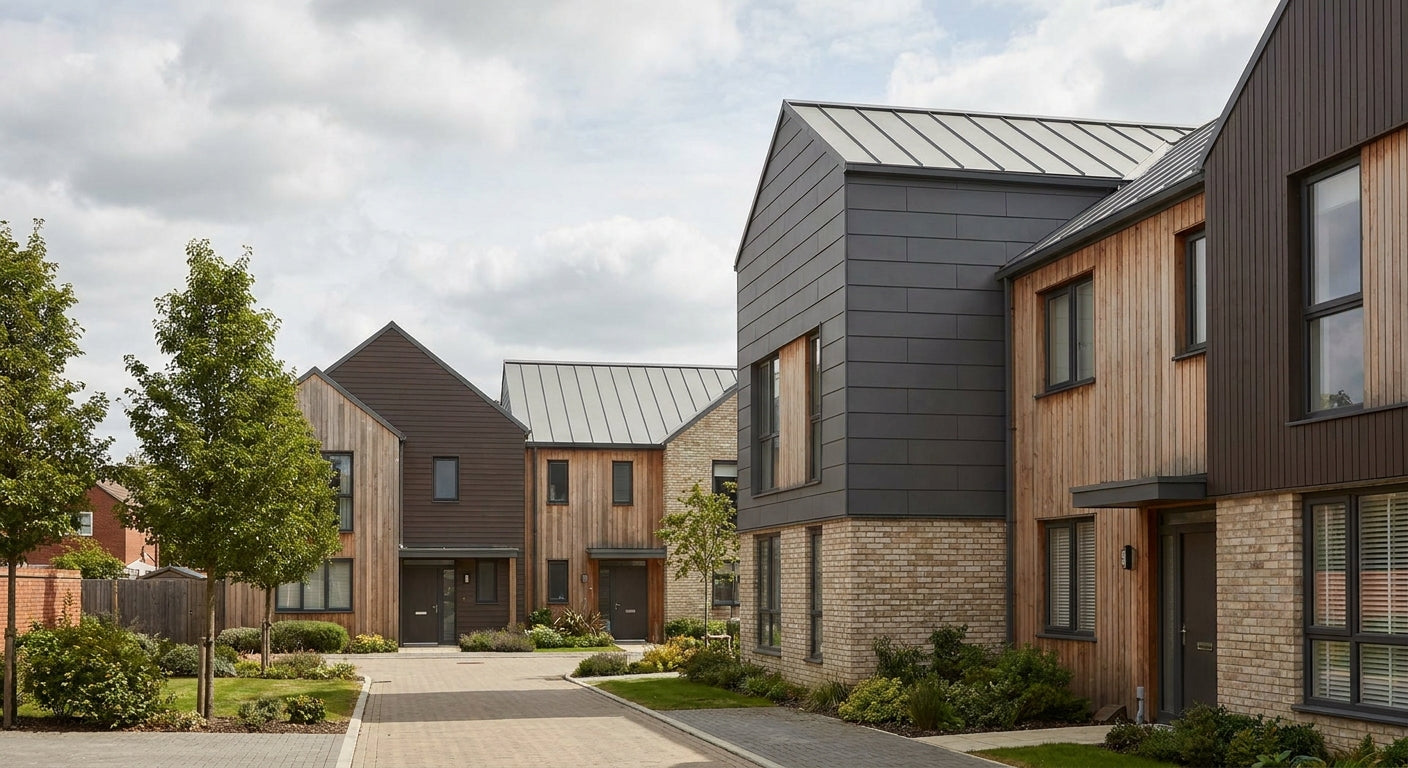
Choosing the best exterior cladding for new build UK estates in 2026 comes down to three things: weather performance, planning compliance, and long-term maintenance cost. This guide ranks the top cladding types and finishes by those criteria — so you can specify or buy with confidence.
TL;DR: For new build estates in the UK, composite cladding panels are the strongest all-round choice in 2026 — low maintenance, planning-friendly, and available in finishes from birch to stone grey. Akustiq UK's exterior cladding panels cover the most common estate aesthetics, with colour-matched trims and screws sold separately. If you want a wood-look finish without annual treatment, the exterior wall cladding panel in stone grey or oak finish are the two to shortlist.
Why this matters for UK new builds in 2026
Housebuilders and self-builders face tighter aesthetic controls than ever. Many new build estates operate under design codes that restrict render colours, brick bonds, and cladding materials. At the same time, buyers are increasingly judging kerb appeal at first viewing — and cladding is the fastest way to differentiate a plot. The wrong material choice costs money twice: once on installation, again on maintenance within five years.
How we ranked
This list ranks exterior cladding options against four criteria relevant to UK new builds specifically: weather resistance in a temperate maritime climate (frequent rain, low UV), planning acceptability on managed estates, installation speed for volume builds, and whole-life cost over ten years. Each material is assessed on those four dimensions, not just purchase price. Verdicts reflect 2026 product availability in the UK market.
The ranked list: best exterior cladding for new build UK estates
1. Composite cladding panels — the practical default
The safe pick for estate-wide specification.
Composite cladding is engineered from a mix of wood fibre and polymer, which gives it dimensional stability in the UK's freeze-thaw cycles. It does not warp, split, or require annual sealing. On a new build estate where 20–80 identical units need the same finish, consistency matters — composite delivers it.
Akustiq UK's composite exterior cladding panels are available in four finishes: birch, oak, black, and stone grey. Each finish ships with colour-matched corner trims, finishing trims, and screws, so the full system is specifiable from one supplier. Panel dimensions are standardised, which cuts on-site cutting time versus timber.
Whole-life cost advantage over natural timber is significant: no annual treatment, no staining from tannin run-off, and no risk of insect damage. On a 30-unit estate, that maintenance saving compounds quickly.
Verdict: Buy. The default choice for new build estates where maintenance liability and aesthetic consistency both matter.
2. Black composite cladding — the modern estate standout
The statement pick for contemporary plot designs.
Black exterior cladding has moved from architect-led one-offs to mainstream new build specification in 2026. Planning departments across England are increasingly approving it on modern estate types — particularly flat-roof extensions, garden studio plots, and mixed-use schemes.
The exterior wall cladding panel in black from Akustiq UK carries the same composite core as the other finishes, so weather performance is identical. The black finish holds colour without fading because it is not a surface paint — the pigment runs through the composite layer. That matters in the UK, where UV is low but damp and algae growth can dull lighter finishes within 18 months.
Black cladding pairs well with anthracite window frames and dark fascias — a combination that is dominating 2026 new build aesthetic codes in the Midlands and South East.
Verdict: Buy for contemporary plots. Hold if the estate design code specifies natural-tone or brick-dominant frontages.
3. Oak-finish composite cladding — the planning-safe warm tone
The compromise pick when planners want "natural" but owners want low maintenance.
Natural oak timber cladding scores well on appearance but requires treatment every 1–2 years to prevent greying and cracking in UK conditions. The composite oak finish delivers the same warm grain visual without the upkeep. On managed estates where residents own their plots, maintenance obligations are notoriously hard to enforce — composite oak removes the problem entirely.
Stone grey is the second warm-neutral option in the same range, suited to rendered facade schemes where the cladding acts as an accent rather than the primary surface.
Verdict: Buy for estates with design codes requiring natural-look finishes. Hold if the budget allows real hardwood and a maintenance covenant is enforceable.
4. Birch-finish composite cladding — the light and Scandinavian-inflected option
The wildcard for lighter palette schemes.
Birch is the palest finish in the Akustiq UK exterior range and suits schemes where the aesthetic brief calls for a Scandinavian or coastal feel. It is less common on volume new build estates than oak or black, but increasingly specified on smaller boutique developments of 5–15 units in 2026.
One practical note: lighter finishes show algae and green mould faster in wet UK microclimates — particularly north-facing elevations. The composite core still resists moisture, but surface cleaning is more frequent than with darker finishes. Factor that into the maintenance plan.
Verdict: Consider for boutique schemes. Skip if the site faces north or sits in a high-rainfall area without a maintenance schedule.
5. Natural timber cladding — the high-maintenance premium option
The legacy choice that is losing ground fast.
Timber cladding — larch, cedar, and oak are the three most specified in the UK — remains popular with architects for its authentic grain and ability to silver naturally. However, on new build estates, natural timber creates a maintenance liability that buyers increasingly reject. Untreated timber in the UK climate begins to grey within 12 months and can crack within 3–5 years without annual oiling.
Specification cost is higher than composite per square metre, installation requires more precision to manage expansion gaps, and the fire performance classification requires careful documentation under Part B of the Building Regulations — particularly relevant on multi-storey new builds following regulatory changes in 2022.
Verdict: Hold for prestige custom builds. Skip for volume estate specification in 2026.
Comparison table
| Cladding type | Weather resistance | Maintenance (10-yr) | Planning risk | Whole-life cost |
|---|---|---|---|---|
| Composite — black | Excellent | Very low | Low–medium | Low |
| Composite — oak/stone grey | Excellent | Very low | Low | Low |
| Composite — birch | Excellent | Low | Low | Low–medium |
| Natural timber (larch/cedar) | Medium | High | Low | High |
| Render-only | Medium | Medium | Low | Medium |
Where to buy: 3 sourcing rules for 2026
- Order samples before specifying at volume. Colour variation between screen and reality is significant on cladding. Akustiq UK ships outdoor panel samples in all four finishes — order the birch, oak, black, and stone grey samples before committing to a full estate order. See the sample outdoor wall panel in oak as a starting point.
- Buy trims and fixings from the same supplier as the panels. Colour-matched finishing trims, corner trims, and screws all exist in the Akustiq UK range. Mixing suppliers on trims is the single most common cause of mismatched aesthetics on completed builds.
- Confirm fire classification documentation before submission. Any cladding on a building over 11 metres in England requires A2-s1, d0 or better under the Building Safety Act 2022. Confirm the product's fire classification certificate with the supplier before including it in a planning or building regs submission.
FAQ
What is the best exterior cladding for a new build UK estate in 2026? Composite cladding panels are the strongest choice for UK new build estates in 2026. They resist the UK's wet climate without annual treatment, come in finishes that satisfy most design codes, and carry a lower ten-year maintenance cost than natural timber.
Is composite cladding better than timber cladding for UK new builds? For volume estate builds, yes. Composite does not warp, split, or require sealing, which matters when maintenance is distributed across individual homeowners. Timber is a better choice for prestige custom builds where a maintenance covenant is enforceable.
What colour exterior cladding is most popular on UK new builds? Black and oak-finish composite are the two most specified colours on new build estates in 2026. Black dominates contemporary schemes; oak suits design codes requiring natural-look finishes.
Does exterior cladding need planning permission on a new build? On an estate subject to a design code or Article 4 direction, yes — any change from the approved cladding material or colour requires consent. Specify cladding at the planning stage and include manufacturer documentation in the submission.
How much does exterior cladding cost per square metre in the UK? Composite cladding panels typically cost between £30 and £70 per square metre installed in 2026, depending on finish and fixing method. Natural timber runs £50–£120 per square metre installed, before ongoing maintenance costs.
Can you use exterior cladding on a flat roof extension on a new build plot? Yes. Flat roof extensions on new build plots are one of the most common applications for black composite cladding in 2026. The composite's dimensional stability suits the thermal movement common on flat-roof structures.
What maintenance does composite exterior cladding need? Light cleaning once or twice a year — typically a brush-down and a rinse with a garden hose. No oiling, staining, or sealing is required. This is the primary reason composite is displacing natural timber on managed estates.
How do you fix exterior cladding panels to a new build timber frame? Most composite cladding systems are screw-fixed to timber battens installed over a breather membrane. Colour-matched screws are available to avoid staining the panel face. For detailed installation steps, see the guide on how to fit black exterior cladding on a timber frame.
One last thing
The most overlooked part of any cladding specification is the corner detail. Poorly finished external corners are the number-one reason cladding looks cheap on an otherwise well-built new build. Colour-matched corner trims exist for every finish in the Akustiq UK range — birch, oak, black, and stone grey — and they take less than five minutes per corner to fit. If you are sourcing panels, order the corner trims at the same time. It is a small addition to the order that makes a visible difference to the finished elevation.
Share:
Outdoor Wall Panels for House Exteriors: 2026 Guide
Best Cladding Panels for Garden Office Exteriors 2026