

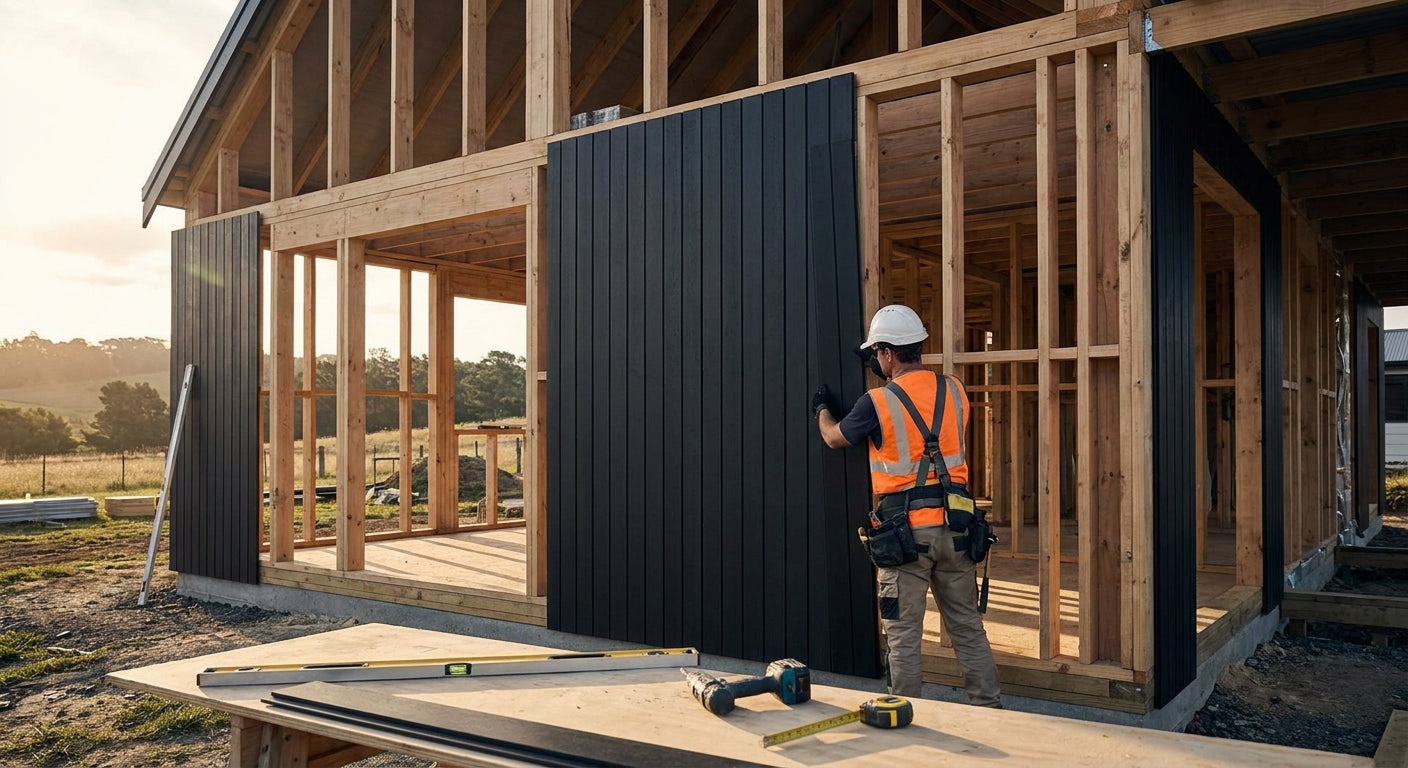
Fitting black exterior cladding on a timber frame takes a full day if you plan the job properly — rush the prep and you'll be re-doing it within two winters.
TL;DR: To fit black exterior cladding on a timber frame in 2026, you need a prepared timber substrate with 25 mm ventilation battens, stainless-steel fixings, and panels cut to allow a 3–5 mm expansion gap at every joint. Akustiq UK's exterior wall cladding panel in black is the straightforward material choice for this job — pre-finished, UV-stable, and designed for direct batten fixing. Done right, black cladding on a timber frame looks sharp for 15+ years without repainting.
Why this matters
Timber frame buildings — garden rooms, summer houses, self-build homes, extensions — are almost always clad rather than rendered. Black cladding on a timber frame is the most-searched finish in 2026 because it reads as contemporary, hides weathering, and pairs with aluminium windows. The installation sequence matters more than the product choice: wrong fixings or no ventilation gap causes moisture lock, which rots the frame behind the panels inside 3 years.
What you'll need
Materials
- Black exterior cladding panels (measure your wall area, add 10% for cuts and waste)
- 25 mm x 50 mm treated softwood battens
- Stainless-steel ring-shank nails or A4-grade stainless screws, 65 mm minimum length
- Proprietary panel adhesive rated for exterior use (optional but recommended on tall runs)
- Timber preservative for cut ends
- Starter strip / J-trim in matching black
- Top and corner trims
- Expanding foam or flexible exterior sealant (low-modulus silicone, black)
Tools
- Tape measure and pencil
- Level and chalk line
- Circular saw or mitre saw with fine-tooth blade
- Drill/driver
- Hammer
- Safety glasses, ear defenders, gloves
Time: Allow 6–8 hours for a standard 20 m² wall, including prep.
The steps
Step 1 — Survey the frame and mark datum lines
Check the timber frame for plumb and square before you fix a single batten. A frame that is out by 10 mm over 3 m will cause your panel joints to drift visibly by the top course. Use a long level or a laser level to strike a true horizontal datum line at the base of the wall, 150 mm above finished ground level — this keeps the first panel clear of splash-back. Mark vertical datum lines every 600 mm to align your battens with studs wherever possible.
Common mistake: Skipping the datum lines and eyeballing the first panel. The gap compounds over each course and you cannot correct it without stripping back.
Step 2 — Fix the counter-battens
Fix 25 mm x 50 mm treated softwood battens vertically over the frame's sheathing board or directly to the studs, spaced at 400–600 mm centres. These battens create the ventilated cavity that stops moisture accumulating behind the cladding — 25 mm depth is the minimum recommended by the British Board of Agrément for timber-frame cladding systems in 2026. Nail or screw through into studs where possible; if fixing into sheathing only, use 90 mm screws. Check each batten is plumb before moving to the next.
Expected outcome: A flat, plumb grid of battens with a consistent 25 mm air gap between the sheathing and the back face of the cladding.
Step 3 — Install the starter strip and trims
Fix a metal starter strip along the base datum line — this holds the first panel at the correct angle and keeps its bottom edge from cupping forward. Fit corner trims at all external corners and J-trims around window and door reveals before the panels go on. Getting these in place first means you can slide panel ends cleanly into channels rather than cutting and sealing in awkward positions later. Check all trims are level and plumb; any deviation here telegraphs through every subsequent course.
Common mistake: Fitting trims after panels, which forces you to use sealant to bridge gaps that should be mechanically closed.
Step 4 — Cut panels to size and treat all cut edges
Measure each panel run individually — do not assume all courses are the same length. Cut with a fine-tooth circular saw blade (minimum 60 teeth) from the face side to avoid splintering the finish. Allow a 3–5 mm expansion gap at every panel end that terminates into a trim or against another panel. Immediately after cutting, brush preservative onto all raw cut ends. Black panels show moisture-related edge swelling far more visibly than lighter finishes, so this step is non-negotiable.
Common mistake: Cutting panels tight to the trim with zero gap. Exterior timber composites expand up to 2 mm per metre in wet UK winters, and a tight fit buckling is impossible to fix without removing panels.
Step 5 — Fix the first course
Slide the bottom edge of the first panel into the starter strip and press it flat against the battens. Fix through the nail hem or through-fix with stainless screws at each batten — typically every 400–600 mm along the panel length. Do not overtighten screw fixings; the panel needs slight freedom to expand. Check the top edge of the first panel is level across its full run before fixing the final screw. This course sets everything above it.
Expected outcome: The first course sits flat, level, and at the correct height above ground, with clean trims at both ends.
Step 6 — Lay subsequent courses with correct overlap
Slide each rising course over the top of the previous one according to the manufacturer's stated overlap — typically 20–25 mm for a profiled exterior panel. Stagger all vertical joints by at least 300 mm between courses so no two joints align vertically, which is the primary defence against wind-driven rain getting behind the panels. Fix each course as you go, checking level every second course. On tall walls (over 2.4 m), re-check plumb at each storey height.
Common mistake: Aligning vertical joints on the same batten across multiple courses. This creates a continuous water path straight to the frame.
Step 7 — Seal, finish, and inspect
Once all panels are fixed, run a bead of black low-modulus silicone sealant at any interface the trim system does not fully close — around window and door reveals, at the soffit line, and at ground-level terminations. Do not seal the vertical expansion gaps between panels; these need to remain open for ventilation. Stand back and check the wall in raking light (an angle torch works well) for any panels sitting proud. Tap these back flat before the adhesive — if used — sets fully.
Expected outcome: A clean, flat black cladding finish with no visible gaps at trims, no proud panels, and open ventilation at top and bottom of the cavity.
Troubleshooting
Panels bowing outward mid-span — The battens are too widely spaced. Add an intermediate batten at 300 mm from the bowing point and re-fix the panel with an additional screw. Battens over 600 mm apart rarely hold composite panels flat in UK temperature swings.
Vertical joints opening wider than 5 mm — Panels were not butted correctly into trims or expansion gaps were cut too large. Fill with black silicone to 3 mm depth; do not pack solid or you remove the expansion allowance.
Rust staining running from fixings — Zinc or bright steel screws were used. Remove the affected fixings, treat the stain with oxalic acid solution, refix with A4 stainless steel screws, and touch up with black exterior-grade paint.
Black finish fading to grey within 12 months — The panels were not rated for exterior UV exposure. Check the product specification. Akustiq UK's exterior panels carry a UV-stable finish; if you used an interior-grade panel in error, the only fix is replacement.
Water tracking behind the bottom course — The base expansion gap between the starter strip and the ground level was sealed or blocked by debris. Clear the gap, ensure 150 mm clearance above any hardstanding or soil, and leave the cavity open.
Corner trims lifting — Adhesive was relied on without mechanical fixings. Fix a screw at 300 mm centres through the trim flange into the batten behind, then re-seal the exposed screw heads with black silicone.
Tools and resources
- Stainless-steel ring-shank nails or A4 screws, 65 mm — non-negotiable for exterior durability
- Fine-tooth circular saw blade (60+ teeth) — cleaner cuts on composite panels than coarse blades
- Low-modulus black silicone sealant — stays flexible at −10°C, essential for UK winters
- Timber end-grain preservative — brush onto every cut edge before fixing
- Laser level — saves 30 minutes of re-checking on walls over 4 m wide
- Akustiq UK's exterior wall cladding panel in black — pre-finished, batten-ready, and stocked for UK delivery in 2026
- For broader panel options, the exterior wall cladding collection covers all available finishes
- For detail guidance on cladding around openings, see how to fix exterior cladding around windows and doors
What to do next
Once the cladding is on, the next decision is maintenance schedule. Black finishes show efflorescence and algae growth earlier than lighter colours in high-rainfall UK regions. Read how to maintain exterior wall cladding panels for the annual inspection checklist and the cleaning products that won't strip the UV coating.
FAQ
What is the best black exterior cladding for a timber frame in 2026? A pre-finished composite or treated-timber panel rated for exterior UV exposure is the best choice. It arrives ready to fix, needs no on-site painting, and holds colour for 15+ years. Akustiq UK's exterior wall cladding panel in black fits this spec and is designed for direct batten fixing onto timber frames.
Do I need planning permission to clad a timber frame building in black? For most outbuildings, garden rooms, and extensions, permitted development rules apply and planning permission is not required, provided the building already has consent. Painting or cladding a listed building in any colour requires listed building consent. Always check with your local planning authority before starting work on a main dwelling.
How wide should the ventilation gap be behind exterior cladding on a timber frame? A minimum 25 mm ventilated cavity between the sheathing board and the back of the cladding panel is the standard recommended for UK timber-frame construction. This gap allows moisture vapour to escape and prevents the rot cycle that shortens frame life.
Can I fit black exterior cladding directly to a timber frame without battens? No. Direct fixing without a counter-batten eliminates the ventilation cavity, traps moisture against the frame, and voids most panel warranties. The battens also allow the panels to move with thermal expansion without buckling.
What screws or nails should I use to fix exterior cladding to a timber frame? Use A4-grade stainless-steel screws or stainless ring-shank nails, minimum 65 mm length. Bright steel and galvanised fixings corrode within 2–3 UK winters and leave rust stains on black panels that are extremely difficult to remove.
How do I cut black exterior cladding panels without chipping the finish? Cut from the face side with a fine-tooth circular saw blade of at least 60 teeth. Score the cut line with a knife first if you want a perfectly clean edge. Support the panel close to the cut line to stop the offcut vibrating and causing micro-chips at the edge.
How much black exterior cladding do I need for a timber frame? Measure the total wall area in square metres, subtract window and door openings, then add 10% for waste and cuts. For a standard 3 m x 6 m garden room wall, you need approximately 18 m² of cladding after openings, so order 20 m² to cover cuts and matching.
Is black exterior cladding harder to maintain than lighter colours? Black shows dust, pollen, and algae growth more quickly than pale grey or natural finishes. Plan a light wash with a soft brush and diluted exterior cleaner once per year. Do not use a pressure washer on panel joints — it forces water behind the fixing points.
One last thing
The single most common reason black exterior cladding looks cheap within five years is not the panel — it's the trims. A bright-silver aluminium corner trim against a matte black panel breaks the finish immediately. Specify powder-coated black aluminium trims, or paint standard trims with exterior-grade metal primer before fitting. It adds 30 minutes to the job and makes a visible difference from 10 metres away.
Share:
Black Cladding Panels for New Builds 2026 | Akustiq UK
Composite Cladding for Timber Frame Houses 2026