

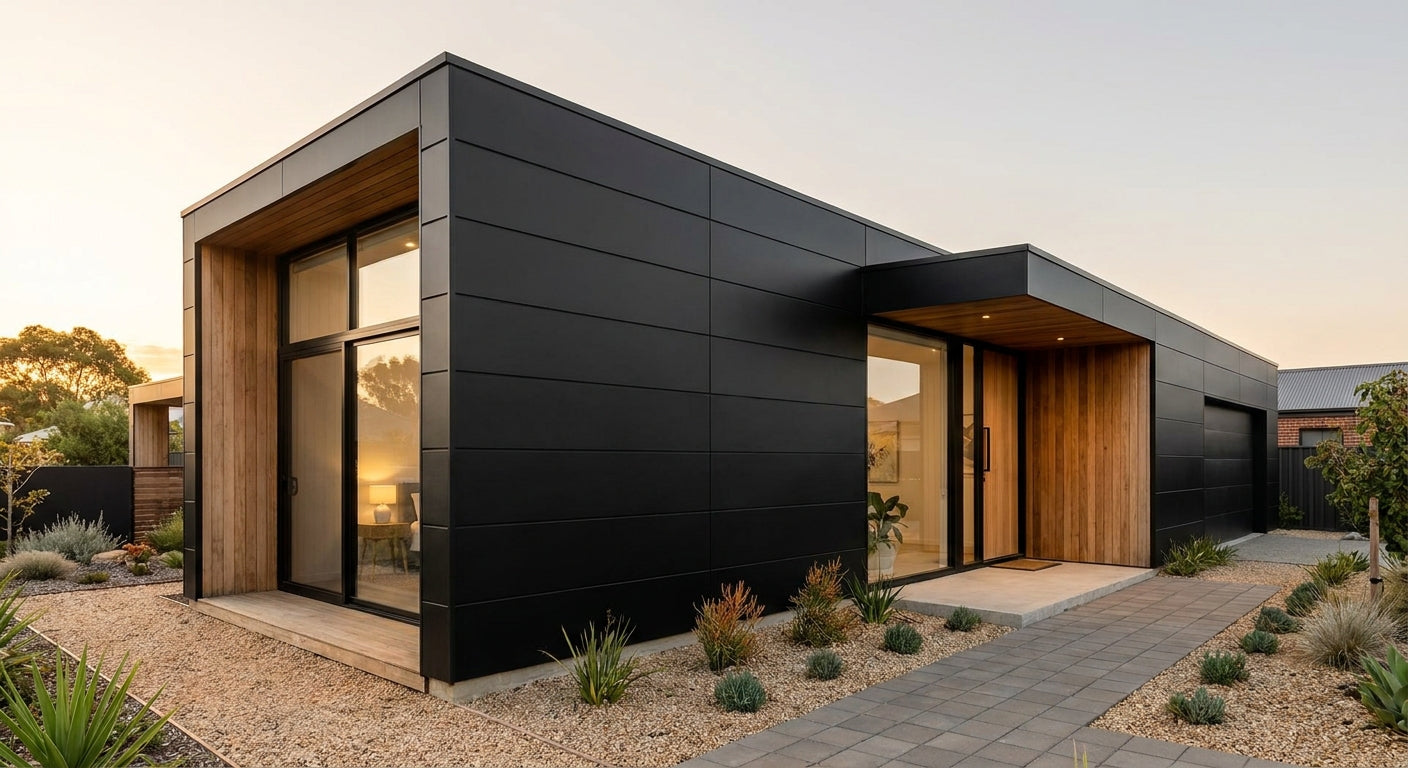
Black cladding panels are the defining exterior finish of the contemporary new build in 2026 — sharp, low-maintenance, and increasingly specified by self-builders and developers who want a facade that stands out from the buff-brick norm.
TL;DR: If you're specifying black cladding panels for a new build house exterior in 2026, the Akustiq UK exterior wall cladding panel in black is the strongest direct-to-consumer option: weather-engineered for the UK climate, available in a horizontal slat profile, and supplied direct so you cut out the merchant margin. For timber-frame new builds or self-build plots, it covers the facade cleanly without the lead times of bespoke joinery.
Why black cladding is dominating new build facades in 2026
Planning policy across England and Wales has shifted. Local authorities that once defaulted to matching-brick requirements are increasingly approving contemporary cladding on new builds, especially where the plot is infill, brownfield, or rural. Black specifically reads as "designed" rather than "budget" on a planning elevation — which is why it appears on everything from affordable timber-frame housing to high-spec self-build projects this year.
The practical case is just as strong. A black panel facade hides weathering and surface variation that would show immediately on a lighter finish. Dirt tracking from rain is almost invisible. And because the colour sits at the dark end of the spectrum, minor tonal inconsistencies between panels disappear once the elevation is viewed from street distance.
Who this guide is for
This page is written for self-builders, project managers on small residential new build schemes (1–6 units), and homeowners adding a new-build extension or outbuilding who want black exterior cladding specified and ordered without going through a timber merchant. You're comparing panel systems on cost, weather resistance, fixing method, and planning compatibility — not sourcing raw timber.
What to look for in black cladding panels for a new build exterior
Weather resistance rated for UK exposure
New build exteriors in the UK face driving rain, UV cycling, and freeze-thaw across every season. A panel that performs in a sheltered garden room will fail prematurely on a fully exposed gable. Look for a panel explicitly rated for exterior use — not an interior panel retrofitted with a coat of exterior varnish. The Akustiq UK exterior wall cladding panel black is engineered specifically for outdoor exposure, which matters most on north-facing elevations where damp sits longest.
Profile depth and shadow line
On a new build facade, the slat profile does the visual work that brickwork coursing does on a traditional house. A deeper shadow line — created by wider slats or a pronounced reveal — gives the elevation scale and reads well in planning drawings. Shallow profiles can look flat and low-cost once built. For a two-storey new build, a profile with at least 12 mm of visible relief makes a material difference to the finished quality.
Fixing system compatibility with the substrate
New builds vary: timber frame with OSB sheathing, block and render, or insulated concrete formwork. Your panel system needs to fix reliably to whatever substrate your builder has specified. A horizontal batten-and-clip system works across all three, but confirm whether the panel supplier provides the fixing detail or expects you to source battens separately. Missing fixings at specification stage is one of the most common causes of on-site delays in 2026.
Consistent colour across a full facade order
Black is the finish most sensitive to batch variation. A single panel from a different production run will read as dark charcoal or near-brown next to true black — visible from the pavement. Order your full facade quantity from a single batch wherever possible, and ask the supplier explicitly whether they can fulfil the entire order from matched stock. For a typical two-storey new build semi, you're likely ordering 40–80 panels depending on the facade area and panel format.
Low-maintenance finish for the long term
New build exteriors are expected to perform for 25–30 years with minimal intervention. A black cladding panel that needs re-oiling every 18 months becomes a maintenance liability, especially for a developer selling on. Look for factory-applied finishes that are integral to the panel rather than surface-applied coatings. This is the single biggest differentiator between budget cladding and a panel worth specifying at construction stage.
Planning and building regulations compatibility
Exterior cladding on new builds falls under Part B (fire) and Part L (energy) of Building Regulations in England. For buildings under 11 m in height — which covers almost all residential new builds — the cladding material class requirement is less restrictive than for higher-risk buildings, but you should still confirm the reaction-to-fire classification of any panel before it goes on the building regulations drawings. Your architect or building inspector will ask for it.
Top picks for black cladding panels on a new build
The direct specification pick — Akustiq UK Exterior Wall Cladding Panel Black
The safe pick for self-builders and small developers in 2026.
This is the panel to specify when you want black exterior cladding supplied direct, without merchant markup, to a UK address. The exterior wall cladding panel black from Akustiq UK is purpose-built for outdoor use — not an interior slat panel with a cosmetic exterior finish. It carries a genuine black finish across the panel face, holds up against the wet-cold cycling that UK facades experience between October and March, and ships to site in a format that a competent builder or confident self-builder can fix without specialist labour.
The panel suits horizontal installation on timber-frame or block-built new builds. Order your full facade quantity in one go to ensure colour batch consistency across the elevation.
Verdict: Buy. This is the right panel for a standard residential new build facade where you want black cladding specified cleanly, priced transparently, and delivered direct.
The moody interior-exterior crossover — Black Oak Slat Panel
The wildcard for new build interior-to-exterior transitions.
If your new build includes an open-plan ground floor where the interior wall treatment continues visually through floor-to-ceiling glazing to the exterior facade, a black oak slat panel on the inside creates a coherent dark-toned finish that bridges both elevations. The Akustiq UK wooden wall panel black oak is an interior panel with a 3-sided real wood veneer finish — it is not rated for direct exterior exposure, but used on sheltered interior walls adjacent to glazing it extends the black facade aesthetic inward without a jarring material change.
Spec this alongside the exterior cladding panel on the exposed walls, and use it internally on the feature wall that faces the garden.
Verdict: Consider — only where the brief calls for interior-exterior visual continuity on a glazed ground floor.
The dark-toned alternative — Mocca Veneer Panel
For new builds where pure black reads too stark.
Planning officers in some conservation-adjacent areas will push back on pure black on a new build facade. A deep mocca finish — warm dark brown with near-black depth in shade — reads almost as dark as black on a planning elevation but carries a warmer tone that sits more comfortably in a wooded or rural setting. The Akustiq UK wooden wall panel mocca is an interior panel, so it does not replace the exterior cladding panel on exposed walls, but it can inform the palette discussion with your planning officer and work on sheltered porches or covered entrance zones.
Verdict: Consider — for rural or conservation-adjacent plots where pure black may draw planning objection.
What to avoid when specifying black cladding panels for a new build
- Interior panels on exposed exterior walls. The most common specification error in 2026. An interior slat panel will delaminate, swell, and lose its finish within 12–18 months on an exposed gable. Confirm exterior-rated specification before the panels go on the material schedule.
- Small sample orders ahead of a full facade. Ordering 2–3 panels to test installation and then placing the main order separately risks batch colour mismatch. Black is the finish where this shows most. Order the full quantity at specification stage.
- Ignoring the ventilated cavity behind the panel. Exterior cladding on a new build needs a drained and ventilated cavity behind it to manage moisture. Fixing directly to the sheathing board without a batten void traps moisture and accelerates decay — regardless of how good the panel is.
Comparison: black cladding panel options for new builds
| Panel | Exterior rated | Finish | Best use | Verdict |
|---|---|---|---|---|
| Exterior Wall Cladding Panel Black | Yes | True black | Exposed new build facade | Buy |
| Wooden Wall Panel Black Oak | No | Black oak veneer | Interior adjacent to exterior glazing | Consider |
| Wooden Wall Panel Mocca | No | Deep warm brown | Sheltered porch / planning-sensitive plots | Consider |
FAQ
What are the best black cladding panels for a new build house exterior in 2026? The Akustiq UK exterior wall cladding panel black is the strongest direct-supply option for new build facades in 2026. It is purpose-built for outdoor exposure, ships to UK addresses direct from the supplier, and is available in a horizontal slat profile suited to contemporary new build elevations.
Do black cladding panels need planning permission on a new build? The new build itself requires planning permission, and the cladding material and colour will be specified on the approved drawings. If you want to change the approved cladding to black panels after consent is granted, you will need to submit a non-material amendment or minor material amendment application to your local authority. Always confirm with your architect before ordering.
How long do black exterior cladding panels last on a UK house? A factory-finished exterior cladding panel with an integral black finish, installed with a proper ventilated cavity and correct fixings, should perform for 20–30 years with minimal maintenance. Surface-coated panels that rely on applied paint or oil will need re-treatment every 3–5 years depending on exposure.
Can black cladding panels go on a timber frame new build? Yes. Timber frame is one of the most common substrates for exterior cladding panels on new builds in 2026. Fix horizontal battens at 400–600 mm centres to the sheathing board, confirm the cavity is drained and ventilated at top and bottom, then fix the cladding panels to the battens using the manufacturer's specified fixing.
Is black exterior cladding more expensive than other colours? Not significantly. The price difference between black and natural wood-effect exterior cladding panels from the same supplier is typically minimal — the cost variable is the panel format and order quantity, not the colour. Ordering a full facade quantity in one batch from a single supplier like Akustiq UK keeps unit costs down compared with sourcing through a builders merchant.
How many black cladding panels do I need for a new build house? Calculate the total facade area in square metres, subtract window and door openings, then divide by the coverage area per panel (check the product specification for exact dimensions). For a typical two-storey semi-detached new build with three cladded elevations, expect to need 50–90 panels depending on panel size and facade area. Order 5–10% extra for cuts and waste.
What is the difference between exterior cladding panels and interior slat panels? Exterior cladding panels are engineered to resist moisture ingress, UV exposure, and freeze-thaw cycling. Interior slat panels — including most acoustic wood veneer panels — are not designed for these conditions and will fail if installed on an exposed external wall. Always confirm the exterior or interior rating before specifying.
Can I use black cladding panels on a flat roof extension on an existing house? Yes, and this is one of the most popular uses for black exterior cladding panels in 2026. A flat-roof rear extension with black horizontal cladding on the side and rear elevations reads as a deliberate contemporary addition and typically falls within permitted development for single-storey rear extensions. Confirm with your local planning department before work starts.
One last thing
Black fades less visibly than almost any other cladding colour over time. Lighter timber-effect cladding silvers and bleaches on south and west-facing elevations within 5–7 years without maintenance. Black panels, especially those with factory-applied finishes, show weathering as a deepening of tone rather than a colour loss — which means a new build clad in black in 2026 will still look intentional a decade from now with minimal intervention.
Share:
Best Black 3D Wood Grain Cladding for Modern Homes 2026
How to Fit Black Exterior Cladding on a Timber Frame 2026