

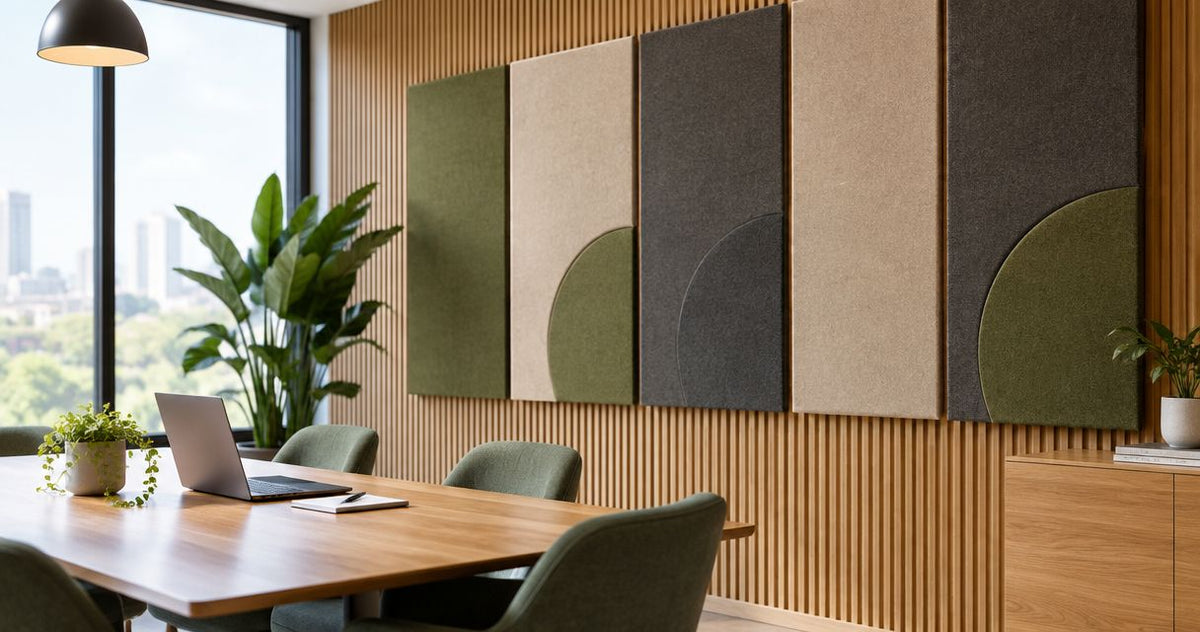
Interior designers specifying acoustic wall panels in 2026 need a shortlist that separates the acoustic workhorses from the decorative extras. Best overall acoustic wall panel for interior designers in 2026: Wooden Wall Panel Natural Oak Grey Felt from Akustiq UK. Best for boardrooms and geometric feature walls: Hexagon Acoustic Panel Walnut with Grey Felt. Best for dark-toned hospitality and cinema specs: Wooden Wall Panel Black Oak. Best for light Scandinavian and minimalist residential schemes: Wooden Wall Panel Grey Oak. Best for client sign-off before a full order: Sample Wooden Wall Panel Rustic Oak. Best for matching interior panelling to an exterior finish: Exterior Wall Cladding Panel Oak.
- Wooden Wall Panel Natural Oak Grey Felt is the best overall pick among acoustic wall panels for interior designers specifying open-plan offices and reception areas in 2026.
- Hexagon Acoustic Panel Walnut with Grey Felt suits boardrooms where the panel pattern needs to read as a feature, not just an acoustic fix.
- Wooden Wall Panel Black Oak carries dark hospitality and home cinema specs where light absorption matters as much as sound absorption.
- Sample Wooden Wall Panel Rustic Oak lets a designer get client sign-off on grain and colour before ordering a full run.
- Panels ship in 240 cm and 300 cm lengths across seven wood finishes, so the format decision comes before the finish decision.
Why this matters
Open-plan offices, hotel lobbies, and reception desks built with hard flooring and glass partitions bounce sound instead of absorbing it. Designers get called back after the fit-out is finished because the client can't hear across the room. Acoustic wall panels solve two problems in one spec line: they cut reverberation and they finish the wall in real wood instead of foam or fabric-wrapped panels that don't survive a commercial environment.
Akustiq UK panels pair a 3-sided real wood veneer face with an acoustic felt backing, so the spec reads as a design material first and an acoustic treatment second. That matters when a client cares more about the finish than the room's decay time. The finish, the format, and the felt backing all need to earn their place on a 2026 spec sheet, not just look good in a sample pack.
What makes the best acoustic wall panel for interior designers to specify
- Acoustic felt backing, not just visual slats. A panel that only mimics a slat-wall look does nothing for reverberation; the felt layer behind the veneer is what absorbs sound.
- Real wood veneer on the visible faces. A 3-sided veneer reads as timber in a spec pack and under site lighting; printed laminate reads as timber only in a product photo.
- Two length formats. 240 cm and 300 cm formats cover standard commercial ceiling heights and floor-to-ceiling runs from the same finish.
- Finish consistency across a production run. A wall specified in one finish needs every panel from the same batch to match — grain variation between deliveries kills a spec.
- CAD and BIM availability. A panel that drops into a specification package without a manual redraw saves a design team hours on a commercial job.
- Sample availability before commitment. A client sign-off on a full wall of panels should never happen from a screen render alone.
Acoustic wall panels for interior designers: at a glance
| Panel | Best for | Standout feature | Key limitation |
|---|---|---|---|
| Wooden Wall Panel Natural Oak Grey Felt | General commercial and residential specs | Neutral oak tone works across most colour schemes | Less distinctive than a patterned finish on a feature wall |
| Hexagon Acoustic Panel Walnut with Grey Felt | Boardrooms and geometric feature walls | Hexagon layout reads as a design statement, not a retrofit | Needs a flat, unobstructed wall to land properly |
| Wooden Wall Panel Black Oak | Dark hospitality and home cinema specs | Absorbs light as well as sound in low-lit rooms | Shows dust and fingerprints more than lighter finishes |
| Wooden Wall Panel Grey Oak | Scandinavian and minimalist residential schemes | Cool grey tone suits Japandi and light-wood interiors | Can read cold without warm textiles nearby |
| Sample Wooden Wall Panel Rustic Oak | Client sign-off before a full order | Lets a designer test grain and colour on-site before committing | A decision tool, not a wall solution |
| Exterior Wall Cladding Panel Oak | Matching interior panelling to an exterior finish | Same oak tone carries from inside to outside a building | Built for exterior exposure, not indoor acoustics |
1. Wooden Wall Panel Natural Oak Grey Felt: best overall acoustic wall panel for interior designers
Wooden Wall Panel Natural Oak Grey Felt pairs a light oak veneer with a grey acoustic felt backing, which is the most flexible combination in the Akustiq UK range for offices, retail, and reception specs. The neutral tone sits under most existing colour schemes, so it doesn't force a redesign around the panel. It ships in both 240 cm and 300 cm lengths, covering standard commercial ceilings and taller floor-to-ceiling runs from the same finish.
Wooden Wall Panel Natural Oak Grey Felt pros:
- Neutral oak tone works with warm and cool palettes
- Grey felt backing gives genuine acoustic absorption, not just texture
- Available in both length formats from one finish
Wooden Wall Panel Natural Oak Grey Felt cons:
- Less visually distinctive than a patterned or dark finish on a standalone feature wall
- Can read plain without contrasting trim or lighting
Best for: general commercial fit-outs and reception areas where the panel needs to blend, not dominate. Verdict: Buy.
2. Hexagon Acoustic Panel Walnut with Grey Felt: best for boardrooms and geometric feature walls
The hexagon format breaks up a flat wall into a repeating geometric pattern, which reads as a deliberate design choice rather than an acoustic retrofit bolted on afterward. Walnut tone darkens the wall without going as far as black oak, keeping a boardroom grounded rather than cave-like. The grey felt backing behind each hexagon does the same acoustic job as the rectangular panels, just cut to a different shape.
Hexagon Acoustic Panel Walnut with Grey Felt pros:
- Geometric layout works as a standalone feature wall, no extra decoration needed
- Walnut tone reads warm under daylight and downlighting
- Same felt-backed construction as the rectangular range
Hexagon Acoustic Panel Walnut with Grey Felt cons:
- Needs a flat, unobstructed wall section — sockets and switches complicate the layout
- Can look busy in a small meeting room rather than a large boardroom
Best for: boardrooms, reception feature walls, and briefs asking for something more than a flat panel wall. Verdict: Buy.
3. Wooden Wall Panel Black Oak: best for dark-toned hospitality and cinema specs
Black Oak absorbs light as effectively as it absorbs sound, which is exactly what a home cinema or a dim hospitality bar needs from a wall finish. Designers working on restaurant fit-outs and screening rooms specify it for the same reason they'd specify a dark paint: it disappears into the room instead of competing with the lighting design. It carries the same 3-sided veneer and felt-backed construction as the lighter finishes in the range.

Wooden Wall Panel Black Oak pros:
- Dark tone reduces light bounce in screening rooms and low-lit hospitality spaces
- Same acoustic felt backing as every finish in the range
- Reads as an intentional dark material rather than a painted wall
Wooden Wall Panel Black Oak cons:
- Shows dust, fingerprints, and scuffs more visibly than mid-tone finishes
- Not the right pick for a bright, daylight-led residential room
Best for: home cinemas, hospitality bars, and any space where the brief calls for a dark, light-absorbing wall. Verdict: Buy for the right brief, skip for daylight-led rooms.
4. Wooden Wall Panel Grey Oak: best for light Scandinavian and minimalist residential schemes
Grey Oak sits at the cool end of the range, which is why it turns up in Japandi and Scandinavian-influenced specs more than any other finish. It keeps a room feeling light even when fully panelled floor-to-ceiling in the 300 cm format. Designers pair it with pale flooring and minimal trim rather than warm walnut tones.
Wooden Wall Panel Grey Oak pros:
- Cool grey tone keeps panelled walls from darkening a room
- Works in the taller 300 cm format for floor-to-ceiling coverage
- Pairs cleanly with pale flooring and minimal trim
Wooden Wall Panel Grey Oak cons:
- Can read cold in a room without warm textiles or timber furniture to balance it
- Less forgiving of warm-toned existing joinery than the natural oak finish
Best for: Scandinavian, Japandi, and other light, minimal residential interiors. Verdict: Buy for the right palette.
5. Sample Wooden Wall Panel Rustic Oak: best for client sign-off before a full order
No interior designer should ask a client to commit to a full wall of panelling from a screen render. The sample format exists for that step: it puts the real veneer grain and colour in the client's hand before the order goes in. It's a decision tool, not a wall covering, which is why it earns a place in this ranking for a different reason than the other five.
Sample Wooden Wall Panel Rustic Oak pros:
- Removes the risk of a colour or grain mismatch on delivery
- Cheap way to test a finish against existing flooring and joinery on-site
- Speeds up client sign-off compared to a digital render alone
Sample Wooden Wall Panel Rustic Oak cons:
- Doesn't tell you anything about acoustic performance across a full wall
- An extra step in the process on a tight-turnaround project
Best for: any spec where the client hasn't seen the finish in person yet. Verdict: Buy — order it before, not after, the full quote.
6. Exterior Wall Cladding Panel Oak: best for matching interior panelling to an exterior finish
When a brief asks for the same timber tone to run from an entrance canopy through to a reception wall, the exterior cladding range in oak matches the interior oak panels. It's built for exterior exposure rather than indoor acoustic performance, so it belongs on the outside of the wall, not the inside of the boardroom.
Exterior Wall Cladding Panel Oak pros:
- Matches the interior oak tone for a continuous material story
- Built for outdoor exposure, unlike the indoor felt-backed range
- Useful for entrance canopies, porches, and garden room exteriors that connect to an interior spec
Exterior Wall Cladding Panel Oak cons:
- Not felt-backed, so it does nothing for indoor acoustics
- Limited to exterior-rated applications, not a substitute for the indoor range
Best for: projects where the material story needs to continue from outside to inside. Verdict: Buy for the exterior half of the brief only.
Decorative accent panels for feature walls
Acoustic panels handle the sound-absorption line on a spec. Decorative 3D wall panels handle the line that reads "this needs to look expensive," and designers often combine both in the same room — acoustic panels on the long wall, a decorative panel behind a reception desk or a fireplace. Akustiq UK's decorative range uses the same handcrafted, pre-oiled American walnut construction as the acoustic line, just without the felt backing.


How we ranked
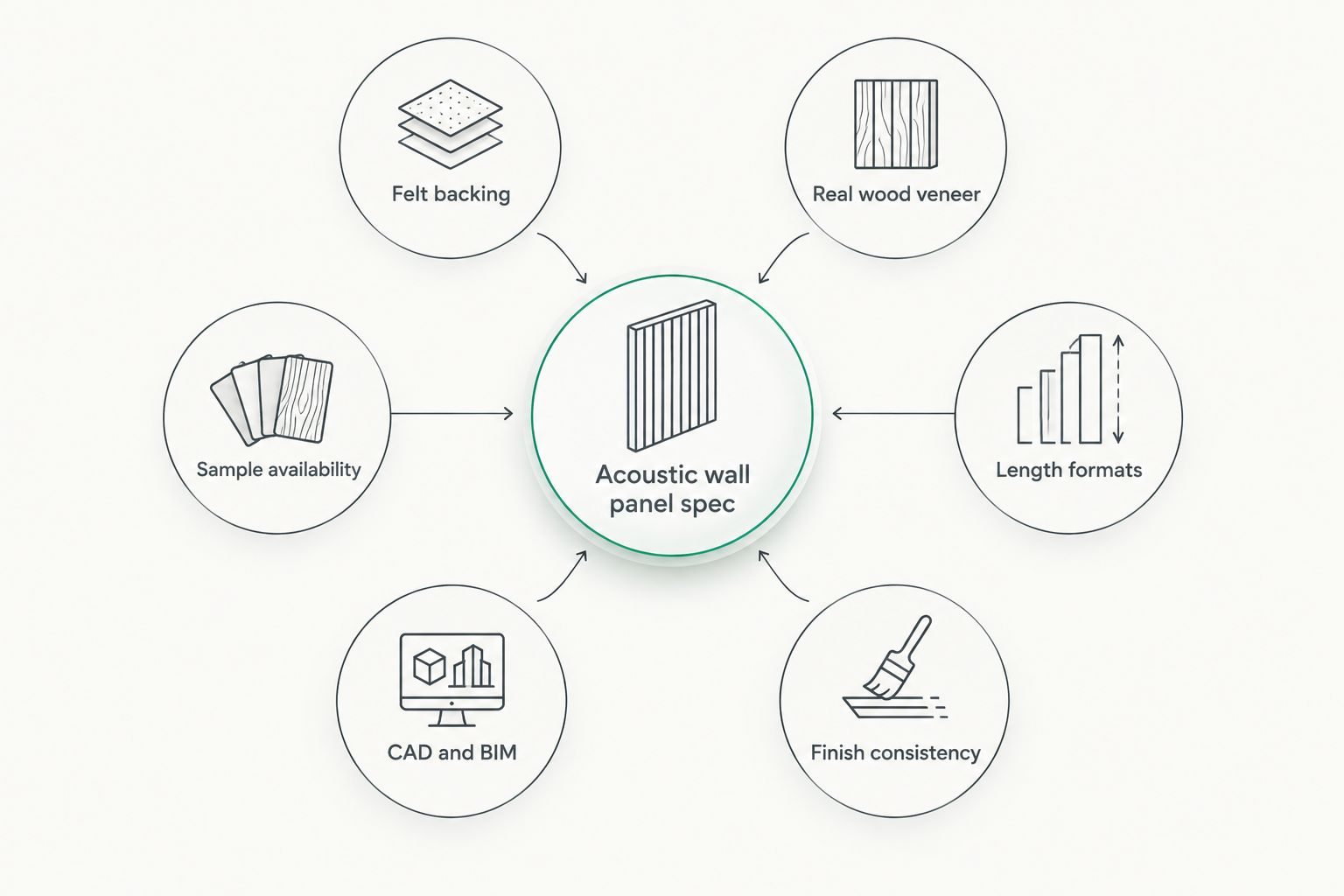
Every panel above earns its "best for" label against the same six criteria: felt backing, real veneer, length format, finish consistency, CAD/BIM availability, and sample access. None of the six wins on every criterion — Black Oak loses points in daylight rooms, the sample format isn't a wall at all, and the exterior cladding panel drops the felt backing entirely.
“A ranked list that scores one product highest on everything isn't ranking anything, it's marketing copy with a table attached.”
Which acoustic wall panel should you specify?
Default to Wooden Wall Panel Natural Oak Grey Felt for any brief without a strong colour direction — the neutral tone and dual length format make it the safest first line on a 2026 spec sheet. Move to Hexagon Acoustic Panel Walnut with Grey Felt when the brief explicitly asks for a feature wall, and to Wooden Wall Panel Black Oak when the room is dark by design rather than by accident. Order a sample before any of them go on a purchase order — that's the one step every design team skips under deadline pressure and regrets after delivery.
FAQ
What is the best acoustic wall panel for interior designers to specify in 2026?
Wooden Wall Panel Natural Oak Grey Felt from Akustiq UK is the best overall pick for general commercial and residential specs in 2026 because it pairs a neutral oak veneer with a felt acoustic backing and ships in both 240 cm and 300 cm lengths. Designers move to a hexagon or dark oak finish only when the brief calls for a stronger visual statement.
Do acoustic wood panels actually reduce echo, or is it just the wood look?
The reduction comes from the felt layer behind the wood veneer, not the timber itself. A panel with only a printed or laminate slat face and no felt backing won't meaningfully change a room's reverberation.
What size formats do acoustic wall panels come in?
Akustiq UK's range ships in 240 cm and 300 cm lengths, covering standard commercial ceiling heights and taller floor-to-ceiling runs from the same finish.
Should I order a sample before specifying a full wall of acoustic panels?
Yes. A sample panel lets a client sign off on grain and colour in person before a full order goes in, which avoids a mismatch between a screen render and the delivered material.
Are hexagon acoustic panels harder to install than rectangular ones?
Hexagon panels need a flatter, more unobstructed wall section than rectangular panels because the repeating pattern shows any misalignment more clearly. Sockets, switches, and door frames complicate the layout more than a plain rectangular run.
Can exterior wall cladding match an interior acoustic panel finish?
Yes, when both are specified in the same wood tone. Exterior Wall Cladding Panel Oak is built for outdoor exposure rather than indoor acoustics, so it belongs on the exterior half of a project that wants a continuous timber story.
Is black oak a good choice for a home cinema?
Yes. Wooden Wall Panel Black Oak absorbs light as well as sound, which suits a dim screening room, but it shows dust and fingerprints more visibly than lighter finishes and isn't the right pick for a bright, daylight-led room.
Can I get CAD or BIM drawings for acoustic wall panels before I specify them?
Availability varies by panel line, so check with the supplier before finalising a commercial spec pack — it saves a redraw later in the project.
One last thing
The detail most designers miss on a first spec: felt-backed panels and non-backed decorative panels look almost identical in a product photo, but only one of them changes how a room sounds. If acoustics are anywhere in the brief, check for the felt backing before the finish.
Share:
Best DIY Acoustic Wall Panel Kits Compared (2026)
Best Acoustic Wall Panel Sample Packs Compared (2026)