

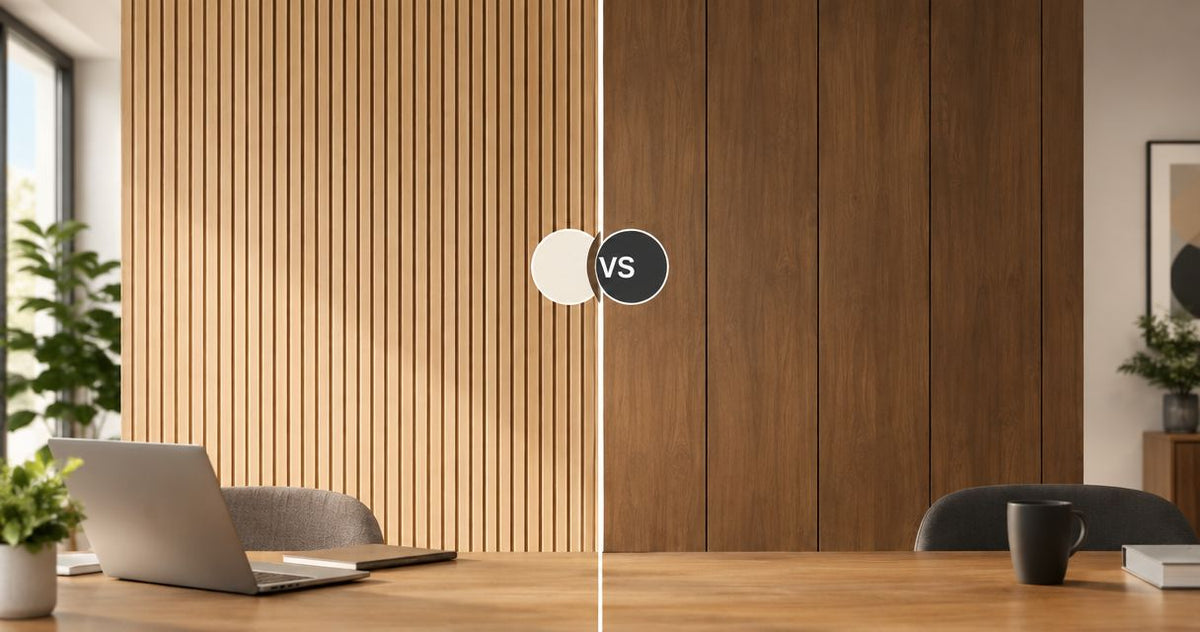
Choose Akustiq UK if you want acoustic wooden slat panels with a specified three-sided real wood veneer finish; choose Selco if you are a trade buyer organising a wider building-materials order rather than choosing a feature wall alone. This 2026 comparison separates panel specification from purchasing convenience so you can choose for the job you actually have.
- Aku wood panel vs Selco is a choice between specialist acoustic wooden slat panels and broader trade purchasing.
- Akustiq UK acoustic wood panels suit homeowners prioritising three-sided real wood veneer and a coordinated feature wall.
- Selco is the better starting point for trade buyers sourcing materials across a wider building project.
- Compare exact panel dimensions, installation requirements and acoustic evidence before choosing either supplier.
Why this matters
An oak-coloured wall panel is not a complete specification. You need to know what covers the slat faces and sides, how the backing works, and where the panel will finish around sockets, skirting and corners.
Your purchasing priorities matter too. A homeowner choosing a living-room wall needs a different buying route from a contractor ordering materials for several parts of a refurbishment. Separate the wall’s requirements from the convenience of the order.
For a 2026 project, use the exact product description and installation instructions as your reference. A supplier’s name does not establish acoustic performance, suitability for a particular room or the finished appearance of a cut edge.
At a glance
| Dimension | Akustiq UK | Selco |
|---|---|---|
| Best for | Homeowners and businesses choosing a wood-led acoustic feature wall | Trade buyers purchasing across a wider building project |
| Standout feature | Three-sided real wood veneer on the indoor slat panel range | Broad builders’ merchant purchasing scope |
| Panel dimensions | Listed indoor formats include 240 × 60 cm and 300 × 60 cm | Match the dimensions of the exact product under consideration |
| Wider project purchasing | Panel-focused choice with related finishing products | Better starting point for a mixed building-materials order |
| Finish selection | Natural Oak wooden wall panel, other named wood finishes and samples | Choose against the exact product specification, not the merchant name |
| Acoustic suitability | Felt-backed acoustic wooden slat panels; assess the specified installation | Assess the selected panel and its installation evidence |
| Installation planning | Check substrate, cuts, exposed edges and compatible fixings | Apply the same substrate, cutting and fixing checks |
| Pricing model | Product-by-product purchasing; budget for the complete panel installation | Product-by-product materials purchasing; compare the complete project basket |
The specialist wins when the panel finish drives the project
Akustiq UK acoustic wood panels are best for buyers who prioritise three-sided real wood veneer. That is a specific construction detail, not simply a description of the panel’s colour.
Three-sided veneer covers the front and sides of the slats. This matters when you look along a hallway wall or approach a bedroom feature wall from the doorway: the slat sides form part of what you see.
The benefit has a limit. Veneer coverage does not tell you how a site-cut end will look, and it does not remove the need to plan exposed panel edges. Check the finishing detail before deciding where the panelled area stops.
For either supplier, ask these questions:
- Is the visible finish real wood veneer or another surface material?
- Which slat surfaces receive that finish?
- What becomes visible after cutting?
- How will the outside edge meet the surrounding wall?
The specialist’s stated veneer construction gives you a clear selection criterion. It does not justify assuming that every panel sold elsewhere has a different construction.
The specialist gives you a clear height choice
The listed indoor slat panel formats include 240 × 60 cm and 300 × 60 cm. Those dimensions give you a practical starting point for planning a full-height wall, a headboard or a smaller panelled section.
Measure the intended finished area, not just the room height. Skirting, ceiling lines and any planned borders affect the length you need. Check the height at different positions along the wall before choosing a format.
A longer panel is useful when it avoids an unwanted horizontal joint. It also needs a handling and cutting plan. Do not choose the longer format automatically when your design uses only a shorter section.
For a 2026 bedroom or office project, settle the following before ordering:
- The bottom and top boundaries of the panelled area.
- Whether slats run vertically or horizontally.
- The positions of sockets, switches and wall-mounted fittings.
- Where full panels end and cut sections begin.
Selco remains a valid route when the exact panel you select meets those requirements. Dimensions decide fit; the supplier name does not.
Selco wins when you are buying for the whole building job
Selco is a builders’ merchant, so its strongest distinction here is purchasing scope. Selco is the better starting point for a trade buyer assembling a mixed building-materials order.
That is a different task from selecting a wood finish for one wall. If your refurbishment involves several material categories, it makes sense to assess the merchant route against the complete materials list rather than treating panelling as an isolated purchase.
The drawback is that purchasing convenience cannot substitute for panel selection. You still need to identify the exact board, its dimensions, its finish and the installation it requires. A convenient order containing the wrong panel is not a successful purchase.
Use Selco’s broader scope as an organisational advantage, not evidence that a particular panel is better. Keep the acoustic and decorative requirements written down while you compare the wider order.
The specialist wins for finish-led sampling
The supplied range includes real wood veneer samples in finishes such as Natural Oak, Black Oak, Smoked Oak, Walnut and Mocca. Use a sample when the relationship between the panel, your flooring and your furniture determines the choice.
Check it beside the materials that will stay in the room. A finish that works beside a desk can look different beside a large wardrobe or an existing timber floor. View it in daylight and under the lighting you normally use in the evening.
Sampling has a limitation: a small piece does not show the effect of a complete slatted wall. It helps you judge material and colour, but you still need to plan the overall width, slat direction and boundaries.
For a living room, compare the sample beside the sofa and floor. For a bedroom, place it near the bed and wardrobe. For an office, check it behind the desk rather than judging it against an unrelated wall.
Selco wins when your trade purchasing route is already established
A trade buyer who already organises building-materials purchasing through Selco has a genuine reason to start there. Keeping the panel decision within an established purchasing process can be more practical than opening a separate supplier relationship for an otherwise suitable product.
Choose that route when the selected panel meets your written brief. Do not change the finish, height or intended acoustic function simply to keep the order together.
The specialist route serves a different priority: selecting a particular panel construction and appearance first, then arranging the project around it. Its limitation is equally clear. A panel-focused supplier is not a substitute for a builders’ merchant across an entire refurbishment.
For your 2026 purchasing decision, decide which constraint comes first:
- Panel specification: choose the finish and construction, then organise purchasing.
- Wider materials order: start with the trade purchasing route, then check the panel against the brief.
- Installation requirements: reject any option that does not suit the planned wall assembly.
These are purchasing priorities, not a quality ranking between every product sold by either business.
Neither supplier wins acoustics on name alone
Acoustic wall treatment and soundproofing solve different problems. Sound absorption helps control reflections inside a room; sound insulation concerns sound passing between spaces.
If conversation sounds harsh in your living room, acoustic treatment addresses the relevant type of problem. If you hear neighbours through a shared wall, do not treat decorative slat panels as a replacement for an assessment of the separating construction.
Choose acoustic panels against evidence for the intended installation. Backing, mounting method and the surrounding room all matter. A performance result for one assembly does not automatically describe another installation.
Ask the same questions whichever supplier you choose:
- What acoustic test information applies to this exact panel?
- How was the tested panel mounted?
- Does your proposed wall build-up match that arrangement?
- Is the objective less echo, better speech clarity or reduced sound transmission?
For an office or commercial interior, agree the acoustic objective before settling the decorative finish. Neither a familiar merchant name nor a specialist product description replaces that step.
Both routes need the same installation discipline
Neither buying route removes the need to assess the wall. Check its condition, identify services before cutting or fixing, and follow the instructions for the exact panel and substrate.
Plan the visible details before installation begins. Panel edges, socket openings and the meeting point with skirting are part of the finished wall, not minor decisions to leave until the last cut.
Use this sequence:
- Measure the wall: record the finished area and openings.
- Check the substrate: establish the appropriate preparation and fixing method.
- Plan the edges: decide where panels stop and how exposed boundaries finish.
- Confirm the fixings: follow the panel and fixing manufacturers’ instructions.
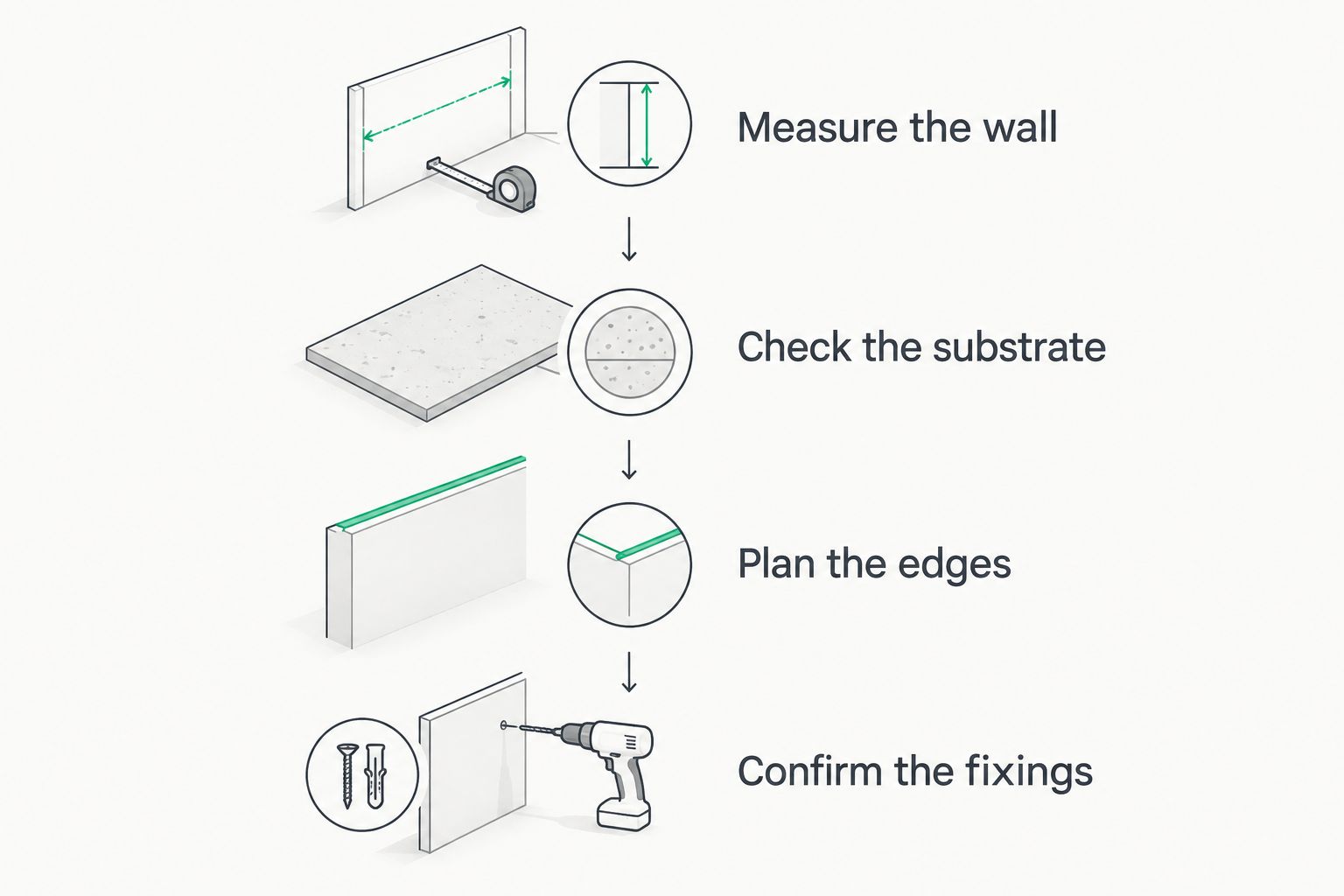
The practical advantage comes from a complete installation plan. Buying from either supplier without one leaves the same basic questions unresolved.
Pricing: compare the finished wall, not an isolated panel
Both routes involve purchasing physical products, so assess quantities and the complete installation rather than comparing a panel in isolation. For the specialist range, the different lengths make dimension matching especially important.
Build a like-for-like materials list covering:
- Panels in the required format and finish.
- Finishing pieces for the exposed boundaries.
- Fixings or adhesive specified for the installation.
- Any preparation materials required by the substrate.
- Cutting waste based on your actual layout.
Keep labour separate from materials when comparing installation proposals. Ask each installer to work from the same drawing and finished-wall requirements.
For your 2026 budget, compare the current complete basket and applicable terms directly with each supplier. There is no useful value verdict until the panel specification, quantities and installation scope match.
A shorter format that creates an unwanted joint is not equivalent to a longer uninterrupted panel. Equally, a longer panel adds no design benefit when your layout cuts away the extra length.
Final verdict: choose for the job, not the name
Choose Akustiq UK if your feature wall comes first
Best for: homeowners and interior buyers specifying a wood-led acoustic wall. Choose the specialist when three-sided real wood veneer, named finishes and the choice between the listed panel formats match your brief.
The trade-off is scope. You are choosing a panel-focused supplier, not consolidating every building material for a refurbishment.
Choose Selco if your wider trade order comes first
Best for: trade buyers coordinating a broader building project. Choose Selco when its builders’ merchant role fits your purchasing process and the exact panel under consideration meets the wall specification.
The trade-off is selection responsibility. Broader purchasing convenience does not establish veneer construction, acoustic suitability or the right dimensions for your room.
| Dimension | Winner |
|---|---|
| Feature-wall buying focus | Specialist |
| Stated three-sided veneer construction | Specialist for this requirement |
| Clearly listed panel height choices | Specialist for this brief |
| Wider building-materials purchasing | Selco |
| Established Selco trade purchasing workflow | Selco |
| Acoustic performance | Product-specific; no supplier-level winner |
| Installation planning | Tie: both require it |
| Finished-wall value | Compare equivalent complete baskets |
FAQ
Is Aku Wood Panel better than Selco for acoustic wall panels?
Akustiq UK is the clearer choice when you specifically want its three-sided real wood veneer acoustic slat panels. Selco is the better starting point when broader trade purchasing is the priority, provided the selected panel meets your requirements.
Which supplier should I choose for a living-room feature wall?
Choose the specialist route when wood finish and panel construction lead your decision. Check a sample beside your flooring and furniture, then confirm panel dimensions and exposed-edge details.
Are the panels from both suppliers the same?
Do not treat panels from different suppliers as equivalent without comparing their exact specifications. Check surface material, veneer coverage, backing, dimensions and installation requirements.
Should I choose 240 cm or 300 cm wall panels?
Choose the length that fits your measured design with the intended joint layout. The listed indoor formats include 240 × 60 cm and 300 × 60 cm; confirm the finished height before ordering.
Will acoustic wooden panels stop noise from next door?
Acoustic wooden panels are not a substitute for sound-insulation design. Absorption controls reflections within a room, while noise from next door requires assessment of the separating wall and other transmission paths.
How should I compare the cost of panels from these suppliers?
Compare complete, equivalent installation baskets rather than isolated panels. Match the finish, dimensions, quantities, finishing pieces, fixing method and preparation requirements before judging value.
What should I check before ordering wall panels in 2026?
Confirm the exact panel specification, measured layout and installation instructions before ordering in 2026. For acoustic or commercial requirements, also obtain the relevant product evidence for the proposed assembly.
One last thing
Check the wall from the doorway, not only from directly in front. An angled view exposes slat sides and outside edges that a front-facing product image does not explain.
Make the edge detail part of your buying decision. A finish sample, a measured layout and a clear stopping point give you a firmer basis for choosing than the supplier name alone.
Share:
Aku Wood Panel vs British Homes Direct: which is better in 2026
Aku Wood Panel vs Wickes: which is better in 2026