

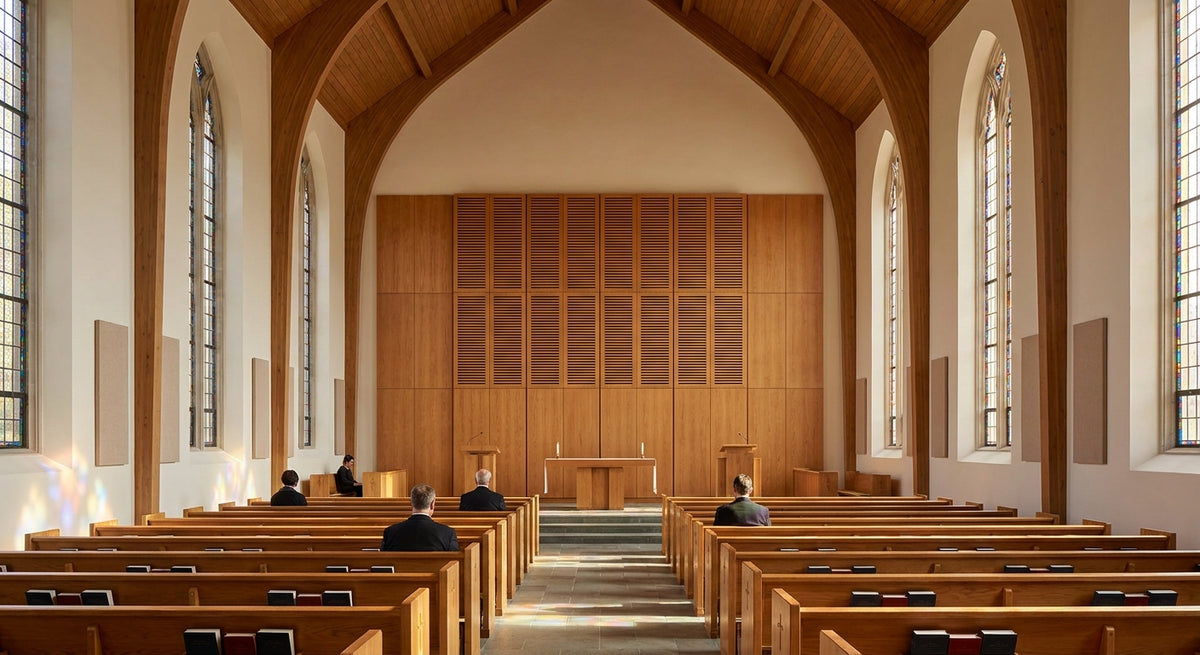
Echo in a nave, chapel, or prayer hall doesn't just annoy the congregation — it swallows the sermon, the readings, and the choir, and acoustic panels for places of worship fix that without hiding the wood and stone that make the space feel sacred in the first place.
- Rustic Oak Premium suits stone naves and traditional chapels — Buy for 2026 sanctuary retrofits.
- Smoked Oak wall panels cut echo in contemporary worship halls with a felt-backed NRC around 0.75 — Buy.
- Black Oak panels dramatise cathedral ceilings above 4 metres but read too heavy in small chapels — Consider only for large volumes.
- Skip acoustic foam wedges in a sanctuary — the industrial look clashes with pews, altar rails and exposed joinery.
Why this matters
Stone walls, vaulted ceilings and hard floors were built for visual grandeur, not speech clarity. Sound bounces for seconds rather than fractions of a second in a large hall, and every extra microphone or hearing loop you add just amplifies the same reverberation instead of solving it.
A new PA system rarely fixes a sanctuary that echoes — it just makes the echo louder. Acoustic wood panels absorb sound at the wall instead of reflecting it, which is why places of worship across the UK are turning to felt-backed wood panelling rather than curtains, carpet, or foam that would look out of place next to pews and altar woodwork.
Who this is for
This guide is for facilities managers, church wardens, building committees, and mosque or synagogue trustees dealing with a space where the congregation keeps asking people to speak up, where an existing sound system still can't beat the reverberation, and where any wall treatment has to sit comfortably beside a pulpit, a mihrab, a bimah, or exposed oak beams rather than looking like an office ceiling tile.
If your building committee has already ruled out spray acoustic plaster or hanging baffles on cost or looks, wood acoustic panels are usually the next call — and the rustic oak premium 3-sided wood veneer panel is the one most committees land on first for a traditional nave.
What to look for in acoustic panels for places of worship
Sound absorption rating (NRC)
A panel that looks like wood but absorbs nothing is decoration, not acoustic treatment. The felt-backed range from Akustiq UK carries an NRC rating around 0.75, which matters far more in a 12-metre nave than in a living room, because the volume of air the sound has to travel through is so much larger.
Real wood veneer vs printed finish
A sanctuary is one of the few interiors left where congregants look closely at the woodwork — altar rails, pews, and lecterns are usually solid or veneered timber. A 3-sided real wood veneer panel reads as an extension of that joinery; a printed laminate reads as a retail fit-out the moment the light from a stained-glass window hits it.
Fire performance and public assembly compliance
Places of worship are public assembly buildings, and any wall treatment going up in 2026 needs to meet the same fire compliance expectations as a community hall or theatre. Ask for the fire classification documentation on any panel before it's ordered — not after installation.
Panel format: 240cm vs 300cm
Most UK nave and chapel walls run taller than a domestic room, and a 240cm panel can leave an awkward gap under a cornice or window sill. The 300cm format covers standard chapel wall heights in a single run, which matters for the finished look as much as for install speed.
Retrofit-friendly fixing for stone and masonry walls
Many worship buildings are listed or built from solid stone, which rules out anything that needs a stud wall or deep chasing. Panel systems that fix with glue and light mechanical fixing over furring battens avoid damaging historic masonry — check this before a heritage-listed building goes to committee for approval.
Finish coordination with existing joinery
A panel that clashes with 100-year-old pew ends or a dark altar table undoes the whole point of choosing wood over foam. Matching or complementing the existing timber tone — oak against oak, walnut against a darker altar — keeps the acoustic upgrade from reading as an obvious retrofit.
Entrance halls and narthex areas often carry less weight acoustically but more visually, which is where a hexagon panel earns its place as a feature rather than a full acoustic treatment.


Top picks for places of worship
Rustic Oak Premium — the traditional-nave pick. Three-sided real wood veneer over felt backing, 300cm format, and a grain that sits naturally against stone and old timber. Building committees choosing between three or four samples usually settle on this one for a full nave wall. Buy.
Smoked Oak — the contemporary chapel pick. Smoked oak wall panelling reads darker and more modern than natural oak, which suits newer worship buildings or a redesigned side chapel with concrete or plasterboard rather than stone. NRC sits around 0.75 across the felt-backed range. Buy.
Black Oak — the wildcard for high ceilings. Black oak wall panels hold their tone even four or five metres up, where lighter finishes wash out under uplighting. Wrong choice for a small, low-ceilinged chapel where it will just look heavy. Consider for cathedral-scale volumes only.
Natural Oak — the budget-safe pick for daylight-heavy halls. Lighter reflectance keeps stained-glass light bouncing around the room instead of getting absorbed into a dark wall, which matters in buildings that lean on natural light rather than spotlighting. Consider where budget and daylight both point toward a paler finish.
Grey Oak with Grey Felt — the one that photographs better than it performs. It looks striking in a showroom shot, but the pale grey felt shows dust and candle soot faster in a high-footfall foyer than the darker felt options do. Skip for entrance areas; fine for low-traffic side walls.
What to avoid
- Acoustic foam wedges. They work in a podcast booth, not a sanctuary — the industrial look clashes with pews, an altar, or exposed oak beams, and most building committees reject them on sight.
- Printed laminate "wood-look" panels. They photograph fine but read as flat and synthetic the moment daylight from a stained-glass window hits them at an angle.
- Non-fire-rated composite boards bought on price alone. A place of worship is a public assembly building, and any panel going up in 2026 needs proper fire classification documentation before installation, not after a fire officer asks for it.
Verdict comparison
| Panel | Best for | NRC | Size options | Verdict |
|---|---|---|---|---|
| Rustic Oak Premium | Traditional stone naves | ~0.75 | 240cm / 300cm | Buy |
| Smoked Oak | Contemporary chapels | ~0.75 | 240cm / 300cm | Buy |
| Black Oak | High-ceiling cathedrals | ~0.75 | 240cm / 300cm | Consider |
| Natural Oak | Daylight-heavy halls | ~0.75 | 240cm / 300cm | Consider |
| Grey Oak with Grey Felt | Low-traffic side walls | ~0.75 | 240cm / 300cm | Skip for foyers |
FAQ
What's the best acoustic panel for a church or chapel?
Rustic Oak Premium is the safest choice for stone-walled naves and traditional chapels in 2026 because its 3-sided real wood veneer and felt backing match existing joinery while absorbing sound. Smoked Oak suits newer, more contemporary worship buildings.
Is real wood veneer necessary or will printed laminate work?
Real wood veneer holds up better under the close scrutiny a sanctuary gets, especially near stained glass where printed laminate looks flat under angled daylight. Veneer also ages more consistently than a printed finish over years of use.
Can acoustic wood panels be fitted to stone or masonry church walls?
Yes, panel systems that fix over furring battens with glue and light mechanical fixing avoid chasing into historic masonry. Confirm the fixing method with a heritage officer before work starts on a listed building.
What panel size works best for tall nave walls?
The 300cm format covers most chapel and nave wall heights in a single run, avoiding an awkward gap under a cornice or window sill that a 240cm panel would leave. Measure floor to sill or floor to cornice before ordering.
Do acoustic wood panels meet fire safety rules for public buildings?
Fire classification varies by panel range, so ask for documentation before ordering rather than assuming compliance. A place of worship counts as a public assembly building, which carries stricter expectations than a domestic living room.
How many panels does a typical parish hall need?
It depends on wall length and height rather than floor area alone, since panels are sold by linear coverage in the 240cm or 300cm formats. Measure the walls you're treating first and work out coverage from there rather than guessing from room size.
Is Black Oak too dark for a small chapel?
Yes, in most cases. Black Oak reads best in volumes over four or five metres tall where lighter finishes wash out under uplighting; in a small, low-ceilinged chapel it tends to look heavy rather than dramatic.
Do acoustic wood panels replace a PA system upgrade?
No. Panels reduce reverberation so an existing PA system or hearing loop performs better, but they don't replace amplification in a large hall. Treat the walls first, then reassess whether the sound system still needs work.
One last thing
Most complaints about not being able to hear the sermon trace back to the first three metres of wall height, not the ceiling — treating pew-level walls with acoustic panels does more for speech clarity than treating the roof, and it's the cheaper wall to reach with scaffolding.
Share:
Acoustic Panels for Courtrooms: 2026 Buying Guide
Acoustic Panels for Site Cabins: 2026 Buying Guide