

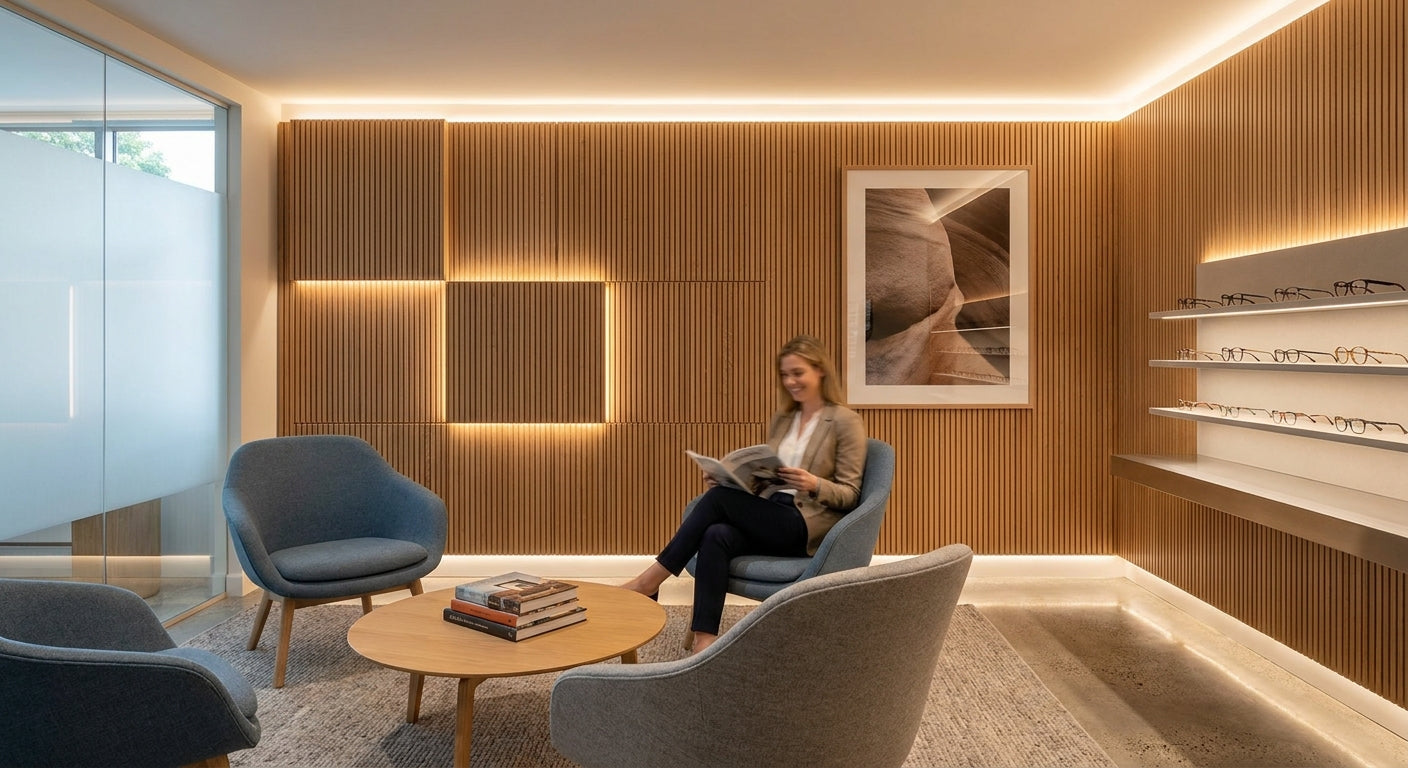
Optician waiting rooms mix glass display cabinets, tiled or vinyl floors and hard partition walls — a combination that bounces sound around the room and makes prescription conversations carry further than most practice owners realise. Acoustic panels for optician waiting rooms cut that reverberation while keeping the retail-meets-clinical look opticians need in 2026.
- Acoustic panels for optician waiting rooms need close to NRC 0.75 to tame glass-fronted reception echo - Hexagon Natural Oak with Grey Felt hits that mark. Buy.
- Standard Natural Oak wooden wall panels run in 240cm and 300cm lengths with a 3-sided veneer finish - the safe pick for most practices. Buy.
- Grey Oak panels give a clinical-calm palette without the flat look of foam tiles. Consider.
- Smoked Oak and Black Oak look striking but darken small waiting areas under retail lighting - skip them for the main wall.
Why this matters
A reception desk backed by glass cabinets and a tiled floor reflects sound instead of absorbing it. Patients discussing a prescription, a contact lens fitting, or an insurance query end up audible three seats away, and staff start lowering their voices or repeating themselves — neither helps the flow of a busy clinic day.
Bare walls are the easiest fix because they're the largest untreated surface in the room. A wall carrying an NRC rating near 0.75, like the hexagon panels stocked by Akuwood Panel, absorbs a meaningful share of that reflected sound rather than just decorating over the problem.
Who this is for
This guide is for independent high-street optician owners refurbishing a single reception, optical chain branch managers rolling the same fit-out across multiple stores, and ophthalmology clinic managers who need a waiting area that reads calm rather than clinical. If you're comparing a Natural Oak wooden wall panel against acoustic foam tiles for the first time, start here before you order a full room's worth.
What to look for in acoustic panels for optician waiting rooms
Sound absorption rating (NRC)
Glass display cabinets and tiled floors already work against you, so the panel itself needs to do real acoustic work, not just look textured. An NRC of 0.75, the rating on Akuwood Panel's felt-backed hexagon range, absorbs roughly three-quarters of the sound hitting the surface — enough to notice within a single afternoon of foot traffic.
Colour and finish that reads calm, not clinical
Patients waiting for an eye test are often already a little anxious. Foam acoustic tiles in grey or charcoal read institutional fast, while a real wood veneer in natural oak or grey oak signals a considered retail space rather than a corridor.
Cleanable, durable surface for high footfall
A waiting room sees dozens of people brushing past a feature wall every day, plus staff wiping down surfaces after closing. Fabric-wrapped acoustic panels stain and flatten under that kind of contact; a 3-sided wood veneer finish holds its look far longer.
Panel size versus ceiling height
Most UK high-street opticians work with standard shopfront ceiling heights, which is why the 240cm and 300cm run lengths cover the majority of installs without extra cutting. A taller unit or a converted retail unit with higher ceilings will need the 300cm option to avoid a visible seam.
Installation downtime
A practice can't close for a week to refit reception. Panels that click together over battens install in a single closed evening or a quiet Sunday, which matters more here than in a home renovation project.
Cost per square metre for multi-branch rollouts
A single-site independent can absorb a slightly higher spec than a chain fitting out six branches on the same budget. Decide your ceiling price per panel before you start picking finishes, or the aesthetic choice will make the decision for you.
Top picks for optician waiting rooms
Natural Oak wooden wall panel — the safe pick Three-sided real wood veneer over an acoustic felt backing, available in the standard 240cm and 300cm run lengths. It's the finish that works in almost any reception without a design consultation, and it doesn't read as a statement piece that risks dating. Buy.
Hexagon Natural Oak with Grey Felt — the reception feature-wall pick The hexagon acoustic panel in natural oak with grey felt carries the 0.75 NRC rating and comes in 81cm units that tile into a geometric pattern behind the reception desk. It's the pick when the waiting wall doubles as the practice's Instagram backdrop. Buy.
Grey Oak wooden wall panel — the neutral calm pick A cooler, more clinical grey tone than natural oak, without the flat, sterile look of foam. Works well where the practice brand already leans grey-and-white rather than warm wood tones. Consider.
Walnut wooden wall panel — the premium pick Darker and richer than oak, Walnut suits boutique high-street opticians positioning themselves above the high-volume chains. It reads expensive under warm reception lighting, less so under cool fluorescent strip lighting. Consider.
Smoked Oak / Black Oak — skip for the main waiting wall Both finishes look striking in showroom photography but pull light out of small waiting areas, especially in units with limited street-facing glazing. Save them for a single accent panel behind the optometrist's chair rather than the full reception wall. Skip.
What to avoid
- Fabric-wrapped acoustic panels — they absorb sound well but stain under hand contact and don't wipe clean the way a veneer surface does.
- Standard foam acoustic tiles — cheap per square metre, but the grid pattern and matte grey finish read as a call centre, not a retail optical practice.
- Full-wall dark finishes in small units — a converted shopfront under 20 square metres loses perceived floor space fast once you commit an entire wall to black or smoked oak.
Verdict comparison
| Panel | Finish | Sound performance | Size options | Best for | Verdict |
|---|---|---|---|---|---|
| Natural Oak wall panel | 3-sided veneer, felt back | Acoustic felt backing | 240cm / 300cm | Most reception walls | Buy |
| Hexagon Natural Oak with Grey Felt | 3-sided veneer, hexagon | 0.75 NRC | 81cm units | Feature wall behind desk | Buy |
| Grey Oak wall panel | 3-sided veneer, felt back | Acoustic felt backing | 240cm / 300cm | Clinical-cool colour schemes | Consider |
| Walnut wall panel | 3-sided veneer, felt back | Acoustic felt backing | 240cm / 300cm | Boutique/premium practices | Consider |
| Smoked Oak / Black Oak | 3-sided veneer, felt back | Acoustic felt backing | 240cm / 300cm | Single accent panel only | Skip (main wall) |


FAQ
What are the best acoustic panels for optician waiting rooms in 2026?
Hexagon acoustic panels with a 0.75 NRC rating, like the natural oak with grey felt range, and standard 240cm or 300cm wood veneer panels both work well in 2026. The right pick depends on whether the wall is a feature wall or a full reception run.
Do acoustic wood panels actually reduce echo in a waiting room?
Yes - a panel rated close to NRC 0.75 absorbs a large share of the sound reflecting off glass cabinets and tiled floors. The effect is most noticeable on the wall directly facing the reception desk.
Is real wood veneer better than foam acoustic tiles for a waiting room?
For a patient-facing space, yes - foam tiles absorb sound but look institutional, while a 3-sided wood veneer panel gives similar acoustic performance with a retail finish. Foam still works in back-office consultation rooms where appearance matters less.
How much wall do I need to panel in a small optician reception?
Most small units only need the wall facing the street-front glazing treated, not all four walls. That single wall is usually where the sound reflection problem starts.
Should I choose 240cm or 300cm panels?
240cm suits standard shopfront ceiling heights, while 300cm avoids a visible seam in converted units with taller ceilings. Measure the wall before ordering rather than guessing from the shopfront next door.
Are dark finishes like black oak a bad choice for waiting rooms?
Dark finishes reduce perceived brightness in small units, which is why smoked oak and black oak work better as a single accent panel than a full wall. Save them for the consultation room or a feature strip.
Can acoustic wall panels be installed without closing the practice for days?
Panels that click onto battens typically install in a single closed evening or a quiet Sunday. Ask about installation time before ordering if downtime is the deciding factor.
One last thing
Most practices over-panel. The wall that actually needs treatment is the one facing the street-front glass or the largest hard surface in the room — not all four walls of the reception. Order a sample of the finish you're leaning toward, hold it against the reception desk under the practice's actual lighting, and only then commit to a full 240cm or 300cm run for 2026.
Share:
Acoustic Panels for Therapy Rooms: 2026 Buying Guide
Best Acoustic Panels for University Seminar Rooms 2026