

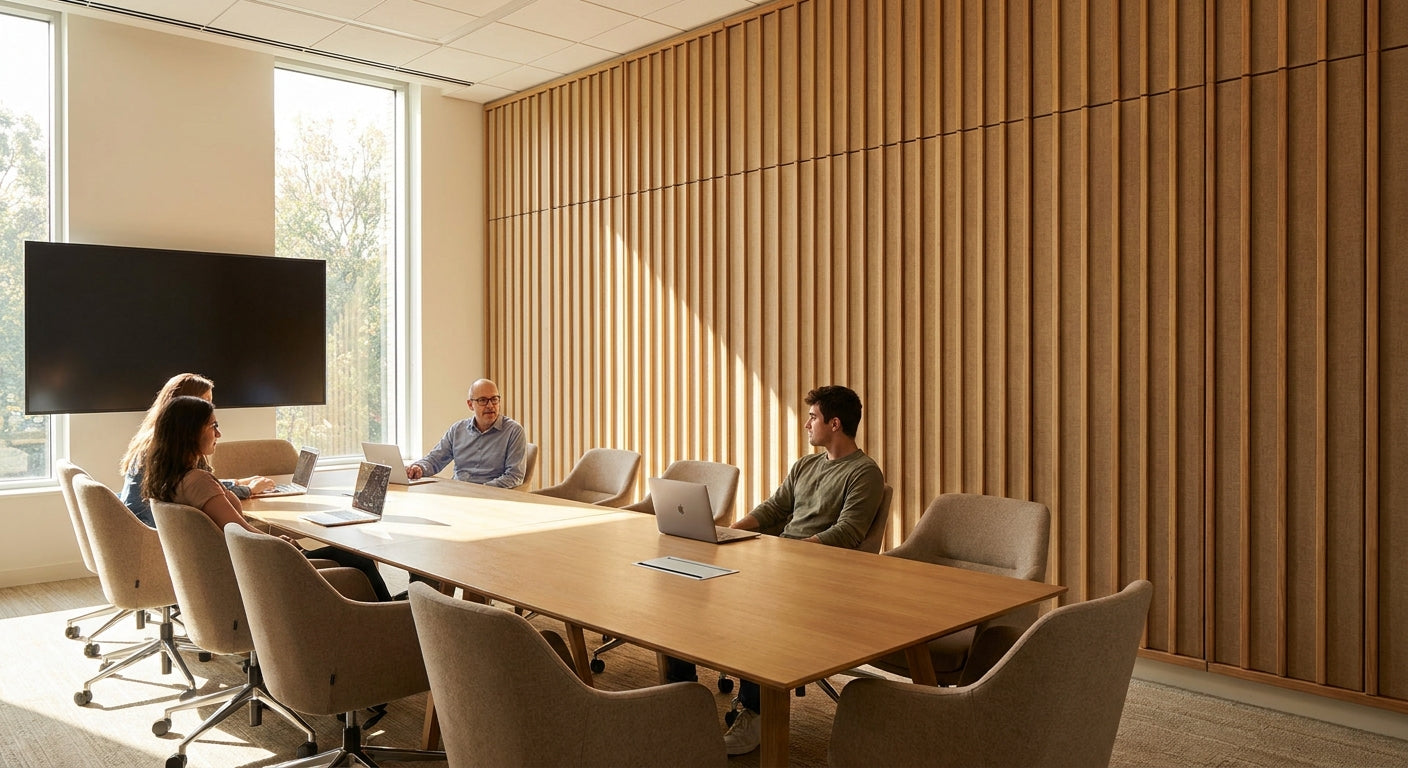
Estates teams booking out a seminar room for 40 students hear the same complaint every term: the lecturer's voice bounces off bare plaster and nobody past row three can follow the discussion. Acoustic wood panels fix that specific problem in teaching spaces without turning a room into a recording booth.
- Natural Oak with grey felt backing is the safe pick for most seminar rooms in 2026 — order it first.
- Smoked Oak suits rooms with wall-mounted screens because the dark veneer cuts glare — Buy for AV-heavy spaces.
- Grey Oak matches institutional colour schemes without looking clinical — Consider for refurbishment projects.
- Skip decorative-only panel ranges with no felt backing; they look right but do nothing for reverberation.
- Hexagon acoustic panels carry an NRC of 0.75 and work well for breakout corners inside larger seminar suites.
Why this matters
University seminar rooms are small, hard-surfaced, and used back-to-back all day — the exact conditions that produce flutter echo and speech fatigue. A room with bare walls, a whiteboard, and a suspended ceiling tile floor reflects sound aggressively, which means students in the back rows lose consonants and lecturers strain their voices by the third session of the day.
Akuwood Panel supplies acoustic wood panels built specifically to interrupt that reflection: a real wood veneer face over a felt acoustic backing, sold in 240 cm and 300 cm lengths so a facilities team can plan a wall run without excessive cutting. That combination — visible timber finish plus absorption backing — is what separates acoustic wood panels from purely decorative cladding, and it's the distinction that matters most when you're speccing for a teaching room rather than a lounge.
Who this is for
This guide is for estates and facilities managers, procurement leads, and interior fit-out contractors specifying finishes for university seminar rooms, tutorial rooms, and smaller teaching spaces in 2026. If you're comparing acoustic wood panels against suspended acoustic baffles or fabric-wrapped foam tiles for a refurbishment budget, the criteria below apply directly to your shortlist.
What to look for in acoustic wood panels for university seminar rooms
Felt backing, not just a wood face
A panel that's veneer-only looks the part in a photo but does almost nothing to control reverberation. The felt backing behind the wood face is what actually absorbs sound energy, so confirm the backing material before comparing finishes — a wood-look panel without it is decorative cladding, not an acoustic product.
Panel length matched to your wall run
Seminar rooms are typically narrower than lecture theatres, and wall runs often sit between 3 and 6 metres once you account for doors and whiteboards. Panels come in 240 cm and 300 cm lengths, and picking the length that divides your wall run cleanest cuts waste and reduces the number of visible joints.
Finish consistency across a full order
A seminar room refurbishment usually needs 15 to 30 panels covering multiple walls, and real wood veneer varies naturally between batches. Order from a single production run where possible, and request a sample before committing a full room's worth of panels — grain variation that looks fine on one wall reads as inconsistent across four.
Durability under daily academic use
Seminar rooms get used six or more times a day during term, with chairs, bags, and foot traffic close to the walls. A three-sided real wood veneer finish holds up better against knocks than a painted MDF slat, which is why veneer construction matters more here than in a domestic living room spec.
Fitting that doesn't take the room out of the timetable
Most universities can't take a seminar room offline for a week. Panels that glue or click directly onto plasterboard or battens install in a day per room with the right adhesive, which matters when your only window is a reading week or a weekend.


The hexagon range above is worth pairing with full-length slat panels in breakout corners or reading nooks off a larger seminar suite — the 81 cm hexagon format carries the same felt backing at an NRC of 0.75, but works better as an accent than a full wall.
Top picks for seminar room walls
The safe pick: Natural Oak with grey felt
The lightest finish in the range, and the one that reads as "neutral academic" rather than "corporate boardroom." It pairs with whiteboards and projector screens without competing for attention, and the grey felt backing shows through the slats just enough to signal the panel is doing acoustic work, not just decorative work. Buy — natural oak wall panel with grey felt is the default spec for most seminar room refurbishments in 2026.
The AV-room pick: Smoked Oak
Dark veneer cuts glare on the wall opposite a projector or wall-mounted screen, which matters in rooms running lecture-capture software during back-to-back sessions. It also hides scuff marks better than pale finishes over a multi-year academic calendar. Buy — smoked oak wall panel for any seminar room where the screen wall gets afternoon sun through adjacent windows.
The institutional-match pick: Grey Oak
University interiors lean toward grey and muted palettes across signage, carpet tile, and furniture in 2026 refurbishment specs, and Grey Oak sits inside that palette without looking like an afterthought. It's the pick when the brief says "blend in, don't stand out." Consider — grey oak wall panel for refurbishments constrained by an existing interior colour scheme.
The one to think twice about: Walnut
Walnut's warm, dark grain photographs beautifully and suits a private members' lounge, but in a seminar room with fluorescent or LED panel lighting it can read heavier than intended, especially in a room under 20 square metres. It's not wrong, it's just a finish that rewards a larger room with softer lighting. Hold on Walnut until you've seen a sample under your actual room lighting.
What to avoid
- Decorative-only wall panels with no felt backing. Ranges built for accent walls in living rooms — clover, snowdrop, and similar 3D decorative styles — look striking but don't address reverberation, which is the actual problem in a seminar room.
- Panel lengths that force awkward cuts. Speccing 300 cm panels into a 3.4 m wall run leaves an off-cut that either gets wasted or creates a visible seam in the wrong place — measure the run before ordering.
- Skipping a sample order on a multi-room refurbishment. Veneer grain and tone shift slightly between production batches; a sample checked against your lighting avoids a mismatch across four or five seminar rooms fitted the same week.
Verdict comparison
| Panel | Backing | Best for | Verdict |
|---|---|---|---|
| Natural Oak, grey felt | Felt-backed | General seminar rooms | Buy |
| Smoked Oak | Felt-backed | Rooms with screens/AV | Buy |
| Grey Oak | Felt-backed | Colour-matched refurbishments | Consider |
| Walnut | Felt-backed | Larger rooms, softer lighting | Hold |
| Hexagon Natural Oak, grey felt (NRC 0.75) | Felt-backed | Breakout corners, accents | Consider |
FAQ
What's the best acoustic panel for a university seminar room in 2026?
A felt-backed real wood veneer slat panel, such as Natural Oak with grey felt, is the best default for most seminar rooms in 2026. It absorbs reverberation while keeping a neutral, non-corporate finish that suits teaching spaces.
Do acoustic wood panels actually reduce echo in a classroom-style room?
Yes, when the panel has a felt backing rather than a plain wood veneer face. The felt layer absorbs sound energy that would otherwise bounce off a bare wall, which is the main cause of echo in hard-surfaced teaching rooms.
Is 240 cm or 300 cm better for a seminar room wall?
It depends on your wall run length — pick whichever size divides the run with the fewest cuts. A 300 cm panel suits longer runs typical of larger seminar rooms, while 240 cm fits standard ceiling heights and shorter walls more cleanly.
How many acoustic wall panels does a typical seminar room need?
Most seminar rooms of 20 to 40 square metres need 15 to 30 panels covering the walls most exposed to student seating, though exact counts depend on room dimensions and how much wall coverage the brief calls for.
Are decorative wall panels the same as acoustic wall panels?
No. Decorative panel ranges are built for visual effect and typically lack the felt backing that does the acoustic work, so they don't meaningfully reduce reverberation in a teaching space.
What finish works best for a seminar room with a projector screen?
A darker veneer such as Smoked Oak reduces glare on the wall behind or beside a screen and holds up better against scuffing over a full academic year of back-to-back use.
Can acoustic wood panels be installed without taking a seminar room out of the timetable?
Yes, in most cases. Panels that glue or click onto plasterboard or battens can be fitted in a day per room, which fits inside a reading week or weekend maintenance window.
Do hexagon acoustic panels work in a seminar room?
Hexagon panels with grey felt backing carry an NRC of 0.75 and work well as an accent in breakout corners or reading nooks, but full-length slat panels cover more wall area more efficiently for the main teaching walls.
One last thing
The detail estates teams miss most often: panel finish matters less for acoustics than felt backing does, yet most refurbishment briefs specify the finish first and ask about the backing as an afterthought. Flip that order in 2026 — confirm the felt backing is on the shortlist, then pick the veneer that matches your room.
Share:
Acoustic Panels for Optician Waiting Rooms: 2026 Picks
Best Acoustic Panels for Climbing Centres, 2026