

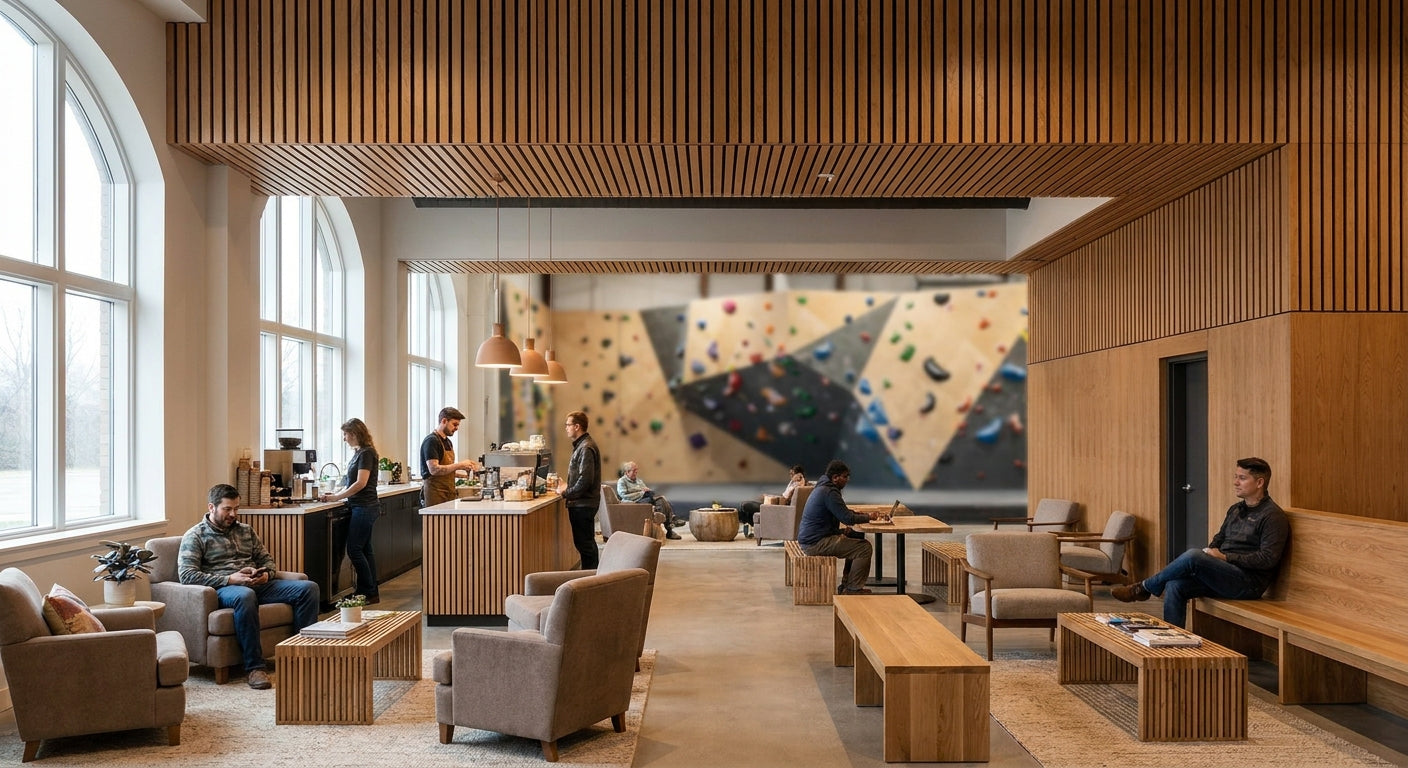
Climbing centres are echo chambers by design: concrete floors, high ceilings, glass frontages and bare block walls all reflect sound instead of absorbing it. This guide is for facility managers and gym owners fitting out cafes, reception desks, viewing lounges and changing corridors who need acoustic treatment that survives chalk dust and heavy foot traffic.
- Acoustic panels for climbing centres need an NRC around 0.75 to cut reverberation in hard-surfaced common areas — the Natural Oak Grey Felt panel hits that mark. Buy.
- Black Oak wood panels hide chalk marks and scuffs better than pale finishes in high-traffic reception zones. Buy.
- Fabric-wrapped foam panels look wrong in a bouldering gym and soil fast under chalk dust. Skip them for common areas.
- Hexagon acoustic panels at 81 cm and £40.95 each work as a feature wall behind a climbing centre reception desk. Consider.
Why this matters
A climbing centre's training walls get acoustically engineered by default — mats, ropes and soft flooring absorb a lot of noise. The common areas rarely do. Cafes, lounges, reception desks and corridors sit on hard flooring under bare ceilings, so every conversation, coffee machine hiss and door slam bounces around the room. Members notice this the moment they sit down after a session; staff notice it every shift when they have to repeat themselves at the front desk.
Acoustic wood panels solve this without turning a gym into a soft-play centre. A 3-sided real wood veneer front with an acoustic felt backing absorbs sound while still looking like a finished wall, not a padded cell. That distinction matters in 2026 more than it did five years ago, because members increasingly judge a gym's quality on the common areas, not just the wall height.
Who this is for
This guide is for the person who signs off on the fit-out: a gym owner opening a second site, a facility manager tackling noise complaints in an existing café, or a contractor specifying materials for a new climbing centre build. If you're choosing between raw plasterboard, foam tiles and real wood acoustic panels for a reception, lounge or corridor, read on.
What to look for in acoustic panels for climbing centres
Sound absorption rating (NRC)
Noise Reduction Coefficient tells you how much sound energy a panel actually absorbs versus reflects. Panels rated around 0.75 NRC pull a meaningful chunk of reverberation out of a room with a hard concrete floor and a high ceiling — the exact combination most climbing centres have. Anything markedly lower is decorative, not acoustic.
Impact and abrasion resistance
Chalk dust, dropped chalk bags, rolling crash pad edges and constant hand contact near a boulder wall entrance all take a toll on wall finishes. A wood veneer surface holds up to repeated wiping and knocks far better than fabric or foam facing, which tears and stains.
Wipe-clean finish
Chalk gets everywhere in a climbing centre, including common areas members walk through straight off the wall. A hard veneer surface wipes clean with a damp cloth; a fabric-wrapped acoustic panel absorbs the dust into the weave and discolours within months.
Fit around existing joinery
Reception desks, café counters and signage all interrupt a common-area wall. Panels sold in fixed-width slats let you cut and fit around obstacles without reordering a custom size, which matters when you're panelling a working space rather than an empty showroom.
Aesthetic fit with the gym's brand
Most climbing centres lean into an industrial-meets-natural look: exposed steel, concrete, and warm timber accents. Real wood veneer finishes read as premium without softening the space into a spa. Painted acoustic foam reads as an afterthought bolted onto a budget fit-out.
Format and coverage
Panels come in different lengths — Akustiq UK's range runs to 240 cm and 300 cm formats — so measure ceiling height and wall runs before ordering. A common-area wall behind a café counter rarely needs full floor-to-ceiling coverage; targeted placement at ear height often does more for perceived noise than covering the whole wall.
Top picks for climbing centre common areas
Natural Oak Grey Felt panel — the safe pick. NRC 0.75, real wood veneer front, grey acoustic felt backing that reads neutral against most gym colour schemes. This is the panel to specify when you need genuine sound absorption without a design meeting about it. Buy for cafes and reception walls facing hard flooring.
Black Oak panel — the durability pick. Dark finishes hide chalk smudges and scuff marks that show up fast on pale wood in a high-traffic corridor. Same acoustic felt backing, same 3-sided veneer construction, just a finish built for wear-and-tear zones like entrance corridors and changing area approaches. Buy if the wall gets touched constantly.
Hexagon acoustic panel, Natural Oak with grey felt — the feature-wall pick. Sold in 81 cm units at £40.95 each, these work as an accent behind a reception desk or in a lounge seating nook rather than as full wall coverage. They deliver the same acoustic felt backing in a geometric pattern that reads as intentional design, not just noise control. Consider for a statement wall where the full acoustic run isn't needed.
Rustic Oak Premium 3-sided veneer panel — the wildcard. Heavier grain, more visual texture, closer to a reclaimed-timber look than a clean modern finish. It suits a gym leaning into a raw, warehouse-style brand rather than a sleek studio look. Consider only if the rest of the fit-out already runs rustic industrial; otherwise it clashes.


What to avoid
- Fabric-wrapped foam panels. They absorb chalk dust into the weave, discolour within a season, and rarely carry the fire ratings a public sports building needs.
- "Acoustic" panels with no published NRC figure. If a supplier won't state a rating, assume it's decorative MDF with a felt sticker on the back, not real sound treatment.
- Full floor-to-ceiling coverage everywhere. Common areas rarely need every wall panelled. Targeted placement at ear height around the café and reception cuts more perceived noise per pound spent than blanket coverage.
Verdict comparison
| Panel | NRC rating | Best for | Wear resistance | Verdict |
|---|---|---|---|---|
| Natural Oak Grey Felt | 0.75 | Café and reception walls | High | Buy |
| Black Oak | 0.75 | High-traffic corridors | Very high (hides marks) | Buy |
| Hexagon Natural Oak Grey Felt | 0.75 | Feature/accent walls | High | Consider |
| Rustic Oak Premium veneer | 0.75 | Warehouse-style gyms only | High | Consider |
| Fabric-wrapped foam | Varies, often unpublished | Nowhere in a climbing centre | Low | Skip |
FAQ
What NRC rating do acoustic panels need for a climbing centre common area?
Aim for an NRC around 0.75 in cafes, reception and lounge areas with hard flooring and high ceilings. Lower-rated panels are mostly decorative and won't cut noticeable echo in a large open room.
Are wooden acoustic panels durable enough for chalk dust and heavy foot traffic?
Yes, a real wood veneer surface wipes clean and resists scuffing far better than fabric or foam facing. Dark finishes like Black Oak also hide chalk marks and scuffs between cleaning cycles.
Can acoustic panels be used behind a climbing centre café or reception desk?
Yes, this is one of the most effective placements because reception and café counters are where staff and members talk over background noise all day. A wall panel section at ear height behind the desk absorbs the reflections causing the strain.
Do acoustic wood panels need fire certification for public sports buildings?
Check fire compliance documentation with any supplier before specifying panels for a public building, since requirements vary by building type and local authority. Ask for the fire rating in writing rather than assuming a wood-veneer product is automatically compliant.
What size format works best for high-ceiling bouldering gym walls, 240 cm or 300 cm?
300 cm panels suit taller common-area walls and reduce the number of horizontal joins on a floor-to-ceiling run. 240 cm formats fit standard ceiling heights and are easier to handle during installation around desks and counters.
Are hexagon acoustic panels good for a climbing centre feature wall?
Hexagon panels work well as an accent behind seating or reception rather than as the primary acoustic treatment for a whole room. At 81 cm per unit and an NRC of 0.75, a cluster of them absorbs meaningful sound while doubling as a design feature.
How much does it cost to treat a climbing centre common area with acoustic panels in 2026?
Cost depends on wall area and panel format, since pricing varies by size and finish. Check current per-panel pricing on the product pages before budgeting a full common-area fit-out.
One last thing
The common-area wall that gets skipped most often is the corridor between the boulder wall and the changing rooms — exactly the stretch where chalky hands touch the wall constantly and noise carries loudest between two hard surfaces. Panel that stretch with a Black Oak or Smoked Oak finish before the café, and the perceived noise drop across the whole facility is bigger than treating the café alone.
Share:
Best Acoustic Panels for University Seminar Rooms 2026
Best acoustic wall panels for architects | 2026