

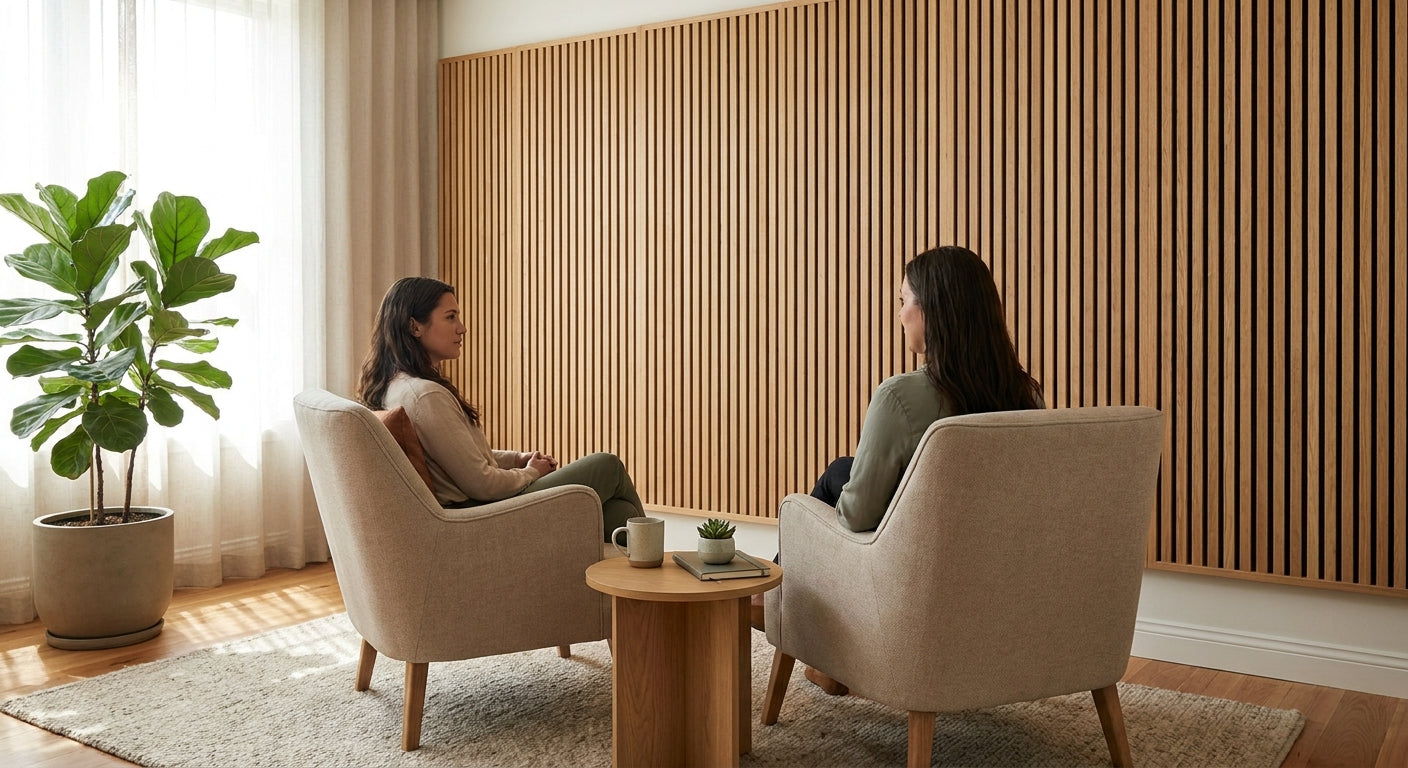
Confidentiality is the whole business model in a therapy or counselling room, and a bare plasterboard wall does nothing to protect it. Acoustic wood panels for therapy rooms cut sound transmission between sessions while giving the space the calm, professional look clients expect the moment they sit down.
- Natural Oak wood panels are the safe buy for calming consulting rooms in 2026 — warm tone, real veneer, proven NRC absorption.
- Grey Oak panels suit clinical-neutral counselling suites without the cold, sterile look of laminate.
- Skip printed laminate acoustic panels for therapy rooms — the veneer wears through faster under daily client traffic.
- Hexagon Natural Oak felt panels carry a 0.75 NRC rating and work as a single accent wall behind the therapist's chair.
Why this matters
A counselling room with untreated walls lets voices carry through doors and thin partitions, and clients notice. Poor acoustics also make a small consulting room feel harsher than it is — every chair creak and pen click bounces straight back at the person in the chair. Acoustic wood panels absorb that mid-frequency speech noise instead of reflecting it, which is exactly the range human conversation sits in.
The wood veneer finish does double duty: it's a sound treatment that also reads as furniture-grade interior design, not a clinical fix bolted to the wall. For a therapy practice, that distinction affects whether a new client feels safe enough to talk.
Who this is for
This guide is for private therapists, counselling charities, EAP providers, and clinic managers fitting out one or more consulting rooms where speech privacy and a calm visual tone both matter. It applies whether you're treating a single 3m x 3m room in a converted terrace house or five identical rooms in a shared wellness centre — the buying criteria don't change, only the quantity.
What to look for in acoustic panels for therapy rooms
Sound absorption rating
Check the NRC (Noise Reduction Coefficient) before anything else — it tells you what fraction of sound energy the panel actually absorbs rather than reflects. Felt-backed hexagon and slat panels in the 0.75 NRC range meaningfully reduce speech bleed-through and room echo, which matters more in a small consulting room than a large open lounge.
Real wood veneer vs printed finish
A 3-sided real wood veneer holds its colour and grain under daily wear far longer than a printed laminate skin, which starts looking flat and scuffed within a year of client turnover. Clients sit close to these walls for 50 minutes at a time — texture and grain read as quality up close in a way a photo-print never does.
Panel size format
Panels come in 240 cm and 300 cm lengths, and picking the wrong one means visible seams at eye level in a room designed to feel seamless and calm. Measure your ceiling height first: 240 cm suits standard UK consulting rooms, 300 cm suits taller converted Georgian or Victorian rooms where a seam would sit awkwardly mid-wall.
Installation method and downtime
Therapy rooms are booked back-to-back, so a fixing method that needs a full day of drilling and dust between appointments is a real cost. Adhesive-mounted panels go up with panel glue and minimal noise, which matters if you're fitting one room while the practice next door is running sessions.
Wood finish tone
Colour affects how a room feels within seconds of walking in — warm oak tones read as approachable and calming, while very dark finishes can feel heavier and more formal. Match the tone to the type of work happening in the room: grief counselling and family therapy tend to suit lighter, warmer finishes; executive coaching and EAP consulting rooms can carry darker tones without feeling oppressive.
Long-term durability
A therapy room sees the same wall touched, brushed past, and stared at for years without a refit budget. Real veneer over MDF with a felt back holds up to that kind of low-impact daily contact far better than foam acoustic tiles, which crumble and discolour within a few seasons.
Top picks for therapy and counselling rooms
The safe pick — Natural Oak wall panel. This finish gives a warm, neutral tone that works in almost any consulting room without competing with soft furnishings or artwork. The real wood veneer and felt backing bring genuine absorption rather than a decorative-only slat look. Buy the Natural Oak wall panel for the default choice across multiple rooms.
The clinical-neutral pick — Grey Oak wall panel. Grey Oak reads as calm and modern without the coldness of grey laminate or exposed acoustic foam, which suits practices that want a more contemporary, less domestic feel. It pairs well with the muted colour schemes many counselling suites already use for signage and soft furnishings. Buy the Grey Oak wall panel for rooms with a more corporate or EAP-style brief.
The wildcard — Smoked Oak wall panel. Darker and richer than Natural or Grey Oak, Smoked Oak suits a single feature wall behind the therapist's chair in rooms with good natural light, where a heavier tone won't make the space feel closed in. It's a bolder choice, so Consider it only where the rest of the room stays light and simple.
The accent-wall specialist — Hexagon Natural Oak with Grey Felt. At an 81 cm hexagon format with a 0.75 NRC rating, this panel works as a standalone acoustic feature rather than full-wall coverage, which suits practices on a tighter refit budget. Consider it for a single wall where full-room panelling isn't in the 2026 budget.


What to avoid in a therapy room
- Printed laminate acoustic panels. They look identical to real veneer in a photo but scuff and flatten within 12-18 months under daily client contact — a bad trade for a room clients judge on trust.
- Foam acoustic tiles as the only treatment. Foam absorbs high frequencies well but does little for the mid-range of human speech, and it looks institutional in a room meant to feel like a lounge, not a recording booth. Practices treating GP-adjacent waiting areas run into the same mismatch — see acoustic panels for GP surgery waiting rooms for how that plays out in a clinical setting.
- Undersized coverage. Panelling one small wall in a large room barely changes the echo — full-wall or two-wall coverage is usually what actually stops a room sounding hollow.
Verdict comparison
| Panel | NRC-relevant finish | Best for | Verdict |
|---|---|---|---|
| Natural Oak wall panel | Real veneer, felt-backed | Default warm consulting room | Buy |
| Grey Oak wall panel | Real veneer, felt-backed | Clinical-neutral / EAP suites | Buy |
| Smoked Oak wall panel | Real veneer, felt-backed | Feature wall, well-lit rooms | Consider |
| Hexagon Natural Oak with Grey Felt | 0.75 NRC hexagon | Single accent wall, tight budget | Consider |
| Printed laminate panels (generic) | No real veneer | Nothing in a therapy room | Skip |
FAQ
What's the best acoustic panel for a therapy room?
Real wood veneer panels with a felt backing, such as Natural Oak or Grey Oak, work best in 2026 because they absorb speech-range sound and hold their finish under daily client contact. Foam tiles absorb less of the mid-frequency range that human voices sit in.
Do wood acoustic panels actually stop a counselling room being overheard?
They reduce reflected sound inside the room and cut down on echo, which lowers how far raised voices carry through thin partitions. For full soundproofing between rooms you still need adequate wall construction; panels handle the in-room acoustic treatment, not structural sound isolation.
How much does it cost to panel a therapy room in 2026?
Cost depends on room size, panel format, and finish chosen, so check current pricing on the product pages directly. Hexagon accent panels cost less per wall than full-coverage slat panelling across every wall.
Is 240 cm or 300 cm better for a small consulting room?
240 cm suits standard UK ceiling heights typical of converted terraced or semi-detached consulting rooms. 300 cm suits taller period rooms where a shorter panel would leave a visible seam mid-wall.
Can acoustic panels be installed without disrupting client appointments?
Adhesive-mounted panels using panel glue go up with far less noise and dust than mechanically fixed alternatives, so a single room can be fitted between bookings. Full-room jobs across multiple consulting rooms still take longer and are best scheduled outside clinic hours.
What NRC rating do you need for a counselling room?
A 0.75 NRC rating, as found on felt-backed hexagon and slat panels, meaningfully reduces speech-range echo in a small consulting room. Lower-rated decorative-only panels look similar but absorb far less sound.
Are wood panels better than foam tiles for a professional office?
Wood veneer panels look like furniture rather than studio equipment, which matters in a room clients judge for trust and professionalism. Foam tiles absorb high frequencies well but read as clinical and wear out faster under daily wear.
How many panels does a 3m x 3m therapy room need?
Coverage depends on wall height and how many walls you're treating, so measure total wall area before ordering. Most practices panel one or two walls rather than the full room to balance acoustic gain against budget.
One last thing
The wall behind the therapist's chair does more acoustic work than any other surface in the room, because it's the one clients face for the entire session. If budget only stretches to one wall in 2026, panel that one first — a single Grey Oak or Natural Oak wall behind the chair changes how the whole room sounds before you've touched anything else.
Share:
Acoustic Panels for Physiotherapy Clinics: 2026 Buying Guide
Acoustic Panels for Optician Waiting Rooms: 2026 Picks