

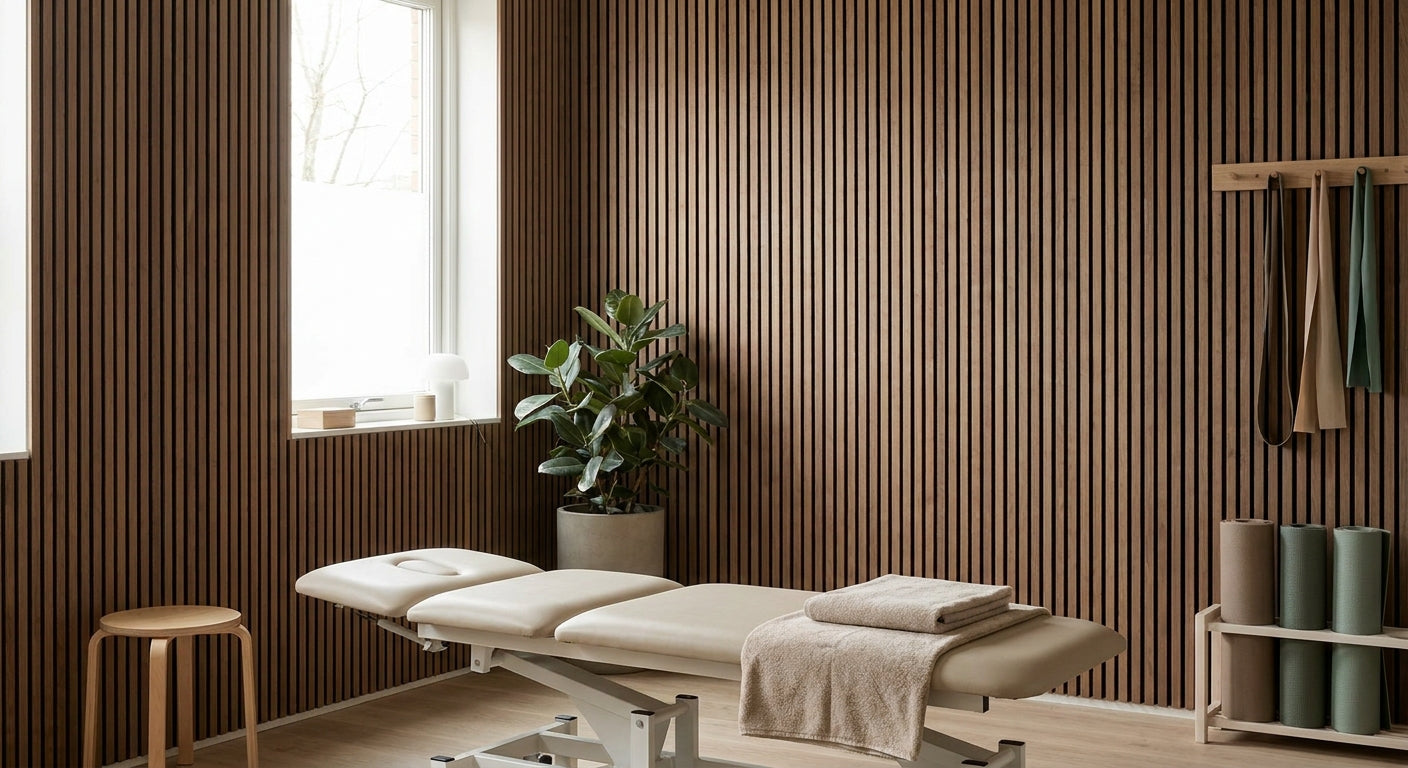
Hard floors, plastered walls, and a treatment table in the middle of the room turn every physiotherapy clinic into an echo chamber. This guide breaks down what to look for in acoustic panels for physiotherapy clinics in 2026, with specific picks, a comparison table, and the finishes that look right on a mood board but fail on a clinical wall.
- Hexagon Acoustic Panel Natural Oak with Grey Felt carries an NRC of 0.75 and costs £40.95 per panel — buy for treatment room feature walls.
- Wooden Wall Panel Natural Oak suits reception and waiting areas where a calm, neutral tone matters more than absorption depth.
- Skip fabric-wrapped foam tiles in clinical settings — they trap moisture and don't wipe clean between patients.
- Panels ship in 240cm and 300cm lengths, which covers most UK clinic ceiling heights without extra cutting.
Why this matters
A physiotherapy clinic isn't a living room. Patients discuss injuries, pain levels, and sometimes medical history within earshot of a waiting room. Bare plaster and vinyl flooring bounce that conversation straight back into the corridor, which is a privacy problem as much as a comfort one.
Staff feel it too. Therapists giving instructions over the hum of a treatment room, plus the scrape of equipment on hard flooring, adds up to real fatigue across an eight-hour shift. Acoustic wood panels solve both problems at once — they absorb reflected sound and they look like a finished clinical interior rather than a converted retail unit.
Who this is for
This guide is for physiotherapy clinic owners and practice managers fitting out treatment rooms, waiting areas, or consultation spaces in 2026 — whether that's a new-build clinic, a converted retail unit, or a single-room private practice inside a shared health centre. If you're weighing hard surfaces that need to survive daily wipe-downs against a budget that still needs to stretch across three or four rooms, the criteria below apply directly to you.
What to look for in acoustic panels for physiotherapy clinics
Sound absorption rating (NRC)
The Noise Reduction Coefficient tells you how much sound a panel actually absorbs rather than reflects. Akustiq UK's hexagon acoustic panels carry an NRC of 0.75, which means roughly three-quarters of the sound hitting the panel gets absorbed instead of bouncing back into the room. In a clinic, that's the difference between a treatment room where you can hear the next patient through the wall and one where you can't.
A surface that wipes clean
Clinical spaces get sanitized constantly. A real wood veneer finish holds up to routine wiping in a way that fabric-wrapped foam panels don't — fabric absorbs spills and holds odour, and it's the first thing an infection-control inspector will flag. Look for a 3-sided veneer finish over a felt backing rather than an exposed textile face.
Panel size matching your room height
Most UK clinic rooms sit between standard 2.4m and taller 3m ceiling heights. Panels that come in both 240cm and 300cm formats mean you're not cutting down oversized sheets or piecing together undersized ones — either dimension usually reaches floor to ceiling without extra joins.
A finish that reads calm, not clinical
Wood tone affects how anxious a patient feels walking into a treatment room. Natural oak and grey oak read neutral and reassuring; smoked oak and black oak read sharper and work better in gyms or larger rehab spaces than in a one-to-one consultation room.
Installation that doesn't damage a leased unit
Most physiotherapy practices operate from leased premises, so structural fixings aren't always an option. Panel glue systems let you mount acoustic panels without drilling into a party wall, which matters if your lease has a reinstatement clause.
Price per square metre against room count
A single-room practice fitting one feature wall has a very different budget ceiling than a five-room clinic panelling every treatment bay. Price the job per panel and multiply by your actual wall count before you commit to a finish across the whole site.
Top picks for physiotherapy clinic walls
Wooden Wall Panel Natural Oak — the safe pick. Neutral tone, 3-sided real wood veneer, works in reception and waiting areas where you want calm without drawing attention to the wall itself. Natural oak wall panel fits the brief for most front-of-house spaces. Buy.
Hexagon Acoustic Panel Natural Oak with Grey Felt — the treatment room specialist. At £40.95 per panel with an NRC of 0.75, this is the pick for a feature wall directly behind a treatment table, where absorption matters more than anywhere else in the clinic. The hexagon acoustic panel also breaks up the flat, institutional look of a standard consult room. Buy.
Wooden Wall Panel Natural Oak with Grey Felt — the contemporary consult room option. The grey felt backing reads cooler than standard felt, which suits a clinic leaning into a modern, low-clutter interior rather than a warm reception feel. Consider if your branding is already grey-and-white; skip it if your waiting room runs warmer tones.
Wooden Wall Panel Smoked Oak — the dark accent. Strong grain, deep tone, good for a single feature wall in a larger gym-style rehab space where the room already gets plenty of natural light. In a small windowless treatment room it can make the space feel tighter rather than calmer. Consider for larger rooms, Skip for small consult rooms under roughly 3m wide.


What to avoid
- Fabric-wrapped foam acoustic tiles. They absorb sound well on paper but hold moisture and odour once patients start touching walls between sessions — hard to sanitize, easy to stain.
- Deep foam wedge panels. These eat into a treatment room's usable floor space and create a trip hazard around a table you're already moving patients around.
- Ultra-dark finishes in small consult rooms. Black oak and heavily smoked tones can make a windowless room feel smaller rather than calmer — reserve them for larger, brighter spaces.
Verdict comparison
| Pick | Best for | NRC / absorption | Verdict |
|---|---|---|---|
| Natural Oak wall panel | Reception, waiting rooms | Standard acoustic felt backing | Buy |
| Hexagon Panel Natural Oak w/ Grey Felt | Treatment room feature wall | 0.75 | Buy |
| Natural Oak w/ Grey Felt (standard panel) | Modern consult rooms | Standard acoustic felt backing | Consider |
| Smoked Oak wall panel | Larger, bright rehab spaces | Standard acoustic felt backing | Consider / Skip in small rooms |
Start with the treatment rooms first — that's where absorption has the most measurable effect on patient conversations carrying through the wall — then extend the same finish family into the waiting area for a consistent look across the clinic in 2026.
FAQ
What's the best acoustic panel for a physiotherapy treatment room?
A hexagon acoustic panel with an NRC of 0.75, like the Natural Oak with Grey Felt finish, gives the strongest absorption for a treatment room feature wall. It also breaks up the flat look of a standard clinical wall without adding clutter.
Are wood acoustic panels hygienic enough for a clinic?
A 3-sided real wood veneer finish wipes clean, which suits routine clinical sanitizing better than fabric-wrapped foam panels. Fabric surfaces absorb spills and are harder to disinfect between patients.
How much does it cost to panel a physiotherapy clinic wall?
Hexagon acoustic panels run £40.95 each in 2026, so total cost depends on wall size and how many rooms you're covering. Price the job per panel against your actual wall count before committing to one finish across a multi-room clinic.
Is a wood panel wall better than foam acoustic tiles for a clinic?
Wood veneer panels wipe clean and look like a finished interior, while foam tiles trap moisture and stain more easily under clinical use. For absorption alone foam can compete, but hygiene and appearance favour wood panels in patient-facing rooms.
What size acoustic panels fit a standard UK clinic room?
Panels come in 240cm and 300cm lengths, which covers most standard and taller UK ceiling heights without extra cutting. Measure your wall height first and pick whichever length reaches closest to the ceiling.
Can acoustic panels be installed without damaging a leased clinic unit?
Panel glue systems let you mount acoustic panels without drilling structural fixings into a party wall. That matters directly if your lease includes a reinstatement clause at the end of the term.
Do dark wood finishes work in small consultation rooms?
Smoked oak and black oak finishes tend to make small, low-light consult rooms feel tighter rather than calmer. Save darker tones for larger rehab spaces with more natural light.
Should waiting rooms and treatment rooms use the same finish?
Matching finishes across a clinic in 2026 creates a consistent, calming interior, but it isn't required for the acoustics to work. Prioritise absorption in treatment rooms first, then extend the same wood tone into the waiting area if budget allows.
One last thing
Most clinics panel the wall behind the treatment table and stop there — but the wall a patient faces while lying down, not the one behind the therapist, is the one that actually shapes how the room feels during a session. Panel that wall first in 2026 fit-outs, then move outward.
Share:
Acoustic Panels for Insurance Offices: 2026 Buying Guide
Acoustic Panels for Therapy Rooms: 2026 Buying Guide