

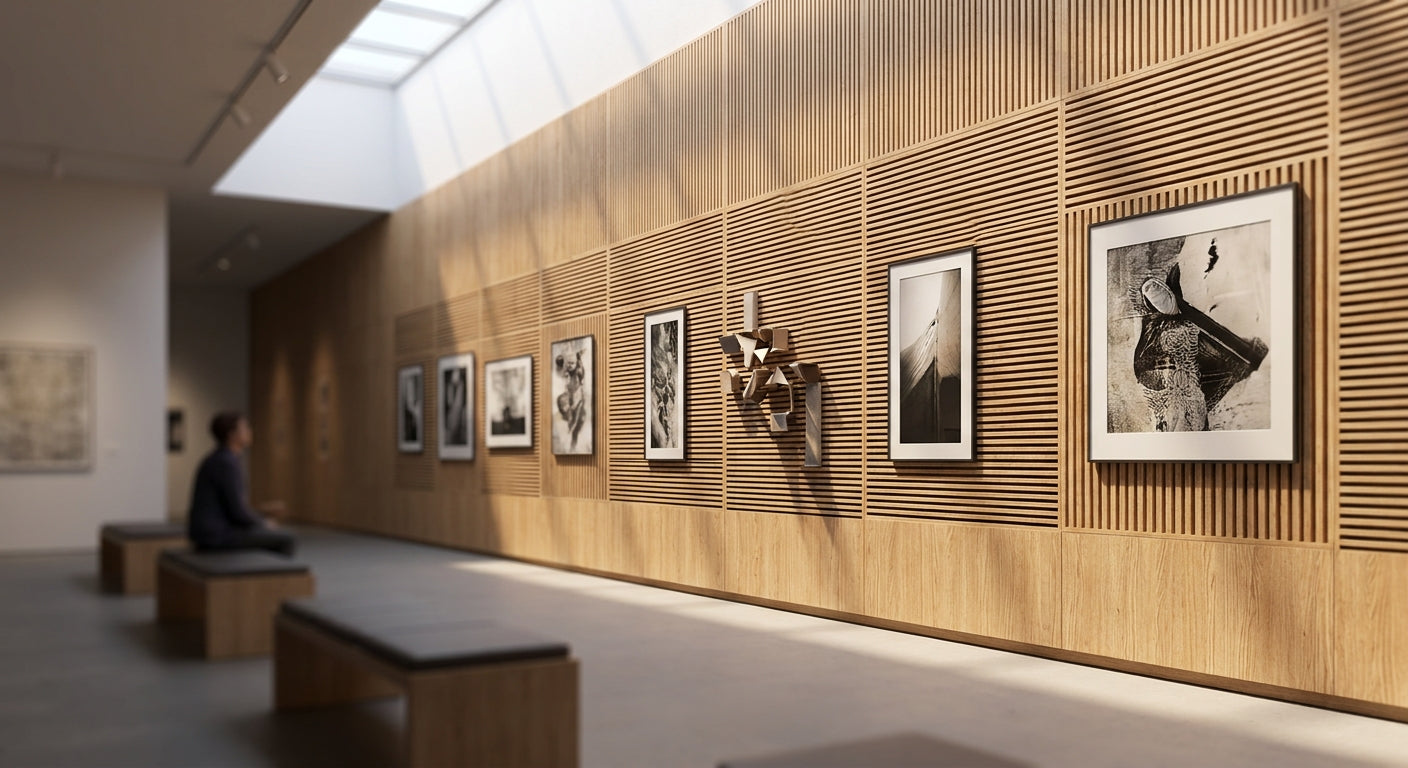
Museum and gallery walls have to do two jobs at once: control echo across large, hard-floored volumes and stay visually silent enough that nobody notices them over the art. Standard acoustic foam fails the second test immediately, and plain plaster fails the first.
- Acoustic wood panels for museums need an NRC rating near 0.75 to cut reverberation in tall gallery halls — foam substitutes look wrong on exhibition walls.
- Akuwood Panel's Natural Oak and Grey Oak wall panels work as neutral backdrops that won't compete with artwork on the wall.
- 240 cm and 300 cm formats cover most ceiling heights in converted warehouse and Victorian-era gallery spaces without visible seams.
- Black Oak suits contemporary and photography exhibits; skip glossy laminate panels that glare under gallery lighting.
- Hexagon acoustic panels work well as a feature treatment in lobbies and entrance halls, not primary display walls.
Why this matters
A gallery hall with hard floors, glass cases, and bare plaster walls behaves like an echo chamber — visitor conversation, footsteps, and audio-guide bleed all stack on top of each other. Curators solve this with soft furnishings in a living room; they can't do that in an exhibition space without covering the walls in fabric or clutter that competes with the work on display. That's the specific problem acoustic wood panels for museums solve in 2026: real wood veneer on the surface, acoustic felt behind it, absorbing sound without looking like a sound treatment. Akuwood Panel builds its panel range around that exact trade-off.
Who this is for
This guide is for exhibition designers, museum facilities managers, and gallery owners specifying wall treatment for permanent collections, touring exhibitions, or new-build gallery fit-outs. If you're dealing with visitor complaints about noise in a converted warehouse space, a listed building with hard surfaces throughout, or a new wing where the architect spec'd drywall and forgot acoustics, this is your buyer profile. It's not for anyone needing industrial soundproofing between rooms — that's a different product category with mass-loaded barriers, not decorative wood panels.
What to look for in acoustic panels for museums
Sound absorption rating (NRC)
The NRC (Noise Reduction Coefficient) tells you what fraction of sound energy a panel absorbs versus reflects. Akuwood Panel's felt-backed range carries an NRC of 0.75, which is meaningfully higher than bare wood cladding or painted MDF — those absorb almost nothing. In a double-height gallery hall with concrete or stone flooring, that 0.75 rating is what actually shortens reverberation time instead of just decorating a wall.
Panel format and sizing
Gallery walls run tall — 240 cm is standard for converted commercial and warehouse ceiling heights, while 300 cm covers taller Victorian-era or purpose-built exhibition halls without a visible horizontal seam. Fewer seams means fewer places for dust and grime to collect on a wall that gets cleaned constantly by museum maintenance staff.
Finish neutrality
A panel that competes visually with the artwork defeats the point. Lighter, low-contrast finishes like Natural Oak or Grey Oak recede into the background under gallery lighting, letting the collection hold visual attention. Darker finishes have a role too, but only in specific exhibition contexts — more on that below.
Fixing method for permanent vs touring exhibitions
Permanent collection walls can be glued or batten-fixed once and left. Touring or rotating exhibition spaces need a fixing approach that survives repeated re-hanging of frames, mounts, and lighting rails without damaging the panel surface. Ask about fixing method before you commit to a finish across an entire wing.
Visual consistency across long runs
A 40-metre gallery wall built from wood veneer panels needs batch-matched grain and tone, or the seams between panel runs become visible from across the room. This matters more in museums than in any residential application because visitors stand and stare at these walls for minutes at a time.
Top picks for exhibition and gallery walls
The safe pick — Natural Oak wooden wall panel. NRC 0.75, available in 240 cm and 300 cm formats, and the lightest, most neutral tone in the range. It works as a permanent backdrop for mixed media collections without pulling focus from the work. Verdict: Buy.
The neutral backdrop — Grey Oak wooden wall panel. A cooler, more muted tone than Natural Oak, suited to contemporary art spaces and white-cube-adjacent galleries that still want warmth and acoustic control without a rustic wood look. Verdict: Buy.
The moody accent — Black Oak wooden wall panel. Dark, high-contrast finish that works for photography exhibitions, film screening rooms, or a deliberate feature wall at the entrance to a wing — not for a room full of light-sensitive works where you want the eye drawn outward. Verdict: Consider.
The wildcard — Hexagon acoustic panel in Natural Oak. A modular geometric format better suited to a lobby, café, or entrance hall than a primary display wall — it adds texture and still carries acoustic backing, but the pattern draws attention in a way that main galleries usually want to avoid. Verdict: Consider for entrance areas only.


What to avoid
- Acoustic foam panels. They absorb well but look institutional and cheap next to framed or displayed work — wrong material for a public-facing exhibition wall.
- Wood-look laminate without felt backing. It photographs like real veneer but carries none of the sound absorption; you'll get the wood look and none of the acoustic benefit.
- High-gloss finishes near track lighting. Gallery lighting rigs throw hard light across walls, and gloss surfaces bounce glare directly into visitors' eyes at certain angles — matte wood veneer avoids that problem entirely.
Verdict comparison
| Panel | NRC rating | Best use | Verdict |
|---|---|---|---|
| Natural Oak wall panel | 0.75 | Primary gallery walls, mixed media | Buy |
| Grey Oak wall panel | 0.75 | Contemporary / white-cube style spaces | Buy |
| Black Oak wall panel | 0.75 | Photography, film, entrance feature walls | Consider |
| Hexagon Natural Oak | 0.75 | Lobbies, entrance halls, café areas | Consider (entrance only) |
FAQ
What's the best acoustic panel for a museum wall?
Natural Oak or Grey Oak wooden wall panels are the safest picks for primary display walls in 2026 because their neutral tone doesn't compete with artwork while still carrying an NRC rating of 0.75. Darker finishes like Black Oak work better as accent or entrance treatments.
Is wood veneer better than foam for gallery acoustics?
For exhibition spaces, yes — foam absorbs sound but looks out of place next to displayed work. Felt-backed wood veneer panels absorb sound at a comparable NRC while reading as a finished wall surface.
Can acoustic wood panels be removed for touring exhibitions?
It depends on the fixing method used during installation — batten-fixed panels are easier to remove and reposition than glued panels. Confirm the fixing approach with your supplier before specifying a wall for a rotating exhibition schedule.
What size wood panels work for tall gallery walls?
240 cm panels suit standard converted warehouse and commercial ceiling heights, while 300 cm panels cover taller Victorian-era or purpose-built exhibition halls without a horizontal seam. Match the format to your actual ceiling height before ordering.
Do dark panels affect how artwork looks under gallery lighting?
Darker finishes like Black Oak absorb more ambient light and can make a room feel more intimate, which works for photography and film exhibits but competes with brightly lit mixed media collections. Lighter finishes like Natural Oak reflect more light and stay neutral.
How much sound absorption do gallery walls need?
There's no single number that fits every room, but an NRC around 0.75 across a significant portion of wall area noticeably shortens reverberation time in a hard-floored gallery hall. Larger, taller rooms need more wall coverage to hit the same perceived effect.
Do acoustic wood panels need special fire ratings for public buildings?
Public exhibition spaces typically have fire rating requirements that vary by building type and local regulation, so check documentation with your supplier before specifying panels for a museum or gallery fit-out. Don't assume a residential-grade panel meets a public building's fire code.
Are hexagon acoustic panels suitable for main gallery walls?
Hexagon panels work better in lobbies, cafés, and entrance halls than primary display walls because the geometric pattern draws visual attention away from artwork. Reserve flat panel formats like Natural Oak or Grey Oak for the main exhibition rooms.
One last thing
The detail most exhibition designers miss: panel finish choice affects perceived room temperature and dwell time as much as acoustics does. Visitors linger longer in rooms with warmer wood tones and shorter reverberation — a combination that plain painted plaster or foam treatment can't deliver on its own. Before you commit an entire wing to one finish, read how NRC ratings are actually measured so you're comparing suppliers on the same basis rather than trusting a marketing number.
Share:
Timber Cladding for Bin Stores: What to Buy in 2026
Timber Cladding for Passivhaus: Best Picks 2026