

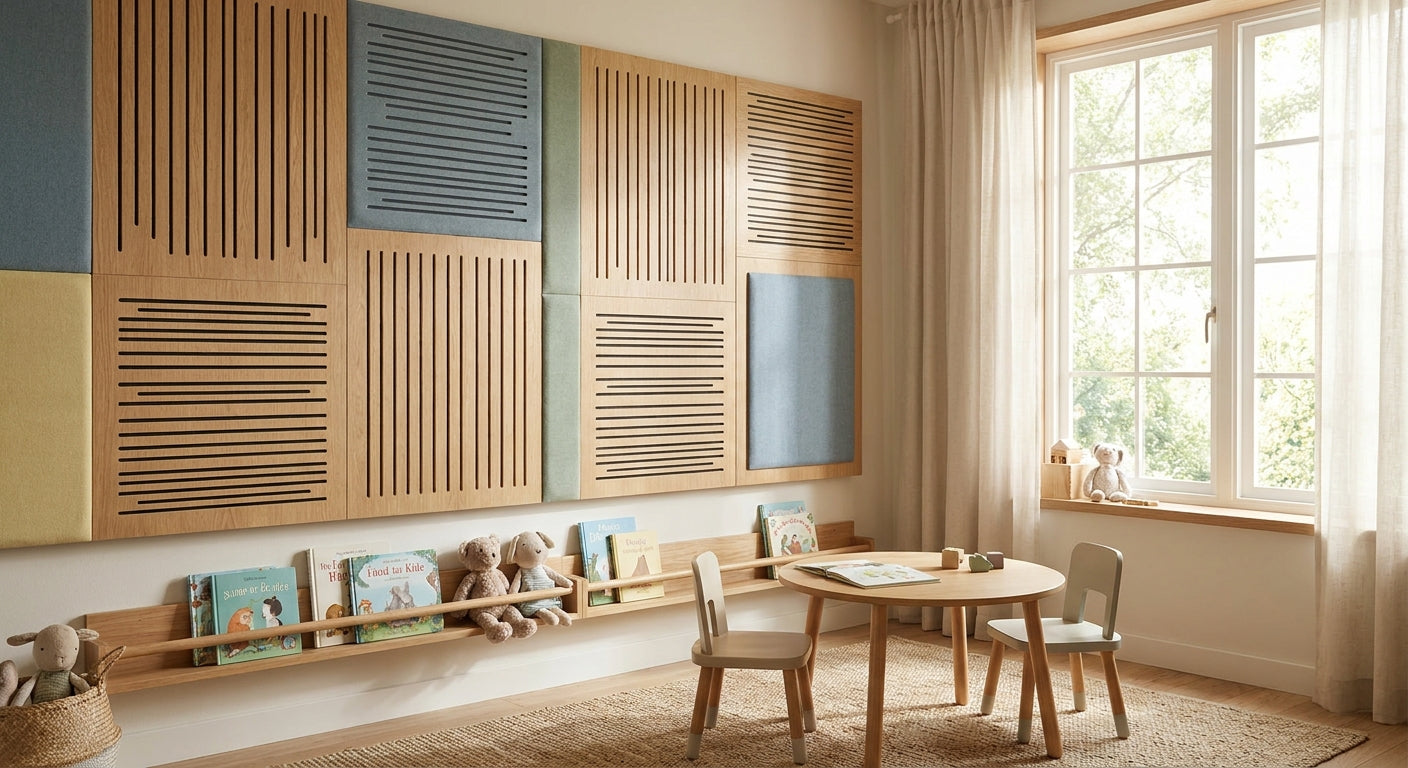
Childcare centres and nurseries are some of the loudest spaces you'll ever fit acoustic panels into — twenty toddlers, hard floors, and bare walls make every scream and chair scrape bounce straight back at staff and children. This guide covers what actually matters when choosing acoustic panels for childcare centre walls in 2026, and which finishes hold up to daily wear without turning the room into a design project.
TL;DR: For childcare and nursery walls, light-toned real wood veneer panels with acoustic felt backing outperform painted acoustic boards on both noise reduction and visual warmth — AKU Woodpanel's Natural Oak panel is the safe pick for general playrooms, while the Smoked Oak finish works better in high-traffic corridors where scuffs show fast. Hexagon-shaped panels add a playful feature wall without introducing sharp trims. Skip anything with protruding 3D relief near toddler height — it's a snag risk, not a design win.
Why this matters
Childcare rooms combine three acoustic problems most homes never see at once: hard vinyl flooring for easy cleaning, high ceilings for ventilation, and a dozen small humans generating noise at close range. Reverberation in a room like that isn't background annoyance — it's a factor in whether staff can hear a child in distress across the room, or whether nap time actually works.
A standard acoustic panels for classroom walls approach — carpet tiles, soft furnishings, curtains — doesn't survive nappy changes, paint spills, or daily bleach-wipe cleaning. Wood panel systems with felt backing solve the noise problem while keeping a wipeable, durable surface that passes an Ofsted-style inspection without looking institutional.
Who this is for
This guide is written for nursery managers, childcare centre owners, and facilities staff specifying wall finishes for playrooms, sleep rooms, and reception areas — anyone balancing acoustic performance against a room that gets cleaned twice a day and used by children under five.
What to look for in acoustic panels for a childcare centre
Acoustic performance in high-decibel rooms
A playroom full of under-fives regularly hits noise levels well above a domestic living room, and panels rated for home cinemas or offices aren't always tested against that kind of sustained, high-pitched noise. Felt-backed wood panels absorb mid-to-high frequency sound — the register children's voices sit in — rather than just deep bass, which is the frequency range most relevant here.
Wipeable, low-maintenance surface
Childcare rooms get cleaned constantly, and fabric-wrapped acoustic panels absorb spills and stains permanently. A real wood veneer surface wipes clean with a damp cloth, which matters more in a nursery than in almost any other commercial setting.
Rounded profiles, no sharp trims
Toddlers run into walls. Panel systems with protruding 3D geometry or unfinished metal edge trims create a genuine snag and impact risk at child height, and that's before you consider a child putting fingers into a gap. Flat slat profiles with rounded slat edges are the safer specification.
Colour and tone for a calm environment
Dark, high-gloss finishes read as moody in a home cinema and clinical or gloomy in a nursery. Light oak tones lift the room and reflect more daylight, which matters in rooms that rely on natural light for most of the day.
Fire performance and documentation
Any wall finish going into a registered childcare setting needs paperwork a fire risk assessor can check. Ask any supplier for fire performance documentation before ordering — don't assume domestic-grade panels carry commercial certification by default.
Installation that doesn't shut the room down
Most childcare centres can't close a room for a week of building work. Panel systems that glue directly to plasterboard or battens install in a day rather than requiring a full refit, which keeps disruption to a single weekend.
Top picks for childcare and nursery walls
The safe pick: Natural Oak wall panel Light, warm-toned real wood veneer with acoustic felt backing, available in the 240 cm and 300 cm formats to suit standard nursery ceiling heights. It's the tone that reads calmest under fluorescent lighting and hides the least dirt while still looking clean. Verdict: Buy — the default choice for playrooms and reception walls.
The wildcard: Smoked Oak wall panel A darker veneer that hides scuffs, handprints, and scrape marks far better than a light finish in corridors and drop-off areas where hands touch the wall constantly. It reads more grown-up than playful, so it suits staff areas and entrance corridors better than the main playroom. Verdict: Consider for high-contact zones, not the whole nursery.
The feature wall: Hexagon Acoustic Panel in Natural Oak with grey felt Hexagon shapes break up a flat expanse of slat panelling and give a reading corner or quiet zone a distinct visual identity children respond to, without introducing sharp trims or protruding relief. Verdict: Buy for a single feature wall in a playroom or reading corner.
What to avoid
- High-gloss dark 3D relief panels — they look striking in a showroom photo but show every fingerprint by lunchtime and often carry unfinished edge geometry that's a genuine hazard at toddler height.
- Fabric-wrapped acoustic tiles marketed for offices — they absorb sound well but absorb spills and stains permanently, which is a non-starter in a room that gets cleaned daily.
- Unfinished metal end trims — fine in a home office, risky at 60 cm off the floor in a room full of running toddlers. Ask for capped or rounded trim options before you order.
Verdict comparison
| Panel | Tone | Format | Best zone | Verdict |
|---|---|---|---|---|
| Natural Oak | Light | 240 cm / 300 cm | Playroom, reception | Buy |
| Smoked Oak | Dark | 240 cm / 300 cm | Corridors, drop-off | Consider |
| Hexagon Natural Oak, grey felt | Light, patterned | Hexagon | Reading corner, feature wall | Buy |
FAQ
What's the best acoustic panel for a childcare centre? A light-toned, felt-backed real wood veneer panel like Natural Oak covers the two things childcare rooms need most in 2026: genuine echo reduction and a surface that wipes clean daily without staining.
Is wood panelling better than fabric acoustic tiles for a nursery? For a childcare setting, yes — wood veneer wipes clean of spills and handprints, while fabric-wrapped tiles absorb stains permanently and can't be sanitised the way a nursery room needs.
How much wall coverage do you need to notice a difference in a playroom? Most noticeable acoustic improvement in a mid-size playroom starts once you cover one full wall, typically the wall behind the noisiest activity zone rather than spreading panels thinly across every wall.
Do acoustic wood panels need special fixings for a commercial childcare setting? Panels glue directly to plasterboard or timber battens using a compatible panel adhesive, the same method used in residential installs, which keeps install time to a single day rather than a full refit.
Are dark wood finishes a problem in a nursery room? Not as a whole-room finish, but dark tones like Smoked Oak show less scuffing in high-contact corridors than light finishes, so they work better as an accent in drop-off zones than as the main playroom wall.
Can hexagon panels go in a baby room as well as a playroom? Yes — hexagon panels in Natural Oak work in sleep rooms and reading corners as well as active playrooms, since the shape adds visual interest without changing the acoustic felt backing underneath.
What's the difference between the 240 cm and 300 cm panel formats? The 240 cm format suits standard ceiling heights found in most converted nursery buildings, while 300 cm covers taller commercial ceilings without a horizontal seam, which matters in purpose-built childcare centres.
Is real wood veneer durable enough for daily nursery cleaning? A 3-sided real wood veneer surface holds up to a damp cloth and standard sanitising wipes used in most childcare settings, which is the main reason it outperforms fabric-wrapped panels in these rooms.
One last thing
The detail most childcare buyers miss in 2026: the loudest complaint from nursery staff isn't usually about the playroom, it's about the corridor outside the sleep room where drop-off chatter carries straight through a bare wall. A single Smoked Oak panel run along that one corridor wall often does more for actual quiet-time complaints than covering the entire playroom.
Share:
Panelled Headboard Wall Wood Slats: 2026 DIY Guide
Exterior Cladding for Garage Conversion 2026: Best Picks