

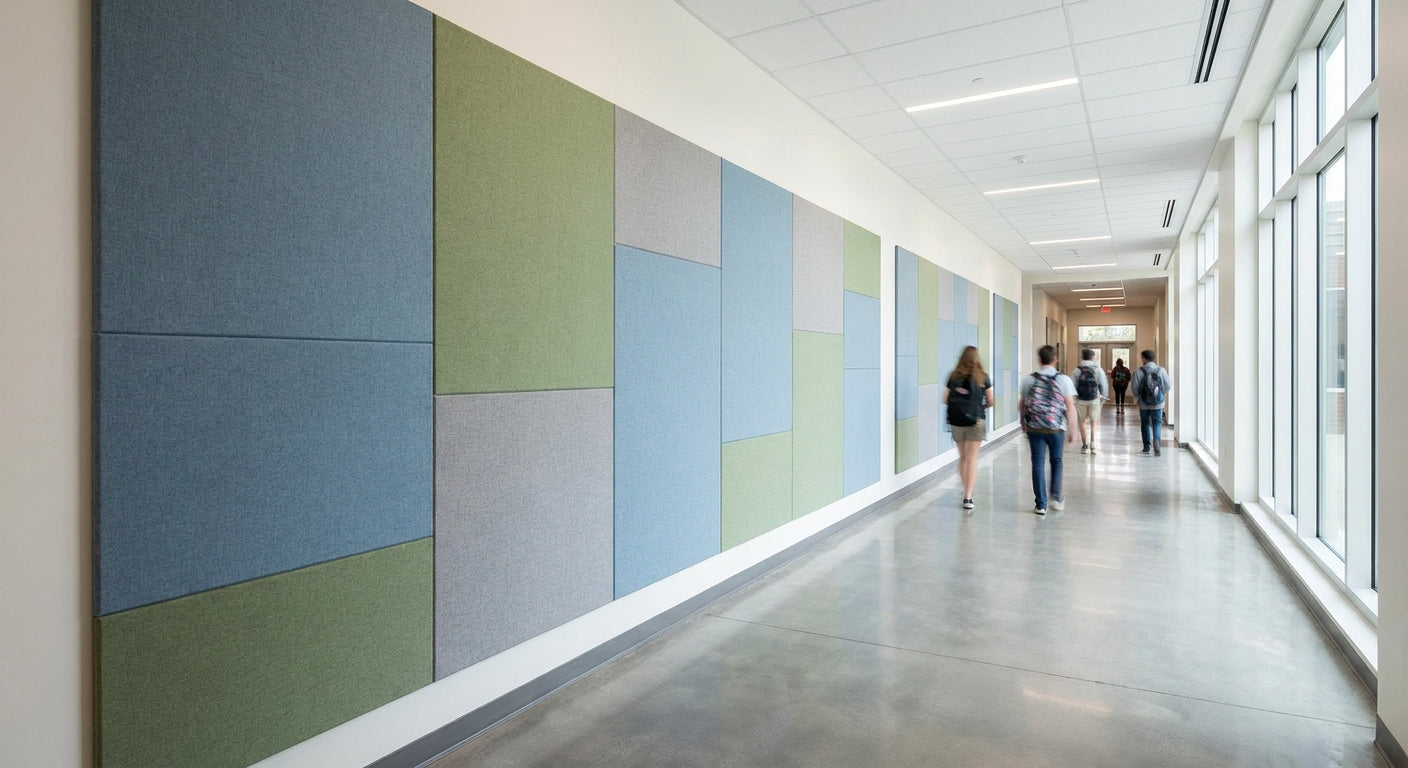
Acoustic panels for school corridor walls need to survive high footfall, resist impact, meet Class B fire ratings, and still cut reverberation times that regularly exceed 1.5 seconds in untreated masonry corridors. This guide covers exactly which panel types work, which criteria matter for a school procurement, and what to avoid.
TL;DR: Acoustic panels for school corridors must combine impact resistance, Class B (or better) fire performance, and an NRC of at least 0.65 to make a measurable difference. Akuwoodpanel UK's slatted wood acoustic panels — particularly the Natural Oak and Smoked Oak ranges — meet all three demands while keeping installation straightforward. Order samples before committing to a full corridor run. The panels that look right in a brochure often read differently under strip lighting at 2.4 m height.
Why corridor acoustics matter more than classrooms
Classrooms get acoustic treatment first. Corridors get ignored. That is the wrong priority for a significant proportion of the school day. UK Building Bulletin 93 (BB93) targets a reverberation time of 0.8 seconds or below in circulation spaces used for speech — most untreated brick or block corridors sit at 1.2–1.8 seconds. Every lesson changeover, every fire drill, every after-school club exit sends 200–400 pupils through a space that amplifies noise rather than absorbs it. Staff report noise fatigue; pupils with hearing impairments or auditory processing difficulties are disproportionately affected. Fixing corridor acoustics in 2026 is no longer an optional upgrade — it is increasingly part of SEND compliance planning.
Who this is for
This guide is written for estates managers, bursars, and facilities leads in UK state and independent schools who are specifying acoustic treatment for existing corridor walls — not new-build. You are likely working with painted plasterboard, bare blockwork, or glazed brick. You have a budget approved per square metre, a requirement to meet BB93, and a headteacher who wants something that looks intentional rather than institutional.
What to look for in acoustic panels for school corridors
Impact resistance
School corridors take more physical punishment per square metre than almost any commercial interior. Bags, elbows, trolleys, and the occasional thrown object are daily realities. Panels specified for offices or home studios will dent, delaminate, or chip within one academic year. Look for panels with a hardwood veneer or solid-slatted construction backed by a dense substrate — MDF core panels with 3 mm or greater veneer thickness perform significantly better than paper-faced alternatives. The backing material also matters: a dense polyester felt backing adds absorption without sacrificing structural rigidity.
Fire classification
All materials installed in school corridors must meet a minimum of Class B fire rating under EN 13501-1 (the European classification adopted in UK building regulations post-2020). Class C is not acceptable in a circulation route. Confirm the fire test certificate covers the panel as a composite — veneer plus substrate plus backing — not just the face material in isolation. Request the full EN 13501-1 test report, not a summary.
Noise Reduction Coefficient (NRC)
NRC is the single number rating that tells you what fraction of incident sound a panel absorbs, averaged across 250 Hz, 500 Hz, 1 kHz, and 2 kHz. For corridors targeting BB93's 0.8-second RT, specify panels with NRC ≥ 0.65. Slatted wood panels with a felt backing consistently achieve NRC values in the 0.65–0.85 range depending on slat spacing and felt depth. Panels with no backing or a thin foam insert rarely exceed NRC 0.40 — not enough for a hard-surfaced corridor.
Coverage area and panel dimensions
Standard UK school corridors run 1.8–2.4 m wide with walls 3.0–3.6 m high. Panels that are too narrow (under 120 mm per slat board) require more joints, more adhesive, and more labour time. Full-length panels of 2,400 mm or 2,700 mm length reduce cut waste and keep grout lines minimal. Calculate your total wall area, subtract door and window openings, then aim to treat at least 40% of the remaining wall surface — below that threshold, the RT reduction is negligible in a hard-floored corridor.
Maintenance and cleanability
School walls get marked. Specify panels with a factory-applied UV lacquer or hardwax-oil finish rather than raw veneer — these surfaces wipe clean with a damp cloth and resist scuff marks far better. Avoid panels with deep textured grooves that collect dust and are impractical to clean with standard janitorial equipment.
Colour and finish
Institutional grey is not the only option and is frequently the wrong one. Warmer wood tones — natural oak, smoked oak — make corridor environments feel less clinical, which has a documented positive effect on pupil behaviour in circulation spaces. Darker finishes like black oak or mocca work well in sixth-form and FE college corridors where a more serious aesthetic is appropriate. Always order physical samples and view them under the corridor's actual lighting conditions before approving a specification.
Top picks for school corridor walls
Natural Oak — the safe specification
The wooden wall panel natural oak is the most versatile starting point for a school corridor. The warm, light tone works under both fluorescent strip lighting and LED batten fittings without appearing washed out. Slatted construction with felt backing delivers NRC performance in the range required by BB93. The finish is factory-lacquered, which survives standard school cleaning protocols. Verdict: Buy — this is the default specification for primary and secondary corridors where a neutral, professional finish is required.
Smoked Oak — the considered upgrade
The wooden wall panel smoked oak suits secondary schools and sixth-form blocks where a more contemporary aesthetic is part of the brief. The darker, cooler tone hides scuffs and everyday marks better than lighter finishes — a practical advantage in high-traffic zones. Acoustic performance is equivalent to the natural oak range. Verdict: Buy — specify this where the design brief calls for a more sophisticated environment, or where light-coloured panels would show wear too visibly.
Natural Oak with Grey Felt — the acoustic-first pick
The wooden wall panel natural oak grey felt makes the backing visible between slats, which increases the effective absorbing surface area. This construction typically achieves higher NRC values than panels where the felt is fully concealed — useful when the corridor has an unusually hard floor (polished concrete or ceramic tile) that adds its own reflective load. The grey felt reads as a deliberate design detail rather than an exposed substrate. Verdict: Buy — specify this for corridors with particularly long reverberation problems or very hard floors.
Hexagon Acoustic Panel — the wildcard
The hexagon acoustic panels break the standard horizontal-run format and work well as a feature installation on a dead-end wall, stairwell landing, or entrance lobby off the main corridor. They are harder to install over large linear runs and cost more per square metre of coverage. Verdict: Consider — use as a feature element alongside a primary slatted panel specification, not as the sole treatment.
What to avoid
- Foam-backed fabric panels marketed as "acoustic tiles" — these typically carry NRC values of 0.35–0.50, well below what BB93 corridor targets require, and they do not meet Class B fire classification as installed in most configurations.
- Unfinished or raw veneer panels — raw surfaces in school environments accumulate grime rapidly and cannot be cleaned without damaging the face. Any panel specified without a factory-applied lacquer or oil finish will need refinishing within 18 months.
- Panels under 12 mm total thickness — thinner panels flex under impact and delaminate at fixings. In a corridor taking daily physical use, panels need to be rigid enough to resist deflection between fixing points. Specify minimum 12 mm substrate thickness.
Comparison table
| Panel | Fire Class | NRC Range | Finish | Best For |
|---|---|---|---|---|
| Natural Oak | Class B | 0.65–0.80 | Factory lacquer | Primary/secondary corridors |
| Smoked Oak | Class B | 0.65–0.80 | Factory lacquer | Secondary/sixth form |
| Natural Oak Grey Felt | Class B | 0.70–0.85 | Lacquer + grey felt | High-reverberation corridors |
| Hexagon Acoustic | Class B | 0.65–0.75 | Factory lacquer | Feature walls, landings |
FAQ
What acoustic panels are suitable for school corridors in the UK? Slatted wood acoustic panels with a felt backing and a minimum NRC of 0.65 are the correct specification for UK school corridors. They must carry a Class B fire classification under EN 13501-1. Panels without fire test certification covering the full composite construction should not be specified for any school circulation route in 2026.
Do acoustic panels in corridors need to meet Building Bulletin 93? BB93 sets a target reverberation time of 0.8 seconds or below in school circulation spaces. Acoustic panels are the primary tool for achieving that target in existing buildings where structural changes are not possible. Panels with NRC ≥ 0.65 covering at least 40% of the wall surface area will typically reduce RT by 0.4–0.7 seconds in a standard masonry corridor.
How many acoustic panels do I need for a school corridor? Measure the total wall area of the corridor, subtract all doors, windows, and service panels, then multiply the remaining surface by 0.40 — that is your minimum treatment area in square metres. A fuller treatment of 50–60% of wall surface will achieve greater RT reduction. Akuwoodpanel UK's product pages include panel dimensions to help calculate coverage. For a detailed method, see the guide on how to calculate how many wall panels you need.
Are wood acoustic panels fire-safe for schools? Yes, provided the panels carry a tested Class B rating under EN 13501-1. Request the full test certificate from the supplier — not a summary or a self-declaration. Class C panels are not acceptable in a circulation route under UK building regulations. Always specify panels tested as a complete composite (face veneer, substrate, and backing together).
What is the best finish for acoustic panels in a busy school corridor? Factory-applied UV lacquer is the most practical finish for school corridors in 2026. It resists scuffing, cleans with a damp cloth, and does not require annual maintenance. Raw or oiled finishes require periodic reapplication and are not practical in a school environment.
Can acoustic panels be installed in a corridor without specialist contractors? Slatted wood panels installed with panel adhesive and mechanical fixings can be fitted by an experienced in-house maintenance team, but a corridor installation covering 40–60 m² typically benefits from a specialist to ensure level alignment and consistent fixing centres. Akuwoodpanel UK supplies high-tack panel glue suitable for panel adhesive installation on plasterboard and block substrates.
How long do wood acoustic panels last in a school environment? Well-specified panels with factory-lacquered finishes and a minimum 12 mm substrate thickness should last 15–20 years in a school corridor with standard maintenance. Impact damage to individual slats is repairable without replacing full panel runs — an important specification consideration when comparing with fabric or foam alternatives.
Is there a difference between acoustic panels for classrooms and corridors? Yes. Classroom panels are typically specified to BB93's classroom RT target (0.6 seconds or below) and sit at lower heights. Corridor panels face higher impact risk, must be impact-resistant to at least 1.5 m height, and need to handle wider ambient noise frequency ranges from mass movement of pupils. See the related guide on acoustic panels for classroom walls for a direct comparison.
One last thing
Reverberation time in a corridor drops non-linearly as you add absorptive surface area. The first 30% of wall coverage does the heavy lifting — often cutting RT by 0.5 seconds — while the next 20% adds a further 0.2–0.3 seconds of reduction. That means a partial treatment that covers only the lower 1.2 m of the wall (the most impact-exposed zone) still delivers most of the acoustic benefit at a lower material cost. Specify full-height panels where budget allows, but do not delay treatment entirely if full coverage is not immediately fundable.
Share:
Wall Panels for Garden Room Interior Walls 2026
Acoustic Panels for Dental Practices: Top Picks 2026