

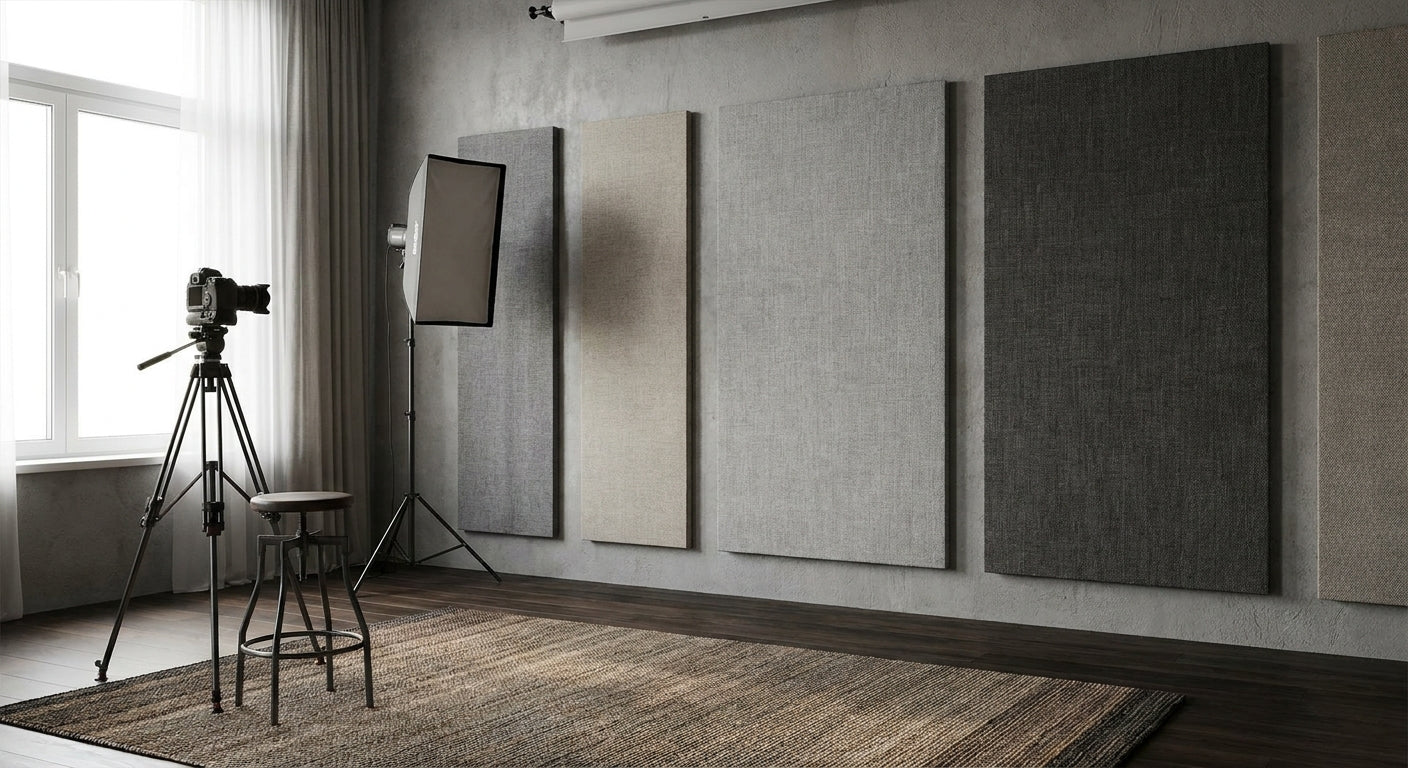
Photography studios need walls that behave in front of a lens and behave in front of a microphone. If your cyclorama wall bounces flash and your voiceover takes are drowned in echo, acoustic panels for photography studio walls solve both problems in one install.
TL;DR
Natural Oak wood veneer panels are the safe pick for most photography studios in 2026 — neutral tone under continuous lighting, real 3-sided wood veneer that reads authentic on camera, and a felt backing that cuts reflections during video and voiceover work. Black Oak works for moody portrait sets and podcast corners; Walnut suits warm lifestyle and product shoots. Skip printed foil panels and high-gloss finishes — both throw hotspots under strobes. Panels come in 60 cm widths at either 240 cm or 300 cm heights, so match the format to your ceiling before you order.
Why this matters
A bare studio wall does two things wrong at once. It reflects flash and continuous LED output unevenly, which shows up as hotspots and colour casts in your images. It also bounces sound, which ruins the audio on the behind-the-scenes reels, client interviews, and podcast segments most studios now shoot alongside stills.
Acoustic wall panels address both. The 3-sided real wood veneer finish gives you a consistent, camera-true tone across the whole wall, and the acoustic felt backing behind it absorbs sound instead of throwing it back into your shotgun mic. That combination is why photography studios in 2026 are treating one feature wall the same way a home cinema or podcast room would.
Who this is for
This guide is for studio owners and working photographers fitting out a fixed shooting space — a rented unit, a converted garage, or a dedicated home studio — who need a wall that looks good on camera and doesn't turn every video clip into an echo chamber. If you're shooting stills only, on a white cyclorama with no audio component, some of this still applies but the acoustic criteria matter less.
What to look for in acoustic panels for a photography studio
Real wood veneer, not printed foil
Printed foil panels look convincing in a showroom but fall apart under studio strobes. The repeating print pattern shows up as banding on camera, and the surface sheen catches flash differently across the panel width. A genuine 3-sided wood veneer finish has natural grain variation, so it reads as real wood in every frame instead of a flat texture.
Felt acoustic backing
The felt layer behind the veneer is what actually kills reverb, not the wood itself. For a studio that records interviews, BTS content, or voiceovers between shoots, this is the difference between usable audio straight off the camera mic and a clip that needs a de-reverb plugin in post.
Panel format matched to ceiling height
Panels ship in 60 cm widths, in either 240 cm or 300 cm heights. A standard studio unit with a 2.4-2.5 m ceiling suits the 240 cm format with minimal trim cutting; a converted warehouse space with 3 m-plus ceilings needs the 300 cm option to avoid a visible seam above head height in every backdrop shot.
Low-sheen finish under continuous and strobe lighting
High-gloss lacquered panels create hotspots the moment a softbox or beauty dish points at them. A satin or matte veneer finish diffuses light instead of bouncing it back into the lens, which matters more in a studio than almost anywhere else panels get installed.
Fixing method for a working set
Studios rearrange backdrops more than living rooms do. Panels fixed with high-tack panel glue suit a permanent feature wall; if you expect to reconfigure the space within a year or two, batten-mounted installation is worth planning for from day one instead of gluing panels you might need to remove.
Top picks for photography studio walls
Natural Oak — the safe pick
This is the neutral option most studios default to, and for good reason: it reads as warm-neutral under 5600K daylight-balanced continuous lighting without pulling a colour cast into your white balance. The 3-sided veneer and felt backing come standard across the 240 cm and 300 cm formats. Verdict: Buy — order the Natural Oak wall panel as your default if you shoot a mix of portrait, product, and interview content.
Black Oak — the moody backdrop pick
Black Oak absorbs far more ambient light than a light-toned panel, which is exactly what a dramatic low-key portrait set or a podcast recording corner needs — less bounce-back off the wall means punchier contrast in the frame and cleaner audio in the room. It's a specialist choice, not an everyday one. Verdict: Buy for a dedicated moody set or AV corner, via the Black Oak wall panel.
Walnut — the warm-tone pick
Walnut's deeper red-brown grain suits lifestyle and product photography where you want a warm wood accent wall in shot rather than a neutral backdrop — think interiors content, furniture product shots, or founder-brand portraits. It reads warmer than Natural Oak under the same lighting, so white balance accordingly. Verdict: Consider for the Walnut wall panel if warm tones fit your brand's shoots more often than neutral ones.
Smoked Oak — the wildcard
Smoked Oak sits between Natural and Black Oak in depth, and it's a strong choice for a single accent wall behind a desk or seating area rather than a full shooting backdrop — it's too dark for most portrait lighting setups but works well framing an interview subject off to one side. Verdict: Skip as a primary backdrop, Consider as a secondary accent wall.
What to avoid
- Printed foil panels marketed as "wood effect" — the repeating pattern shows up on camera and the surface doesn't diffuse flash the way real veneer does.
- Standard acoustic foam tiles — they cut reverb but look unfinished in any shot that includes the wall, which defeats the point of a dual-purpose studio wall.
- High-gloss lacquered timber cladding — built for exterior or retail use, not for a wall that sits three feet from a softbox.
If you're also treating a separate recording booth or voiceover corner rather than the main shooting wall, the felt-backed approach used for acoustic panels for recording studio walls applies the same logic with a tighter focus on sound absorption over camera appearance.
Verdict comparison
| Panel | Tone | Best for | Fixing | Verdict |
|---|---|---|---|---|
| Natural Oak | Neutral warm | Mixed portrait/product/interview | Glue or batten | Buy |
| Black Oak | Dark, low-reflect | Moody portraits, podcast corner | Glue or batten | Buy |
| Walnut | Warm red-brown | Lifestyle/product, warm brand shoots | Glue or batten | Consider |
| Smoked Oak | Mid-dark | Secondary accent wall only | Glue or batten | Skip as backdrop |
FAQ
What's the best acoustic panel for a photography studio in 2026? Natural Oak wood veneer panels with felt backing are the most versatile choice for 2026, because the neutral tone works under most lighting setups and the felt layer handles the audio side of hybrid photo-video studios.
Do photography studios actually need acoustic treatment? Yes, if the studio records any audio — interviews, BTS clips, podcasts — alongside stills. Bare walls and hard floors reflect sound the same way they reflect flash, and both problems show up in the final content.
Is real wood veneer better than printed panels for studio backdrops? Real 3-sided wood veneer holds up better on camera because it has natural grain variation instead of a repeating printed pattern, which avoids banding under strobe and continuous lighting.
How many wall panels do I need for a photography studio wall? Measure the wall width and divide by 60 cm, the standard panel width, then round up to account for trims at each end — a 4 m wall needs roughly 7 panels plus end pieces.
Can acoustic wall panels double as a photo backdrop? Yes. A single feature wall in Natural Oak or Black Oak works as both a photographic backdrop and sound treatment, which is why more studios are fitting them in 2026 instead of separate foam panels and a painted backdrop.
What size acoustic panels fit a standard studio ceiling? The 240 cm format suits ceilings around 2.4-2.5 m, common in converted retail or office units; the 300 cm format suits warehouse-style studios with 3 m-plus ceilings.
Do acoustic panels help with video and podcast recording in a studio? Yes — the felt backing behind the veneer absorbs reverb that would otherwise show up on camera mics and lavalier audio, which matters more in a hard-floored studio than almost any other room type.
Should I glue panels or mount them on battens in a working studio? Glue suits a permanent feature wall you won't reconfigure; battens suit a studio that expects to change its shooting sets or move walls within a year or two.
One last thing
Most studios panel the backdrop wall and stop there — but the wall behind the camera position, the one nobody photographs, is usually what's bouncing flash back into the lens and causing the faint double-shadow some photographers spend hours retouching out. Treating that wall in 2026, even with a smaller run of panels than the main backdrop, fixes a problem most studios never trace back to the room itself.
Share:
Wall Panels for Developer Show Homes: 2026 Buy Guide
Exterior Cladding Around Bifold Doors: 2026 Buying Guide