

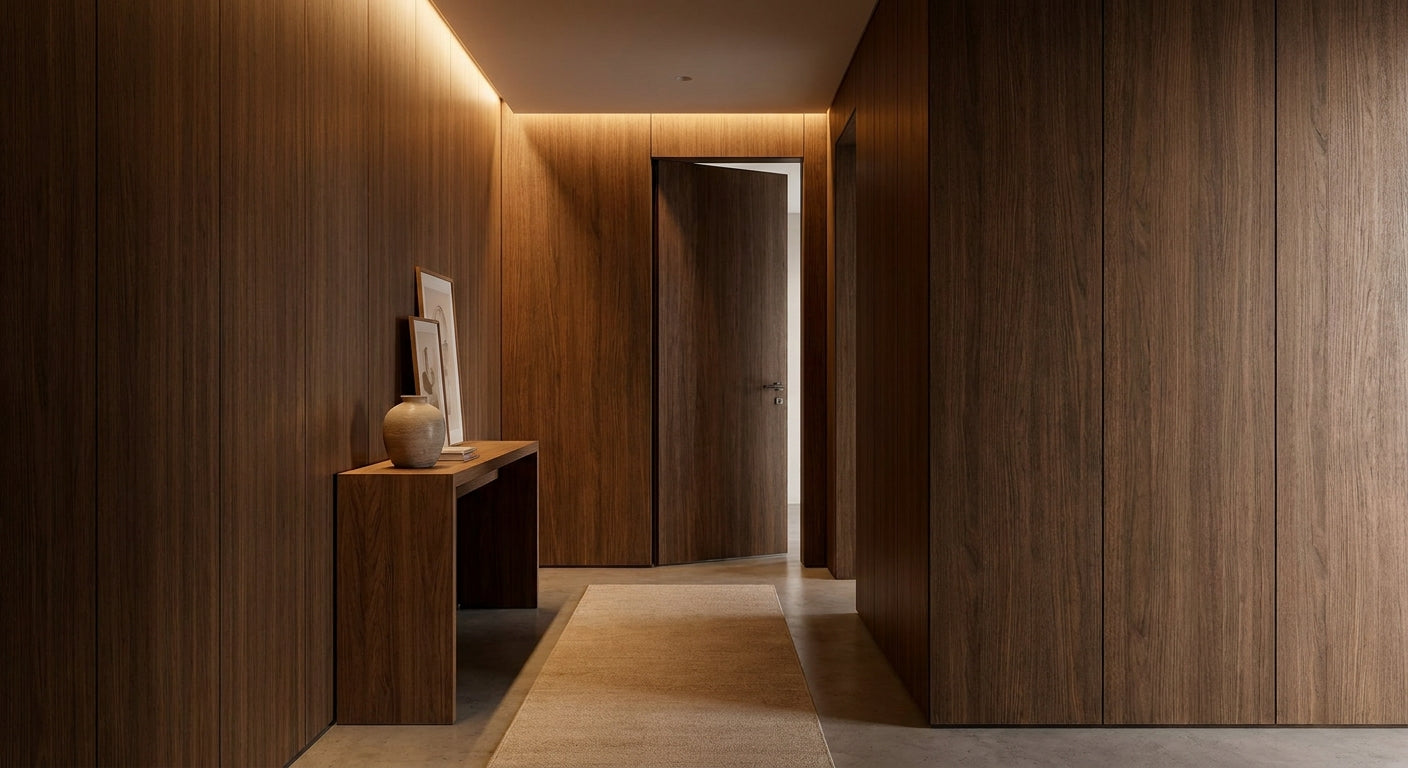
Mocca veneer panels hallway installations are one of the most requested finishes in 2026 — warm, dark, and visually grounding in a space that rarely gets natural light or furniture to anchor it.
TL;DR: The Akustiq UK wooden wall panel mocca is the right pick for hallway feature walls in 2026. Its 3-sided real wood veneer finish means exposed slat edges stay clean, the acoustic felt backing cuts echo in narrow corridors, and the deep mocca tone works with both light and dark flooring. Available in 240 cm and 300 cm lengths, it suits standard UK ceiling heights without awkward cuts.
Why this matters
Hallways are acoustically brutal. Hard floors, bare plaster walls, and no soft furnishings create a barrel-echo effect — every door slam and conversation bounces. A standard painted wall solves nothing. Mocca veneer panels fix the visual and acoustic problem in one install: the slat profile breaks up sound reflections, the felt backing absorbs residual reverberation, and the finish looks deliberate rather than purely functional. In 2026, more homeowners are treating the hallway as the first design statement rather than an afterthought, and a dark veneer finish anchors that shift.
Who this is for
This guide is for homeowners and interior designers specifying a single feature wall — typically the wall facing the front door, the staircase wall, or a long corridor wall. You want a panel that photographs well, holds up to coats being brushed against it, and does not require a carpenter to install. You are not looking for paint-grade MDF panelling or wallpaper alternatives. You want real wood veneer with visible grain and a finish that ages rather than deteriorates.
What to look for in mocca veneer panels for hallways
3-sided veneer coverage
In a hallway, panel edges are visible from multiple angles — someone walking past sees the slat face, the side, and occasionally the rear-facing edge. A 1-sided veneer panel shows raw MDF or composite on the sides. A 3-sided veneer finish means the two long edges of each slat carry the same mocca grain as the face, so the panel looks finished from every sight line. This is not a cosmetic luxury in a hallway; it is a structural requirement.
Acoustic felt backing
Hallways are narrow hard-surfaced tubes. Sound from the living room, voices from upstairs, and the front door all converge. The felt backing on Akustiq UK panels is bonded to the rear face and covers the full panel area, so it absorbs sound rather than just diffusing it. In 2026, building acoustics guidance increasingly flags corridor echo as a health-comfort issue in residential properties, particularly in open-plan homes where the hallway connects multiple rooms.
Panel length vs ceiling height
UK hallways typically run 240 cm to 260 cm ceiling height on the ground floor. A 240 cm panel fits flush with no vertical cut. A 300 cm panel gives you a floor-to-ceiling run in rooms up to 300 cm and leaves material to trim in standard heights. Choosing the wrong length means either a visible horizontal joint mid-wall or wasted material. Measure first; pick length second.
Slat spacing and visual rhythm
Tighter slat spacing creates a denser, more shadow-heavy look — the mocca tone deepens. Wider spacing reads lighter and lets the felt backing show through as a contrasting dark line. In a narrow hallway, tighter slat spacing tends to read better because it avoids visually fragmenting a wall that is already broken up by doors and light switches.
Durability at contact height
Hallways get physical contact — bags, pushchairs, coat sleeves. Real wood veneer resists surface scuffs better than printed or wrapped finishes because the wood grain runs through the surface layer, not just on top of it. The mocca finish also hides minor marks better than pale veneers.
Installation method
Panel glue combined with finishing nails is the standard method for plasterboard walls. The panels are light enough that one person can hold a panel in position while the adhesive tacks. No specialist tools needed. Hallways rarely have the floor space for two installers working simultaneously, so single-person-manageable weight matters.
Top picks
The main pick — Akustiq UK Wooden Wall Panel Mocca
The safe pick. 3-sided real wood veneer, acoustic felt backing, available in both 240 cm and 300 cm lengths. The mocca finish is a mid-to-dark warm brown with visible grain variation — consistent enough to look intentional, varied enough to look natural rather than laminated. Each panel covers a fixed width run, so coverage calculation is straightforward. This is the panel specified for hallway feature walls in 2026 when you want a finish that reads as premium without a bespoke joinery budget.
Verdict: Buy. Wooden wall panel mocca
The contrast option — Akustiq UK Wooden Wall Panel Black Oak
The bold alternative. If the hallway is light — white walls on three sides, pale stone flooring — a black oak panel creates a sharper contrast than mocca. The grain character is similar; the tone is cooler and darker. Works well in contemporary new-build hallways with dark ironmongery. Less forgiving if the adjacent decor is warm-toned.
Verdict: Consider if existing decor skews cool. Wooden wall panel black oak
The warm-rustic option — Rustic Oak Premium 3-Sided Wood Veneer
The wildcard. More pronounced grain movement and a lighter brown base than mocca. Suits period hallways with original features — tiled Minton floors, cornicing, painted panelling on lower walls. Clashes with minimalist or industrial styling. The 3-sided veneer spec matches the mocca panel, so the installation process is identical.
Verdict: Consider for period properties. Rustic oak premium 3-sided wood veneer
What to avoid
- 1-sided veneer panels in hallways. The exposed MDF edges on slat sides are immediately visible at the angles people pass through. The panel looks unfinished the moment someone walks alongside it.
- Panels sold without felt backing for a hallway. Purely decorative slat panels without acoustic backing add visual texture but do nothing for echo. In 2026 hallways designed as part of open-plan layouts, this is a missed function.
- Panels longer than your ceiling height without checking the trim plan. A 300 cm panel in a 240 cm hallway is not a problem only if you have planned the top and bottom trim detail. Without it, the cut end sits raw at floor or ceiling level and looks unfinished.
Comparison table
| Panel | Veneer sides | Acoustic felt | Available lengths | Best for |
|---|---|---|---|---|
| Mocca | 3 | Yes | 240 cm, 300 cm | Warm-toned hallways, feature walls |
| Black Oak | 3 | Yes | 240 cm, 300 cm | Cool, contemporary hallways |
| Rustic Oak Premium | 3 | Yes | 240 cm, 300 cm | Period and character properties |
FAQ
What are mocca veneer panels for hallways? Mocca veneer panels are acoustic wooden slat wall panels with a real wood veneer surface in a warm dark-brown mocca finish. In hallways, they are installed on a single feature wall to add visual depth and reduce echo.
Are 3-sided veneer panels worth it for a hallway? Yes. In a hallway, slat edges are exposed at eye level as people walk past. 3-sided veneer means the long edges of each slat carry the same grain and tone as the face, so no raw material shows from any angle.
What size panel do I need for a standard UK hallway? Most UK ground-floor hallways have 240 cm ceiling height. A 240 cm panel fits flush. If your ceiling is taller — 260 cm to 300 cm — the 300 cm panel is a better starting point. Measure the wall height before ordering.
Do acoustic panels actually reduce echo in a hallway? Yes, within limits. The felt backing absorbs mid and high frequency sound rather than reflecting it. A single panelled feature wall in a narrow hallway produces a measurable reduction in reverberation. It will not soundproof the space, but it removes the barrel-echo quality that hard plaster walls create.
How do I install mocca veneer panels in a hallway? Panel adhesive applied to the rear face, pressed against a prepared plasterboard or plastered wall, with finishing nails as mechanical backup. The panels are sized to be manageable by one person. Full installation guidance is available from Akustiq UK. For a step-by-step overview, see the guide on how to calculate how many wall panels you need before you start.
Can mocca veneer panels be used in a rented hallway? They can if your tenancy agreement permits wall fixings. Panel adhesive makes removal without wall damage difficult. If you are a tenant, check your agreement first — there is a specific guide on how to add wall panels to a rented flat without damage.
How do mocca panels compare to dark wallpaper in a hallway? Mocca veneer panels add depth through three-dimensional slat profile and real grain texture; wallpaper is flat. Panels also absorb sound; wallpaper does not. The installation is more involved than hanging wallpaper, but the result reads as a designed interior element rather than a surface covering.
Do Akustiq UK mocca panels come in different widths? The panels are available in 240 cm and 300 cm lengths. Width per panel is fixed. Coverage per panel is consistent, so working out how many panels you need for a given wall area is straightforward arithmetic.
One last thing
In a hallway with a dark floor — anthracite tiles, dark wood, or charcoal stone — mocca veneer on the feature wall creates a tonal stack rather than a contrast. The hallway reads as one cohesive dark volume rather than a wall happening in front of a floor. That is the look that photographs well and holds up in person. If your floor is pale, mocca still works but contrast-orient the rest of the decor: pale ceiling, white joinery, warm brass hardware.
Share:
How to Style Mocca Wall Panels — 2026 Guide
Black Oak Panels for Hallways: Best Picks 2026