

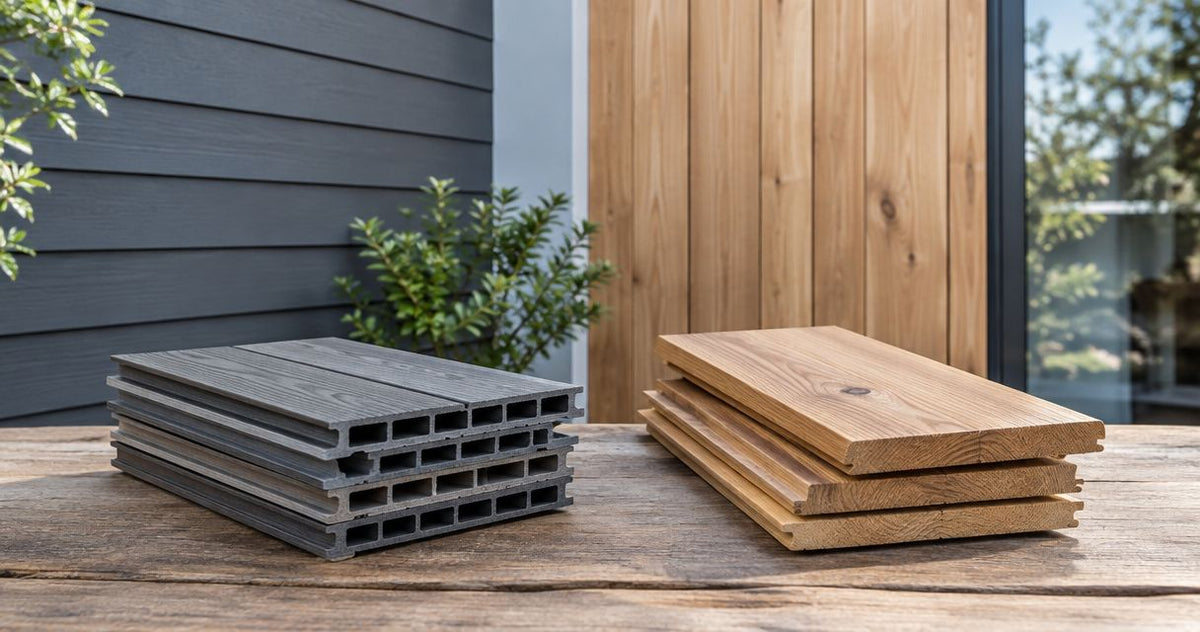
Neither composite nor timber cladding is automatically the cheaper choice for your wall in 2026: compare complete installed quotes, not individual board costs. Include fixings, trims, wall preparation, access and the maintenance needed to keep your chosen finish. The deciding figure is the total for the same finished wall, with the same work included.
- Compare composite cladding cost vs timber cladding cost using installed totals for the same wall.
- Timber offers natural grain; composite offers manufactured finishes, but maintenance requirements depend on the specified product.
- Akustiq UK exterior cladding includes panels, corner trims and finishing trims; budget for the complete installation.
- Check effective coverage, labour, access and care instructions before choosing either material.
Why this matters
A board-only quote and an installed quote answer different questions. Choosing between them on the headline total leaves you comparing different amounts of work rather than different cladding materials.
Start by defining the wall, its openings and its junctions with the roof, ground and adjoining finishes. If your project includes a rendered section, use the guide to combining exterior cladding with render on one façade to plan those boundaries before requesting quotes.
How much does composite wall cladding cost vs timber?
The cheaper option is the compliant, fully specified installation with the lower total—not necessarily the material with the lower board cost. For a useful 2026 comparison, ask each supplier and installer to work from the same measured drawings, finish requirements and installation scope.
Use this table to separate the material choice from the work surrounding it. The benefits and drawbacks describe the categories; confirm the details against the actual products you are considering.
| Comparison point | Composite cladding | Timber cladding |
|---|---|---|
| Best for | Buyers who prefer a manufactured finish and will follow its specified care requirements | Buyers who want natural wood grain and accept its appearance changing outdoors |
| Main benefit | A manufactured wood-effect appearance without choosing solid timber | Natural grain and variation between boards |
| Main drawback | Repair and refinishing methods depend on the product; do not assume sanding or painting is permitted | Retaining a particular coated appearance involves maintaining that coating |
| Supply comparison | Check effective coverage, accessories and fixing requirements | Check species, grade, profile, treatment and finish |
| Installation comparison | Follow the specified support, fixing and movement details | Follow the specified support, fixing and moisture-movement details |
| Maintenance comparison | Obtain the cleaning instructions and any restrictions | Decide whether to retain a coating or accept natural weathering where appropriate |
Do not compare an unspecified composite board against “timber” as a single material. A meaningful timber quote names the species, grade and finish; a meaningful composite quote identifies the exact product and installation system.
What belongs in the initial installation total?
Ask for separate lines covering the cladding, supporting structure, fixings, trims, preparation, labour, access and waste removal. Identify delivery and tax treatment too, so neither quote hides a different basis for comparison.
Keep optional improvements separate from essential installation work. If insulation or extensive wall repairs are included in only one proposal, ask the installer to explain that difference before treating the totals as comparable.
What belongs in the ownership comparison?
Keep future care separate from the initial installation total. List the cleaning, coating maintenance and access arrangements required by each proposed product rather than assigning a generic maintenance schedule to the whole category.
A warranty is not a maintenance plan or a promise that the appearance will remain unchanged. Read the care conditions alongside the warranty terms and ask who is responsible for inspections and upkeep.
Composite cladding: compare the complete system
Best for buyers who prefer a manufactured exterior finish and want care requirements defined before purchase. Assess composite cladding as a system of boards, supports, fixings and edge details, not simply as a decorative surface.
Its practical appeal is the manufactured finish. Its limitation is that repair methods, permitted cleaning products and movement allowances are product-specific; a method suitable for one board is not automatically suitable for another.
For your 2026 quote, request the installation instructions before agreeing the scope. Ask the installer to identify the required support arrangement and explain how corners, cut edges and openings will be finished.
- Confirm the effective coverage after the boards are joined.
- Check which fixings and accessories the installation instructions require.
- Ask how the design accommodates movement.
- Obtain written cleaning and repair guidance.
- Confirm suitability for the building and location before comparing totals.
Do not label composite “maintenance-free”. Cleaning remains a separate consideration, and the manufacturer's instructions determine what other care is required.
Timber cladding: specify the wood and finish
Best for buyers who value real wood grain and accept either natural weathering or the work needed to retain a coated finish. Timber's appearance is a genuine reason to choose it, but that preference needs to be reflected in the specification.
The main budgeting mistake is asking for “wood cladding” without naming what you want. Species, board profile, grade and coating are separate choices; leaving them open makes it difficult to compare proposals accurately.
Decide whether your aim is to retain the initial colour or allow the wood to weather. Those are different appearance goals, and neither should be assumed by the installer.
Ask whether finishing happens before delivery or during installation, including treatment of cut ends where required. Record that work explicitly rather than assuming it is part of the fitting labour.
Timber also needs installation details that manage moisture and movement. A natural material is not a reason to accept an incomplete fixing or drainage specification.
Why composite and timber cladding totals vary
The wall and installation design matter alongside the material. These factors explain why quotes for apparently similar projects need closer inspection.
- Effective coverage: Compare the area covered after joining, not just the overall board dimensions. Overlaps and profiles affect the quantity required.
- Corners and boundaries: Outside corners, exposed edges and window surrounds need their own details. Measure these separately from the main wall area.
- Existing wall condition: Ask what preparation and repairs are included. Do not assume a decorative covering resolves defects behind it.
- Support and fixings: Confirm the specified supporting structure and fastening method. Do not remove required components to make a quote look smaller.
- Access and labour: Identify how installers will reach the work and which tasks the labour allowance covers. Include removal and disposal where relevant.
- Finish and ongoing care: Compare the appearance you intend to maintain. A coated timber finish and an intentionally weathered finish create different care obligations.
Use these headings to question differences, not to impose a standard allowance. Your wall measurements and the selected installation instructions should determine the quantities.
How do you compare cladding quotes fairly?
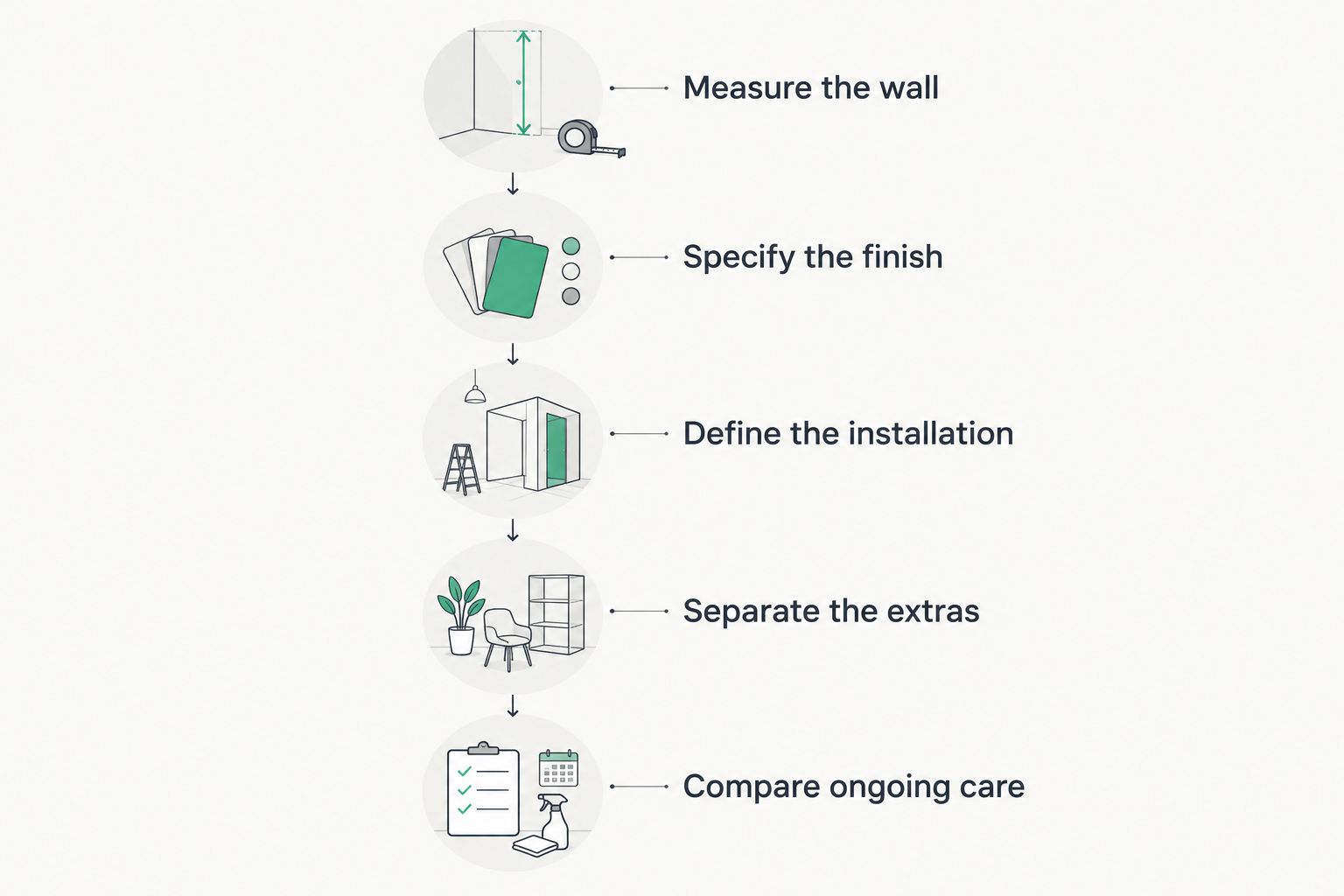
Build a single brief and send it unchanged to each installer. For a 2026 project, ask for a dated quote with a stated validity period and a clear process for approving changes.
- Measure the wall. Record each elevation, opening and return. Ask how the installer calculates deductions and cutting waste.
- Specify the finish. Identify the exact composite product or the timber species, profile and intended finish.
- Define the installation. Request the proposed supports, fixings, ventilation and junction details required for that wall.
- Separate the extras. List preparation, access, delivery, disposal and optional improvements independently.
- Compare ongoing care. Read the maintenance instructions and identify any work needed to retain your preferred appearance.
Request an annotated elevation showing where the cladding starts, stops and changes direction. This makes the scope easier to check than a quantity list alone, particularly around doors and windows.
Before accepting, ask the installer to explain every exclusion. An exclusion is work you still need to arrange, not a saving you have already made.
Where exterior panels and trims fit into your budget
Akustiq UK exterior cladding is best for homeowners comparing named panel finishes with corresponding trim options. Its range provides a practical example of why the panel itself is only part of a cladding order.
The listed exterior panels and trims include 290 cm formats, equivalent to 2.9 metres. Length alone does not establish square-metre coverage: you also need the effective installed width and the proposed layout.
| Exterior panel option | Best for | Stated format | Benefit and limitation |
|---|---|---|---|
| Exterior Wall Cladding Panel Oak | Buyers seeking an oak-labelled finish | 290 cm panel with a 3D wood-grain description | Provides a named finish to specify; the oak label alone does not establish material composition |
| Exterior Wall Cladding Panel Stone Grey | Buyers seeking a grey finish | 290 cm panel with a 3D wood-grain description | Provides a grey alternative; length alone is insufficient to calculate the order quantity |
Akustiq UK also lists exterior corner trims and finishing trims in corresponding finishes. The distinction matters: a corner trim finishes an outside corner, while a finishing trim closes an exposed edge.
Count accessories from the elevation rather than ordering them as an afterthought. The listed exterior screw packs contain 100 screws, but pack size is not a fixing schedule; calculate quantities from the installation requirements.


Is composite cladding cheaper to maintain than timber?
Compare the actual care schedules, not a general promise of lower maintenance. Composite cleaning requirements and timber coating requirements depend on the specified products and the appearance you want to retain.
Include the practicalities of reaching the wall. Even straightforward care needs planning where the cladding sits above an extension, beside an awkward boundary or high on an elevation.
Does DIY installation make timber the cheaper choice?
DIY only removes the labour you can safely and correctly undertake. You still need suitable tools, access equipment, preparation, supports, fixings and a workable installation detail.
Do not assume either material is suitable for your DIY project solely because it can be cut. Follow its instructions, and leave work requiring specialist design or safe access arrangements to competent professionals.
Should you compare cladding per board or per square metre?
Compare material quantities by effective installed coverage, then compare the complete project totals. A per-board comparison is misleading when the boards cover different areas or require different accessories.
Keep the measured wall area consistent between quotes. Ask installers to explain their cutting layouts rather than applying an arbitrary waste allowance yourself.
FAQ
Is composite cladding always cheaper than timber?
Composite cladding is not automatically cheaper than timber. Compare complete installed quotes for the same wall, including preparation, supports, fixings, trims and access.
What should a cladding installation quote include?
A cladding installation quote should identify the product, quantities, supports, fixings, trims, preparation, labour and access. Ask for delivery, disposal, exclusions and tax treatment to be stated separately.
Does composite cladding need maintenance?
Composite cladding needs care in accordance with its manufacturer's instructions. Obtain the cleaning guidance and repair restrictions before choosing the product.
Do I have to keep painting timber cladding?
Painting is not a universal requirement for timber cladding. The species, supplied finish and intended appearance determine whether a coating is appropriate and how it must be maintained.
Can I calculate cladding coverage from the board length?
Board length alone does not establish cladding coverage. You also need the effective installed width, the joining detail and a cutting layout for the wall.
Are trims included when I order exterior panels?
Check the order contents rather than assuming trims are included. Akustiq UK lists exterior panels, corner trims and finishing trims as separate products.
Can I choose cladding just by its appearance?
Appearance is only part of choosing exterior cladding. Confirm suitability for the building, installation requirements and care obligations before accepting a quote.
One last thing
Ask for a drawing of the finished edges before signing your 2026 cladding quote. A plain wall area does not show the corners, openings and junctions that still need materials and fitting work.
Then put the quotes side by side and check what each one leaves out. Choose between composite and timber only after both proposals describe the same finished job.
Share:
Can acoustic panels be used outdoors?
Can acoustic panels be used outdoors?