

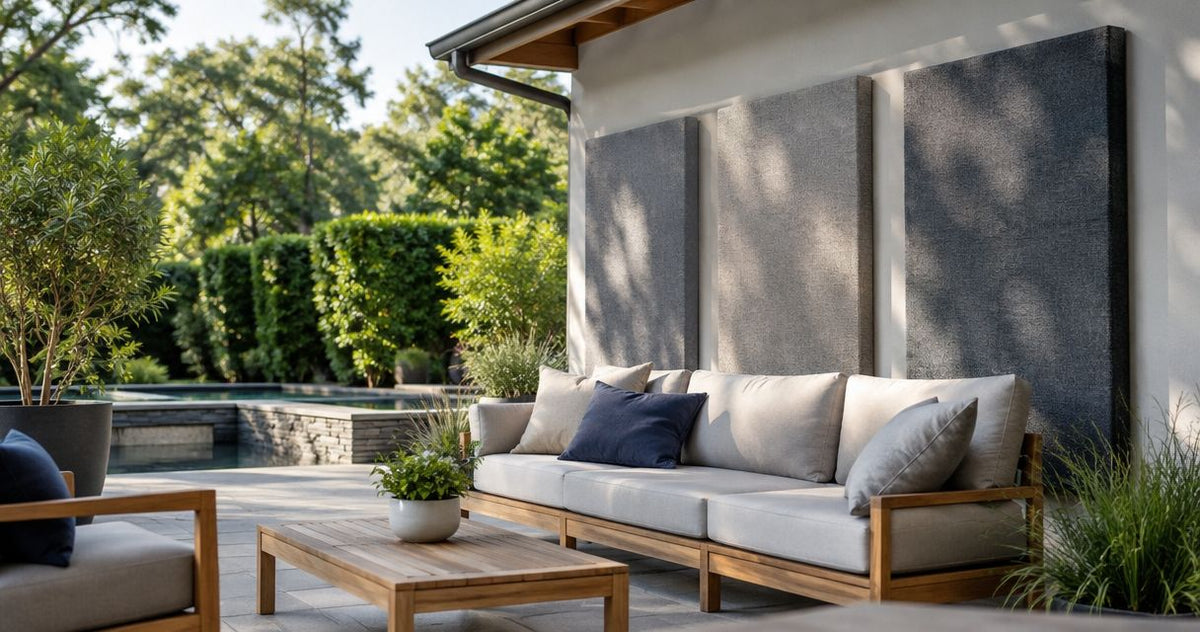
Yes, acoustic panels can be used outdoors only when the manufacturer confirms that the complete panel and fixing system suit the intended outdoor conditions. Indoor acoustic panels are not automatically suitable beneath a canopy or pergola, and weather-resistant wall cladding is not automatically sound-absorbing.
- Can acoustic panels be used outdoors? Yes, but only with confirmed suitability for the intended exposure.
- Indoor acoustic panels, outdoor sound absorbers and exterior cladding serve different purposes.
- Akustiq UK offers acoustic wood panels and exterior cladding; choose by location and function, not appearance.
- A roof provides shelter, not proof that an indoor panel is suitable outside.
Can acoustic panels be used outdoors?
Use an acoustic panel outdoors only when its installation guidance explicitly covers your location and exposure. Check the backing, face material, edges, fixings and supporting structure together. A weather-resistant surface alone does not establish that the whole assembly belongs outside.
For a 2026 project, separate these options before choosing a finish:
| Panel type | Best for | Main benefit | Main limitation | Outdoor decision |
|---|---|---|---|---|
| Indoor acoustic panel | Reducing reflections inside a suitable room | Adds sound absorption to an interior | Indoor suitability does not establish weather resistance | Keep indoors unless the manufacturer explicitly approves the outdoor application |
| Purpose-designed outdoor acoustic panel | Treating outdoor sound reflections where a design identifies a benefit | Combines an acoustic function with specified exterior suitability | Requires evidence for both weather exposure and acoustic performance | Consider when the documented specification matches the site |
| Exterior wall cladding | Finishing an external wall | Provides a finish intended for exterior use | Exterior suitability alone says nothing about sound absorption or sound insulation | Choose for cladding, not as an assumed noise treatment |
If your main objective is an external wall finish, start with how to choose outdoor wall cladding for UK homes. If your objective is quieter seating or less noise reaching a neighbour, define the sound problem first.
Why this matters
A garden wall can look like a living-room feature wall while facing entirely different conditions. Rain, sunlight, changing temperatures and moisture behind the finish all affect what you should specify. Shelter changes the exposure; it does not turn an outdoor wall into an indoor one.
The acoustic task changes too. Inside a room, sound repeatedly reflects between enclosing surfaces. Outside, sound also travels away through open space, so an indoor treatment layout does not transfer directly to a patio.
Decide whether you need sound absorption, sound isolation or an exterior finish. Those are separate requirements, even when the finished panels look similar.
Indoor acoustic panels: best for suitable interior rooms
Indoor acoustic panels belong in the environments covered by their installation instructions. Their acoustic function does not establish resistance to rain, condensation or prolonged outdoor humidity. Nor does a wood-look face tell you how the concealed backing behaves.
Akustiq UK acoustic wood panels include indoor formats with real wood veneer and acoustic felt backing. The stated indoor sizes include 240 cm and 300 cm formats, with a 3-sided real wood veneer finish. Those details describe the indoor range; they are not evidence of exterior suitability.
For a garden office, distinguish the internal wall from the external wall. A dry, enclosed interior is a different application from the building's outer face. Confirm the room conditions against the panel instructions rather than choosing solely because the building stands in the garden.
- Benefit: an acoustic finish can address reflected sound inside a suitable room.
- Limitation: indoor product details do not establish outdoor suitability.
- Recommendation: keep indoor panels inside unless you have explicit approval for the proposed exterior installation.
Exterior wall cladding: best for an external wall finish
Exterior cladding is the relevant category when you want to change the appearance of an outside wall. Select the product and installation method for that wall's exposure, substrate and detailing. Do not select it on the assumption that slats will absorb noise.
For example, Akustiq UK's Exterior Wall Cladding Panel Stone Grey belongs to the exterior cladding category. That designation distinguishes its intended application from indoor acoustic panelling; it does not establish a sound-absorption rating or a reduction in noise crossing a boundary.
For your 2026 specification, request the current installation instructions before planning battens, corners or openings. Confirm how the system handles water and how its fixings connect to the supporting wall. Avoid treating the visible panel as the entire wall assembly.
- Benefit: the product category matches an exterior finishing task.
- Limitation: exterior cladding is not automatically an acoustic treatment or a complete weatherproof wall.
- Recommendation: choose exterior cladding for the finish, then assess any noise requirement separately.
Outdoor acoustic panels: best for a defined reflection problem
Purpose-designed outdoor acoustic panels are relevant when sound absorption is needed outside. Ask for evidence of the acoustic performance and confirmation that the product suits the intended weather exposure. Neither requirement substitutes for the other.
A sheltered courtyard with hard surrounding surfaces presents a different acoustic problem from an open lawn. The useful treatment area depends on where sound originates, which surfaces reflect it and where people listen. Covering a convenient wall is not the same as designing a treatment.
Sound absorption reduces reflected sound; sound insulation limits sound transmission. An absorber mounted on a patio wall is not automatically a barrier against traffic, music or voices travelling to another property.
- Benefit: a correctly specified outdoor absorber can address a relevant reflection path.
- Limitation: its rating alone does not predict the change at every listening position.
- Recommendation: use a site-specific acoustic assessment when the result matters to neighbours, customers or planning requirements.
Why outdoor suitability varies
Outdoor suitability depends on the complete construction and its exposure, not just the decorative face. Check these factors against the manufacturer's documents rather than assuming that all panels within a material category behave alike.
- Panel construction: identify the face, core, backing and any bonded layers. Each component must suit the application.
- Moisture exposure: distinguish direct rain, wind-driven rain, splashback and condensation. A canopy does not eliminate all of them.
- Sunlight and temperature: confirm the permitted exposure and any movement requirements rather than assuming an indoor finish will behave identically outside.
- Edges and joints: follow the specified treatment for cuts, junctions and penetrations. Water management depends on details as well as the main surface.
- Fixings and support: use a method approved for the panel, substrate and outdoor loading conditions. Indoor adhesive instructions do not establish exterior suitability.
- Acoustic installation: match any quoted sound-absorption evidence to the backing, cavity and mounting arrangement being proposed.
A product decision made in 2026 should use the current guidance for the exact panel, not instructions for a visually similar product. Keep the installation document with your project notes so the installer can follow the same specification.
Can I put indoor acoustic panels under a pergola?
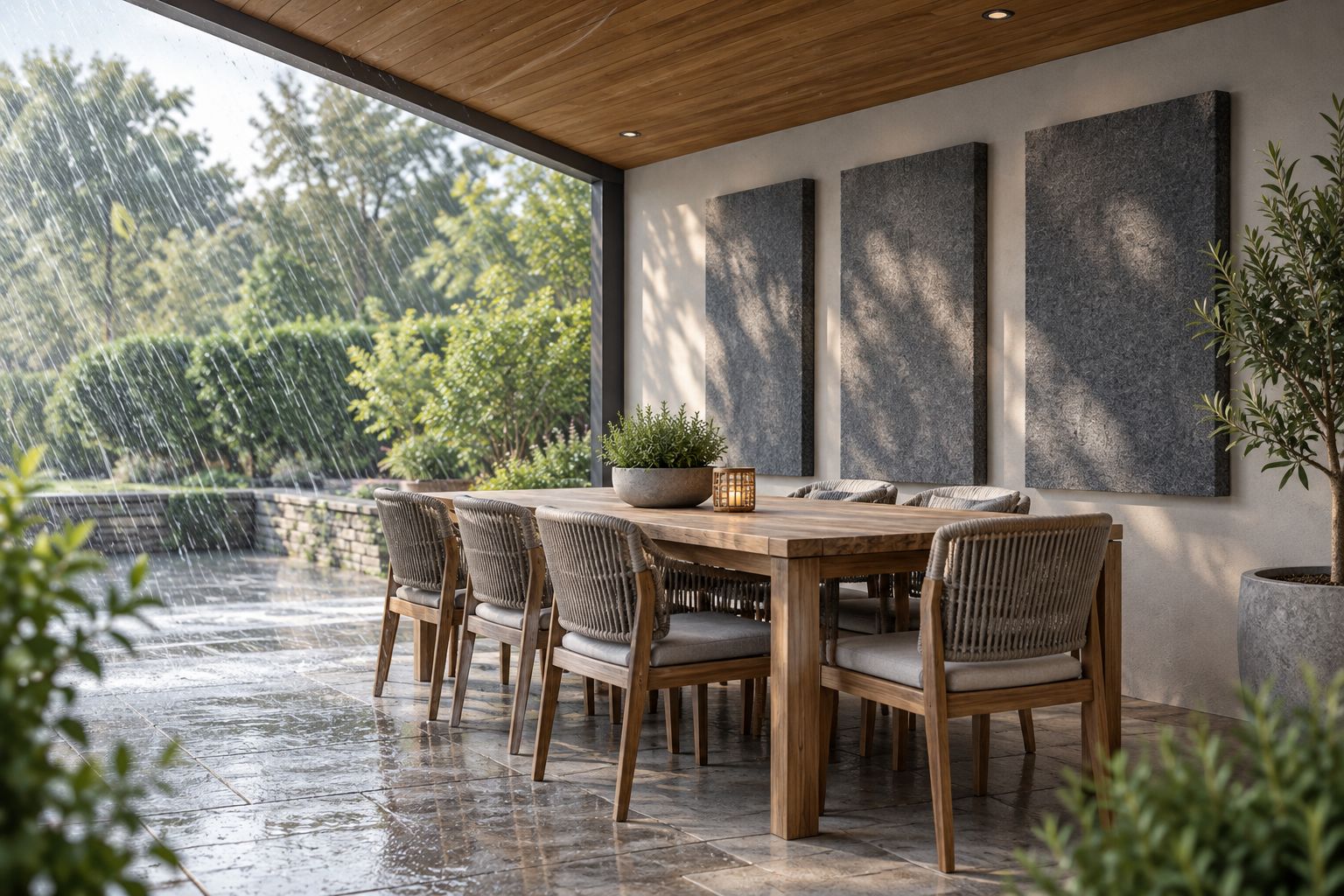
A pergola does not establish that indoor acoustic panels are suitable outdoors. Even with a solid roof, open sides leave the installation exposed to outdoor air and potentially wind-driven rain. Ask for approval covering the actual location.
Describe the site clearly when you enquire: whether the roof is solid or open, which sides are enclosed, and whether water reaches the wall. Include photographs of the supporting surface and nearby ground. That gives the supplier a specific application to assess rather than a vague description of a sheltered area.
A covered dining space also needs a realistic acoustic objective. If the concern is sound reflected from a hard wall behind the table, investigate that reflection. If the concern is music reaching neighbouring gardens, assess the source and transmission route instead.
Can I waterproof indoor acoustic panels for outdoor use?
Do not treat a coating as proof that an indoor acoustic panel is suitable outside. Applying a finish to the visible face does not establish protection for the backing, cut edges, joints or bonded layers. Obtain approval for the complete proposed treatment.
Coatings also need checking against the panel's acoustic function. A change to an exposed absorbing surface can affect how sound interacts with it. Do not assume an acoustic rating still applies after an unapproved modification.
For a 2026 installation, ask whether the manufacturer explicitly permits the coating and exterior application together. Without that confirmation, select a product intended for the location instead of creating an unverified assembly.
Will outdoor panels stop noise from neighbours?
Outdoor panels do not automatically stop noise from neighbours. Sound-absorbing panels address reflections, while noise entering your seating area requires an assessment of how sound travels from the source to you.
A barrier's position, continuity and dimensions matter because sound travels over and around obstructions. Decorative cladding attached to an existing fence does not establish a particular reduction in noise. Avoid choosing a panel from its appearance or the word acoustic alone.
For persistent or disputed noise, get an acoustic professional to assess the site before buying materials. Describe whether the disturbance is speech, music, machinery or traffic, and identify where you need improvement. That information is more useful than starting with a preferred panel finish.
How to check a panel before fitting it outdoors
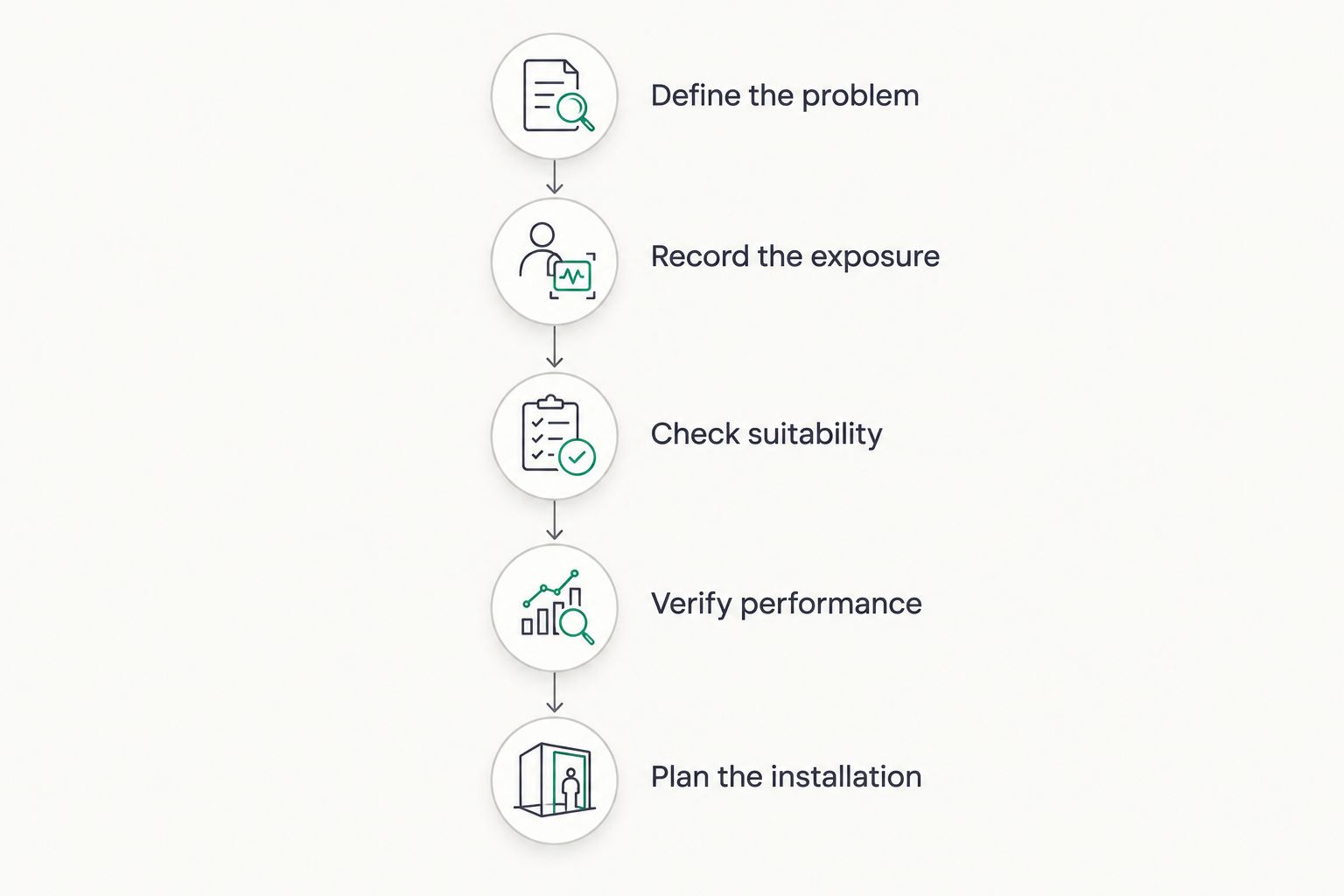
Use this sequence before ordering or cutting materials. Confirm the location first, the function second and the installation method third. A finish sample helps you judge appearance, not outdoor durability or acoustic performance.
- Define the problem. Write down whether you want less reflected sound, less transmitted noise or a different wall appearance. Keep separate requirements separate.
- Record the exposure. Note rain access, shelter, splashback, sunlight and any visible damp. Take photographs of the wall and its surroundings.
- Check suitability. Obtain the manufacturer's guidance for the exact product and proposed environment. Ask directly about covered outdoor spaces if that is your application.
- Verify performance. For acoustic work, request the relevant test information and mounting details. For cladding, review the exterior installation requirements.
- Plan the installation. Confirm support, fixings, drainage details, junctions and access for maintenance before work starts. Resolve conflicting instructions with the supplier.
For commercial work, include relevant fire and building requirements in the specification. Exterior suitability and acoustic performance do not establish compliance with every requirement for a particular building. The proposed assembly and its location need checking together.
Which route should you choose?
Akustiq UK is best for buyers comparing acoustic wood panels for interiors with exterior wall cladding. Choose between those categories by the job the wall needs to do, not by whether the finish resembles wood slats.
For a living room or enclosed office, investigate interior sound absorption. For an external garden-room wall, investigate exterior cladding. For an outdoor noise problem, establish the sound path and required performance before selecting either.
The practical rule for 2026 is simple: keep evidence for appearance, weather suitability and acoustics separate. A panel can satisfy one requirement without satisfying the others. Buy only after the documents match the application.
FAQ
Can acoustic panels be used outdoors in the UK?
Yes, acoustic panels can be used outdoors when the manufacturer confirms suitability for the intended exposure and installation. Indoor acoustic panels are not automatically suitable for UK outdoor conditions.
Can I use felt-backed acoustic panels on a garden fence?
Use felt-backed acoustic panels on a garden fence only with explicit approval for that exterior application. Felt backing and a slatted face do not establish weather resistance or sound-barrier performance.
Are exterior cladding panels soundproof?
Exterior cladding panels are not automatically soundproof. An exterior designation describes the intended application, not a tested reduction in sound transmission through the completed wall.
Can indoor acoustic panels go inside a garden room?
Indoor acoustic panels can be considered inside a garden room when its conditions meet the manufacturer's requirements. Check damp, condensation and the installation guidance rather than treating every enclosed outbuilding as a suitable interior.
Will varnish make acoustic panels suitable outside?
Varnish does not establish that an indoor acoustic panel is suitable outside. The backing, edges, bonds and complete fixing system still need approval for the application.
What should I ask Akustiq UK before choosing outdoor wall panels?
Ask Akustiq UK to confirm the intended application and installation guidance for the exact panel. If you need an acoustic result, request relevant performance evidence separately from exterior suitability.
One last thing
Check the hidden face before choosing the visible finish. Outdoor suitability concerns the backing, edges, joints and fixings as much as the front surface. A photograph of an attractive patio wall cannot answer those questions; the product specification must.
Share:
How much does composite wall cladding cost vs timber?
How much does composite wall cladding cost vs timber?