

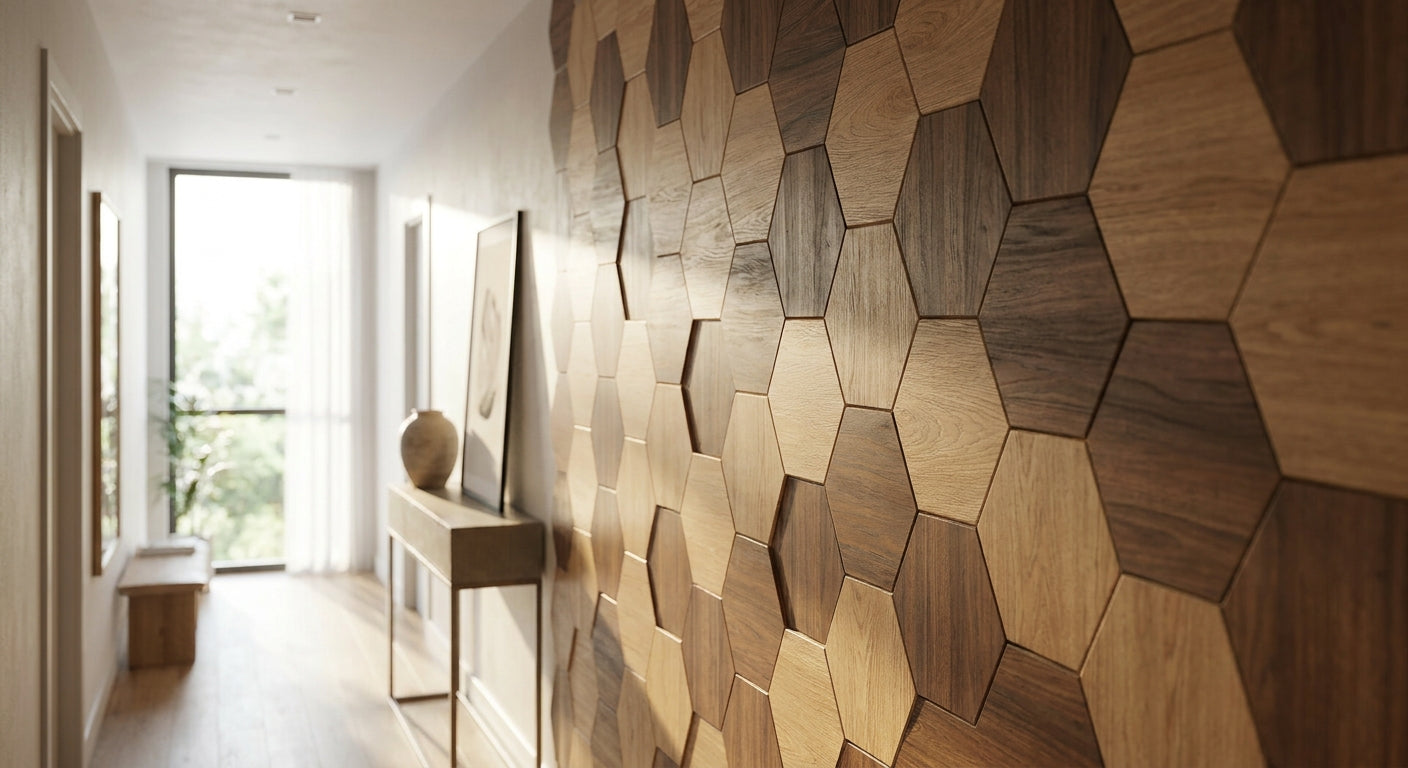
Hexagon wall panels turn a flat, echoey hallway into the one wall visitors actually stop and look at — but not every hexagon tile on the market handles a narrow hallway, daily foot traffic, and acoustic felt backing the same way.
- Hexagon Acoustic Panel Natural Oak is the safe buy for hexagon wall panels hallway projects in 2026.
- Grey Walnut with grey felt hides scuffs better in dark, low-light hallways than lighter finishes.
- Skip laminate hex tiles with no felt backing — pattern only, zero acoustic benefit.
- Walnut with grey felt warms up north-facing hallways without looking like a fire hazard.
Why this matters
Hallways are the worst room in a British house for echo: hard floors, no soft furnishings, two parallel walls bouncing sound end to end. A hexagon layout breaks that flat surface at an angle, and a panel with acoustic felt backing — like the Hexagon Acoustic Panel Natural Oak — cuts reflected noise while covering the scuff marks that coats, school bags, and pushchairs leave behind.
It's not only about acoustics. A hallway is the first wall a guest sees, and in 2026 that wall does more talking for your house than the front door. Flat plasterboard says "we haven't finished decorating." A hexagon panel wall says the opposite in about four seconds.
Who hexagon wall panels for hallways are for
This is for homeowners with a narrow entrance hallway, typically 90cm to 120cm wide, who want a feature wall that survives coats, bikes, and buggies without looking like a boardroom. It also fits anyone renovating a Victorian terrace hallway in 2026 who wants pattern without wallpaper, and landlords who want a wall finish tenants won't gouge with keys and umbrellas.
If your hallway runs under 80cm wide, hexagon tiles will read as busy in that width — a straight slat panel does the same acoustic job with less visual noise.
What to look for in hexagon wall panels for hallways
Mounting depth in a pinch point
Hallways under a metre lose real width to anything that projects off the wall. A panel that sits proud by even a few centimetres turns a tight hallway into a shoulder-grazing corridor, so shallow-profile hex tiles matter more here than in an open living room.
Acoustic felt backing, not just decorative texture
A hexagon shape alone doesn't cut echo — the felt layer behind the veneer does the acoustic work. If a hex panel is described purely as "decorative," it's giving you pattern, not sound absorption, and a hallway with hard flooring needs both.
Finish consistency across the veneer grain
Real wood veneer means every panel carries slightly different grain, which is the point — a uniform, printed finish looks flat under hallway spotlighting. Check that the range ships in enough panels of one finish to cover your run without visible colour drift.
Interlocking pattern with no visible seam
Hexagon tiles only read as a pattern if they nest cleanly against each other. Loose tolerances between tiles show up as a grid of gaps rather than a honeycomb, which is exactly the mistake a step-by-step layout guide on arranging hexagon wall panels in a pattern is built to prevent.
Fixing method that survives daily traffic
A hallway wall takes more knocks than any other wall in the house. Panel glue rated for real wood veneer holds up to that traffic better than double-sided tape or picture hooks, both of which loosen within months on a wall people brush past daily.
The top hexagon wall panel picks for hallways
The safe pick — Hexagon Acoustic Panel Natural Oak. Already flagged above for its felt backing, this finish reads light in a hallway with limited natural light, which is most UK hallways. The 3-sided real wood veneer finish means the grain runs consistently across every tile in the run. Verdict: Buy — it's the lowest-risk finish for a first-time hex install in 2026.
The moody pick — Grey Walnut hexagon panel with grey felt. This finish hides fingerprints and scuff marks far better than pale oak, which matters on a wall at hand height. The grey felt backing behind the veneer also disappears visually in the tile gaps instead of showing as a pale line. Verdict: Buy for a dark, dramatic hallway; Consider if your hallway already has little natural light, since two dark elements together can feel like a corridor rather than a feature.
The warm pick — Walnut hexagon panel with grey felt. Walnut's warmer red-brown undertone works on north-facing hallways that never get direct sun and read cold under grey oak or ash finishes. Verdict: Buy for a hallway that needs warming up, Skip if your existing skirting and doors are already a warm oak, since two competing wood tones read as clutter rather than contrast.
The quiet pick — Hexagon Acoustic Panel Grey Walnut (no felt-contrast face). This is the plainest of the four, a single-tone grey walnut hex with no visible felt line at the seams. It suits a hallway where the panels need to sit in the background behind a gallery wall or coat rack rather than be the main event. Verdict: Consider for a supporting-wall role, Skip if the hexagon wall is meant to be the statement piece — pick the natural oak or walnut instead.
What to avoid in hallway hexagon panels
- Laminate or printed "wood-effect" hex tiles. They copy the pattern without the felt backing, so you get zero acoustic benefit and a finish that scratches through to a plain substrate.
- Adhesive-only fixing straight onto textured or patterned wallpaper. Panel glue needs a flat, stable surface — glued straight onto old wallpaper, the whole run can lift within a season of hallway humidity and door draughts.
- Mixing warm and cool wood undertones on the same wall. A wall that combines a golden natural oak hex with a cool grey oak hex in one layout reads as mismatched stock rather than deliberate design, even if each finish looks fine alone.
“A hexagon feature wall only works if the tiles interlock without a visible seam — anything else is wallpaper with corners.”
Verdict comparison table
| Pick | Felt backing | Best for | Verdict |
|---|---|---|---|
| Natural Oak hexagon | Yes | Light, low-traffic hallways | Buy |
| Grey Walnut with grey felt | Yes | Dark, dramatic hallways | Buy |
| Walnut with grey felt | Yes | North-facing, cold hallways | Buy |
| Grey Walnut (plain) | Yes | Supporting/background wall | Consider |
FAQ
What's the best hexagon wall panel for a hallway in 2026?
Hexagon Acoustic Panel Natural Oak is the safest choice for most 2026 hallway installs because its lighter finish works in low-light entrance spaces. Grey Walnut with grey felt is the better pick for a hallway that already gets good natural light and can carry a darker tone.
Is hexagon paneling better than straight slat panels for a hallway?
Hexagon panels add more visual pattern than straight slats, which suits a wider hallway better than a narrow one. In hallways under 80cm wide, straight slat panels give the same acoustic felt backing with a calmer look.
Do hexagon wall panels actually reduce hallway echo?
Yes, when the panel includes acoustic felt backing behind the wood veneer, which is what actually absorbs sound rather than the hexagon shape itself. A hallway with hard flooring and no soft furnishings benefits the most from this because there's nothing else in the room absorbing reflected noise.
Can you mix different wood finishes on one hexagon feature wall?
Mixing a warm finish like walnut with a cool finish like grey oak on the same wall usually reads as mismatched rather than styled. It's safer to pick one undertone, warm or cool, and vary only the depth of tone within that family.
Are hexagon wall panels hard to install in a narrow hallway?
Installation difficulty comes from tight working space rather than the panel itself, since a narrow hallway leaves little room to manoeuvre full sheets. Planning the interlocking layout on paper first, before any panel goes on the wall, avoids most fitting mistakes.
Do hexagon panels need special glue or fixings?
Real wood veneer panels need a fixing rated for that weight and material rather than generic double-sided tape or picture hooks. A flat, stable wall surface matters as much as the glue itself, since panels glued over loose or textured wallpaper can lift over time.
What's the difference between grey walnut and walnut hexagon panels?
Walnut carries a warmer red-brown undertone that suits colder, north-facing hallways, while grey walnut leans cooler and hides scuffs and fingerprints more effectively. Both come with grey felt acoustic backing in the hexagon range.
Do hexagon wall panels work in a rented flat hallway?
Hexagon panels are typically glued or fixed to battens, both of which leave marks on removal, so tenants should check with their landlord before installing a permanent hallway feature wall. A smaller test run on one section of wall is a lower-risk way to trial the look before committing to a full hallway.
One last thing
The detail most people miss on a hexagon hallway wall isn't the finish, it's the light. Hexagon panels catch raking light from a hallway pendant or wall light at an angle that flat panels never do, which is why the same Natural Oak finish can look completely different photographed in daylight versus lit at night in 2026 show homes. Test your finish choice under the actual light your hallway gets before ordering the full run, not just under a shop's daylight bulbs.
Share:
Acoustic Panels for Laboratory Offices: 2026 Buying Guide
Budget Acoustic Wall Panel Installation: 2026 Costs