

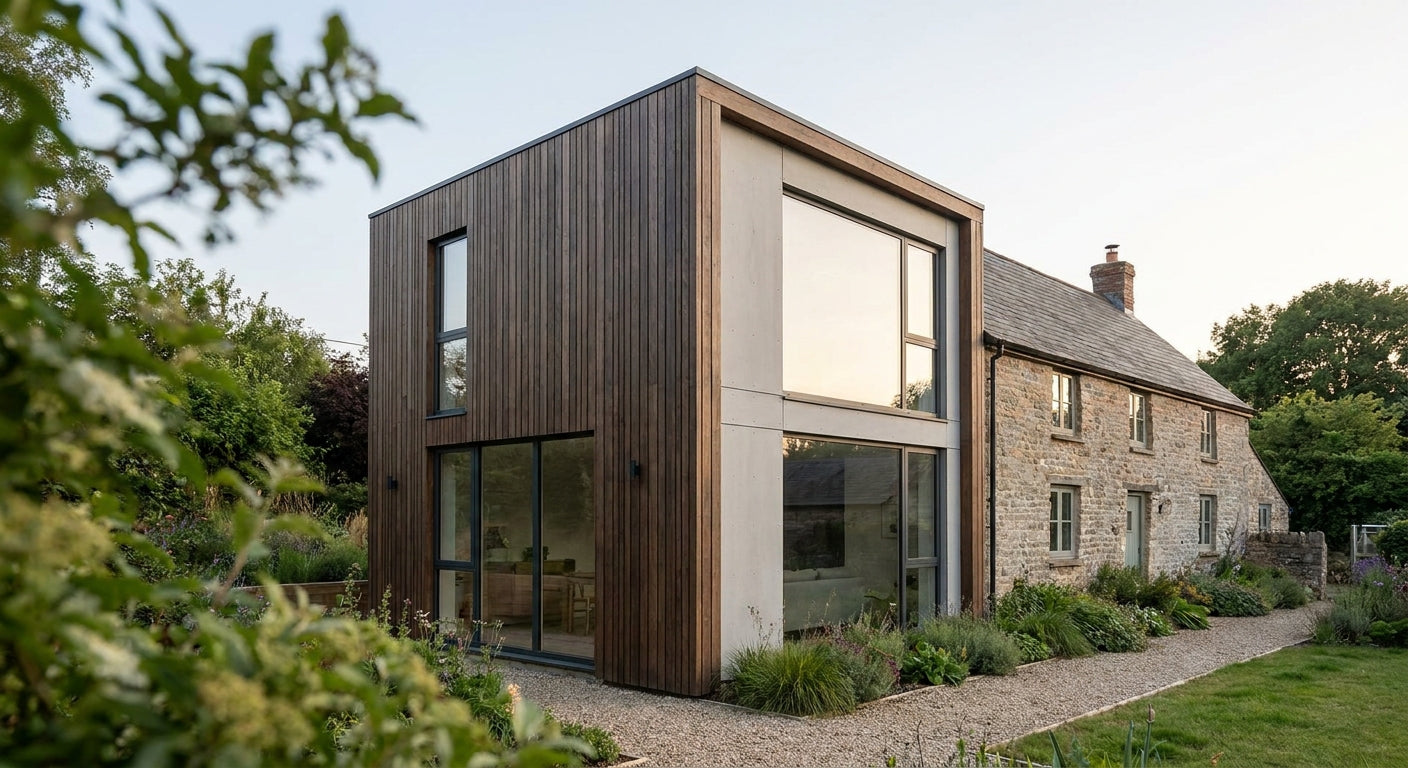
Choosing the right exterior cladding for a timber frame extension is one of the most consequential decisions you'll make on the project — get it wrong and you're looking at premature rot, planning headaches, or a finish that clashes with your main house.
TL;DR: For exterior cladding on a timber frame extension in 2026, composite cladding panels are the most practical choice for most UK homeowners — they handle moisture, require almost no maintenance, and come in finishes that sit comfortably alongside brick, render, or existing timber. Akustiq UK's exterior wall cladding range covers Birch, Oak, Black, and Stone Grey, with matching corner trims, finishing trims, and fixings so everything arrives from one supplier. If you want a natural wood look without the upkeep of real timber, this is where to start.
Why this matters for timber frame extensions
Timber frame structures move. They expand and contract with temperature and humidity, and the substrate behind your cladding will do the same. That movement punishes rigid or poorly fixed materials — panels crack, gaps open, and water finds a way in. In the UK's climate, where a single week in 2026 can deliver sunshine, driving rain, and a hard frost, cladding on a timber frame extension needs to perform across a wide range of conditions without constant attention.
The cladding choice also intersects with planning. Most single-storey rear extensions fall under permitted development, but the material and colour can still trigger conditions from a planning officer, particularly in conservation areas or where the extension is visible from the street. Picking a finish that reads as appropriate — rather than jarring — saves revision rounds.
Who this guide is for
This page is written for homeowners extending an existing property with a timber frame rear or side extension, and for self-builders specifying cladding during the build phase. It also covers garden room owners who have used timber frame construction and want a durable, finished exterior. If you are a contractor buying on behalf of a client, the same criteria apply — the product specs are identical whether you're fitting one panel or forty.
What to look for in exterior cladding for a timber frame extension
Weather resistance
Timber frame extensions are directly exposed to wind-driven rain, and the cladding is the first line of defence. You need a product rated for exterior use — not a repurposed interior panel. Composite cladding with a sealed, textured face resists moisture penetration without needing annual treatment. Check that any product you buy is explicitly described as exterior-grade; in 2026 this distinction matters more than ever with increasing UK rainfall intensity.
Movement tolerance
The fixing method must allow for minor substrate movement. Screw-fixed systems are preferable to adhesive-only on timber frame because screws can be torqued to the correct depth and the panel sits proud of the substrate, allowing drainage. Avoid any system that bonds directly and rigidly to the OSB sheathing with no drainage gap.
Finish durability
On an extension that faces a garden or side return, the cladding will be seen daily. UV fade resistance determines how good it looks in year five compared to year one. Composite panels with a co-extruded or factory-applied colour hold their finish significantly longer than site-painted timber. A Stone Grey or Black finish will show less variation over time than lighter, more reflective colours.
Compatibility with the host building
The extension cladding needs to sit convincingly alongside your existing house material — brick, render, stone, or timber. A warm Birch tone reads well against red brick. Black cladding works with white render or dark-stained fascias. Oak tones bridge old and new where the main house already uses a warm palette. Getting this wrong is expensive to fix.
Installation straightforwardness
Timber frame extensions often have tight access on side returns or near fencing. A click-and-screw panel system that can be cut on site with standard woodworking tools saves hours. Check that the supplier offers matching corner trims and finishing trims — buying main panels from one source and trims from another almost always results in colour mismatches.
Maintenance requirement
Real timber cladding on an extension needs sanding and re-oiling or re-painting every two to three years, more frequently in exposed positions. Composite panels need washing down once or twice a year — that is the full maintenance requirement. For most homeowners extending a family home, the lower maintenance demand is worth a price premium at point of purchase.
Top picks from the Akustiq UK exterior range
The natural choice — Birch
The exterior wall cladding panel in Birch is the most versatile finish in the range. The light, warm tone reads as natural timber from a distance without any of the upkeep real timber demands. It works well on extensions beside buff brick or light render, and it won't dominate a garden view. Buy if your main house is warm-toned brick or you want a Scandinavian-influenced aesthetic.
The statement finish — Black
Black exterior cladding has become the default choice for contemporary extensions in 2026, and the exterior wall cladding panel in Black delivers that look without the cost of hand-finished timber. It contrasts sharply with white or grey render and pairs well with aluminium bi-fold doors. Buy if the extension is modern in profile and the planning context allows a bold exterior treatment.
The safe match — Stone Grey
Stone Grey sits between Birch and Black — neutral enough to work with almost any host material, distinctive enough to look considered rather than default. Good choice where the planning officer has asked for a "sympathetic" finish. Consider as a first option in conservation-adjacent areas or where the main house is rendered in a mid-grey.
The warm alternative — Oak
The Oak-finish panel brings warmth without the paleness of Birch. Best suited to extensions on older properties with red or brown brick, or where there is existing oak joinery on the building. Consider if Birch feels too light for your context.
What to avoid
- Interior-grade slat panels on an exterior application. Acoustic wood slat panels with felt backing are engineered for indoor walls. They will fail within one season if fitted externally. Exterior panels are a distinct product category with different core materials and surface treatments.
- Skipping the drainage gap. Fixing composite panels flush against OSB sheathing with no ventilated cavity traps moisture. On a timber frame, this accelerates rot in the structural members behind the panel. A 25–38 mm batten cavity is standard practice.
- Buying panels without matching trims. External corners, window reveals, and panel ends need finishing. If you specify panels without ordering corner trims and finishing trims in the same colour at the same time, you will end up with visible raw edges or mismatched filler strips.
Comparison table
| Finish | Best match | Maintenance | Bold vs neutral | Planning risk |
|---|---|---|---|---|
| Birch | Buff brick, light render | Wash annually | Neutral | Low |
| Oak | Red/brown brick, warm joinery | Wash annually | Warm-neutral | Low |
| Black | White/grey render, aluminium frames | Wash annually | Bold | Medium in sensitive areas |
| Stone Grey | Any render, mid-tone brick | Wash annually | Neutral | Very low |
Frequently asked questions
What is the best exterior cladding for a timber frame extension in the UK? Composite cladding panels are the best choice for most UK timber frame extensions in 2026. They handle wet weather without warping, require no annual treatment, and are available in finishes that suit both contemporary and traditional host buildings.
Does exterior cladding on a timber frame extension need planning permission? Most single-storey rear extensions fall under permitted development, so the cladding itself typically does not need a separate application. However, if the property is in a conservation area or the extension is on a principal elevation, the material and colour may need to be approved. Check with your local planning authority before ordering.
How is exterior cladding fixed to a timber frame? The standard method is screw-fixing through the panel face into battens, which are themselves fixed through the sheathing into the timber frame members. Matching coloured screws — available in Birch, Oak, Black, and Stone Grey — keep fixings discreet. A ventilated cavity of 25–38 mm behind the panels is recommended.
Can you use the same cladding on a timber frame extension and a garden room? Yes. The exterior cladding panels from Akustiq UK are suitable for both applications. The panel dimensions, fixing system, and trim accessories are the same across both uses. The only variable is the length of batten and number of panels required.
How long does composite exterior cladding last on a UK extension? Well-fixed composite cladding with a proper drainage cavity typically lasts 20–30 years on a UK exterior without structural failure. Colour retention depends on UV exposure — south-facing elevations fade faster than north-facing ones, but the difference is gradual over a decade.
Is composite exterior cladding suitable for a flat roof extension? Yes. Flat roof extensions are common candidates for composite cladding on the vertical faces. The key requirement is that the cladding terminates correctly at the roof junction with appropriate flashing, which is a job for your roofer or builder rather than the cladding supplier.
How do you finish the corners on a clad timber frame extension? Use matching corner trims in the same colour as your panels. These are mitred over the external corner and fixed to battens, giving a clean finish that also protects the panel edges from moisture ingress. Akustiq UK supplies corner trims in all four cladding colours.
Can I order a sample before buying full panels? Yes. Physical samples are available for each colour in the exterior range, and ordering a sample before committing to full panels is the right approach — on-screen colour renderings rarely match the real-world finish accurately, especially in different lighting conditions.
One last thing
In 2026, the single most common installation mistake on timber frame cladding projects is not the panel choice — it is the omission of a ventilated cavity. Builders under time pressure sometimes fix battens at 600 mm centres to save material, which leaves spans too wide for the panel to sit flat and restricts airflow. Fix battens at 400 mm centres maximum on a timber frame extension, check that the cavity is clear of mortar droppings or insulation spill before boarding up, and the system will perform exactly as specified for the life of the building.
Share:
Composite Cladding for Barn Conversions 2026
Garden Wall Panels for Raised Beds 2026 | Buyer's Guide