

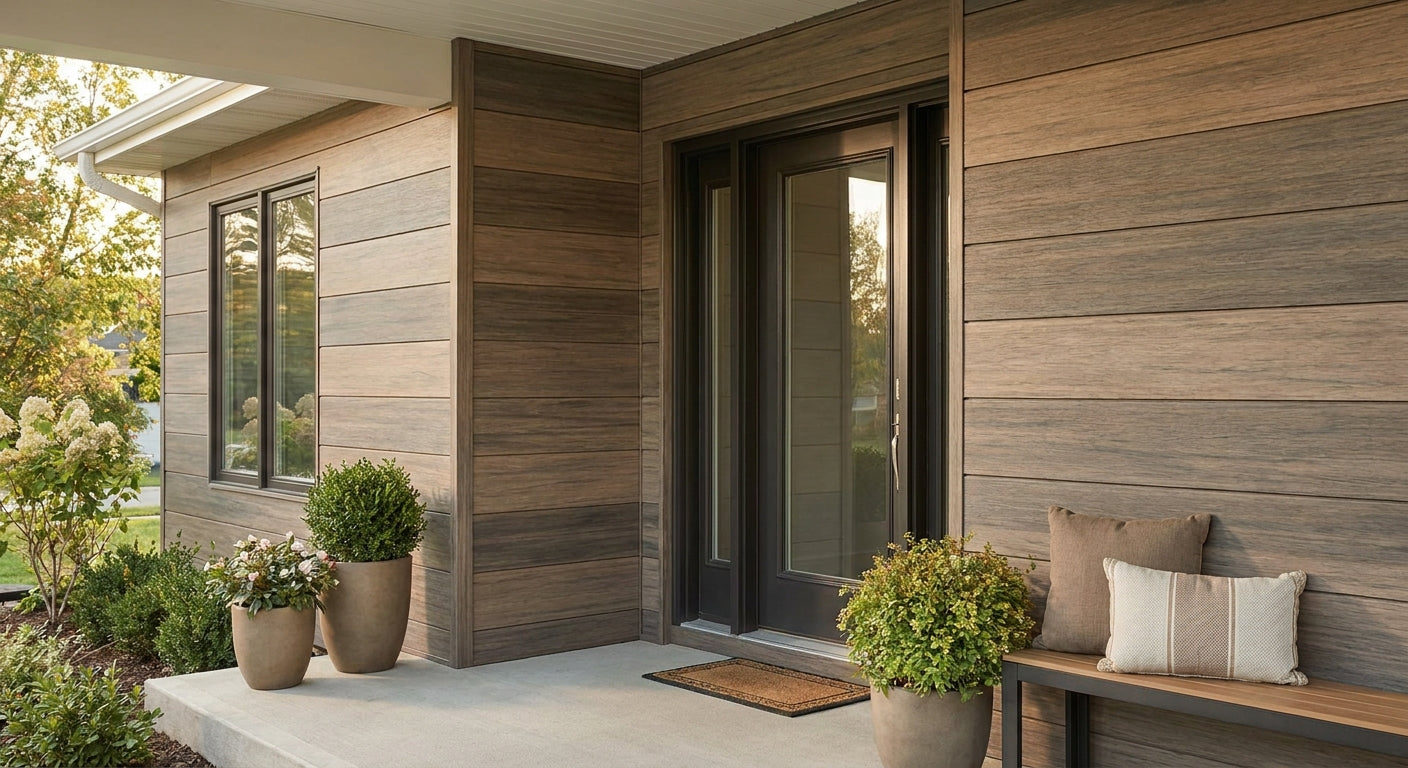
Composite cladding panels for porch and entrance walls handle one of the toughest jobs in UK residential exteriors: a surface that faces direct rain, UV, foot traffic, and the full scrutiny of anyone approaching your front door.
TL;DR: In 2026, composite cladding panels are the go-to choice for porch and entrance walls because they hold colour and dimension without the annual maintenance of timber. Akustiq UK's exterior wall cladding range covers this application directly — boards engineered for UK weather, available in black and wood-grain finishes. If you want a low-maintenance entrance wall that still reads as premium, composite is the material to specify.
Why porch and entrance walls are the hardest surface to get right
Your porch is the one wall that never gets a break. It catches driving rain from the front, bakes in summer afternoon sun, and sits at eye level for every visitor and passer-by. Timber cladding here means stripping and re-oiling every one to two years. Brick needs repointing. Render cracks and stains. Composite cladding sidesteps all three problems: it is engineered to resist moisture ingress, UV fade, and freeze-thaw cycling — the exact conditions a UK porch entrance faces from October through March.
The aesthetic case is just as strong. A well-clad porch entrance reads as a deliberate design choice, not an afterthought. In 2026, black wood-grain composite panels on entrance walls have become a signature finish for modern self-builds, extensions, and renovation projects across the UK.
Who this is for
This guide is written for homeowners planning a porch renovation or new-build entrance, self-builders specifying exterior finishes, and tradespeople advising clients on cladding options. You need a panel that installs cleanly over timber frame or masonry, requires no specialist coating after fitting, and holds its finish for a decade or more without intervention. You are not looking for a temporary fix — you want the job done once.
What to look for in composite cladding panels for porch and entrance walls
Weather resistance rated for UK conditions
Porch walls face direct exposure on at least one face, often two. The panel material must be moisture-resistant through its full cross-section, not just surface-treated. Composite boards engineered with a non-porous core do not swell, split, or delaminate when UK rainfall averages hit. Check that the product is rated for exterior use — not every composite panel sold in the UK meets that standard.
UV stability and colour retention
A south- or west-facing porch entrance gets strong afternoon sun from April through September. Composite panels with UV stabilisers in the mix hold their colour for years; surface-coated boards fade visibly within two to three seasons. In 2026, the safest specification is a through-coloured or co-extruded composite where the pigment runs through the board rather than sitting on top.
Panel profile and shadow line
The visual result on an entrance wall depends almost entirely on the shadow line the panel profile creates. Deeper grooves and defined edges read well at distance and give the façade a crisp, intentional look. Shallow profiles can look flat when the light is low, which in a UK winter means roughly six months of uninspiring results. If the entrance is narrow or recessed, a finer slat profile opens the space; wider boards suit larger gable-style porches.
Fixing system and installation tolerance
Porch walls are rarely perfectly flat. The fixing system needs to allow for substrate irregularities without packing out every board individually. Hidden clip systems that ride on a batten framework give you a 12–20 mm ventilated cavity behind the panel — essential for preventing condensation build-up on a partially enclosed porch — and keep the face clean with no visible screws.
Fire classification
For porches attached to a dwelling, Building Regulations in England and Wales require external cladding on residential properties to meet minimum fire performance standards. For most domestic porches, Class C or better (Euroclass) is the practical threshold. Confirm the product's fire classification before specifying; composite panels vary significantly here.
Maintenance requirements over ten years
The honest comparison point for composite versus timber is ten-year running cost, not purchase price. Timber cladding on a porch entrance needs cleaning, sanding, and re-oiling or re-staining roughly every 18 months in a high-exposure location. A well-specified composite panel needs an annual wash with a soft brush and water. Nothing else. Over a decade, that difference in labour and materials cost is substantial.
Top picks for porch and entrance walls in 2026
The sharp modern choice — Exterior Wall Cladding Panel Black
The safe pick for contemporary entrance walls. The exterior wall cladding panel black from Akustiq UK is the go-to specification for modern porch and entrance walls in 2026. The black wood-grain finish is through-textured, not surface-painted, which means it holds the finish under direct weather exposure without fading to grey. The panel is engineered specifically for exterior use — moisture-resistant core, suitable for timber-frame and masonry substrates. For a clean, bold entrance that makes an immediate impression, this is the panel to order.
Verdict: Buy. If your entrance is on a modern house or extension and you want a zero-maintenance finish that photographs well and reads as premium at the kerb, this is the right call.
The warm-toned indoor accent — Wooden Wall Panel Rustic Oak Premium
The wildcard for covered or partially enclosed porches. If your porch is deep enough to be genuinely sheltered — a traditional Victorian-style canopy porch or an enclosed storm lobby — the rustic oak premium 3-sided wood veneer panel brings a warmth to entrance walls that composite exterior boards cannot match. The 3-sided real wood veneer finish and acoustic felt backing make this a premium interior product; it is not rated for full weather exposure. But in a covered entrance with no direct rain contact, it creates an entrance wall that feels considered and warm rather than purely functional.
Verdict: Consider — only where the porch is fully covered and you can guarantee no direct moisture contact.
The dark interior accent — Wooden Wall Panel Black Oak
For enclosed entrance lobbies and internal porch walls. The wooden wall panel black oak suits interior-facing porch walls — the wall behind your front door, the back wall of an enclosed porch, or a hallway-entrance transition wall. The black oak finish carries the same dramatic tone as the exterior black panel but in a veneer format that is purpose-built for interior conditions. Pair it with the exterior black cladding on the outside face for a continuous colour story from kerb to hallway.
Verdict: Buy for enclosed internal entrance walls.
What to avoid
- Interior-rated composite panels on fully exposed faces. Some composite wall panels are marketed broadly but only tested for internal or semi-sheltered use. Fitting them on a directly exposed porch gable voids any warranty and risks delamination within two winters.
- Bright or light finishes on east-facing porches. Light-coloured cladding on an east-facing entrance collects green algae and tide marks quickly in wet UK conditions. Dark finishes — black, smoked, deep brown — mask weathering far better and need cleaning less often.
- Skipping the ventilated cavity. Fixing composite boards directly to masonry or sheathing without a batten gap traps moisture behind the panel. On a porch that catches wind-driven rain from the front, that moisture has nowhere to go and will eventually push back through fixings or junctions.
Comparison table
| Panel | Weather rating | Finish | Best location | Maintenance | Verdict |
|---|---|---|---|---|---|
| Exterior Wall Cladding Black | Full exterior | Black wood-grain | Exposed porch faces | Annual wash | Buy |
| Rustic Oak Premium Veneer | Interior | Warm oak 3-sided veneer | Covered/sheltered porch | Occasional dust | Consider |
| Black Oak Wooden Panel | Interior | Black oak veneer | Enclosed lobby / internal wall | Occasional dust | Buy |
FAQ
What is the best composite cladding for a porch entrance wall in the UK? For a fully exposed porch face, a composite exterior panel in a black wood-grain finish is the most practical choice in 2026 — it handles UK rainfall, UV, and freeze-thaw without repainting or re-oiling.
Can you use wooden wall panels on a porch? Real wood veneer panels are suited to covered or enclosed porches where there is no direct rain contact. On exposed faces, specify an exterior-rated composite board instead.
How long do composite cladding panels last on an entrance wall? A well-specified composite board on a porch entrance, installed with a ventilated cavity and correct fixings, will hold its finish and structural integrity for 15–25 years with only basic cleaning.
Do composite cladding panels need painting? No. The colour and texture on a quality composite panel runs through the material or is co-extruded, so there is nothing to repaint. An annual clean with a soft brush and water is all that is needed.
Is planning permission required to clad a porch entrance wall? For most houses in England, cladding an existing porch entrance wall falls under permitted development, provided the materials used are of similar appearance to the existing house. Listed buildings and conservation area properties require consent — confirm with your local planning authority before starting.
How do you fix composite cladding to a masonry porch wall? Fix treated timber battens to the masonry at 400–600 mm centres, then clip or screw the composite boards to the battens. The batten framework creates the ventilated cavity that prevents moisture build-up behind the panel.
What colour composite cladding works best on a small porch entrance? Darker finishes — black, smoked oak, deep brown — tend to recede visually and make a narrow porch entrance feel less enclosed. Lighter boards can read well on wider gable-style porches.
Is composite cladding fire-safe for a residential porch? Composite panels vary in fire classification. For domestic residential porches, look for a product meeting Class C or better under Euroclass ratings, which satisfies Building Regulations requirements for most attached porch structures.
One last thing
A porch entrance wall is typically 4–8 m² of cladding — small enough that the material cost difference between a budget board and a premium exterior composite is rarely more than £150–£250 total. The ten-year maintenance saving on a premium, correctly specified composite panel routinely exceeds that gap in the first two years alone. Spend on the right product once; do not spend on remediation twice.
Share:
How to Choose Composite Cladding for a Garden Building 2026
Best Composite Cladding for Coastal UK Homes 2026