

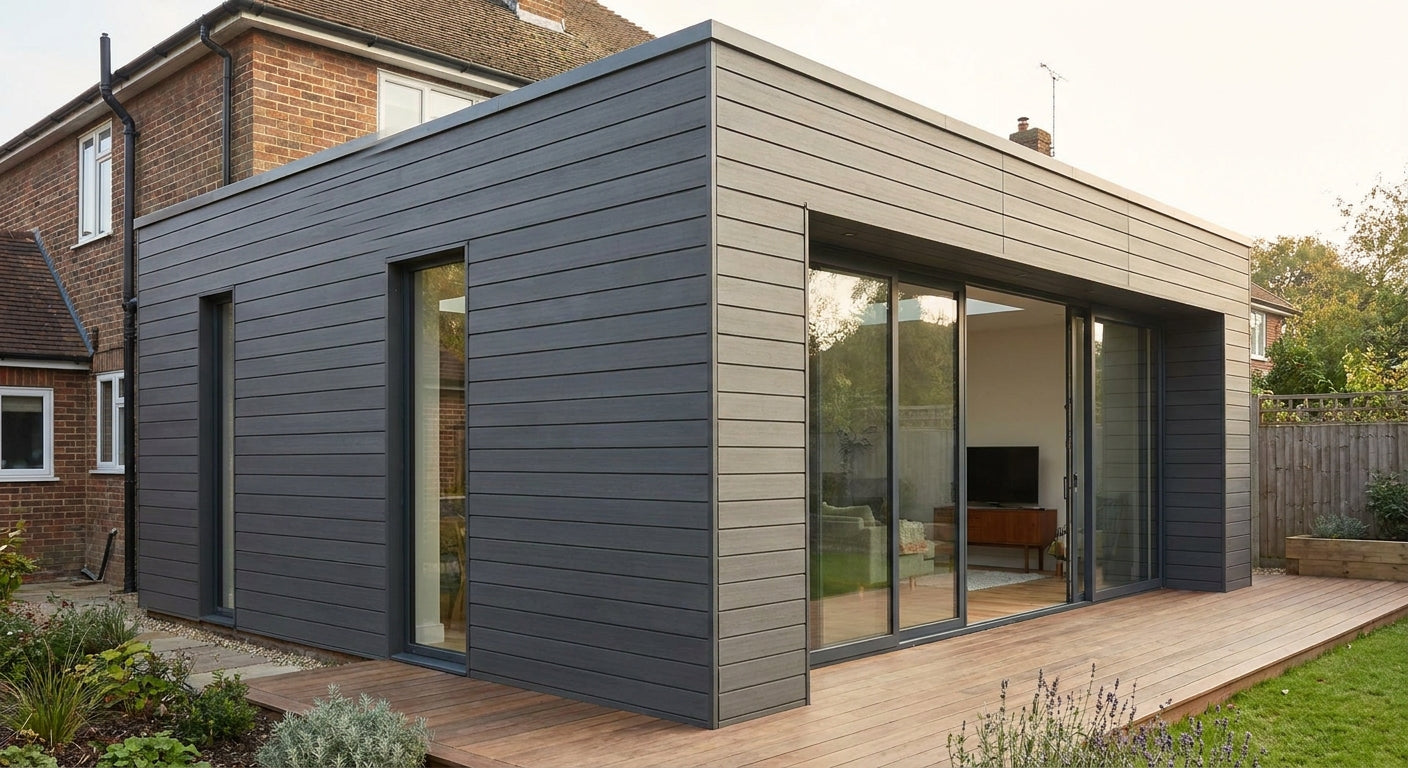
Choosing the right composite cladding panels for extension walls is one of the most consequential decisions in any home extension project — get it wrong and you'll be dealing with warping, fading, or water ingress within a few years.
TL;DR: For extension walls in 2026, composite cladding panels beat timber on durability and maintenance, but the finish, fixing system, and substrate compatibility vary enough to matter. Akustiq UK's exterior cladding range — available in Birch, Oak, Black, and Stone Grey — is engineered specifically for UK weather and installs with concealed screws for a clean, professional result. If you're cladding a rear extension, a flat-roof side return, or a timber-frame build, this guide tells you exactly what to look for and which finish to pick.
Why extension walls need a different approach
Extension walls sit in a different risk category to main house elevations. They're often north- or east-facing, exposed to standing rainwater at the base, and subject to thermal movement where new meets old. Standard painted render is the default for many builders, but composite cladding panels for extensions have become the 2026 go-to for homeowners who want a low-maintenance finish that also makes the extension look intentional rather than bolted on.
The key difference: composite panels are factory-finished, dimensionally stable, and rated for continuous moisture exposure — none of which is true of untreated timber boards.
Who this is for
This guide is written for UK homeowners planning or mid-build on a rear extension, side return, or single-storey flat-roof extension in 2026. It's also relevant to self-builders specifying external finishes for timber-frame structures, and to architects or project managers sourcing cladding for residential schemes where the client wants a contemporary look without the maintenance bill of real wood.
What to look for in composite cladding panels for extensions
Weather resistance rated for the UK
UK extensions face persistent damp — not just rain, but ground moisture wicking up from a new concrete slab, condensation cycling, and the freeze-thaw stress that hits every January. Any composite panel you specify in 2026 should be explicitly rated for wet climates, not just "weather resistant" as a marketing phrase. Look for panels with a UV-stable coating and a closed-cell or solid core construction that won't absorb water at the cut edges. Akustiq UK's exterior cladding panels are designed for exactly this exposure profile and are available with colour-matched screws and trims so the fixing system doesn't become the weak point.
Substrate and fixing compatibility
Extension walls are rarely a single substrate. You might have a block inner leaf, a breather membrane, a timber batten frame, or a steel-stud system depending on whether it's a traditional build or a modular/timber-frame extension. Composite panels need a ventilated cavity behind them — typically 25 mm minimum — and the fixing centres depend on the batten spacing. Panels that rely on adhesive alone are not appropriate for exterior extension walls; they need mechanical fixings. Akustiq UK supplies exterior wall cladding screws in Birch, Oak, Black, and Stone Grey so the fastener matches the panel face exactly.
Panel length and coverage
Extension walls are typically lower than a full house elevation — 2.4 m to 3.2 m floor-to-soffit is the most common range. A 240 cm panel length means you can run floor to soffit on a standard 2.4 m wall with zero horizontal joints, which eliminates the main water-ingress point. For taller walls up to 3 m, check whether the supplier offers a longer format. Fewer joints mean fewer failure points; it's that simple.
Colour and finish longevity
The four finishes relevant to extension cladding in 2026 are natural wood grain tones (Birch, Oak), charred-wood aesthetics (Black), and contemporary neutral (Stone Grey). Black and Stone Grey hold UV degradation better than pale timber tones on south-facing walls because the pigment is factory-bonded rather than surface-applied. If the extension faces south or west, lean towards darker or mid-tone finishes. If it's a north-facing rear return where light is already low, Birch or Oak prevents the elevation feeling gloomy.
Corner and edge detailing
Blunt panel edges at external corners look unfinished and allow moisture to track behind the cladding. A proper composite cladding installation uses colour-matched corner trims and finishing trims — not silicone, not mitred raw edges. This is the detail most DIY installations get wrong, and it's the first thing a building inspector or a future buyer will notice. Akustiq UK supplies matching exterior wall cladding corner trims in Stone Grey, Black, Oak, and Birch, as well as finishing trims for the top and base edges.
Installation speed and reversibility
Extensions are live builds. Cladding usually goes on in the final two to three weeks, when the programme is already under pressure. Panels that require specialist tools, complex secret-fix rails, or a return visit for finishing are a programme risk. Akustiq UK's system fixes with standard screws through pre-profiled panels, and the individual boards — sold separately as cladding boards in Oak — can be replaced individually if one panel is damaged during the build without stripping the whole elevation.
Top picks for extension wall cladding in 2026
Black — the architectural pick
Hook: The finish architects specify on contemporary flat-roof extensions.
Black exterior cladding reads as deliberate and modern against white render, brick, or zinc roofing. The exterior wall cladding panel in Black carries a deep wood-grain texture that avoids the flat, plastic look of cheaper composite boards, and the colour is consistent through the UV-stable coating rather than painted on. Pair it with a black aluminium window frame and the extension looks like an architectural decision, not an afterthought.
This is the right pick for rear extensions on Victorian or Edwardian terraces where the planning constraint is "no impact on the street scene" — black to the rear is almost universally acceptable.
Verdict: Buy — the most specification-ready finish in the range for 2026 extension projects.
Stone Grey — the safe, versatile pick
Hook: Works against every main house material you're likely to encounter.
Stone Grey sits between a warm sand and a cool mid-grey, which means it doesn't clash with red brick, buff brick, painted render, or stone. If you're extending a semi-detached house where you need the extension to read as part of the original building rather than contrasting with it, Stone Grey is the lower-risk choice. UV stability on pale-to-mid-tone composite finishes is good when the substrate coating is sealed at the factory; the exterior wall cladding panel in Stone Grey meets that standard.
Verdict: Buy — the default recommendation for extensions where planning sensitivity is a factor.
Birch — the Scandinavian-influenced pick
Hook: Brings warmth to a north-facing elevation without looking like untreated timber.
Birch has a pale, near-white wood grain that works well on garden-room-style extensions and rear additions where the aesthetic is light and contemporary. It reads as "almost white" from a distance, which opens up the elevation visually. The risk: on south-facing walls with extended sun exposure, pale composites show UV colour shift faster than darker tones. Order a sample before committing to a large elevation.
Verdict: Consider — strong choice for garden-room extensions and north-facing walls; verify UV performance for south-facing installs.
Oak — the warm-neutral pick
Hook: The finish that reads as "timber" from the street without any timber maintenance.
Oak composite cladding sits in the warm mid-brown range, close enough to real timber boarding that most observers assume it is. For extensions on period properties or rural locations where dark or grey cladding would look out of place, Oak gives you the aesthetic without the five-year recoating cycle. The exterior wall cladding panel in Oak uses the same UV-stable finish as the rest of the range.
Verdict: Buy — the right call for period property extensions and rural or semi-rural settings where a grey or black finish would feel wrong.
What to avoid
- Untreated or brushed timber boards on external extension walls. Real wood requires recoating every 3–5 years and is particularly vulnerable at the base of an extension where ground splash is constant. Composite eliminates this entirely.
- Adhesive-only fixing systems on exterior walls. Panel glue is appropriate for interior acoustic panels; exterior extension walls see thermal movement of 2–4 mm per metre across a temperature range of -10°C to +35°C. Mechanical fixings are non-negotiable.
- Panels without colour-matched trims. Silicone-filled mitred joints at corners look poor within 18 months as the sealant discolours. Buy the corner trim system at the same time as the panels — it's not optional.
Comparison: Akustiq UK exterior cladding for extension walls (2026)
| Finish | Best for | UV performance | Works with planning sensitivity |
|---|---|---|---|
| Black | Contemporary flat-roof extensions | Excellent | Yes — rear elevations |
| Stone Grey | Versatile, semi-detached, rendered walls | Good | Yes — wide compatibility |
| Birch | Garden rooms, north-facing walls | Moderate | Yes — light aesthetic |
| Oak | Period properties, rural settings | Good | Yes — reads as timber |
FAQ
What are composite cladding panels for extensions made from? Composite cladding panels combine wood fibre and a polymer binder, factory-finished with a UV-stable coating. They have the visual texture of timber but will not rot, warp, or require periodic recoating the way real wood does.
Do composite cladding panels need planning permission on an extension? In most cases, no — cladding applied to a rear or side extension that already has permitted development approval does not trigger a separate planning application. Front elevations and properties in conservation areas are different; always check with your local authority before ordering.
How long do composite cladding panels last on an exterior wall? Quality composite panels are rated for 25 years or more in exterior exposure when correctly installed with a ventilated cavity and mechanical fixings. The UV-stable factory finish is the critical variable; avoid panels where the colour coating is surface-applied paint.
Can I fit composite cladding panels on a timber-frame extension myself? Yes. The system uses standard screws with pre-profiled panels, and individual boards are cut with a standard circular saw. Allow one full day per 15–20 m² for a competent DIYer. Use colour-matched screws and trim from the outset — retrofitting them after the panels are fixed is slow.
Is composite cladding better than render for an extension? For low-maintenance longevity, yes. Render cracks, stains, and needs repainting every 8–12 years in UK conditions. Composite cladding panels on extension walls require only an occasional wash-down and a check of the fixing screws after the first winter thermal cycle.
What colour composite cladding is most popular for extensions in 2026? Black and Stone Grey are the two most-specified finishes on contemporary UK extensions in 2026, driven by the flat-roof extension trend and the popularity of dark-frame aluminium glazing. Oak remains the top choice for period properties.
How do I finish the corners and edges of composite cladding on an extension? Use the colour-matched corner trim and finishing trim from the same supplier as the panels. Trims are mechanically fixed — not silicone-sealed — and the colour match means the detail reads as a designed finish rather than a patch.
How do I calculate how many panels I need for an extension wall? Measure the wall height and width in metres, multiply for total m², then subtract any window or door openings. Add 10% for cuts and waste. For a standard 3 m × 5 m rear extension wall (15 m² gross, roughly 12 m² net after openings), you'll need panels plus corner trims for two external corners and finishing trims for the top edge.
One last thing
The fixing screw is the detail that fails first on budget composite cladding installations — not the panel itself. Standard zinc-plated screws corrode and stain the panel face within 3–5 years in UK coastal or urban-pollution environments. Using colour-matched stainless or coated screws from day one eliminates that failure mode entirely and keeps the installation looking correct for the full 25-year panel life.
Share:
Composite Cladding Garage Conversion: 2026 Guide
Best Outdoor Wall Cladding for North-Facing Walls 2026