

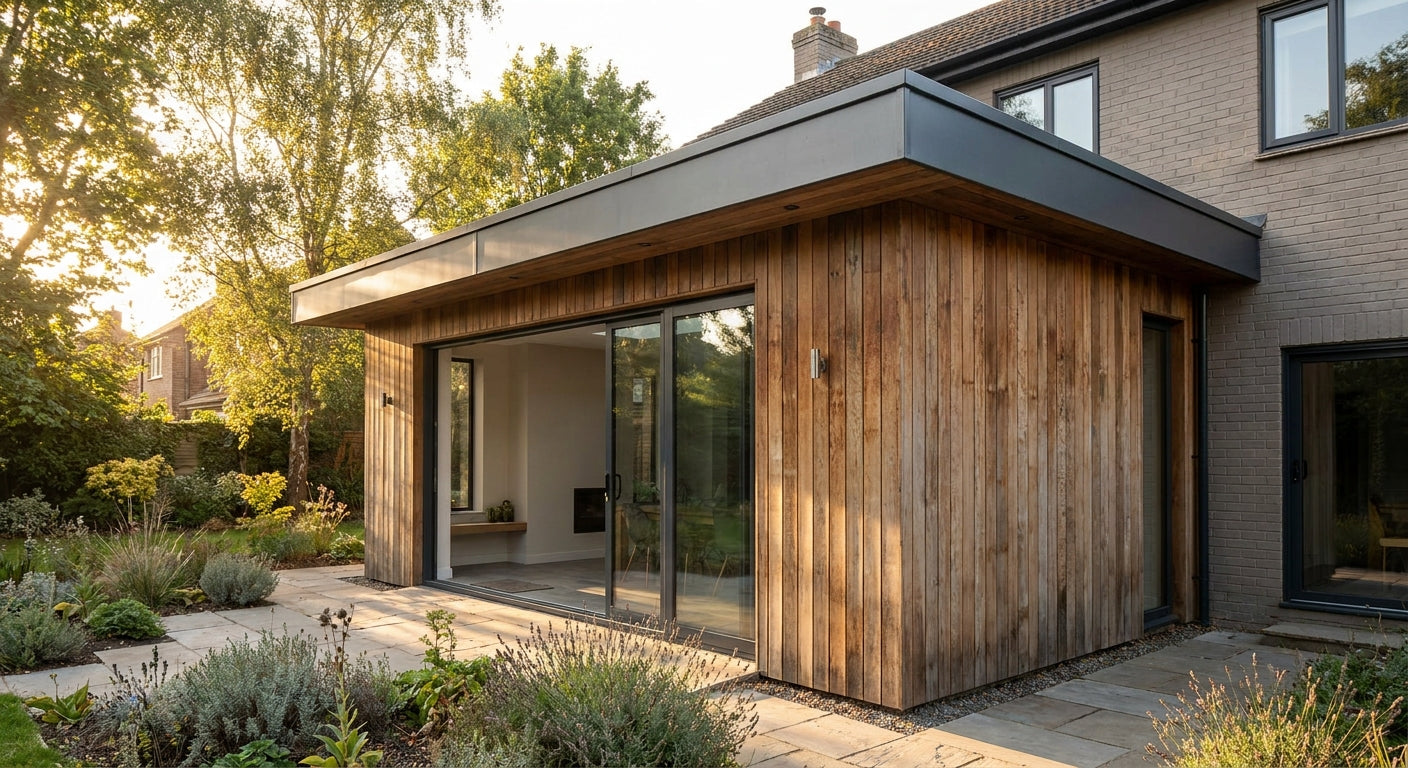
Flat-roof extensions are one of the most popular ways to add space to a UK home in 2026 — but their vertical walls are fully exposed to wind, rain, and UV, making outdoor cladding for flat roof extension walls one of the most consequential material choices you'll make.
TL;DR: The best outdoor cladding for a flat roof extension in 2026 is a composite or engineered panel that resists moisture, needs minimal maintenance, and holds its finish for at least 10 years. Akustiq UK's exterior cladding panels — available in Birch, Oak, Black, and Stone Grey — are purpose-built for exposed UK elevations and fix directly to timber battens or masonry. If you want warm wood aesthetics without the upkeep of real timber, these are the pick. Order a sample before committing to a full run.
Why this matters
A flat-roof extension sits low and horizontal — its walls are at eye level, not 6 metres up like a roofline. Every panel joint, screw head, and colour fade is visible from the garden, the street, or a neighbour's window. Poor cladding choices show within 18 months: splitting, bleaching, or water ingress behind the board. Getting this right in 2026 means choosing panels designed for the UK climate, not repurposed interior products.
Who this is for
This guide is for homeowners and self-builders adding a rear or side flat-roof extension to an existing house — typically a kitchen extension, garden room link, or ground-floor bedroom addition. You already have or are commissioning a structural frame (timber or steel), and you need to clad the vertical walls to a finish that is weatherproof, visually consistent with the main house, and low-maintenance. You are not a professional contractor, but you are comfortable with basic power tools and following a fixing sequence.
What to look for in outdoor cladding for a flat roof extension
Weather resistance rated for the UK
UK south-facing walls receive up to 1,200 hours of direct sun annually; north-facing walls stay damp for weeks at a time. Cladding must handle both extremes without warping or delaminating. Look for panels with a UV-stable finish and a moisture barrier built into the board — not applied as an afterthought.
A fixing system that allows movement
All cladding expands and contracts with temperature. A flat-roof extension has fewer masking details — no overhanging eaves, no deep reveals — so any buckling from thermal movement is immediately obvious. Screw-fixed systems with pre-drilled slots or proprietary clips manage this better than adhesive-only solutions.
Colour consistency across the run
A flat-roof extension wall is often one unbroken plane, 4–8 metres wide. Batch variation between panels is visible at that scale. Order all panels from a single batch if possible, and confirm with the supplier that the finish is consistent across the run.
Edge and corner details
The junction between the cladding and the flat roof upstand, the corners of the extension, and the reveals around windows are where most water ingress starts. Matching finishing trims and corner trims in the same colour finish are not optional — they determine whether the installation looks built or bodged.
Low ongoing maintenance
Real timber cladding on a flat-roof extension needs treating every 2–3 years. Composite and engineered panels with a factory finish need nothing beyond an annual wash. For a ground-level extension where access is easy but time is short, low maintenance is a genuine functional benefit, not just a marketing claim.
Visual fit with the main house
Planners and neighbours notice contrast. A black-finish panel on a white rendered house reads as a deliberate design choice; a mismatched mid-brown looks accidental. Stone Grey works with brick and render; Black reads as contemporary and matches aluminium windows; Oak and Birch warm up white or light-grey walls.
Top picks
The safe pick — Exterior Wall Cladding Panel Oak
Hook: The default choice for any extension that needs to sit quietly next to brick or render.
The exterior wall cladding panel oak has a warm mid-oak finish that reads as natural timber from a distance but requires none of the annual treatment real wood demands. It fixes with matching screws and accepts the Oak finishing trim at roof-edge and window junctions. If your extension is on a semi-detached or terraced house where the finish needs to feel residential rather than industrial, this is the starting point.
Concrete number: Available in lengths covering standard bay widths; pair with Oak corner trim to eliminate exposed substrates at external angles.
Verdict: Buy — the most versatile finish in the range for 2026 residential extensions.
The contemporary pick — Exterior Wall Cladding Panel Black
Hook: Right for modern extensions with aluminium or anthracite window frames.
Black cladding on a flat-roof extension is now one of the most searched exterior finishes in the UK. The exterior wall cladding panel black delivers a consistent dark finish across a full elevation without the fade and grain variation of charred timber. The 3D wood-grain texture stops it reading as flat paint; at arm's length it has depth and movement.
Concrete number: Pair with Black corner trim and Black finishing trim — matching all three keeps the junction lines clean and prevents silver substrate showing at edges.
Verdict: Buy — the strongest design statement in the range and the right call for extensions with modern glazing.
The neutral pick — Exterior Wall Cladding Panel Stone Grey
Hook: The bridge finish between timber-look and render.
Stone Grey sits between white render and dark frames. It reads as contemporary without the commitment of full black, and it blends with concrete, fibre cement, and light brick. For extensions on houses with mixed external materials, Stone Grey is the lowest-risk option visually.
Verdict: Consider — strong choice for mixed-material facades; less distinctive than Black or Oak on a clean modern build.
The warm pick — Exterior Wall Cladding Panel Birch
Hook: Lightest tone in the range; best for north-facing or shaded elevations.
North-facing flat-roof extension walls can feel dark and heavy with deep-toned cladding. Birch keeps the elevation light without the bleaching risk of painted timber. It also reads as Scandinavian in style, which pairs well with large-format glazing and minimal detailing.
Verdict: Consider — ideal for shaded elevations and Scandi-influenced builds; check the sample against your mortar or render colour before ordering.
What to avoid
- Interior acoustic panels on exterior walls. The indoor slat panels in the Akustiq UK range — Natural Oak, Walnut, Smoked Oak, and others — have a real wood veneer and acoustic felt backing. They are not weatherproof. Using them outside voids any performance expectation and the veneer will delaminate within one UK winter. Keep them indoors where they belong.
- Adhesive-only installation on large flat planes. On a 6-metre extension wall with no shade, summer surface temperatures can exceed 60°C. Panel adhesive alone cannot hold dimensional movement at those temperatures. Always use mechanical fixings — the exterior cladding screws matched to your finish colour are the right choice — and treat adhesive as a secondary bond only.
- Mismatched trim colours. Ordering cladding in Black and trimming in Oak (or vice versa) because trims were out of stock is a common and costly mistake. If matching trims are unavailable, delay the order — mismatched junctions cannot be corrected without removing all the cladding.
Verdict comparison table
| Finish | Best for | Maintenance | Visual risk | Verdict |
|---|---|---|---|---|
| Oak | Residential, brick/render context | Low | Low | Buy |
| Black | Modern builds, aluminium glazing | Low | Low if consistent | Buy |
| Stone Grey | Mixed-material facades | Low | Very low | Consider |
| Birch | Shaded/north-facing walls | Low | Low | Consider |
Frequently asked questions
What is the best outdoor cladding for a flat roof extension in 2026? Engineered composite panels with a factory UV-stable finish — such as the Akustiq UK exterior cladding range — outperform real timber on flat-roof extensions because they need no annual treatment and hold their colour for over a decade in UK conditions.
Do I need planning permission to clad a flat roof extension? In most cases, re-cladding an existing extension in a like-for-like material is permitted development. Changing the colour or material significantly — particularly on a front elevation or in a conservation area — usually requires prior approval. Check with your local planning authority before ordering.
Can I use wood cladding panels on a flat roof extension? Real timber cladding works on flat-roof extensions but needs treating every 2–3 years and is prone to splitting if the specification is wrong. Engineered panels with a wood-grain finish give the same visual result with a fraction of the upkeep.
How do I fix cladding to a flat roof extension wall? Mount horizontal timber battens at 400–600 mm centres across the substrate, then fix panels vertically using colour-matched screws. Leave a 2–3 mm expansion gap between panel ends. Finish all exposed edges with matching finishing trim and all external corners with corner trim.
Is black exterior cladding suitable for UK weather? Yes — provided the finish is UV-stable. Dark surfaces absorb more heat, which increases thermal expansion, so a screw-fixed system with movement allowance is more important with black panels than with lighter finishes. The Akustiq UK black cladding panel is designed for exposed UK elevations.
How long does exterior cladding last on a flat roof extension? Engineered composite panels with a factory finish typically last 15–25 years without repainting in UK conditions. Real timber lasts a similar period only with regular treatment. Joint integrity and trim details are the most common failure points — get these right at installation.
Is stone grey or black cladding better for a flat roof extension? Black is the stronger design statement and works best with dark window frames and a deliberate contemporary brief. Stone Grey is safer on mixed-material facades and gives more flexibility if you change the window colour later. Both perform identically in UK weather.
Do I need to order samples before buying cladding panels? Yes. Screen colours vary — what looks like a mid-oak on a monitor can read as orange or yellow against your brickwork in daylight. Order a sample of your preferred finish, hold it against the existing materials at different times of day, then place your full order.
One last thing
The junction between the flat roof upstand and the top of the cladding is where 80% of water ingress problems on flat-roof extensions start. No amount of premium panel quality compensates for a poorly detailed head trim. Specify a continuous finishing trim across the full width of each elevation, and ensure it laps over the upstand flashing by at least 25 mm. This single detail — not the panel brand — determines whether the installation stays dry for 20 years or needs remediation in 5.
Share:
Garden Wall Panels for Raised Beds 2026 | Buyer's Guide
External Cladding for Semi-Detached Houses 2026