

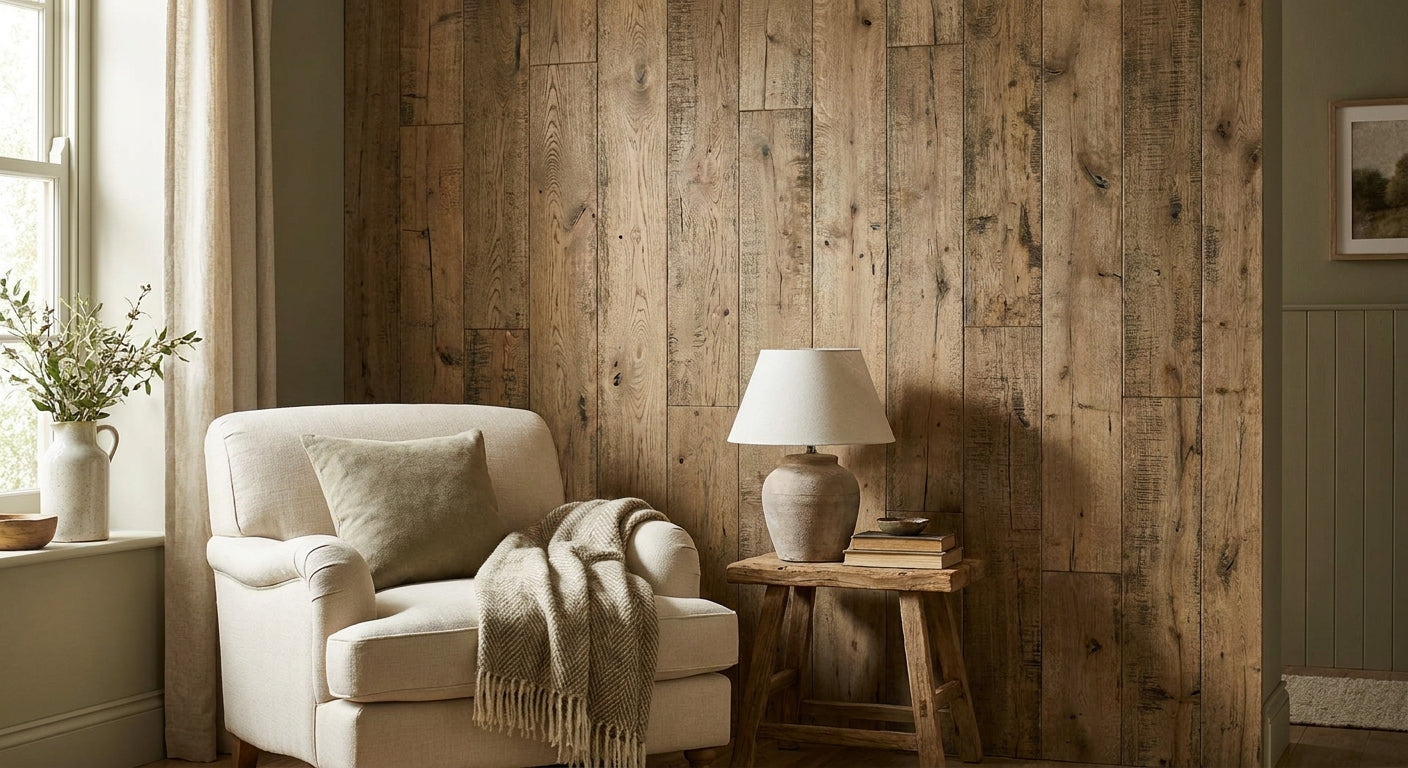
Farmhouse interiors live and die by the warmth of their materials — and nothing pulls a room together faster than real wood on the walls. This guide ranks the best rustic oak wall panels for farmhouse interiors in 2026, with verdicts on finish quality, acoustic benefit, size options, and value.
TL;DR
The best rustic oak wall panels farmhouse buyers should consider in 2026 is the Rustic Oak Premium 3-Sided Wood Veneer panel from Akustiq UK. It combines a genuine 3-sided real wood veneer finish with acoustic felt backing — delivering the authentic grain and warmth farmhouse interiors demand, plus measurable echo reduction. If your shortlist includes vinyl-wrap alternatives or MDF-only options, skip them: the veneer finish is the differentiator here. Buy.
Why this matters in 2026
Farmhouse interiors are one of the most searched interior styles in the UK right now. The defining tension is always the same: you want the authentic character of natural materials, but you also want something that installs cleanly, performs acoustically in a large open-plan space, and does not look cheap after six months. Real wood veneer panels solve all three. Hollow MDF slats with a printed finish do not — the grain fades, the edges chip, and any heat near an Aga or open fireplace accelerates both.
The panels ranked below are evaluated against four criteria that matter specifically in farmhouse settings: grain authenticity, acoustic performance, scale compatibility (farmhouses tend toward high ceilings and long walls), and finish durability.
How we ranked
Rankings are based on material specification (real veneer vs printed finish), acoustic backing presence, available panel lengths (240 cm vs 300 cm), finish depth relative to farmhouse palettes, and installation method. No fabricated test scores. Where a panel meets all four farmhouse-relevant criteria, it ranks higher. Where it meets fewer, it ranks lower or receives a Skip verdict.
The ranked list
1. Rustic Oak Premium 3-Sided Wood Veneer — The outright farmhouse pick
This is the panel built for exactly this application. The 3-sided real wood veneer means the grain wraps the visible faces of every slat — you see authentic oak character from the front and both sides, which matters in farmhouses where panels often wrap around chimney breasts, alcoves, or fireplace surrounds.
Available in both 240 cm and 300 cm lengths, the 300 cm format suits the ceiling heights common in older UK farmhouses without a horizontal join breaking the run. The acoustic felt backing reduces echo — a real issue in stone-floored, plaster-walled farmhouse rooms where reverb is noticeably worse than in carpeted modern builds.
The rustic oak finish reads warm amber with visible grain variation and knot character. It pairs directly with exposed beams, flagstone floors, and linen upholstery — the core farmhouse palette.
Verdict: Buy. This is the panel to order first. See the Rustic Oak Premium 3-Sided Wood Veneer for sizing and finish detail.
2. Mocca Wooden Wall Panel — The darker farmhouse alternative
If your farmhouse leans toward a more brooding, late-2026 palette — think dark linen, aged brass, and reclaimed timber — the Mocca finish works where lighter oak reads too pale. The deep warm brown veneer sits closer to walnut territory than oak but without the premium walnut price point.
Same 3-sided veneer construction, same acoustic felt backing. The Mocca tone complements exposed brick walls and stone surrounds particularly well. It is a stronger choice for dining rooms and snugs than for open kitchens, where lighter finishes tend to read better under artificial light.
Verdict: Buy if your palette runs dark. Wooden wall panel Mocca for the full spec.
3. Black Oak Wooden Wall Panel — The bold accent pick
Black oak in a farmhouse context sounds counterintuitive until you see it against whitewashed plaster or a lime-washed wall. In 2026, the contrast-accent chimney breast has become a standard farmhouse move — and Black Oak is the finish that lands it cleanest.
This is a single-feature-wall panel, not a room-wrap. Use it on one surface and keep the remaining walls neutral. The acoustic felt backing is present here too, which matters on a chimney breast directly adjacent to a room's main living area.
Verdict: Consider for feature walls. Full spec at wooden wall panel black oak.
4. Printed-finish MDF slat panels (generic market) — The temptation to avoid
Nearly every DIY shed and online marketplace carries a version of this product in 2026. The panels photograph well, price low, and ship fast. The issue is the finish: printed grain film over MDF core means zero grain depth, visible repetition in the pattern across panels, and edges that chip at the first knock from a chair back or door frame — events that happen constantly in a busy farmhouse kitchen or hallway.
They also carry no acoustic backing, so the slat profile delivers the aesthetic without any functional echo reduction.
Verdict: Skip. The price gap between these and real-veneer panels narrows once you factor in replacement.
5. Vinyl-wrap composite slat panels (generic market) — Fine for modern, wrong for farmhouse
Vinyl-wrap panels serve modern and Scandi interiors well — the finish is consistent and clean, which is exactly the point. In a farmhouse interior, that consistency works against you. The uniform grain reads artificial next to natural stone, reclaimed wood, or hand-thrown ceramics. Heat from an Aga, open fire, or underfloor heating can also cause vinyl-wrap finishes to lift at panel edges over time.
Verdict: Skip for farmhouse applications specifically.
Comparison table
| Panel | Grain type | Acoustic backing | Max length | Farmhouse fit | Verdict |
|---|---|---|---|---|---|
| Rustic Oak Premium 3-Sided Veneer | Real oak veneer | Yes | 300 cm | Excellent | Buy |
| Mocca Wooden Wall Panel | Real veneer | Yes | 300 cm | Strong (dark palette) | Buy |
| Black Oak Wooden Wall Panel | Real veneer | Yes | 300 cm | Feature wall only | Consider |
| Printed MDF slat (generic) | Printed film | No | Varies | Poor | Skip |
| Vinyl-wrap composite (generic) | Vinyl wrap | No | Varies | Poor | Skip |
What to avoid in farmhouse settings
- Short panel formats only. A 240 cm panel in a room with 280 cm ceilings leaves a gap at the top that requires an additional strip. If the supplier only stocks one length and it does not reach your ceiling height, you will have a visible horizontal join. Always confirm the 300 cm option is available before ordering.
- Panels without edge veneer. If the side faces of the slat are raw MDF or plain substrate, corners and reveals will expose the core. In farmhouses, panels frequently wrap alcoves, window reveals, and chimney breasts — edge finish is not optional.
- Lightweight acoustic foam disguised as wood. Some suppliers print a wood-look surface onto foam acoustic tiles. The depth and texture read as flat in real farmhouse light, particularly in rooms with strong natural light from large sash or casement windows.
Where to buy
- Direct from Akustiq UK — the safest sourcing route for real 3-sided veneer panels with acoustic felt backing. Both 240 cm and 300 cm formats are available, and you can order samples before committing to a full wall. Akustiq UK ships across the UK and Europe.
- Avoid marketplace resellers for veneer panels — grain matching across boxes matters, and resellers sourcing from multiple batches cannot guarantee consistency.
- Trade and bulk orders — if you are fitting multiple rooms or a full barn conversion, Akustiq UK handles commercial quantities directly. Mixing finishes (Rustic Oak on the main living wall, Mocca on the snug accent wall) works well when ordered from the same supplier to keep installation method consistent.
FAQ
What are the best rustic oak wall panels for a farmhouse interior in 2026? The Rustic Oak Premium 3-Sided Wood Veneer from Akustiq UK is the top pick in 2026. It uses genuine oak veneer on three faces of each slat, ships in 300 cm lengths to suit high farmhouse ceilings, and includes acoustic felt backing to reduce echo in stone-floored or open-plan rooms.
Do wood slat wall panels actually reduce echo? Yes, when they include an acoustic felt or foam backing layer. The felt absorbs mid and high-frequency sound that bare plaster walls reflect. In a farmhouse kitchen or living room with hard floors and minimal soft furnishings, the difference is audible. Panels without a backing layer provide the visual only.
How many panels do I need for a farmhouse feature wall? A standard UK feature wall of 3.6 m wide by 2.4 m high requires roughly 6 panels at 240 cm, or 5 panels at 300 cm if your ceiling reaches that height. Always add 10% for cuts, particularly around sockets, light switches, and reveals.
Are rustic oak veneer panels suitable near an Aga or fireplace? Real wood veneer handles ambient heat better than vinyl-wrap or printed-film finishes. Keep panels at least 30 cm from a direct heat source and avoid positioning directly above a radiant heat output. The acoustic felt backing is not combustible at normal room temperatures but is not rated for proximity to open flames.
Is rustic oak or smoked oak better for a farmhouse? Rustic oak reads warmer and lighter — it suits rooms with natural daylight, exposed beams, and pale stone. Smoked oak reads cooler and darker, closer to driftwood or reclaimed timber character. For a classic British farmhouse palette, rustic oak is the more direct match. For a converted barn with industrial elements, smoked oak often works better.
Can I install wall panels myself or do I need a fitter? Most Akustiq UK panels are designed for DIY installation using panel adhesive and finish pins. A standard 3.6 m feature wall takes an experienced DIYer around 3–4 hours for the first install, less on subsequent walls once the spacing rhythm is established. No specialist tools are required beyond a mitre saw or fine-tooth hand saw for length cuts.
What is the difference between 2-sided and 3-sided wood veneer panels? A 2-sided veneer wraps the front face and one side of each slat. A 3-sided veneer wraps the front and both sides. The difference shows anywhere a slat edge is visible — corners, reveals, alcove returns. In farmhouse installs where panels frequently wrap multiple surfaces, 3-sided veneer is the only finish that holds up at every angle.
How do I clean rustic oak wall panels? Dry dust with a soft brush or low-suction vacuum attachment. For marks, wipe with a barely damp cloth — never soak the veneer. Avoid aerosol polishes with silicone; they build up on the grain over time and dull the finish. Once or twice a year, a thin coat of natural wood oil keeps the veneer condition stable.
One last thing
The 300 cm panel length is the single most underrated specification for farmhouse installations. Most panel suppliers stock 240 cm as standard and treat 300 cm as a special order. Akustiq UK carries 300 cm as a standard format — which means no horizontal join on walls up to 3 metres, no filler strip at the top, and a clean floor-to-ceiling run that reads as intentional rather than patched together. If your farmhouse has original ceiling heights above 240 cm, that one spec detail is worth confirming before you order anything else.
Share:
Rustic Oak Wall Panels for Living Rooms 2026 | Akustiq UK
Rustic Oak Acoustic Panels for Home Office Walls 2026