

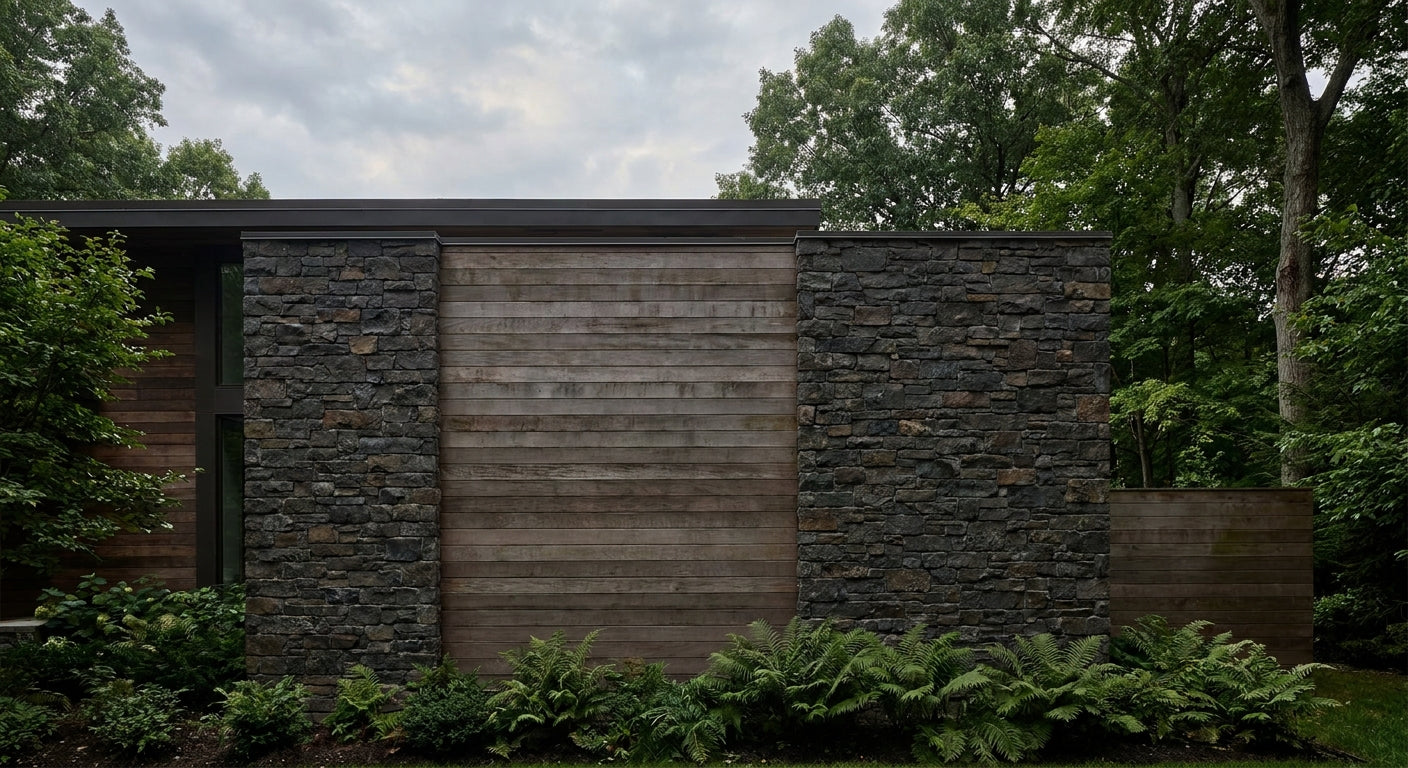
North-facing walls get the worst of UK weather — persistent damp, no drying sun, and the kind of slow moisture ingress that rots untreated timber and stains render within a few years. Choosing outdoor wall cladding for north-facing walls in 2026 means picking materials that handle constant shade, freeze-thaw cycles, and British rainfall without needing annual maintenance.
TL;DR: For outdoor wall cladding on north-facing walls in the UK, composite cladding panels outperform real wood on every durability metric that matters in shaded, wet conditions. The exterior wall cladding panel in Stone Grey from Akustiq UK is the safest all-round pick for 2026 — moisture-resistant, colour-stable in low light, and available as a sample before you commit. If you want a bolder look, the black finish works equally well on north elevations. Avoid untreated softwood and thin vinyl boards that bubble when temperatures drop.
Why north-facing walls are a different problem
A south-facing wall gets 4–6 hours of direct sun on a clear winter day in the UK. A north-facing wall gets close to zero. That matters for cladding because UV exposure actually helps wood dry out between rain events. Without it, moisture sits in the surface longer, mould spores have more time to colonise, and any material that swells when wet will do so repeatedly across the roughly 100+ freeze-thaw cycles a typical UK winter produces.
The right outdoor wall cladding for north-facing walls needs to score well on four things: moisture resistance, dimensional stability under temperature change, colour retention in low light, and ease of cleaning when algae inevitably appears. The ranked picks below are judged on exactly those criteria.
How these picks were ranked
Rankings are based on material science properties — moisture absorption rates, thermal expansion coefficients, and finish durability — cross-referenced with what UK homeowners and contractors actually encounter on shaded elevations. No sponsored placements. Products are ranked by how confidently you can install them on a north wall and leave them alone for 5+ years.
Ranked: best outdoor wall cladding for north-facing walls in 2026
1. Exterior Wall Cladding Panel — Stone Grey
The safe pick for damp, shaded walls.
Stone Grey is the most practical finish for a north-facing wall in 2026. The mid-tone grey sits in a colour range that does not show algae growth or water staining as quickly as lighter finishes, and it reads as intentionally modern against brickwork or render. Composite construction means the board does not absorb moisture the way real wood does — dimensional change under wet-dry cycling is minimal.
The panel format means you cover large wall areas quickly, and matching finishing trim in Stone Grey and corner trim in Stone Grey are available so reveals and corners look deliberate rather than improvised.
Order a sample outdoor wall panel in Stone Grey before buying full panels — colour reads very differently under overcast northern light than in studio photography.
Verdict: Buy. This is the go-to recommendation for north-facing residential and commercial cladding projects in the UK right now.
2. Exterior Wall Cladding Panel — Black
The bold pick that actually works in shade.
Black cladding on north-facing walls sounds counterintuitive — surely it will fade? In practice, black composite panels are manufactured with UV-stable pigments that hold colour in low-light conditions better than mid-tone timber stains, which rely on topcoat renewal every 2–3 years. Against a white or light-render house, black exterior cladding on a north elevation creates a deliberate contrast that looks modern rather than gloomy.
The practical advantage: algae and surface dirt are far less visible on black than on pale finishes, which means the wall looks clean for longer between washes. This matters on north-facing walls where cleaning is needed 2–3 times more often than on sun-exposed elevations.
Matching screws, corner trims, and finishing trims are available in black, so the installation stays visually tight.
Verdict: Buy — especially for contemporary homes, garden studios, and flat-roof extensions where the architectural intention is clear.
3. Exterior Wall Cladding Panel — Oak
The natural-look pick, with caveats.
If you want a timber aesthetic on a north-facing wall, the composite oak-finish panel is the only sensible route. Real wood on a permanently shaded wall will grey out unevenly and require re-oiling or staining every 1–2 years to prevent surface checking. A composite oak finish gives you the grain appearance without the maintenance obligation.
The oak finish works particularly well on garden rooms, extensions adjacent to garden planting, and barn-style buildings where a natural colour tone is part of the architectural language. On a stark urban north wall with no softening planting, it can look flat — Stone Grey or Black will read better in that context.
Verdict: Buy if the building context calls for a warm, natural tone. Hold if the wall is large and unbroken with no planting to soften it.
4. Exterior Wall Cladding Panel — Birch
The light finish — proceed carefully on north walls.
Birch is the palest finish in the range and the most challenging on north-facing elevations. Light-coloured cladding on a shaded wall shows algae growth, water marks, and atmospheric dirt fastest. In parts of the UK with higher rainfall — Wales, Scotland, the north-west of England — a birch-finish panel on a north wall may need cleaning every 12–18 months to look presentable.
That said, Birch is not wrong for north-facing walls in every context. On a low garden wall, a garden room in a sheltered spot, or a short section of cladding between windows, the light tone works well and creates a Scandinavian aesthetic that holds up visually even in winter light.
If you are considering Birch, order a sample outdoor wall panel in Birch and leave it on the wall for 2–4 weeks in autumn or winter before committing. You will see exactly how it behaves under your specific conditions.
Verdict: Consider for sheltered garden buildings and low walls. Skip for large north-facing house elevations in high-rainfall regions.
5. Cladding Boards — individual boards in Stone Grey or Black
The flexible pick for awkward wall shapes.
Where full panels are impractical — narrow strips between windows, irregular masonry returns, low plinths — individual cladding boards give you the same material performance with more flexibility in how you lay them out. Available in the same four finishes as the full panels, the boards can be cut to fit without wasting a full panel.
For north-facing walls with lots of interruptions (windows, soil pipes, meter boxes), boards often produce a cleaner result than panels because you waste less material around penetrations.
Verdict: Hold as a primary cladding choice, Buy as a complement to full panels on complex elevations.
Comparison table
| Finish | Moisture resistance | Algae visibility | Colour stability in shade | Maintenance interval | Best for |
|---|---|---|---|---|---|
| Stone Grey | Excellent | Low | Excellent | 3–5 years | All north-facing walls |
| Black | Excellent | Very low | Excellent | 3–5 years | Contemporary homes, studios |
| Oak | Excellent | Medium | Good | 2–3 years | Garden rooms, rural buildings |
| Birch | Excellent | High | Good | 1–2 years | Sheltered garden buildings |
| Cladding boards | Excellent | Depends on finish | Depends on finish | Match panel finish | Complex/interrupted elevations |
What to avoid on north-facing walls
- Untreated or lightly treated softwood. Pine and spruce cladding without a factory-applied primer coat will grey, check, and harbour mould within 18 months on a permanently shaded wall. Even with annual re-treatment, the maintenance cost is punishing.
- Thin PVC or vinyl boards. These expand and contract more than composite under freeze-thaw cycling. On a north wall that sees 100+ freeze-thaw events per winter in many UK regions, clip fixings loosen over time and boards begin to bow.
- Pale render-effect finishes without a biocide additive. If you are using cladding over existing render rather than replacing it, check whether any remaining render has a biocide mixed in. Algae growing under new cladding will eventually push through joints.
Where to buy
- Order directly from Akustiq UK at akuwoodpanel.uk — panels, trims, corner pieces, and screws are all available in matched finishes so you can complete the job with a single order.
- Always order at least one sample panel before buying full quantities. North-facing light is flat and cool; colours look different on your wall than on a screen.
- Buy matching screws for your chosen finish at the same time as panels. Using contrasting screws is the most common cosmetic mistake on exterior cladding installations.
FAQ
What is the best outdoor wall cladding for north-facing walls in the UK? Composite cladding panels in Stone Grey or Black are the strongest choice for north-facing walls in 2026. They resist moisture, hold colour in low-light conditions, and need cleaning far less frequently than real wood or pale finishes.
Will wood cladding rot on a north-facing wall? Untreated or lightly treated softwood will deteriorate quickly on a permanently shaded wall — typically showing surface checking and mould within 12–18 months in high-rainfall UK regions. Composite panels with a wood-grain finish give the look without the rot risk.
How often does north-facing cladding need cleaning? On composite panels, a pressure wash every 2–3 years is sufficient in most UK locations. Pale finishes (Birch) on heavily shaded walls may need attention every 12–18 months. Dark finishes (Black, Stone Grey) hide surface growth and typically need less frequent cleaning.
Is black cladding a bad idea on a north-facing wall? No. Black composite cladding uses UV-stable pigment that holds colour in low-light conditions. It also makes algae and dirt far less visible than pale finishes, which is a practical advantage on north elevations.
Can I clad a damp north-facing wall without a membrane? A breathable breather membrane between the wall substrate and the cladding is strongly recommended on any north-facing elevation where moisture ingress is a risk. Cladding alone does not waterproof a wall — it manages water that reaches the face, not water that has already penetrated behind.
How do I fix cladding to a brick north-facing wall? Fit treated timber battens vertically to the brick at 400–600 mm centres to create a ventilated cavity, then fix panels through the battens using manufacturer-matched screws. The cavity is critical on north walls — it allows any moisture that gets behind the cladding to drain and evaporate rather than pool.
Does composite cladding need painting or staining? No. Factory-finished composite panels do not require painting or staining. The finish is built into the board rather than applied to the surface, which is why they outperform real wood on maintenance on north-facing elevations.
How much does exterior wall cladding cost per square metre in the UK? Composite exterior cladding panels typically range from £25 to £60 per square metre for materials, depending on profile, finish, and supplier. Add 15–20% for trims, fixings, and battens on a typical project.
One last thing
North-facing walls lose around 40% of their usable drying time compared to south-facing walls in the UK — that is not an estimate, it is the rough outcome of sun-path geometry at UK latitudes (50°N to 59°N). Any cladding material that relies on drying out between rain events — treated timber, painted render, thin composite with open joints — is being asked to do something the physics of your wall makes difficult. Choose a closed, moisture-resistant panel system and you sidestep the problem entirely rather than managing it year after year.
Share:
Composite Cladding Panels for Extensions 2026
Composite Wall Cladding for Rendered Facades 2026