

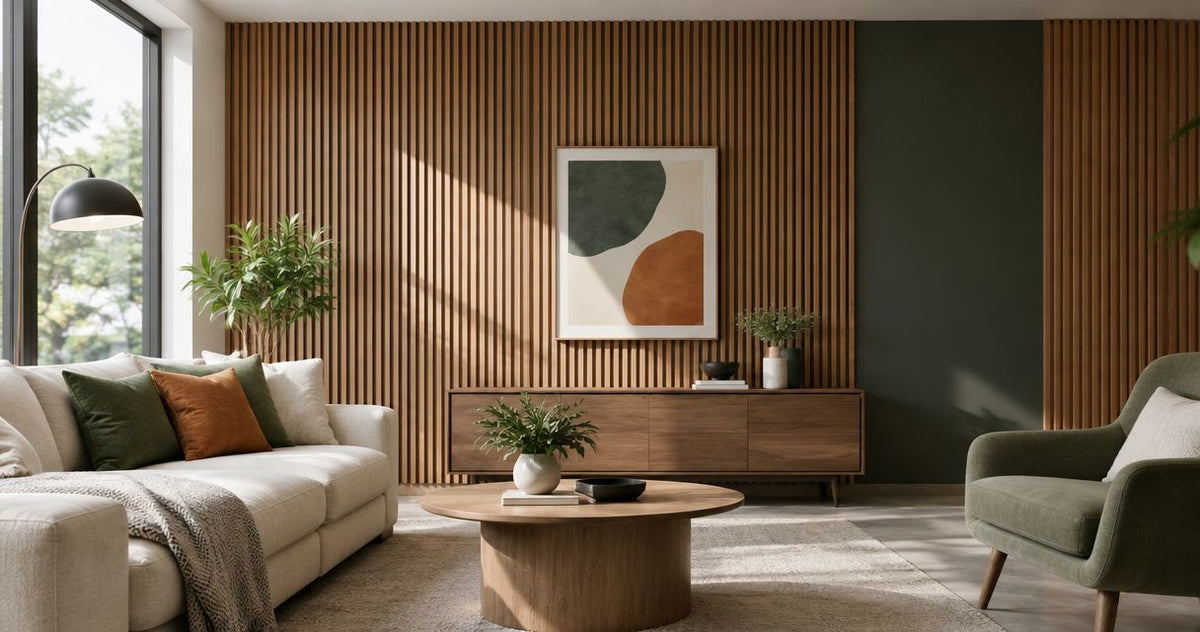
Best overall: Snowdrop – Smoked Brown. Best for coordinating a brown interior: Clover – Brown. Best for compact layouts: Lava Mix. Best for wider modules: Wide Shipwood. These are the best non acoustic wall panels to shortlist for a decorative feature wall in 2026; choose them for material, format and appearance, not as a substitute for tested acoustic treatment.
- Akustiq UK non acoustic wall panels suit appearance-led feature walls; Snowdrop – Smoked Brown is the default decorative choice.
- Choose Clover – Brown for brown interiors, Lava Mix for compact modules, or Wide Shipwood for wider modules.
- Compare panel dimensions, exposed edges and room suitability before choosing decorative wall panels.
- Decorative wood panelling is not evidence of sound absorption or soundproofing.
Why this matters
A feature wall needs to look right from the sofa, doorway and side of the room. Acoustic performance is a separate decision. Akustiq UK decorative wall panels are best for buyers prioritising wood texture and a feature-wall layout over acoustic treatment.
What makes the best non acoustic wall panels?
- Material: real wood or a clearly identified decorative construction.
- Format: dimensions that suit your wall and furniture.
- Layout: joints and cut edges planned before fitting.
- Room suitability: documented compatibility with the intended location.
- Purpose: decorative selection kept separate from acoustic specification.
Non acoustic wall panels at a glance: 2026 shortlist
| Panel | Best for | Standout feature | Key limitation |
|---|---|---|---|
| Snowdrop – Smoked Brown | Default decorative feature wall | Handcrafted American walnut, 60 × 60 cm format | Square modules need a planned joint layout |
| Clover – Brown | Coordinating a brown interior | Handcrafted American walnut in a named Brown finish | A brown-on-brown scheme needs deliberate contrast |
| Lava Mix | Compact modular layouts | Real-wood 3D panel, 30 × 30 cm | More modules to position across a given wall |
| Wide Shipwood | Wider rectangular layouts | Real-wood 3D panel, 30 × 60 cm | Rectangular modules need orientation planning |
The shortlist compares decorative options within Akustiq UK’s range, not the entire wall-panel market. None of these recommendations assigns a sound-absorption rating or treats a textured surface as proof of acoustic performance.
1. Snowdrop – Smoked Brown: best panels for a default feature wall
Snowdrop – Smoked Brown is a handcrafted American walnut decorative panel in a 60 × 60 cm format. It is the default pick when you want a square-module wood feature wall without choosing an acoustic slat system.
Start with a living-room wall behind a sideboard or a bedroom wall behind the bed. Align the proposed panel area with the furniture before deciding whether it should reach the ceiling; a deliberate boundary matters more than covering every available surface.
Snowdrop – Smoked Brown pros:
- American walnut is explicitly identified in the product specification.
- The 60 × 60 cm format supports a repeatable square layout.
- Handcrafted construction is stated in the product title.
Snowdrop – Smoked Brown cons:
- Square modules require decisions about joints and perimeter cuts.
- The Smoked Brown finish needs checking against your existing timber finishes.
Best for: a living-room or bedroom feature wall where a square decorative format is the starting point.
For a 2026 refurbishment, settle the wall boundaries before choosing accessories. Verdict: Buy Snowdrop – Smoked Brown for the default square-format decorative wall, not for a promised acoustic result.
2. Clover – Brown: best panels for coordinating a brown interior
Clover – Brown is a handcrafted American walnut decorative panel measuring 60 × 60 cm. Choose it when the named Brown finish fits the direction of your furniture, flooring and joinery scheme.
Use the finish as a starting point, not a guarantee of a colour match. Put the proposed wall finish beside the timber and upholstery already in the room, then decide whether you want the wall to blend in or stand apart.
Clover – Brown pros:
- American walnut is a stated material.
- The Brown finish provides a clear starting point for coordination.
- The square format suits a regular modular composition.
Clover – Brown cons:
- Similar brown finishes can compete rather than match.
- A square grid needs careful positioning around sockets and furniture.
Best for: a dining room, living room or reception area already planned around brown finishes.
Avoid selecting Clover – Brown solely because another item is described as walnut. Finish names do not establish identical colour. Verdict: Buy Clover – Brown when the finish works with your room; hold if you have not checked that relationship.
3. Lava Mix: best panels for compact modular layouts
Lava Mix is a real-wood 3D wall panel measuring 30 × 30 cm. Its smaller square format makes it the shortlist choice for planning a compact decorative area rather than committing immediately to a broad wall treatment.
Consider a defined section above a console or within a living-room alcove. Draw the modules to scale first, because smaller panels do not automatically produce a better fit: the wall width still determines where the cuts fall.
Lava Mix pros:
- Real wood is explicitly stated in the product title.
- The 30 × 30 cm format supports smaller layout increments.
- The 3D construction provides a texture-led alternative to a flat finish.
Lava Mix cons:
- A given wall needs more modules than with the larger square options.
- More module positions mean more alignment points to check.
Best for: a compact feature area where the module size is central to the design.
Keep nearby decoration restrained if you want the wood texture to remain the focus. Verdict: Buy Lava Mix for a compact modular composition; skip it if your priority is handling fewer panels.
4. Wide Shipwood: best panels for wider rectangular layouts
Wide Shipwood is a real-wood 3D wall panel measuring 30 × 60 cm. It is the best fit here when you want a rectangular module instead of a square grid.
Plan the orientation alongside the furniture arrangement. A rectangular panel creates a different joint pattern when turned, so confirm the permitted installation direction before treating either orientation as an option.
Wide Shipwood pros:
- Real wood is a stated product feature.
- The 30 × 60 cm dimensions offer a wider rectangular format.
- The 3D construction suits a texture-led feature wall.
Wide Shipwood cons:
- Orientation changes the proposed joint layout.
- Narrow wall sections still require a cutting plan.
Best for: a broad feature area where rectangular modules suit the composition better than squares.
Wide Shipwood is a layout choice, not evidence of faster fitting or better acoustics. Verdict: Buy Wide Shipwood when its rectangular proportions suit your wall; hold until orientation and edge details are confirmed.
Choose the format before the finish
The clearest difference in this shortlist is geometry. Snowdrop and Clover use a 60 × 60 cm square; Lava Mix uses a 30 × 30 cm square; Wide Shipwood uses a 30 × 60 cm rectangle. Draw those actual modules on your wall elevation rather than comparing product photographs alone.
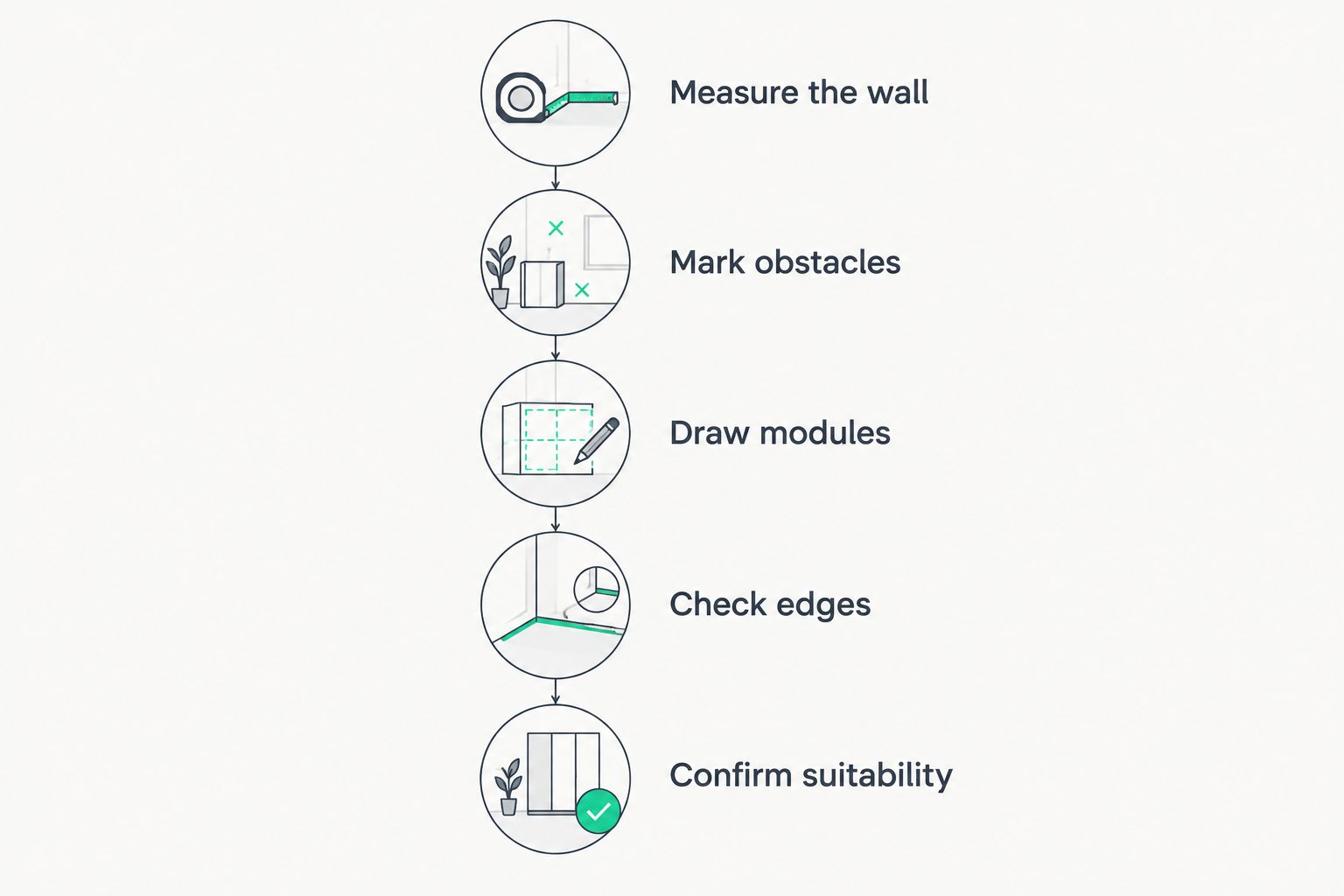
Use this sequence for your 2026 feature-wall plan:
- Measure the wall: record the intended panelled area, not just the room width.
- Mark obstacles: include sockets, switches, shelving and furniture edges.
- Draw modules: show full panels and every perimeter cut.
- Check edges: decide how each exposed boundary will finish.
- Confirm suitability: check the product’s fitting and location requirements.
A module drawing also makes comparisons fairer. A finish you prefer in isolation can become the weaker choice when the layout leaves an awkward strip beside a doorway or a joint directly behind a socket.
Shortlist the decorative products
Once the format works, compare the material and finish. Snowdrop – Smoked Brown represents the larger square option here; Wide Shipwood represents the rectangular real-wood option. These cards keep the two different formats together at the point where you narrow your selection.


Check the wall, edges and adjoining materials
Decorative panels are a finish, not a repair for an unsuitable wall. Inspect the substrate before fitting, resolve damp or loose material, and follow the selected panel’s installation instructions. Do not assume that one adhesive or fixing method suits every decorative panel.
Treat junctions as part of the design. Where wood panelling meets a tiled or slab surface, comparing porcelain slabs belongs alongside checking the wood finish: assess the meeting edge, surface depth and colour relationship before either material is fitted. A successful junction needs a planned detail, not just two finishes you like separately.
Keep sockets accessible and agree any electrical alterations with a qualified electrician. For commercial interiors, confirm the required fire documentation and installation details before specification. Neither a wood species nor the word decorative establishes a fire classification.
Match the feature wall to the room
In a living room, start with the main viewing position. Your panel boundaries should relate to the sofa, television or sideboard rather than an arbitrary point on the wall. Avoid using decorative panelling as a reason to obstruct ventilation around equipment.
In a bedroom, draw the bed and bedside furniture on the elevation. Check whether sockets remain reachable after the panel depth is added. If the panelled area is wider than the bed, make that extension deliberate on both sides.
For a home office, check the wall from your seated position and through your camera view. A decorative background does not establish better speech clarity. If echo is the actual problem, choose an acoustic treatment using relevant performance evidence.
In kitchens and bathrooms, separate a dry feature wall from a splash or wet zone. Do not infer water resistance, heat resistance or shower suitability from a decorative product photograph. Obtain the relevant product confirmation before selecting a panel for those locations.
How the 2026 shortlist is ranked
The ranking prioritises stated material, module dimensions and a distinct decorative use case. Snowdrop – Smoked Brown leads as the default square-format option; Clover – Brown serves finish coordination, Lava Mix serves compact modules, and Wide Shipwood serves rectangular layouts.
This is a specification-based shortlist, not a hands-on durability test. It does not rank fitting speed, fire performance, moisture resistance or sound absorption without supporting product evidence. Use those requirements as selection gates before appearance if your project depends on them.
Which non acoustic wall panels should you choose?
Choose Snowdrop – Smoked Brown if you want a straightforward starting point for a decorative wood feature wall. Its stated American walnut construction and 60 × 60 cm format give you clear material and layout decisions to work with.
Choose Clover – Brown for an established brown scheme, Lava Mix for smaller square modules, or Wide Shipwood for rectangular proportions. For a 2026 project, Akustiq UK non acoustic wall panels belong on an appearance-led shortlist; keep any acoustic requirement in a separate, evidence-based specification.
FAQ
What's the best non acoustic wall panel for a feature wall?
Snowdrop – Smoked Brown is the default decorative pick in this shortlist. It is a handcrafted American walnut panel measuring 60 × 60 cm; choose it for its material and format, not an assumed acoustic rating.
What does non acoustic wall panelling mean?
Non acoustic wall panelling describes panels selected primarily as a decorative finish rather than as tested sound-absorbing treatment. The phrase does not establish a particular construction or prove that a material has no effect on sound.
Will decorative wood panels stop noise from neighbours?
Do not select decorative wood panels to stop noise from neighbours. Sound insulation depends on the wall assembly and sound-transmission paths, not simply the addition of a textured finish.
Are smaller wall panels better for a small room?
Smaller wall panels are not automatically better for a small room. Lava Mix has a 30 × 30 cm module, but the right choice depends on the wall dimensions, furniture position and resulting cuts.
Is Wide Shipwood better than a square decorative panel?
Wide Shipwood is better when a 30 × 60 cm rectangular module suits your proposed layout. Snowdrop – Smoked Brown and Clover – Brown use 60 × 60 cm squares, so compare the joint patterns before choosing.
Can I use these decorative panels in a shower?
Do not specify these decorative panels for a shower without explicit confirmation of suitability. A wood finish or 3D appearance does not establish a waterproof wall system.
Can I fit decorative panels over an uneven wall?
Prepare the wall to meet the selected panel's installation requirements before fitting. Decorative panelling is not a substitute for resolving loose surfaces, damp or an unsuitable substrate.
One last thing
Look at your proposed feature wall from the doorway, not only straight on. Side views reveal exposed edges and how the panel depth meets adjacent finishes. Approve that edge detail before you approve the overall pattern.
Share:
British Homes Direct alternatives in 2026
Aku Wood Panel vs British Homes Direct: which is better in 2026