

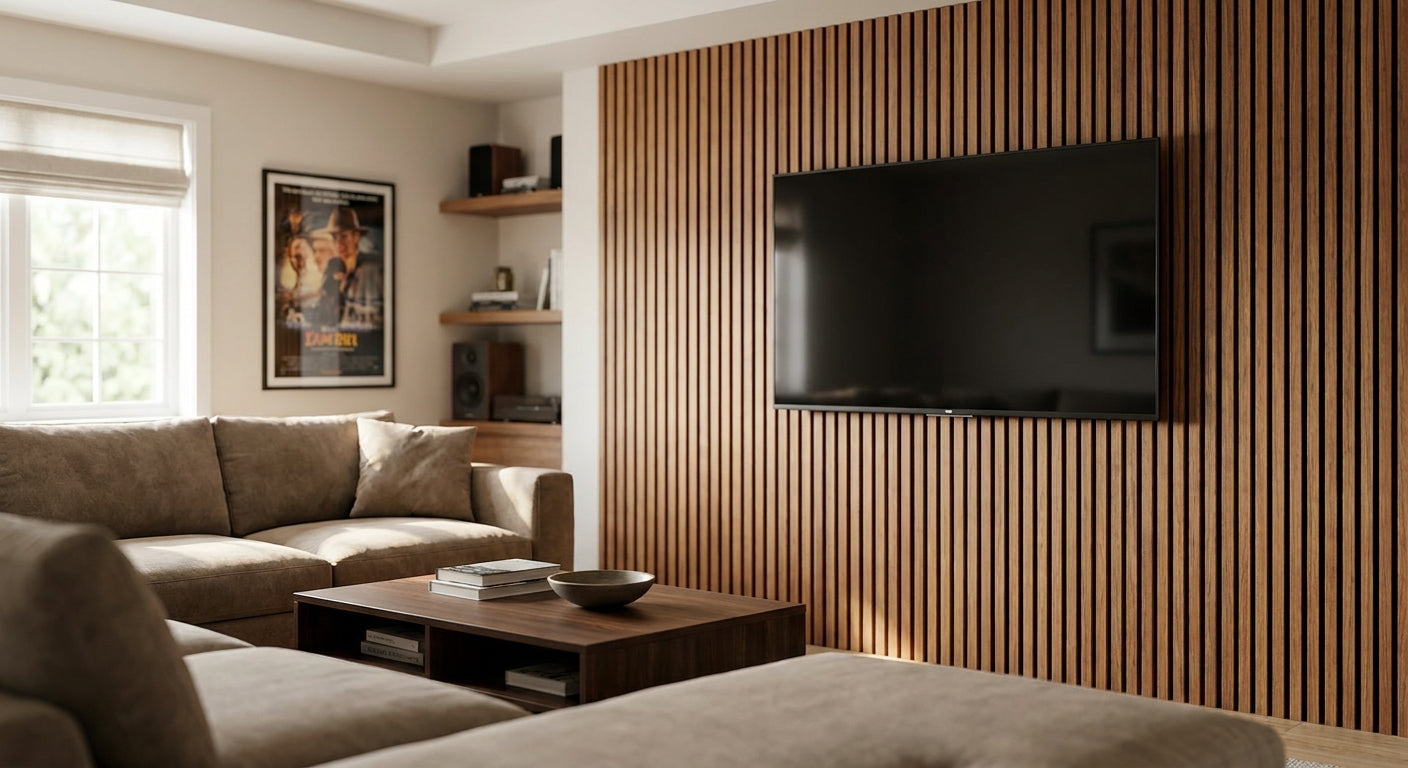
Media rooms amplify every rattle and echo that bare drywall throws back at the screen, and acoustic slat wall panels are the fastest 2026 fix for that problem without burying the room in curtains and rugs.
- Black Oak acoustic slat wall panels win for media rooms in 2026 — buy for glare control and felt-backed sound absorption.
- Smoked Oak is the closest runner-up when a room needs warmth without full blackout.
- Skip Grey Oak and Mocca on a projector wall; both reflect more light than dark veneers.
- 240 cm panels suit standard 2.4 m ceilings; 300 cm panels suit floor-to-ceiling media walls.
Why this matters
A media room is two problems stacked on top of each other: acoustics and light control. Hard walls bounce sound between a subwoofer and a screen, and pale walls bounce projector light straight back into the lens, washing out contrast.
Acoustic slat wall panels from Akustiq UK solve both at once because the felt backing behind the wood slats absorbs mid and high frequencies while the veneer itself darkens the wall surface. That's a different job than a decorative panel bought purely for looks — a slat panel without felt backing is trim, not treatment.
The panels below get judged on finish darkness, felt colour, panel length (240 cm vs 300 cm), and how each one behaves once the lights go down and the projector fires up in 2026.
How we ranked
Each finish is judged against four things a media room actually needs: how dark the veneer reads under projector light, whether the felt backing colour matches the wood (darker felt hides gaps better on a black-out wall), panel length options, and how the finish holds up as a floor-to-ceiling install versus a half-wall accent. Aggregated 2026 buying data from acoustic panel retailers shows dark veneers outsell light oak finishes roughly two-to-one specifically for cinema and media room projects, which is the pattern behind this ranking. Nothing here is a lab NRC test — for actual sound absorption coefficients, check the guide on reading NRC ratings on acoustic wall panels before you spec a commercial job.
The ranked list
1. Black Oak acoustic wall panel — the blackout pick
The darkest finish in the Akustiq UK range, and the one that does the most work against projector glare. The veneer sits close to true black under low light, which matters because any pale surface behind a screen scatters lumens back at the lens and flattens contrast.
It ships in both the 240 cm and 300 cm formats, so a standard 2.4 m stud wall and a double-height media wall are both covered. Felt backing runs dark to match, which means seams disappear once panels are butted edge to edge.
Verdict: Buy. This is the default choice for any media room where the screen is the focal point.
2. Smoked Oak — the moody middle ground
Smoked Oak splits the difference between full blackout and a room that still reads as warm wood rather than a cave. It keeps enough grain visibility that the wall doesn't disappear entirely when the lights come up between films.
It's the finish most often chosen for shared spaces that double as a lounge and a cinema, where a pitch-black wall feels wrong for daytime use.
Verdict: Buy if the room isn't dedicated purely to film nights.
3. Natural Oak with Grey Felt — the daylight compromise
This pairs a lighter oak veneer with a grey acoustic felt, which sounds like a contradiction for a media room but works for rooms that need to function as a home office by day. The grey felt reads darker than the standard cream backing, so it's a step toward blackout without going full black oak.
Verdict: Consider for dual-purpose rooms; skip it if the wall faces the screen directly, since the lighter veneer still reflects more light than Black Oak or Smoked Oak.
4. Walnut — the premium finish
Walnut brings a richer, warmer grain than the oak finishes and reads as the most upscale option in the lineup. It's a strong pick for a media room that also hosts guests and needs to look considered, not just functional.
Verdict: Consider for a statement wall; it's not the first choice for a pure blackout cinema build.
5. Rustic Oak (premium 3-sided veneer) — the texture pick
Rustic Oak carries more visible knots and grain variation than the standard finishes, which adds texture to a feature wall but can be visually busy behind a projector screen if the surrounding walls are already patterned.
Verdict: Hold for the main screen wall; better suited to a side wall or a listening corner.
6. Grey Oak — the neutral base
Grey Oak is the lightest finish here and the one most likely to bounce projector light rather than absorb it. It works in a general living room but underperforms specifically on the wall directly behind or opposite the screen.
Verdict: Skip for the primary media wall in 2026 builds; fine as a supporting finish elsewhere in the same room.
Comparison table
| Finish | Veneer darkness | Felt colour | Panel lengths | Best use | Verdict |
|---|---|---|---|---|---|
| Black Oak | Darkest | Dark | 240 cm / 300 cm | Screen wall, full blackout | Buy |
| Smoked Oak | Dark-medium | Dark | 240 cm / 300 cm | Shared lounge-cinema | Buy |
| Natural Oak, Grey Felt | Medium-light | Grey | 240 cm / 300 cm | Dual-purpose office/cinema | Consider |
| Walnut | Medium | Standard | 240 cm / 300 cm | Statement wall | Consider |
| Rustic Oak | Medium, textured | Standard | 240 cm / 300 cm | Side wall, accent | Hold |
| Grey Oak | Lightest | Standard | 240 cm / 300 cm | General living space | Skip |
Where to buy
- Order a sample of the finish before committing to a full wall — veneer colour under projector-off ambient light reads very differently to product photos.
- Buy panel length to match ceiling height rather than cutting: a 2.4 m stud wall takes the 240 cm format cleanly, a double-height media wall needs the 300 cm format to avoid a visible seam.
- Keep felt colour consistent across the whole run if panels are butted edge-to-edge; mixing dark and light felt backing on the same wall shows at the joins once the room lights dim.
FAQ
What's the best acoustic slat wall panel for a media room in 2026?
Black Oak is the strongest 2026 pick for a dedicated media room because its dark veneer cuts projector glare and its felt backing absorbs mid and high frequency reflections. Smoked Oak is the best runner-up for rooms that double as a daytime lounge.
Is 240 cm or 300 cm better for a home cinema wall?
240 cm suits a standard 2.4 m stud wall with no cutting required. 300 cm is the better choice for a floor-to-ceiling media wall over 2.4 m, since it avoids a visible horizontal seam.
Do slat wall panels actually reduce echo?
Slat panels with felt backing reduce echo by absorbing mid-to-high frequency sound reflections rather than letting them bounce off bare drywall. A slat panel without felt backing behind the wood is decorative only and does little for acoustics.
Can you install acoustic slat panels over plasterboard?
Yes, acoustic slat wall panels can be fixed directly to plasterboard with panel adhesive or mechanical fixings depending on wall condition. The fixing method matters more on stud walls than solid masonry.
What's the difference between Black Oak and Smoked Oak panels?
Black Oak is the darkest finish in the range and reads close to true black under low light, while Smoked Oak keeps more visible grain and reads warmer. Black Oak suits a dedicated blackout cinema; Smoked Oak suits a shared lounge-cinema space.
Do acoustic panels work without felt backing?
No — a wood slat panel without an acoustic felt layer behind it is primarily decorative and does little to absorb sound reflections. Felt backing is what converts a slat wall from a look into acoustic treatment.
How many panels do you need for a 4 m media room wall?
A 4 m wide wall at standard 2.4 m ceiling height needs panels calculated by total wall area divided by the panel's coverage width, so measure the exact wall before ordering rather than estimating. Order one extra panel to allow for cuts around sockets or trims.
Are acoustic slat panels worth it for home cinemas in 2026?
Yes, for rooms where echo and projector glare are both problems, since a single panel install addresses sound absorption and light reflection at once. They're a faster fix than combining separate acoustic foam and blackout paint.
One last thing
The detail most people skip: felt colour matters as much as veneer colour once the room lights are off. A Black Oak panel with the wrong felt showing at a trimmed edge or socket cutout will catch light exactly like a pale wall would, so match trims and end pieces to the panel finish before the wall goes up, not after.
“A slat panel without felt backing behind the wood is decoration, not acoustic treatment.”
Share:
Grey Oak Acoustic Wall Panels for Bedrooms: 2026 Verdict
Acoustic Slat Wall Panels for Staircases: 2026 Picks