

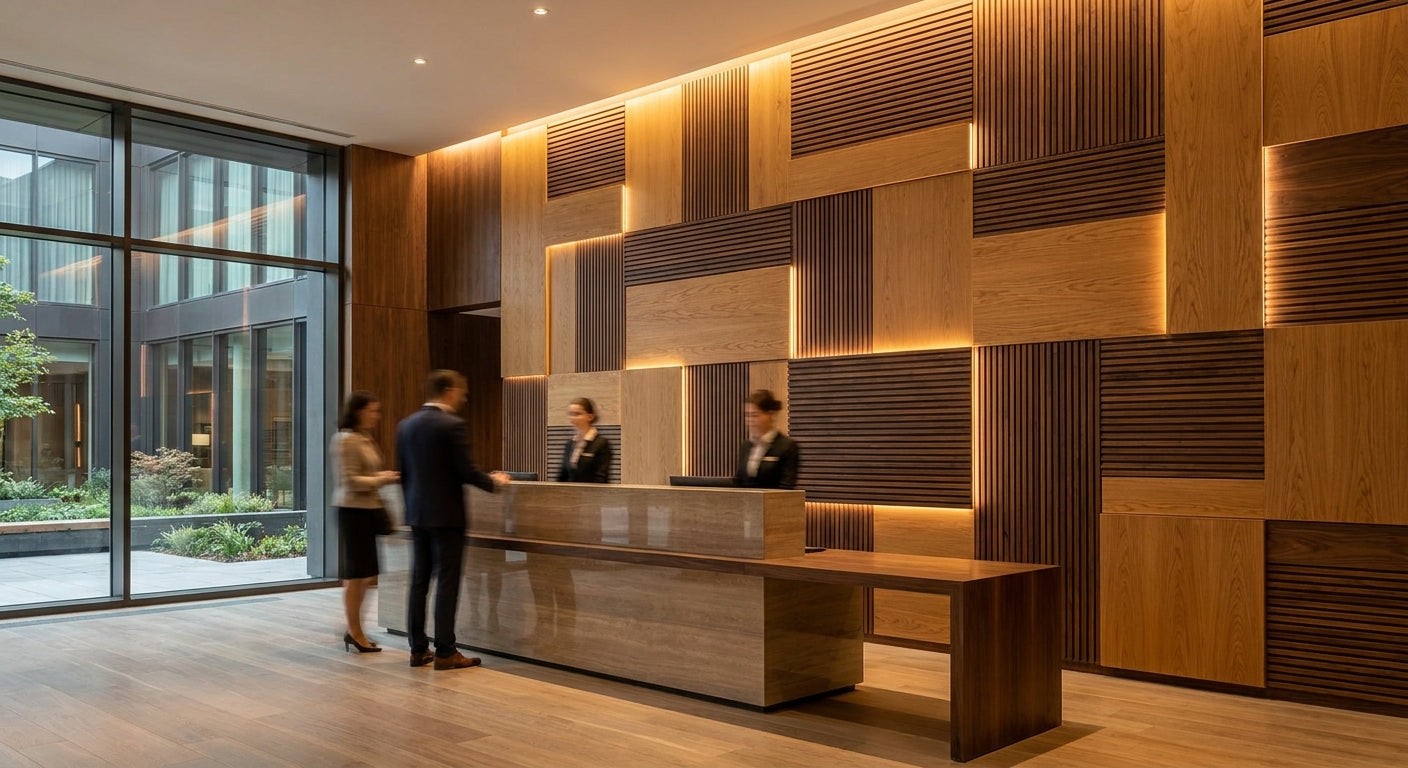
Hotel reception feature walls need to do two jobs at once: greet guests with a material that feels premium, and quiet a hard-floored, hard-ceilinged lobby that would otherwise ring with every trolley wheel and check-in conversation. Wooden wall panels for hotel reception areas solve both problems when the finish carries a real veneer front and an acoustic backing, not just a printed surface screwed to a batten.
TL;DR
Wooden wall panels for hotel reception areas work best when a real wood veneer front is paired with a felt-backed core, because reception halls built for 2026 still lean on tile, glass and plaster that bounce sound rather than absorb it. Black Oak is the strongest all-round pick for reception desks set against pale stone or marble counters: Buy. Walnut suits warmer, hospitality-led lobbies: Buy. Skip any panel without a felt backing if noise at check-in is already a guest or staff complaint.
Why this matters
A reception desk is the first surface guests notice, and it's often finished in materials that reflect sound instead of absorbing it: marble counters, terrazzo floors, glazed entrance doors. Fitting a black oak wall panel behind that desk breaks up the flat bounce with a slatted timber front and a felt-backed core, so voices and luggage wheels stop stacking into echo by mid-morning check-in.
Guests read timber as considered design, not a budget fit-out patched together before a soft opening. Staff at the desk stop competing with reverberation to be heard on the phone or across the counter, which matters more in a 2026 reception than it did a decade ago, now that most check-ins involve a tablet, a card machine and a guest on a call at the same time.
Who this is for
This guide is built for hotel general managers, boutique property owners and hospitality interior designers planning a reception refurbishment. You're likely comparing feature-wall materials against a budget that also covers new flooring or a redesigned check-in desk, and acoustic complaints from guests or front-of-house staff are probably already part of the brief. If you're speccing a multi-property rollout rather than a single reception, the same criteria apply, but order end-piece trims alongside panels so every property finishes to the same standard.
What to look for in wooden wall panels for hotel reception
Acoustic backing, not just a wood face
A reception that runs from 7am check-out to midnight check-in needs more than a good-looking veneer. The felt layer bonded to the back of the panel is what actually reduces the flutter echo bouncing between a hard floor and a glazed entrance, and it's the difference between a wall that looks calm and one that also sounds calm. Reception areas share the same acoustic problem as hotel lobby walls generally: high footfall, hard surfaces, constant conversation.
Veneer that survives commercial footfall
A domestic-grade laminate panel scuffs and dulls within a year of luggage trolleys and cleaning trolleys brushing past it. A three-sided real wood veneer wears more like solid timber, taking small marks without the surface delaminating, which matters in a space that never really closes.
Panel length that avoids horizontal seams
Many UK hotel receptions run under 3-metre ceilings, and panel lengths of 240 cm or 300 cm cover most single-run installations without a horizontal joint breaking the line. A seam behind a reception desk reads as a shortcut, not a design choice, so measure the wall before picking a finish.
Fire and commercial-use compliance
A domestic feature wall and a commercial reception wall aren't held to the same standard. Ask for the panel's fire classification before ordering for a commercial installation, and keep that documentation on file for the hotel's fire risk assessment.
Finish that matches the lighting, not just the mood board
A finish chosen from a swatch under daylight can shift entirely under the warm, low-level lighting most reception areas run in the evening. Walk the wall at both check-in peaks, morning and evening, before locking in a colour.
Top picks for hotel reception feature walls
The safe pick: Walnut wall panel
Walnut is the finish reception designers reach for when the brief says "warm but not rustic." The wooden wall panel walnut finish sits across a felt-backed core and comes in the 240 cm and 300 cm lengths, so a single run covers most reception walls without a seam. Warm walnut tones photograph well under the amber-heavy lighting most receptions run in 2026, which matters when the wall becomes the backdrop for check-in photos guests post online. Buy for reception desks with brass, brown leather or dark stone already in the scheme.
The contrast pick: Black Oak
Black Oak is the pick when a reception needs to read as modern rather than traditional-boutique. Against white marble, pale stone or a light porcelain floor, the near-black slats give the desk a visible frame the eye lands on first, which is exactly the job a reception feature wall is supposed to do. It carries the same felt-backed construction as every finish in the range, so the contrast doesn't cost acoustic performance. Buy if the reception is pale-toned and needs one dark anchor point.
The wildcard: Smoked Oak wall panel
Smoked oak sits between walnut's warmth and black oak's contrast, with a grain that reads almost charcoal in daylight and warms noticeably under tungsten lobby lighting. The smoked oak wall panel works well in receptions that flip between bright daytime arrivals and a dimmer evening bar-and-lounge use of the same space. Consider it where the reception doubles as an evening lounge or bar frontage.
What to avoid
Skip any slat panel sold without a stated acoustic backing; it will look identical in a product photo and do nothing for the echo problem the wall was supposed to solve. Skip mixing three finishes on one reception wall to "soften" a design decision — a reception feature wall does more work as a single dominant surface guests register on arrival than as three competing textures in the same sightline. The same principle applies beyond wall material: the way statement lighting for receptions earns its keep by anchoring one focal point rather than spreading brightness evenly across the ceiling, a slatted feature wall behind the desk should be the one thing guests remember, not one element among several fighting for attention. Skip ordering without samples first — reception lighting shifts finish tone more than any other room type in a hotel.
Verdict comparison
| Finish | Tone | Best paired with | Verdict |
|---|---|---|---|
| Walnut | Warm mid-brown | Brass, leather, dark stone | Buy |
| Black Oak | Near-black contrast | White marble, pale stone, porcelain | Buy |
| Smoked Oak | Charcoal-warm | Mixed daytime/evening lighting | Consider |
| Unbacked slat panel (any finish) | Varies | Nothing — no acoustic gain | Skip |
FAQ
What's the best wood finish for a hotel reception wall? Black Oak wins for pale, marble-heavy receptions because it gives the eye one dark anchor point; Walnut wins for warmer, leather-and-brass lobbies. Both carry a felt-backed core, so the acoustic result is the same regardless of which tone fits the scheme.
Is real wood veneer better than laminate for a commercial reception? Yes, for wear. A three-sided real wood veneer takes small marks and scuffs the way solid timber does, while printed laminate delaminates faster under constant trolley and luggage contact in a space that runs from early check-out to late check-in.
How much does panelling a hotel reception wall cost? Cost depends on wall size, finish and whether trims and glue are included, so check current pricing directly on the site before budgeting a refurbishment.
Do wooden wall panels meet fire safety rules for commercial reception areas? Fire classification should be confirmed for the specific panel before a commercial order goes ahead, since domestic and commercial fit-outs aren't always held to the same standard. Keep that documentation with the hotel's fire risk assessment.
How long do wood veneer feature walls last in a hotel lobby? A felt-backed, three-sided veneer panel is built for repeated daily contact rather than occasional domestic use, which is the main reason commercial receptions specify it over standard MDF slat panels.
Can wooden slat panels actually reduce echo in a marble-floored reception? Yes, when the panel has a felt layer bonded to the back rather than just a decorative timber face. The felt is what absorbs the flutter echo bouncing between hard floors and glazed entrances; a plain veneer face alone won't do it.
Should the reception wall match the check-in desk finish or contrast it? Contrast generally reads stronger in photographs and in person — a pale desk against a dark panel, or vice versa, gives arriving guests a clear focal point instead of a wall that blends into the counter.
What panel length avoids a seam behind a standard reception desk? Most UK reception walls sit under 3 metres tall, so a single 240 cm or 300 cm panel run usually covers the wall without a horizontal joint, provided the wall width is measured before ordering.
One last thing
The finish that tests best in a showroom under daylight is often the wrong call for a 2026 reception, because most check-ins happen under warm, dimmed evening lighting rather than daylight. Order samples, hold them against the actual reception lighting at both peaks, and only then commit to Black Oak, Walnut or Smoked Oak for the full run.
Share:
Soundproof a Shared Wall in a Terraced House: 2026 Guide
Install Acoustic Panels on Concrete Wall (2026 Guide)